
Mudjacking in Kansas City: What It Is and What KC Homeowners Are Choosing Instead
Mudjacking pumps a heavy cement-and-soil slurry under a slab to raise it. It works, but the slurry is heavy and can wash out or re-settle over time. Most Kansas City homeowners now choose lighter, waterproof polyurethane foam instead, which better resists the clay soil and freeze-thaw cycles that sink slabs here.
When Kansas City Says ‘Mudjacking,’ Here’s What That Can Mean
In the Kansas City metro, “mudjacking” has become the catch-all word for lifting settled concrete. The way people say “Kleenex” for any tissue. Concrete jacking, slabjacking, cement leveling. Every one of those terms points at the same job: raising a settled slab instead of replacing it. A homeowner calls around, every company they reach describes a different process, and they still aren’t sure what they’re actually buying.
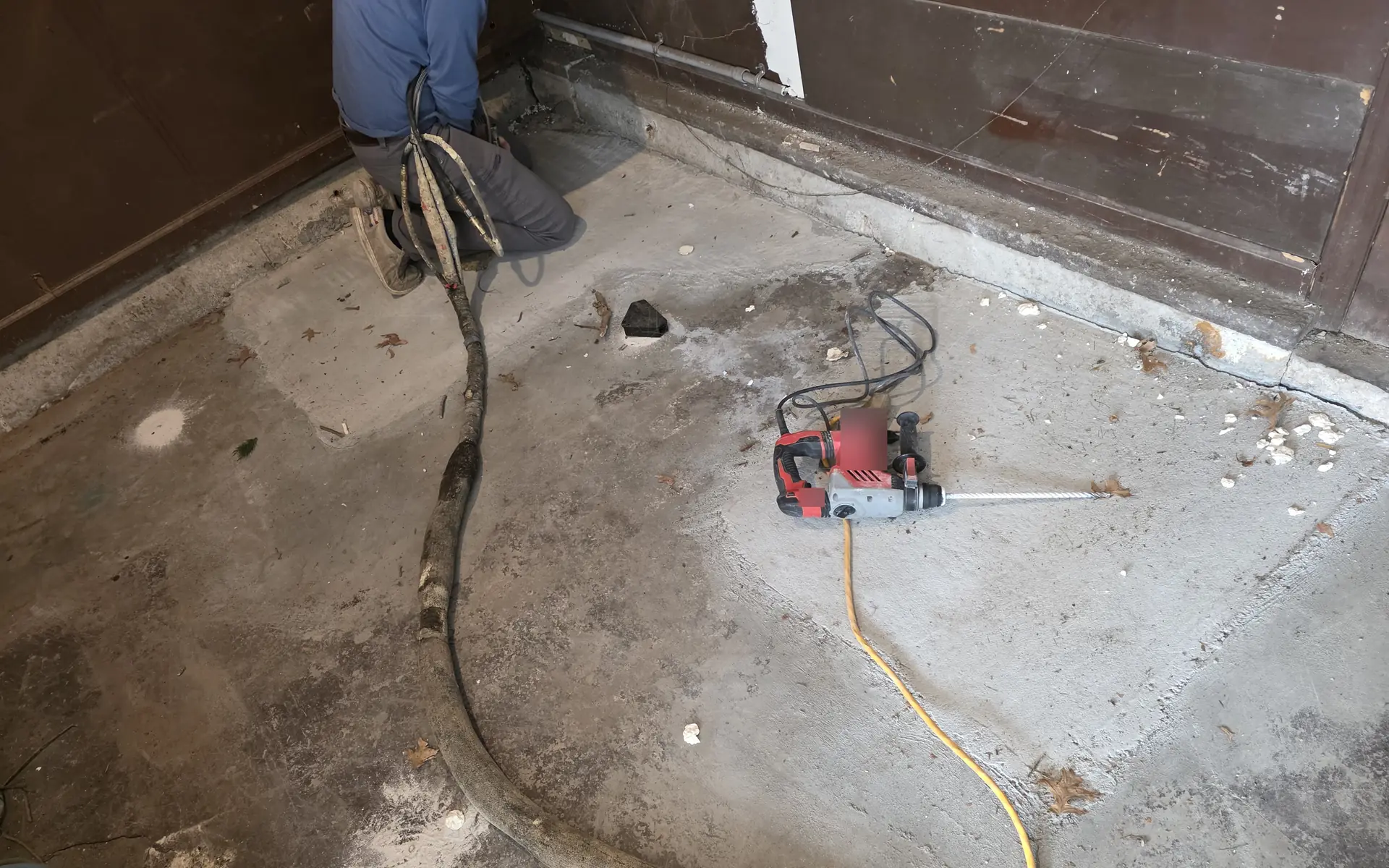
Mudjacking in the strict sense is one specific method: a contractor drills large holes through a sunken slab and pumps a slurry of soil, Portland cement, and water underneath it under pressure. The material fills the void and its weight and volume lift the concrete back up.
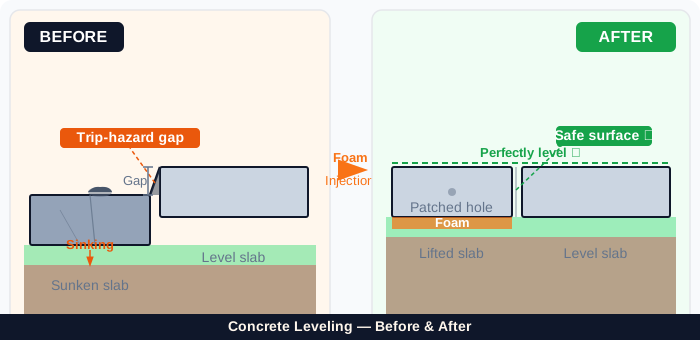
But other companies use “mudjacking” to refer to any concrete lift: including foam injection, which is a fundamentally different material and process. If you’re getting quotes, it’s worth knowing exactly what each contractor means before anyone starts drilling.
PolyJacks does only foam injection. This page explains what mudjacking actually involves, how it compares for Kansas City’s specific soil and climate conditions, and what a foam-based lift looks like instead.
The Kansas City metro spans two states, and the Wymore-Ladoga clay that drives most slab settlement here is shared across the river. The soil problem does not stop at the state line, and the freeze-thaw cycle hits both sides the same way.
Concrete jacking is the broadest of those catch-all terms, and it is worth knowing what it covers before you start comparing quotes. Our concrete jacking page walks through both methods side by side, what a lift can actually raise, and when a slab is past lifting and needs to come out instead.
What Mudjacking Slurry Is and Why the Ingredients Matter Here
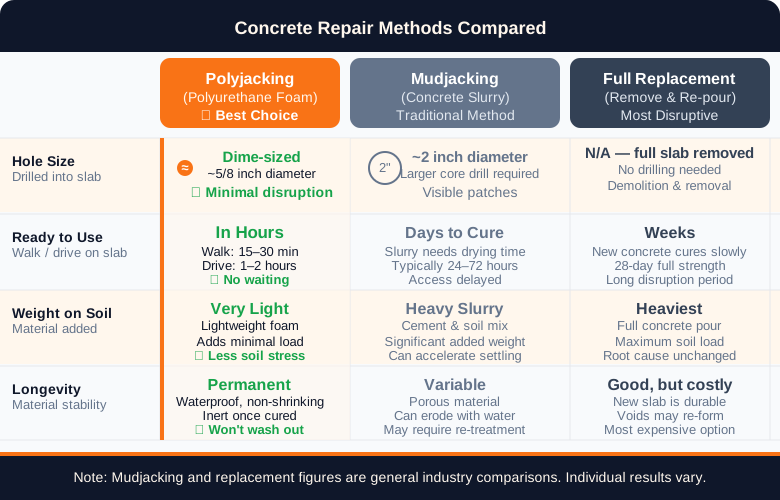
Traditional mudjacking slurry is a wet mix of soil (often local excavation material), Portland cement, and water. The contractor pumps this mixture through holes drilled through the sunken slab: holes significantly wider than what foam injection requires, because the slurry is thick and viscous and needs a wide path to flow at working volume.
As the slurry fills the void under the slab, the material pressure lifts the concrete. The holes are patched with concrete filler once the lift is done.

The material tradeoffs are real:
- It’s heavy. Slurry adds significant load to the same soil that let the slab sink in the first place. In areas where soil compaction failure caused the void, you’re placing more weight on that compromised base.
- It’s porous. Cured slurry absorbs water. Under a slab with active drainage problems, the fill material is continuously in contact with moisture.
- It takes time to cure. Most mudjacking jobs need 24 to 72 hours before the slab can bear vehicle weight. A meaningful disruption for a driveway that’s the only access to a garage.
None of these make mudjacking wrong by definition. They matter more or less depending on where the job is. In Kansas City, they matter a lot.
Wymore-Ladoga Clay: Why KC Soil Is Mudjacking’s Worst-Case Environment
The Kansas City metro sits on Wymore-Ladoga clay complex. A soil series that carries a “very high” shrink-swell rating from USDA NRCS. The clay content commonly runs 35 to 55 percent, and when saturated, it expands 10 to 15 percent in volume. When it dries out through a late-summer drought, it contracts and pulls away from anything resting on it, including slabs, and any fill material sitting in the void below them.
This two-directional movement creates pressure that is continuous and seasonal: - When wet (spring flooding, heavy rain events): surrounding clay swells and presses against cured slurry from the sides, particularly in narrower voids. - When dry (late summer/fall): clay contracts and pulls away, leaving microscopic gaps between the slurry fill and the surrounding soil: entry points for moisture in the next wet cycle.
A porous fill material that itself absorbs and releases moisture is doing its own version of this movement cycle inside the void while the clay does the same thing from outside. The two cycles don’t sync up, and that differential is one of the main reasons mudjacking lifts can re-settle faster in KC than in dry, stable-soil regions.
If you want to see how your specific neighborhood scores on settlement risk, check our KC Concrete Settlement Risk Index.
What KC’s ~80 Freeze-Thaw Days Do to Porous Fill Material Every KC Winter
A typical Kansas City winter brings roughly 80 transitions between freezing and thawing temperatures (NOAA KCI records, 1995–2026). Each cycle, water present in a porous material expands roughly 9 percent as it freezes and contracts as it thaws. For a waterproof, inert material (like cured polyurethane foam) that cycle passes without consequence. The material doesn’t hold water, so there’s no water inside to expand.
For a porous slurry fill sitting in contact with wet clay and under a slab that may have hairline cracks or open joints, the equation is different. Water infiltrates the porous fill. It freezes, expands, creates micro-pressure points. It thaws, the water moves, leaves a slightly enlarged channel. Over roughly 80 cycles per winter, this process gradually works on the structure of the slurry, particularly near the edges, near joints, near any existing cracks.
This doesn’t happen overnight, and it’s not a guaranteed failure mode. But it’s why the same mudjacking repair that holds for years in a dry-climate state tends to show re-settling faster under KC’s specific conditions. The material is doing its job against a climate that is particularly hard on anything that holds water.
Polyurethane Foam Injection: What Changes When You Switch the Material
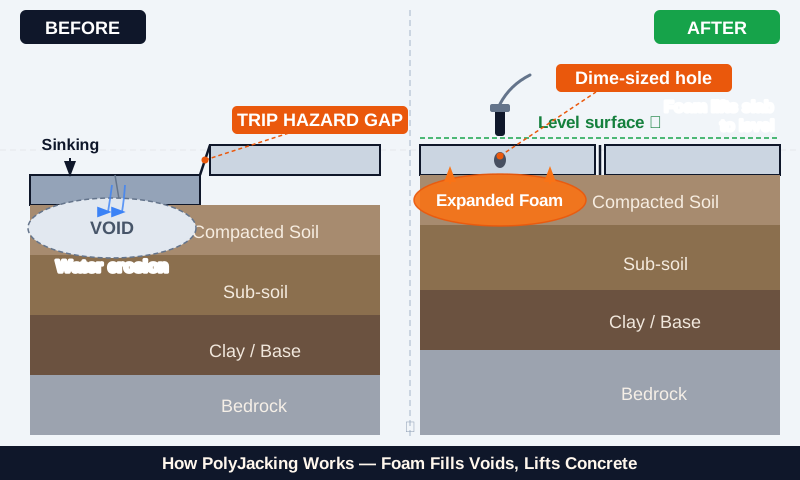
Concrete leveling with polyurethane foam uses the same core concept (drill, fill void, lift slab) but the material behaves completely differently underground.
Hole size: Foam reacts chemically and expands in place after injection, expanding 30 to 40 times its liquid volume to fill the void and lift the slab. Because expansion does the lifting rather than raw material volume, it only needs dime-sized entry points. Smaller holes mean smaller patches and less disturbance to the slab.
Waterproof once cured: Closed-cell polyurethane foam doesn’t absorb water. It’s inert in the void, unchanged by whether the surrounding soil is wet or dry. KC’s roughly 80 annual freeze-thaw days pass through it. No water inside the foam to expand and contract.
Weight: The foam’s expansion is what lifts the slab, not its own mass. This means we’re adding a fraction of the load that slurry would add to the same compromised soil base.
Cure time: Foam reaches usable strength in minutes. You can typically walk on the area within 15 to 30 minutes and drive on it within 1 to 2 hours. No 24-to-72-hour cure window, no cones blocking the driveway for most of the week.
Behavior over time: Cured polyurethane is not a fill that ages. It does not rot, it does not compress under a parked vehicle the way loose fill can, and it does not dissolve or lose its lifting strength years down the road. That matters because the material is the one variable a contractor actually controls. A porous fill sitting in a wet clay void softens and gives ground back; foam sitting in the same void is doing nothing at all. So on a foam-lifted slab the question is never whether the foam is still holding — it is whether the soil around it has moved again, which is a separate problem with a separate fix. That is why we flag drainage and grading on every estimate instead of treating the lift as the whole answer. More on the material side in why foam lasts longer than mudjacking.
For a full side-by-side spec comparison of the two methods, see our polyjacking vs. mudjacking breakdown.
For the whole timeline from estimate to patching, see a polyjacking job day, start to finish.
The Hole Size You’ll See After the Job Is Done
Both methods leave patches in the slab after the lift. How visible those patches stay is directly tied to how big the holes had to be.
Mudjacking holes are wider. The viscous slurry requires a larger opening to be pumped effectively. After the job, those circular patches are filled with concrete filler and left to weather. The size of the patch means it tends to remain visible as a slightly different shade or texture for years, even after cleaning and sealing: there’s simply more patch material sitting in a larger opening.
Foam injection holes run dime-sized. The patches still won’t be invisible (patched concrete rarely disappears completely) but a smaller hole means a smaller patch, and smaller patches blend into the surrounding slab faster, especially after a winter or two of weathering.
For a driveway apron, a patio you entertain on, or a walkway that’s constantly visible from the street, the visible-repair difference is one of the reasons KC homeowners who’ve had both methods done tend to notice.
If you want to see the scale before anyone drills, what the holes actually look like shows how few we drill, where they land around a property, and what the patches look like once the crew has packed up.
One Case Where Prior Mudjacking Can Work in Your Favor
If a slab was mudjacked several years ago and has re-settled, it’s often because the original slurry partially washed out, shifted, or degraded. Leaving new voids under the same concrete. That’s a situation where foam injection can step in effectively.
We drill new dime-sized holes, inject foam to fill the gaps left by the degraded or displaced slurry, and re-lift the slab. Because foam is waterproof and chemically inert, it doesn’t share the same vulnerability to KC’s clay-soil moisture cycles that the original slurry fill did.
A prior mudjacking failure doesn’t rule out a foam repair: it’s a common scenario we estimate regularly. If you’ve had mudjacking done in the last several years and the same area is sinking again, that’s exactly what a free on-site estimate is designed to answer.
Can Your Slab Be Lifted, or Does It Need to Come Out?
Before we talk about lifting a slab, we answer a different question first: is the concrete itself still sound? Four checks tell us it is.
- It sank as one piece. The slab dropped or tilted as a whole rather than breaking apart.
- Any cracks are hairline and cosmetic, not deep cracks running through the slab.
- The edges and corners are still solid enough to bear weight.
- The settling traces to a void underneath — the void is what foam fills, and filling it is what lifts the slab.
If that describes your slab, the concrete is fine and the ground under it is what failed. Be clear about what a lift is, though: foam lifts a structurally sound slab, it doesn't try to replicate a new pour. It raises and supports the concrete you already have.
When the concrete itself has failed rather than the soil under it, no lifting method makes it sound again, and replacement is the honest answer. Replacement is a different job: breaking out the old slab, hauling away the debris, forming and pouring new concrete, and waiting on it to cure before anyone uses it.
One caution either way. A lift corrects the settling you have now; it won't stop future settling if the drainage or soil problem underneath is never addressed. Which of the two you're looking at is what the free on-site estimate settles — our guide on leveling versus replacement walks through the same call.
When Neither Method Will Hold: What We’ll Tell You Straight
Some slabs need more than a lift.
If the concrete has cracked into separate sections or is structurally broken, neither mudjacking nor foam will fix it: broken concrete needs to come out and be replaced. If the sinking is being driven by an active plumbing leak under the slab, that leak must be repaired first or any fill material will keep washing out. If tree roots are heaving the slab from below, the root issue must be addressed before a lift will hold.
We don’t do foundation repair. If a settlement issue is tied to the foundation rather than the slab itself, we’ll say so and refer you to someone who handles that work.
For everything else: driveways, sidewalks, patios, garage floors, pool decks, porches, and commercial slabs across Johnson, Wyandotte, Jackson, Clay, and Platte counties. Foam injection is what we do. One-visit lift, dime-sized holes, walk on it in 15 to 30 minutes, drive on it in 1 to 2 hours. If foam isn’t the right call for your situation, we’ll tell you that during the free estimate instead of selling a fix that won’t hold.
That foam service runs out of Spring Hill, Kansas, on roughly a 50-mile residential radius covering close to 35 towns on both sides of the state line.
Johnson County KS: Overland Park, Olathe, Lenexa, Shawnee, Leawood, Prairie Village, Spring Hill, Gardner, De Soto, Merriam, Mission, Roeland Park, Fairway, Westwood.
Wyandotte County KS: Kansas City, KS, Bonner Springs, Edwardsville.
Missouri side — Jackson, Clay & Platte Counties: Kansas City, MO, Independence, Lee's Summit, Blue Springs, Raytown, Grandview, Grain Valley, Oak Grove, Liberty, Gladstone, North Kansas City, Kearney, Smithville, Excelsior Springs, Platte City, Parkville, Riverside.
Our service area is the radius, not the list. If your town isn't shown, call (913) 713-7794 and ask.
That covers from Overland Park and Olathe on the Kansas side to Lee's Summit and Kansas City, MO on the Missouri side.
If you're not sure whether your slab needs a lift or a replacement, our free concrete diagnostic tool walks through the signs to check before you book an estimate.
What Drives the Cost of a Concrete Lift in Kansas City
When you're comparing quotes for a concrete leveling job, the number you get back reflects a handful of variables specific to your slab. The square footage of the settled area is the most obvious: a full driveway apron is a different scope than a single patio slab. The depth and extent of the void underneath matters, because a deeper void requires more material and more injection points to fill and lift. Accessibility is a practical factor: a slab behind landscaping or in a tight garage entry takes longer to work around than an open walkway. If the sinking is being driven by an active plumbing leak or a drainage problem, that issue has to be repaired before any lift will hold, and that repair is a separate line item. Residential and commercial slabs also differ in scope and scheduling. None of these variables have a single fixed answer, which is why we quote on-site rather than over the phone. For a detailed breakdown of what goes into a KC concrete leveling quote, see our concrete leveling cost guide.
What the work actually looks like
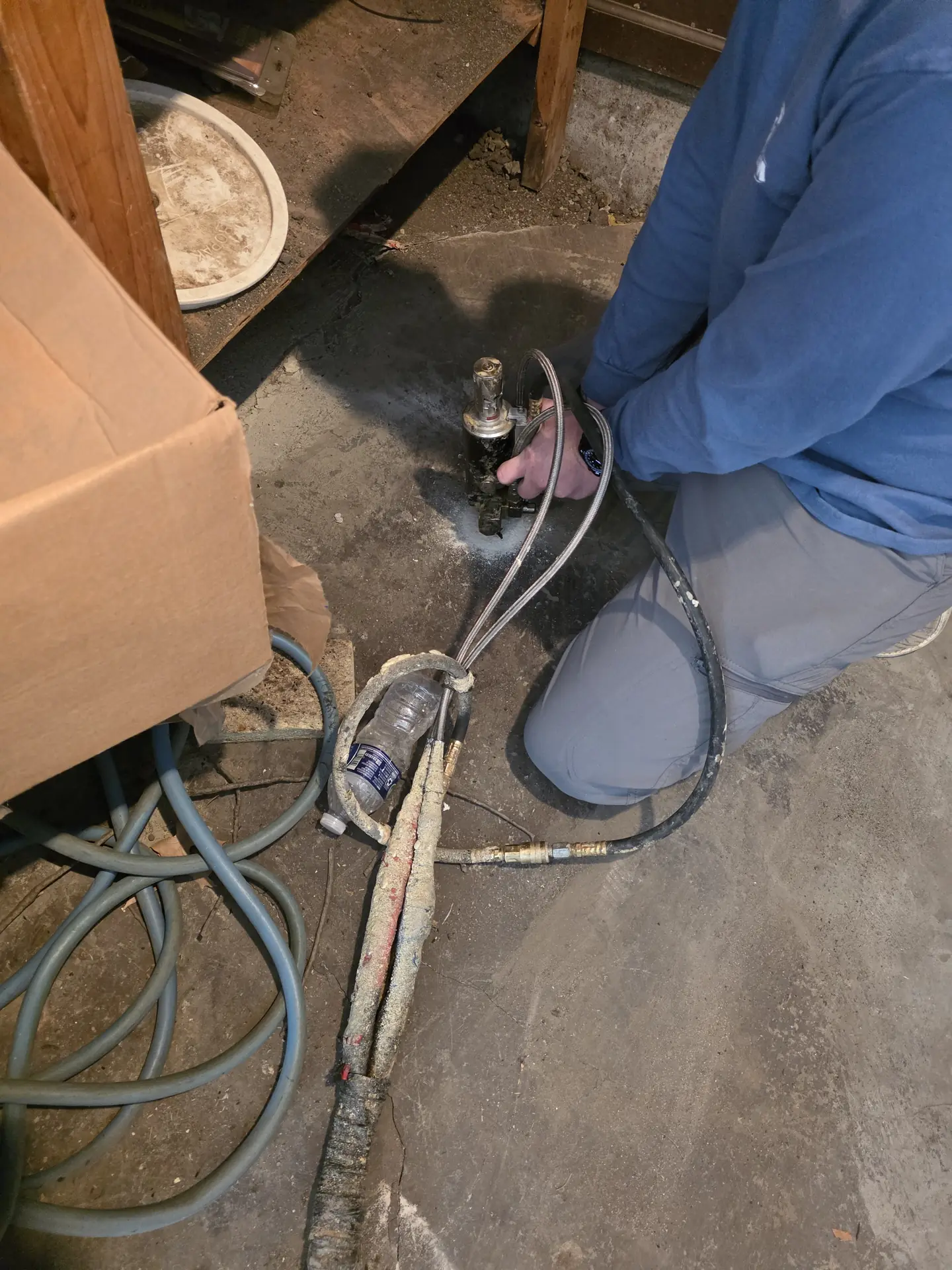
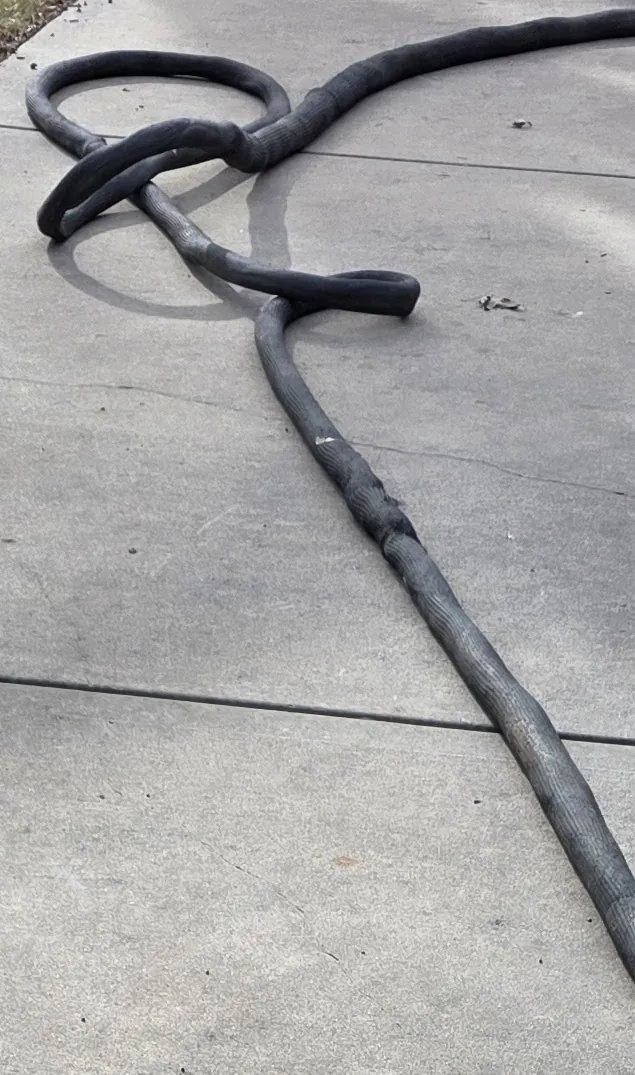
How polyjacking works in 90 seconds
Our team walks you through the three-step process: dime-sized holes, high-density polyurethane foam that fills every void and compresses the soil beneath your slab, and use within hours with no heavy trucks. Call (913) 713-7794 or book a free estimate below.
Frequently asked
Can mudjacking be done in Kansas City winters?
Traditional mudjacking slurry needs ground temperatures above freezing to cure properly. A wet cement-and-soil mix won’t set right in near-frozen ground. Foam injection has a wider cold-weather window because the foam reacts chemically rather than curing as a wet mix. We typically work year-round as long as the ground itself isn’t frozen solid. If you’re comparing winter quotes, the two methods have meaningfully different temperature windows.
Why are mudjacking holes so much bigger than foam injection holes?
Mudjacking slurry is thick and viscous. It needs a wide path to flow under the slab at working volume and pressure. Polyurethane foam reacts chemically after injection and expands 30 to 40 times its liquid volume in place, so the expansion itself does the lifting rather than raw material volume flowing in. That’s why foam only needs a dime-sized entry point. The material behavior at the injection point (not the contractor preference) determines hole size.
If a slab was mudjacked years ago and has sunk again, can foam fix it?
Often yes. Re-settling after mudjacking usually means the original slurry has shifted, washed out, or partially degraded. Leaving new voids under the same slab. We can inject foam to fill those voids and re-lift the concrete. Because foam is waterproof and chemically inert, it doesn’t share the same vulnerability to KC’s moisture-cycling clay soil that the original slurry did. Prior mudjacking doesn’t rule out a foam repair.
How long do mudjacking lifts last in Kansas City?
Longevity varies a lot by drainage management, void cause, and soil conditions at the specific property. In dry, stable-soil regions, mudjacking lifts can hold a long time. In KC’s expansive clay and freeze-thaw environment, porous slurry faces more moisture cycling than in most other markets. We can’t quote longevity for jobs we didn’t do, but for foam: our 5-year warranty covers a free re-lift if the slab settles more than 1/2 inch from our work within 5 years.
Does PolyJacks offer mudjacking as an option?
No. We specialize in polyurethane foam injection exclusively. That’s why we can give you an honest read on both methods without a stake in which one you choose. If we look at your slab and foam isn’t the right fix for it, we’ll tell you that and explain why rather than pushing a repair that won’t hold.
What do mudjacking patch holes look like on a finished driveway?
Wider than most homeowners expect. The slurry needs a large opening to flow through, and those holes get filled with concrete filler after the lift. The patch circles tend to remain visible as a slightly different shade or texture even after weathering, because the larger diameter means more patch material sitting in a bigger cavity. Foam injection holes run dime-sized. Those patches blend in faster and stay less prominent over time, though no patched concrete is ever completely invisible.
Will my slab settle again after a foam lift?
The foam itself does not move once it cures, so the section we lifted stays supported. What can change is the ground around it. If a downspout keeps dumping water next to the slab, if the grading sends rain back toward the house, or if a plumbing leak is still washing soil out, that is a new cause rather than the old repair failing, and it can pull down a neighboring section we never touched. Most of it is preventable: point downspouts away from the slab, keep gutters clear, grade nearby soil so water runs off instead of pooling, and call a plumber first if you suspect a leak near the low spot. On our side, every lift carries a 5-year limited warranty on workmanship and materials, written to the owner who paid for the work at that address, and it ends if the house is sold. If a slab we raised settles more than 1/2 inch within 5 years because of our work, we come back and re-lift it at no charge. Full terms, including what falls outside coverage, are on our warranty page.
Is the foam safe around kids, pets and landscaping?
Yes. The foam finishes reacting in minutes and is chemically inert from that point on: a solid, closed-cell plastic sitting under the slab, not something that off-gasses, leaches or breaks down. Nothing is sprayed in the open air, because the injection stays contained under the concrete, and any faint odor during the reaction is short-lived. Being waterproof is what keeps it out of the soil and groundwater: it will not dissolve or wash out of the void it filled. And because it enters through dime-sized holes aimed at that void, it does not spread across the yard or reach plantings, which is a practical difference from pumping wet slurry underground. There is also no long hazard window to manage. Most areas are walkable in about 15 to 30 minutes and take vehicles in roughly 1 to 2 hours, so no barricades stand in the yard for days while something sets. Is polyurethane foam safe for my yard has the full rundown.
Does mudjacking actually work?
Yes. Pumping a cement-and-soil slurry into the void under a slab does lift concrete, and contractors have been doing it that way for decades. The honest question is not whether the method works but how the material behaves once it is in the ground here. Slurry is heavy, so it loads the same soil that already failed to hold the slab up. It is porous, so it sits in contact with moisture inside a clay void that swells when wet and pulls away when dry. And it needs a long cure before the slab can take vehicle weight, which is a real inconvenience when the driveway is the only way into the garage. Those are material tradeoffs rather than proof the method is invalid. They simply carry more weight in Wymore-Ladoga clay and roughly 80 freeze-thaw days a winter than they would in dry, stable ground.
What's the difference between mudjacking and slabjacking?
Slabjacking is a general name for raising a settled slab instead of replacing it, the same job people also call concrete jacking. Mudjacking, in the strict sense, is one specific way to do it: pumping a slurry of soil, Portland cement and water under the slab through large holes. Foam injection is a different way. Ask each contractor which material they actually use.
Get your free concrete leveling estimate
No obligation, and if foam isn't the right fix, we'll tell you straight.
Pick a time that works for you
Book right here on this page. Prefer to talk? Call (913) 713-7794.