
 Illustrative
Concrete Leveling Holes: What They Really Look Like
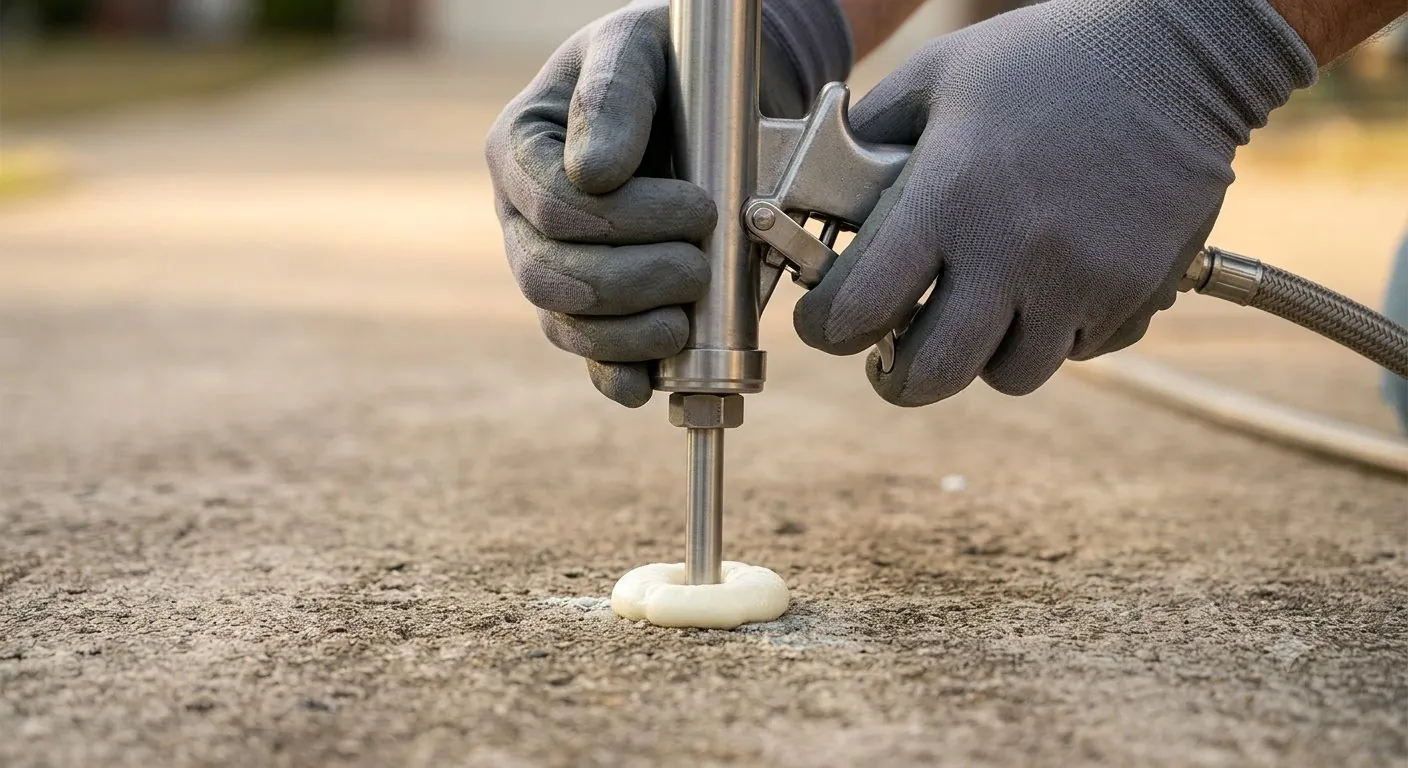
The holes drilled for concrete leveling are about the size of a dime — just wide enough for the injection nozzle to reach the void beneath the slab. A typical job needs only a handful, placed where the foam is needed, and each is patched with a color-matched cap afterward. They are far smaller than the holes mudjacking requires.
The Holes Are Smaller Than You Think
People picture concrete leveling as something that leaves a driveway looking drilled full of craters. It doesn't. The holes we drill to inject waterproof polyurethane foam are about the size of a dime. That's it. We're not trenching, not jackhammering a section out, not tearing anything up. A single hole is just wide enough for the injection nozzle to reach the void underneath the slab and pump in foam that expands to fill the space and lift the concrete. If you've pictured concrete leveling as something dramatic, the reality is a handful of small, neat holes: nowhere close to what a repaved or replaced surface would require.

Why We Only Drill a Few
We don't drill a hole for the sake of drilling a hole. Before we touch a drill, we look at where the slab is low, where it's cracked, and where the void underneath likely sits. That's part of what a free on-site estimate is for. Holes go where they'll actually reach the gap and do something, spaced a few feet apart depending on the size of the section. A single sunken step might need two or three holes; a full driveway panel might need more, but nowhere near a hole for every square foot. The goal is the fewest holes that get the slab fully and evenly supported. If you are weighing the investment against other options, our guide on what leveling costs in KC breaks down the factors that drive the final number.
How This Compares to Mudjacking's Holes
Mudjacking uses a thick mud-and-cement slurry, and that slurry needs a bigger opening to pump through: mudjacking holes are noticeably larger than what foam injection requires. More material moving through a bigger hole also means a heavier, wetter mix pushing into the ground underneath. We cover the fuller picture in our polyjacking versus mudjacking comparison, but hole size alone tells you a lot about how much less invasive foam injection is: smaller openings, lighter material, less disruption to your driveway, patio, or walkway while the work is happening.
For a closer side-by-side look at the openings each method leaves behind, see mudjacking holes vs polyjacking holes.
What Happens to the Holes Afterward
Once the foam has done its job and the slab is level, we patch every hole. The patch is filled flush with the surrounding surface and color-matched as closely as possible so it blends rather than stands out. It won't be invisible up close. No honest patch on any concrete repair ever is, but it's small, flat, and unobtrusive, not a rough plug that catches your eye or your foot. If a smooth, uniform look matters a lot to you, mention it during your estimate and we'll talk through what to expect for your specific surface.
What the Full Process Looks Like
Start to finish, here's the order: we drill the small holes, inject the foam, and it expands to fill the void and lift the slab: curing happens in minutes, not days. Most surfaces are safe to walk on again in 15 to 30 minutes and ready for vehicle traffic in about 1 to 2 hours. There's no waiting days for a new pour to cure and no barricading your driveway for a week. That fast turnaround is part of why concrete leveling is such a practical fix for a walkway or driveway panel you use every day: see our concrete leveling overview for the full rundown.
Where You'll See These Holes Around Your Property
Small injection holes show up wherever we're lifting concrete: driveways, sidewalks and walkways, patios, garage floors, pool decks, and porches and steps. The number and placement shifts depending on the surface. A set of sunken steps needs a different pattern than a wide patio slab, but the hole size stays consistent across every job, because it's tied to the injection equipment itself, not the type of surface it's being used on.
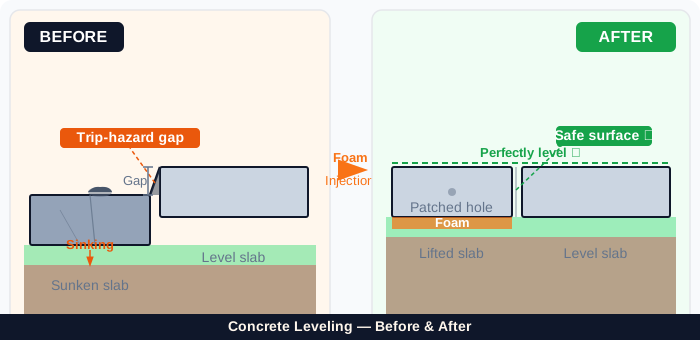
If sunken steps are your concern, our guide to concrete steps and porch leveling explains what that repair involves.
See It for Yourself
The best way to know what the holes will look like on your specific slab is to have us walk it with you. During your free estimate, we'll show you roughly where holes would go and how many, before any drilling happens. Call (913) 713-7794 with questions, or use our diagnose tool if you want a first read on what's likely causing the sinking before we even get there.
How polyjacking works in 90 seconds
Our team walks you through the three-step process: dime-sized holes, high-density polyurethane foam that fills every void and compresses the soil beneath your slab, and use within hours with no heavy trucks. Call (913) 713-7794 or book a free estimate below.
Frequently asked
How big are the holes really?
About the size of a dime across.
How are the injection holes patched afterward?
Once the slab is level, each dime-sized hole is filled with a color-matched concrete patch that sits flush with the surface and weathers in over time.
Do the holes stay visible after the repair?
They're patched flush and color-matched, so they blend in: visible up close but not an eyesore.
Are mudjacking holes bigger?
Yes, mudjacking's slurry needs a larger opening to pump through.
Can I walk or drive on the surface right after?
Most surfaces handle foot traffic in 15-30 minutes and vehicles in about 1-2 hours.
How many holes will my slab need?
It depends on the slab's size and how the voids are spread out underneath, but foam injection uses far fewer and far smaller holes than mudjacking. Typically a modest grid of dime-sized ports rather than the larger openings slurry requires. Your estimator can describe the expected pattern once they've seen the slab. The aim is always the fewest holes that still let the foam reach every void.
Does drilling the holes weaken the concrete?
No. The dime-sized ports are small relative to the slab and are spaced so they don't compromise its strength, and once the void beneath is filled with foam, the slab is better supported than it was before. After the lift the holes are filled with a color-matched patch, leaving the surface solid and continuous.
Is foam jacking the same as polyjacking?
People use foam jacking as another name for polyjacking: small dime-sized holes are drilled, and polyurethane foam is injected to fill the void under the slab and lift it. The holes are patched flush and color-matched afterward. Our polyjacking page covers the method in more detail.
Have a sinking slab?
Book a free on-site inspection. Honest advice, usable within hours.
Pick a time that works for you
Book right here on this page. Prefer to talk? Call (913) 713-7794.