
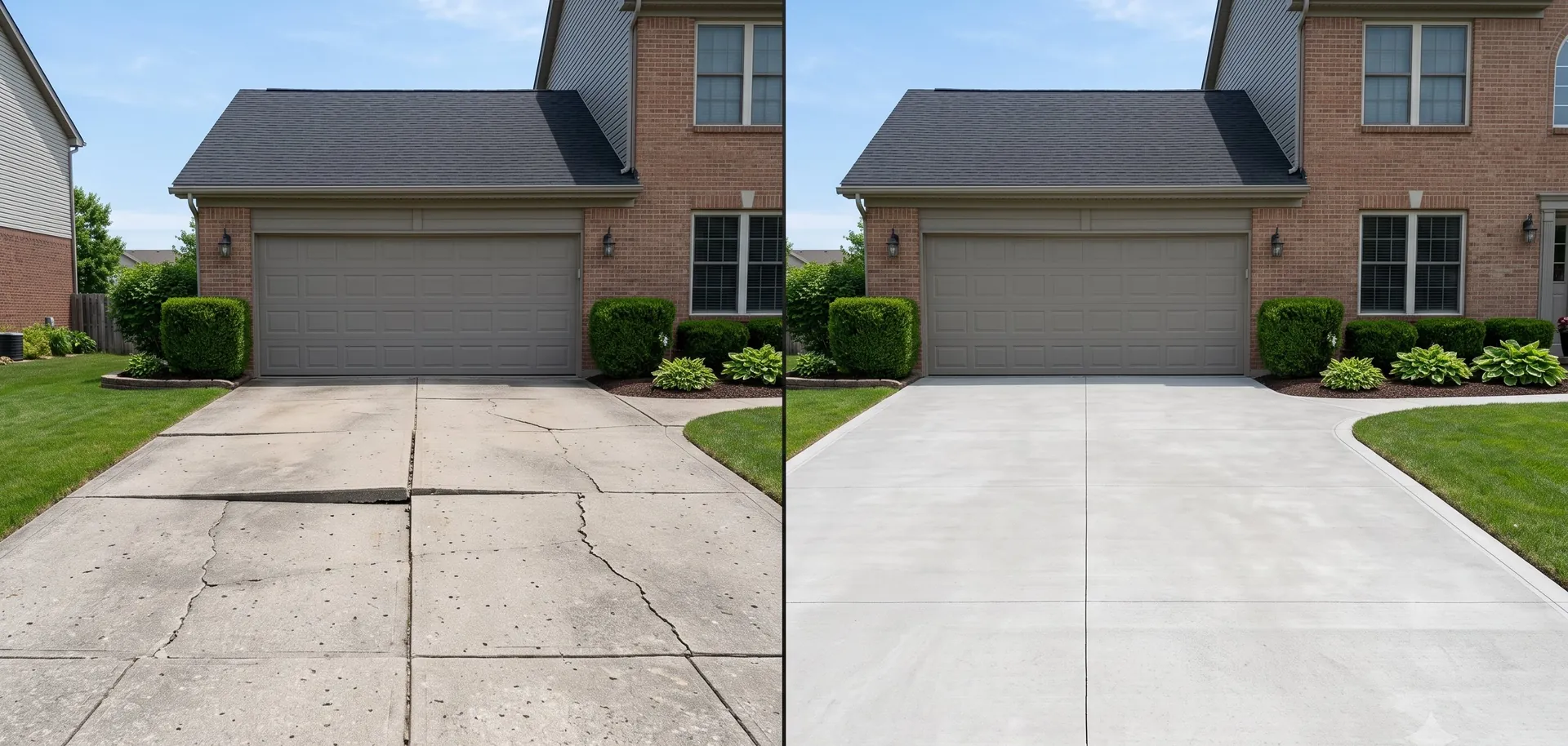
 Illustrative
Signs a driveway has settled and may need leveling: raised trip edges at the joints, water pooling in low spots instead of draining, and widening gaps where sections meet or meet the garage. If the slab is sound but sitting low, foam injection can lift it back to level. A free estimate confirms.
The Quick Edge Check
The simplest test doesn't require any tools: walk your driveway and look at where each concrete panel meets the next one. If you can see or feel a lip - one panel sitting noticeably higher than its neighbor - that's settling, not just a cosmetic seam. A small lip under a quarter inch is minor and mostly cosmetic; anything you'd actually catch a shoe on, or that a stroller or bike wheel bumps over, is worth having looked at. Pay attention near the street, at the transition into the garage floor, and along any section that gets driven over daily, since repeated vehicle weight tends to expose settling faster than a walkway would show it. If one or two spots stand out from the rest of the driveway, you likely already have your answer before you even call anyone.
Water Pooling Where It Never Did Before
Concrete is supposed to shed water toward the street or yard, not hold it. If you're noticing puddles forming in the same spot after every rain - especially near the garage floor threshold, along an edge, or in the middle of a panel - that's usually a sign the concrete has settled slightly and created a low point where there wasn't one before. Standing water isn't just cosmetic, either: water sitting against a slab edge is exactly the kind of moisture that erodes soil out from underneath over time, which is often what caused the settling in the first place. It's a bit of a feedback loop - a small dip collects water, that water washes out more soil, and the dip gets a little deeper each season, particularly with Kansas City's clay soil and freeze-thaw winters.
Cracks and Gaps Opening at the Joints
Every driveway has control joints - the cut lines that let concrete expand and contract without cracking randomly. When a section of driveway is settling, those joints are often the first place it shows: a gap that's visibly wider on one side, a joint where one panel has dropped relative to the other, or a crack that's started to open rather than stay hairline. This is different from normal weathering cracks, which tend to be uniform and don't come with a height change. If you press a coin or a stick into a joint and it visibly sits lower on one side than the other, that's a settling gap, not just seasonal movement. It's one of the more reliable early signs, since joints tend to move before the middle of a panel visibly does.
If you're not sure whether a particular crack is a settling crack or ordinary aging, when a crack in concrete is worth worrying about covers what to look for.
A Visible Dip, Wave, or Tilt
Stand at one end of the driveway and sight down the length of it, the way you'd check a fence line. A driveway that's settling unevenly often shows a visible dip or wave rather than a clean, flat plane - one section noticeably lower in the middle, or a corner that's tilted compared to the rest of the slab. This kind of movement is usually driven by uneven support underneath: part of the slab still has solid ground below it while another part has lost soil to erosion or shrinkage, so the concrete settles unevenly instead of dropping as one flat piece. A driveway that's tilting toward the house rather than away from it is worth prioritizing, since that direction of settling can start sending water toward the foundation instead of away from it. If you're seeing foundation-level cracks alongside the driveway tilt, our guide on foundation vs. slab settling walks through the difference.
Settling Right at the Garage Floor Transition
The spot where the driveway meets the garage floor threshold takes a specific kind of stress - it's where the heaviest, most frequent traffic transitions from exterior slab to interior slab, and it's also often where a downspout or drainage swale sits nearby. A gap or step-down right at that transition, or a driveway apron that's visibly lower than the garage floor slab behind it, is one of the more common settling patterns we see across the metro. Beyond being an eyesore, it can create a scrape point for lower vehicles and a spot where water works its way toward the garage floor over time. If you're seeing daylight or a widening gap right at that seam, it's usually worth a closer look before it gets wider. Garage floor leveling is often paired with the driveway apron for exactly this reason.
What to Do (and Not Do) While You Wait
The most common DIY mistake is caulking or filling the gap at the joint. It looks like it's fixing the problem, but it traps water against the slab edge instead of letting it drain away, which accelerates the soil erosion underneath. The gap is a symptom, not the disease, and sealing it just hides the symptom while the soil keeps washing out. Leave the joint open.
If you've noticed a tilt that's getting worse, try to avoid driving over that section if you can. Repeated vehicle weight over a slab that's already losing support underneath speeds up the settling. This doesn't mean you can't use your driveway, but if there's a clear path that avoids the worst-tilted section, take it until someone has walked the slab and checked the actual height differences.
Before you call anyone, take a few photos of the problem spots with a straightedge or a ruler laid across the joint. You don't need to be precise, but a photo showing the gap or the height difference gives the person on the other end of the phone a concrete reference point. It also gives you a baseline to compare against in a few months if you're watching it.
Write down what season it is when you notice the change. Kansas City's clay soil and freeze-thaw winters mean that a small dip in late fall can look different by mid-spring, and a gap that's stable through a dry summer might widen after the first hard freeze. Noting the season helps separate active, ongoing settling from a one-time seasonal shift that might stabilize on its own.
What's Actually Happening Underneath
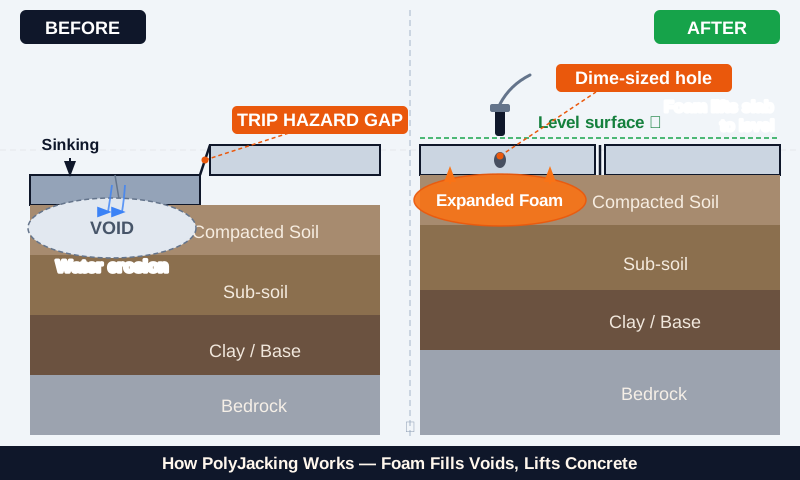
Every one of these surface signs traces back to the same underlying story: the soil supporting the slab has moved. In Kansas City that's usually some mix of expansive clay soil swelling and shrinking with the seasons, water eroding fines out from under an edge, or freeze-thaw cycles disturbing already-loose soil through the winter. The clay swells noticeably in a wet spring and shrinks in a dry fall, and that cycle is what makes the garage-to-street axis a common settling line: the repeated weight of vehicles compacting the soil on the driveway side while the yard side stays undisturbed creates a differential that shows up as a gradual tilt over a few seasons. In newer subdivisions, fill soil placed during grading can be less stable than native ground, so a driveway built on that fill may start showing movement sooner than one sitting on undisturbed soil. If you want a sense of how your specific neighborhood's soil compares to the rest of the metro, our KC Settlement Risk Index breaks it down by area. The driveway itself isn't failing structurally - concrete doesn't wear out the way asphalt does - it's responding honestly to what's happening in the ground below it. That's actually good news for repair: if the slab is otherwise in decent shape, concrete leveling can correct the position without needing to replace the concrete at all, since the material itself usually isn't the problem.
If you're checking in the middle of a wet spring or right after a hard freeze, the ground may still be shifting. A reading taken in the dry, stable season gives a truer picture of where the slab has actually settled.
When It's NOT a Leveling Problem
If the concrete surface is flaking, chipping, or showing a rough pitted texture but the panel still sits level with its neighbors, that's surface deterioration, not settling. Spalling is the top layer breaking down from water working into the concrete and the freeze-thaw cycle doing its work on the surface. It doesn't come with a height change between panels, and leveling won't address it because the slab isn't in the wrong position. It's a surface repair conversation, not a structural one, and a leveling crew isn't the right call for it.
The opposite of settling is heave, where the ground pushes a section of slab upward instead of letting it drop. In Kansas City, freeze-thaw cycles can do this in winter when water in the soil freezes and expands. If a panel is sitting higher than its neighbor rather than lower, or if you're seeing a bump rather than a dip, that's heave. It's a different mechanism and a different fix, and it won't be corrected by injecting material underneath to raise a low spot.
If the cracks you're noticing are in the foundation wall itself, or if you're seeing a step in the interior floor that tracks back to the house structure, that's a foundation issue, not a driveway issue. Driveway settling and foundation movement can share a soil cause, but they're different problems with different solutions and different contractors. Is it my foundation or the slab walks through how to tell the difference before you call the wrong person.
Hairline cracks that run in a consistent pattern, a slightly rougher surface texture, or a joint that's a hair wider than it was a few years ago are normal aging. If the cracks are uniform, don't come with any height difference on either side, and aren't opening wider season over season, the concrete is weathering the way it's supposed to. No amount of leveling changes that, and it doesn't need to be changed.
Getting a Real Answer Instead of Guessing

If you've noticed one or two of these signs but you're not sure how serious it is, that's a reasonable thing to have looked at rather than decide from a photo or a guess. The diagnose tool walks through the common signs in a couple minutes, or you can skip straight to a free on-site estimate - someone will walk the driveway, check the actual height differences with a straightedge, and tell you plainly whether it's cosmetic or worth fixing now. Clear the driveway of vehicles and toys the day before so the technician can walk the full length and check the garage transition without obstruction. We're not going to talk you into a job a driveway doesn't need. Call (913) 713-7794 or fill out the contact form and we'll get eyes on it. For a closer look at how the process works on driveways specifically, see driveway leveling in Kansas City.
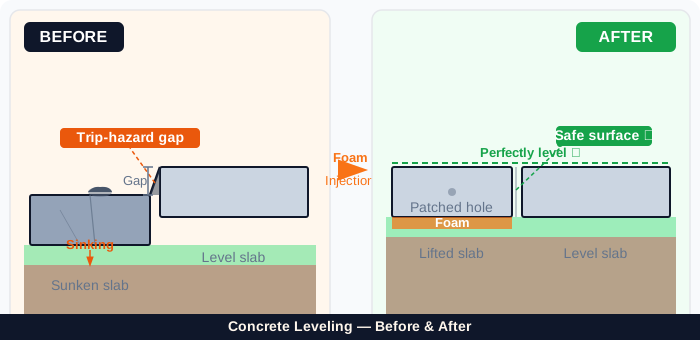
How polyjacking works in 90 seconds
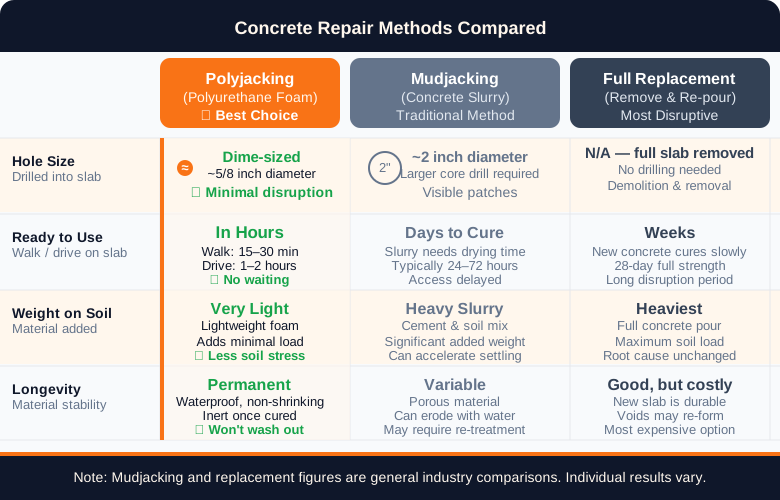
Our team walks you through the three-step process: dime-sized holes, high-density polyurethane foam that fills every void and compresses the soil beneath your slab, and use within hours with no heavy trucks. Call (913) 713-7794 or book a free estimate below.
Frequently asked
How much of a lip counts as a real problem?
A quarter inch or less is generally minor and mostly cosmetic. Anything close to or over a half inch is worth addressing, both for trip risk and because it usually means active settling underneath.
Is it normal for a driveway to have some cracks?
Some hairline cracking is normal as concrete cures and weathers over the years. What's worth watching for is a crack paired with a height difference on either side, which points to settling rather than ordinary aging.
Can I level just part of my driveway, or does the whole slab need it?
Just the settled sections. Foam injection targets the specific panels or areas that have dropped, so the rest of the driveway that's still supported properly doesn't need to be touched.
Will leveling my driveway fix the water pooling too?
In most cases, yes - restoring the slab's original slope corrects the low point that was collecting water, since the pooling is usually a symptom of the same settling.
How do I use the diagnose tool?
It's a short guided check on our site that walks through the common signs of settling - edges, water, cracks, tilt - and helps you sort out whether what you're seeing is worth a closer look before you call.
Related guides
Have a sinking slab?
Book a free on-site inspection. Honest advice, usable within hours.
Pick a time that works for you
Book right here on this page. Prefer to talk? Call (913) 713-7794.