
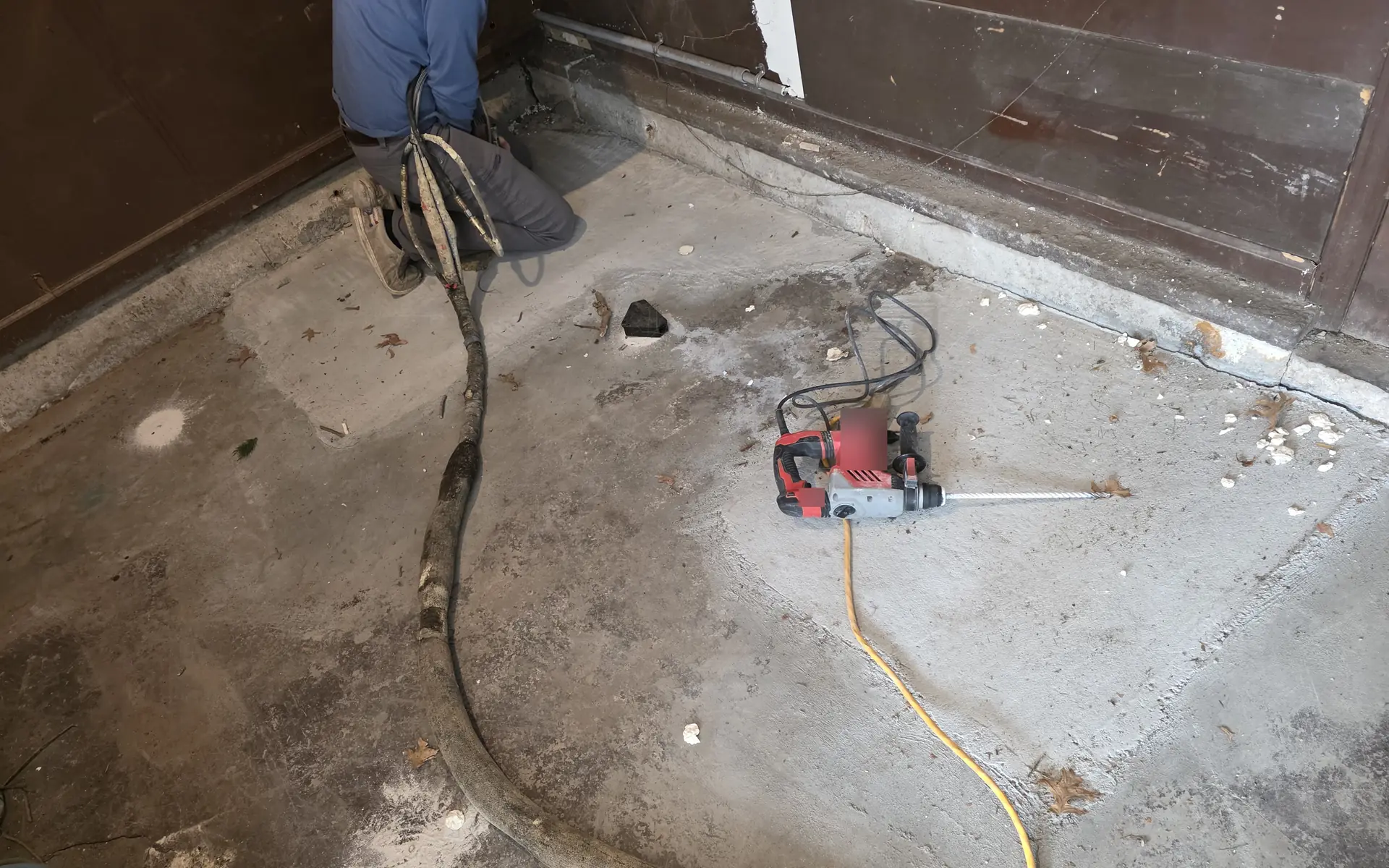
Concrete Leveling in Kansas City, KS
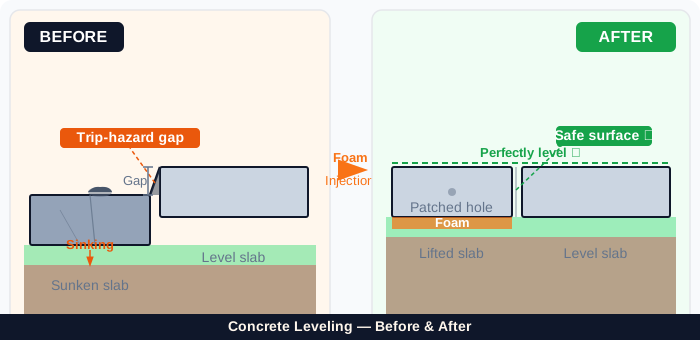
PolyJacks lifts sunken driveways, sidewalks, and patios anywhere in Kansas City, KS with foam injection instead of tearing them out, and the on-site estimate is free.
What makes KCK concrete so unpredictable is its history: Wyandotte County was assembled from five separate towns merged in 1886, with Argentine annexed in 1910 and county government folded into a single Unified Government in 1997. That patchwork past is exactly why concrete age jumps around so much block to block, and why a free look before any tear-out is what saves KCK homeowners the most.
A City Built by Merging Cities
Kansas City, Kansas wasn't founded once. It was assembled. In March 1886, five separate towns — Wyandotte (the oldest, established 1857), "old" Kansas City, Armstrong, Armourdale, and Riverview: consolidated into the "new" Kansas City, Kansas. Argentine, a separate industrial town on the Kansas River, was annexed in 1910. Then in 1997, Wyandotte County voters approved the Unified Government of Wyandotte County/Kansas City, Kansas. The first city-county consolidation in Kansas history. Every one of those towns brought its own already-built street grid and housing stock into the merger, which is why concrete leveling Kansas City, KS calls come from every era at once instead of one dominant building decade.
Argentine's Industrial Legacy Under the Slab
Argentine (named for the Latin word for silver) was platted in 1880, and the ore smelter built there that same year grew into what contemporary accounts called the world's greatest ore-smelting and refining plant by 1898 — processing nearly 7.9 million ounces of silver, over 240,000 ounces of gold, and almost 40,000 tons of lead in a single year, roughly a fifth of the nation's lead output. The Guggenheim family shut the smelter down in 1901, and Argentine was annexed into Kansas City, KS in 1910. Slag and industrial fill from that smelter era still sit under some of the neighborhood's oldest driveways and sidewalks, layered on top of river-adjacent soil, a settlement mechanism unique to this part of the metro.
When that fill has created a void under the slab, filling the void is a separate step from the lift itself — see how void-fill works in Kansas City.
A Population That Peaked, Dipped, and Is Coming Back
Kansas City, KS grew to 129,553 residents by 1950, dipped slightly to 121,901 in 1960, then jumped to a peak of 168,213 in 1970. From there it declined for four straight decades, bottoming out at 145,786 in 2010, before rebounding to 156,607 in 2020. That peak-dip-rebound shape is different from Raytown, Missouri (which peaked once in 1970 and never regrew) or Belton and Liberty, Missouri (both of which grew steadily with no boom-and-bust at all). Practically, it means KCK has driveways and sidewalks poured across a 1970s peak, a multi-decade lull, and a 2010s-forward rebound, which means three settlement clocks running at once instead of one.
Concrete Leveling vs. Mudjacking for KCK Homeowners
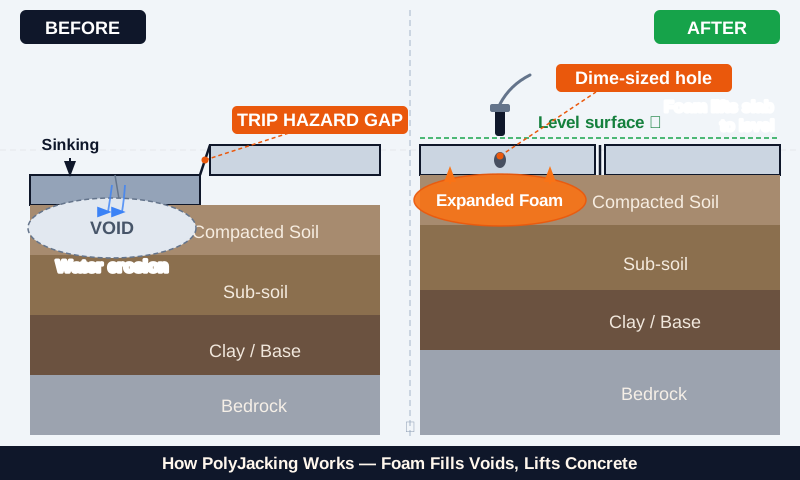
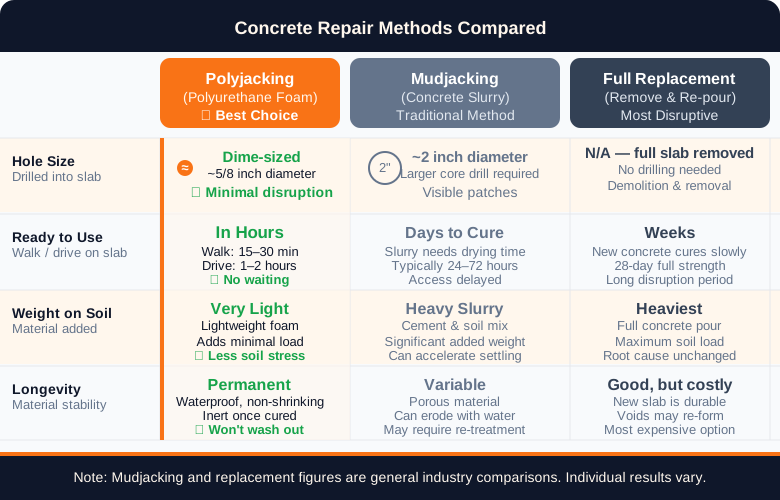
Homeowners who search mudjacking Kansas City are usually looking to fix the same sunken slab PolyJacks handles with polyurethane foam instead. Mudjacking pumps a heavy cement-based slurry through much wider holes, and in parts of KCK where soil has already been disturbed by old industrial fill, flooding, or decades-old construction, that extra weight can push right back down into soft ground. Foam is a fraction of the weight, injected through dime-sized holes, and it cures within minutes instead of days. It's also fully waterproof, which matters in a river city: mudjacking slurry can break down in wet or flood-prone soil over time, while cured polyurethane foam won't wash out or absorb water.
For a closer look at the difference between the two hole sizes, see mudjacking holes vs. polyjacking holes.
Wondering how the waterproof foam holds up over time? Read how long concrete leveling lasts.
Serving Kaw Point and the Rest of the Metro
Kansas City, Kansas covers roughly 125 square miles at the confluence of the Kansas and Missouri Rivers (Kaw Point) and PolyJacks, based in Spring Hill, Kansas, treats it as a regular part of our route alongside Kansas City, Missouri, Roeland Park, Mission, Westwood and the rest of the Wyandotte and Johnson County line. Whether the slab sits on a 140-year-old Wyandotte lot, an Argentine block with old smelter fill underneath, or a Village West driveway poured during the 2010s rebound, every estimate is the same: free, on-site, and honest about what foam can and can't fix.
For the complete, up-to-date list of every neighborhood and surrounding community on our route, see our full service areas.
If your sidewalk sits on the public right-of-way, the Unified Government of Wyandotte County/Kansas City, Kansas handles the repair notice process under the consolidated city-county structure rather than a standalone municipal code office — see how the KCK sidewalk repair notice works before scheduling the lift.
In practice that covers the Wyandotte County communities on the Kansas side of the river and the north Johnson County communities adjacent to them.
Why concrete settles in Kansas City: the local risk data
In Kansas City, about 43.1% of Wyandotte County's soil rates high-shrink-swell (USDA). Kansas City, Kansas was formed in 1886 by consolidating five separate towns, so its concrete varies in age block to block more than a city that grew outward from one center.
Kansas City averages about 80 freeze-thaw days a winter — 79.6 over the last 31 winters at KCI (NOAA station records, 1995–2026).
Sources: USDA SSURGO · NOAA / ACIS (KCI) · local record. See the full KC Concrete Settlement Risk Index.
Our concrete leveling services
Driveway Leveling
Raise a sunken driveway (or a slab that's dropped at the garage) back to level in a few hours, no tear-out.
Raise a sunken drivewaySidewalk Leveling
Kill trip hazards and even out uneven walks and paths: safer footing, less liability.
Raise an uneven sidewalkPatio Leveling
Re-level a patio that's settled, split at the seams, or pools water after every rain.
Lift a settled patioGarage Floor Leveling
Lift a settled garage floor slab back to even, without jackhammering it out.
Garage floor levelingPool Deck Lifting
Raise a sunken pool deck back to level without draining the pool. Foam won't wash out.
Raise a sinking pool deckPorch & Step Leveling
Bring settled porches, stoops, and concrete steps back to safe, even height.
Level sunken concrete stepsCommercial Leveling
Warehouse floors, ADA trip hazards, parking and loading areas — leveled with minimal downtime.
Lift a settled parking lotConcrete leveling near Kansas City
PolyJacks is your local concrete leveling contractor in Kansas City — we serve Kansas City and the surrounding communities:
Neighborhoods across Kansas City:
Real job documentation
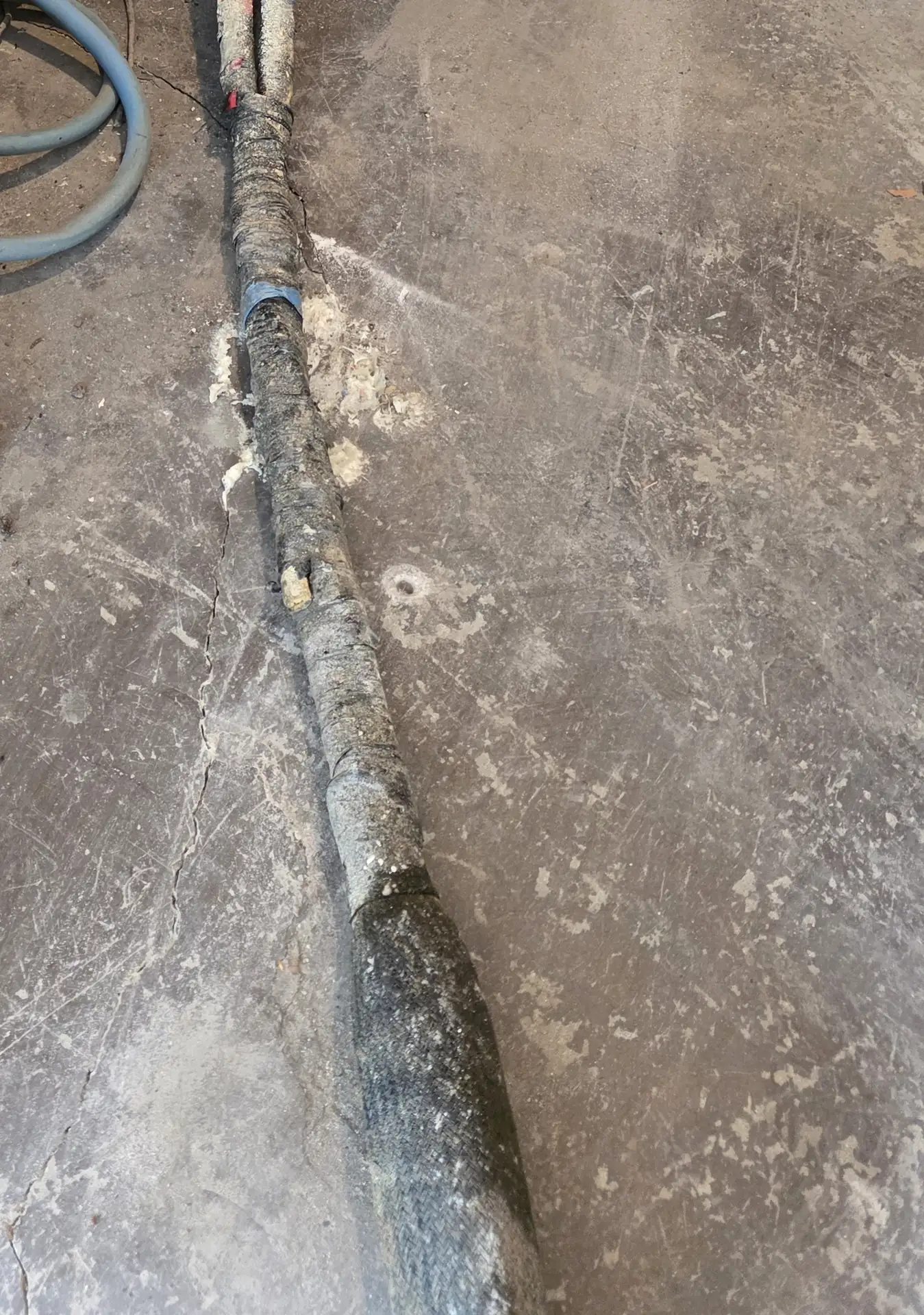
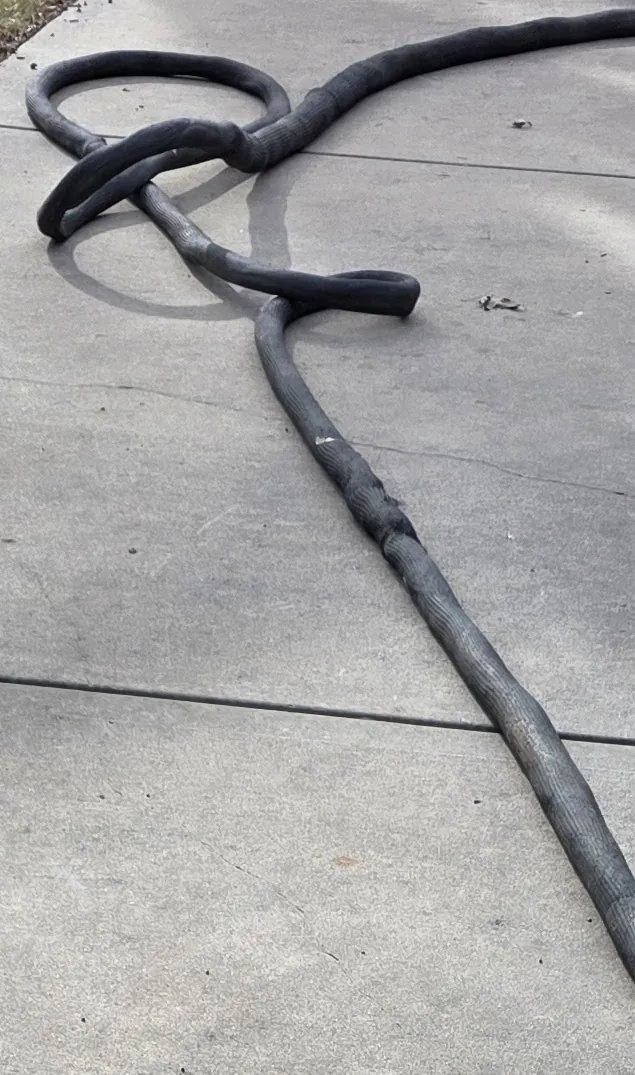
How polyjacking works in 90 seconds
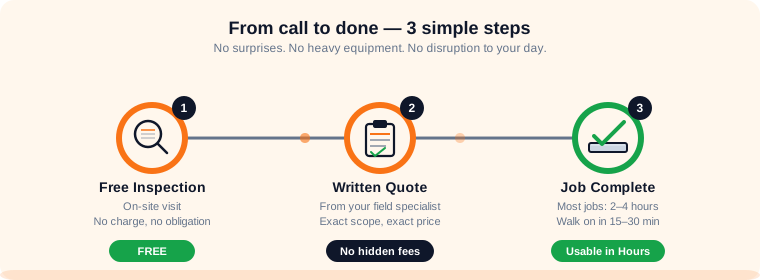
Our team walks you through the three-step process: dime-sized holes, high-density polyurethane foam that fills every void and compresses the soil beneath your slab, and use within hours with no heavy trucks. Call (913) 713-7794 or book a free estimate below.
Frequently asked
What's the cost to level concrete in Kansas City, KS?
It depends on the slab and how much settling has happened, so we don't post a flat price. Every estimate is free and on-site: call (913) 713-7794.
Does Kansas City, KS's merged history actually affect concrete leveling?
Yes, indirectly. Because the city absorbed five already-built towns in 1886 and Argentine in 1910, the underlying construction eras and soil conditions vary more from block to block here than in a city that grew outward from a single downtown. We look at each slab and its soil individually rather than assuming one settlement pattern citywide.
Is foam leveling a permanent fix?
The foam itself is waterproof and won't break down underground, and it fills the void that caused the settling. If a drainage issue near the slab isn't addressed, new voids can form over time. We'll point that out if we see it.
How long until I can use the driveway or sidewalk again?
Usually you can walk on it in 15 to 30 minutes and drive on it in about 1 to 2 hours.
Will the leveled slab match the rest of my concrete?
Yes. We lift your existing slab instead of pouring new concrete, so the color and texture stay the same, with only a small dime-sized patch where the injection holes were.
Do you serve both sides of Kansas City?
Yes, we work both Kansas City, KS and Kansas City, MO, along with Roeland Park, Mission, Westwood, Fairway and North Kansas City.
Who does concrete leveling near me in Kansas City, KS?
That's what PolyJacks does in Kansas City — most leveling jobs finish in 2–4 hours and the slab is back in service within hours (walk on it in 15–30 minutes, drive in 1–2 hours). Book a free estimate.
Free concrete leveling estimate in Kansas City
No obligation. Honest advice, usable within hours. If foam isn't the right fix, we'll tell you straight.
Pick a time that works for you
Book right here on this page. Prefer to talk? Call (913) 713-7794.