
 Illustrative
Concrete Leveling in Smithville, MO
Smithville was founded in 1822 by Humphrey "Yankee" Smith and known for over a century as a small Clay County farm town called Smith's Mill before it incorporated as Smithville in 1867.
It stayed modest, with 947 residents as of 1950, until the Army Corps of Engineers built Smithville Dam between 1972 and 1977, impounding the Little Platte River into Smithville Lake in 1979. The lake drove rapid growth, from 5,514 residents by 2000 to 10,406 by 2020, mostly new construction on graded lots near the water. New construction near the lake and older homes closer to downtown both deal with the same clay-heavy Clay County ground, just in different ways. PolyJacks handles concrete leveling for Smithville homeowners with polyurethane foam and a free on-site estimate.
A Farm Town Until the Corps of Engineers Built a Lake
Smithville's history splits cleanly into two eras. Humphrey "Yankee" Smith settled the site in 1822, and the town that grew up around his mill: first called Smith's Mill, later shortened to Smithville when it incorporated in 1867, as recorded in Smithville's town history — stayed a small Clay County farm town for the next 130 years, with just 947 residents as of 1950. That changed when the U.S. Army Corps of Engineers authorized Smithville Dam in 1965, began construction in 1972, and completed the dam in 1977, impounding the Little Platte River into what's now Smithville Lake starting in 1979, according to the U.S. Army Corps of Engineers' Smithville Lake record. The lake turned Smithville into one of the Northland's fastest-growing towns (5,514 residents by 2000, 10,406 by 2020) with most of that growth as new construction on graded lots near the water. The older downtown, built long before the dam existed, sits on a different kind of ground entirely.
What We Level in Smithville
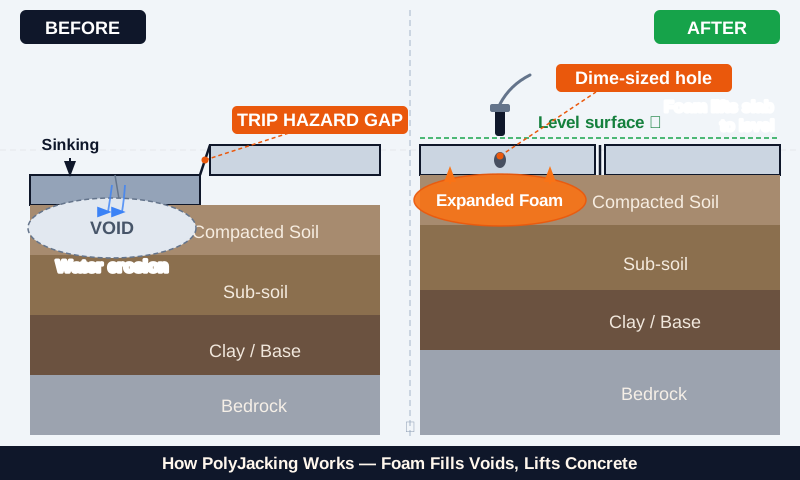
We work on driveways, front walkways, patios, garage floors, pool decks, and porch or step slabs throughout Smithville, plus void filling under slabs before a full settle happens - useful for newer construction where fill soil hasn't finished compacting yet. The approach is consistent no matter the slab: a few dime-sized holes drilled at the low points, expanding polyurethane foam injected underneath, and the slab lifts back toward level as the foam cures. It's fast enough that most jobs wrap up in a single visit, and because the foam is lightweight, it won't overload soil around Smithville Lake that's still settling from recent grading work. The same driveway leveling and patio leveling process applies to lakeside lots and to older downtown slabs alike.
If a patio is the slab giving you trouble, here is why a patio sinks in the Kansas City area.
Lakeside Lots and Downtown Lots Fail Differently in Smithville
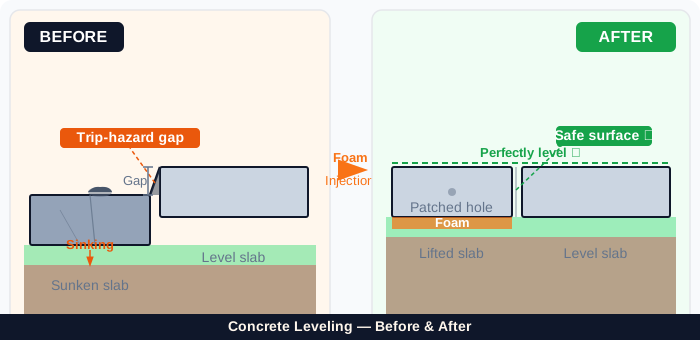
Smithville is really two jobs in one town. Out near the lake, the newer homes sit on lots that were cut and filled to make a buildable pad, often with slope, and the ground there drains toward the water instead of sitting flat. A driveway or patio on that kind of lot has two things working on it at once: fill that has not finished compacting, and a drainage path that runs downhill across or beside the slab every time it rains. Those tend to drop early, sometimes within a few years of the house being finished, and they drop on the downhill side. Closer to the old downtown the ground was never regraded for a subdivision. It has been sitting where it is since long before the dam was built, so the fill question does not apply and what moves is the Clay County clay itself, swelling wet and shrinking dry under slabs that have taken that cycle for decades. On the lake side, start by following the water: five drainage mistakes that sink a driveway.
Polyjacking vs. Mudjacking for Smithville Homeowners
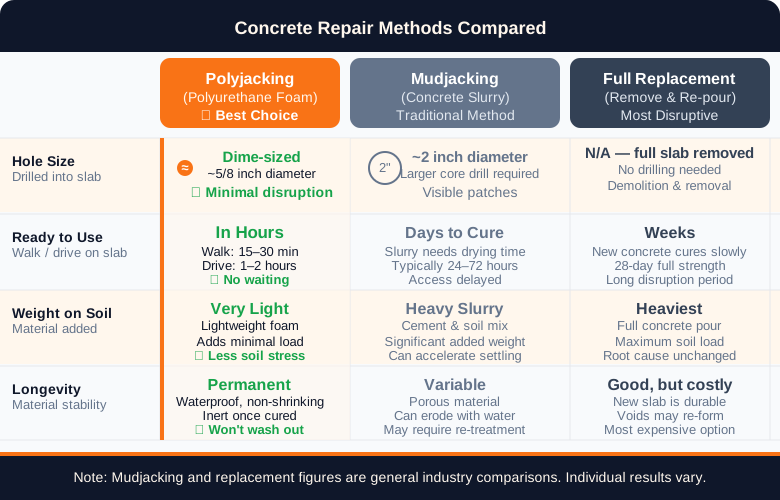
Mudjacking has a long track record of lifting sunken slabs, using a heavy cement-based slurry pumped through much wider holes. It can get the job done, but that slurry's weight is a real consideration on the fresher fill soil found in a lot of Smithville's newer subdivisions, where the ground hasn't fully settled yet. Polyurethane foam weighs a small fraction of that slurry, goes in through dime-sized holes, and cures in minutes rather than days, which makes it a better match for newer construction as well as the older clay-heavy lots closer to downtown Smithville. If a particular slab calls for something other than foam, we'll say so plainly when we give you the estimate.
If you are weighing the two methods for a slab on fill near Smithville Lake, our polyjacking vs mudjacking comparison sets them side by side.
For a closer look at the drill pattern, see how mudjacking holes compare with polyjacking holes.
Serving Smithville and the Northland
PolyJacks is a locally owned business based in Spring Hill, Kansas, and Smithville is a regular stop in our Northland service area.
Nearby Liberty, the Clay County seat, has the same split we see here between older downtown slabs and newer construction still settling on fill.
Why concrete settles in Smithville: the local risk data
In Smithville, about 65.5% of Clay County's soil rates high-shrink-swell (USDA). Smithville grew roughly elevenfold after the Corps of Engineers impounded Smithville Lake (1977-1979), so most of its slabs sit on post-lake subdivision fill.

Kansas City averages about 80 freeze-thaw days a winter — 79.6 over the last 31 winters at KCI (NOAA station records, 1995–2026).
Sources: USDA SSURGO · NOAA / ACIS (KCI) · local record. See the full KC Concrete Settlement Risk Index.
Our concrete leveling services
Driveway Leveling
Raise a sunken driveway (or a slab that's dropped at the garage) back to level in a few hours, no tear-out.
Raise a sunken drivewaySidewalk Leveling
Kill trip hazards and even out uneven walks and paths: safer footing, less liability.
Raise an uneven sidewalkPatio Leveling
Re-level a patio that's settled, split at the seams, or pools water after every rain.
Lift a settled patioGarage Floor Leveling
Lift a settled garage floor slab back to even, without jackhammering it out.
Garage floor levelingPool Deck Lifting
Raise a sunken pool deck back to level without draining the pool. Foam won't wash out.
Raise a sinking pool deckPorch & Step Leveling
Bring settled porches, stoops, and concrete steps back to safe, even height.
Level sunken concrete stepsCommercial Leveling
Warehouse floors, ADA trip hazards, parking and loading areas — leveled with minimal downtime.
Lift a settled parking lotConcrete leveling near Smithville
PolyJacks is your local concrete leveling contractor in Smithville — we serve Smithville and the surrounding communities:
Real job documentation
How polyjacking works in 90 seconds
Our team walks you through the three-step process: dime-sized holes, high-density polyurethane foam that fills every void and compresses the soil beneath your slab, and use within hours with no heavy trucks. Call (913) 713-7794 or book a free estimate below.
Frequently asked
How much does it cost to level a driveway in Smithville?
We don't set a price until we've seen the slab, since it depends on size and how much foam the lift takes. Every estimate in Smithville is free.
My house is newer - can concrete still settle that fast?
Yes - newer homes on graded and filled lots, common around Smithville Lake, often see a driveway or garage floor settle within a few years as the fill soil finishes compacting.
How long until I can park in my garage again?
The foam cures in minutes, so you can usually walk on the area in 15 to 30 minutes and drive on it in about 1 to 2 hours.
Is the foam repair permanent?
It's waterproof and lightweight, so it holds up well long-term, though any drainage issue that caused the original settling should still be addressed to avoid future movement.
Do you serve towns near Smithville, like Kearney or Liberty?
Yes - we regularly serve Kearney, Liberty, Gladstone, Pleasant Valley, Platte City, and Parkville in addition to Smithville.
Why has Smithville grown so much since the 1970s?
Smithville was a small farm town for 150 years until the Army Corps of Engineers built Smithville Dam between 1972 and 1977 and impounded Smithville Lake. Development around the lake since then accounts for most of the city's growth, which is why we see so much newer construction settling on graded lots near the water.
Searching “concrete leveling near me” from Smithville — who covers it?
PolyJacks covers Smithville, MO. Count on 2–4 hours on site for most jobs, then you're back to using your concrete within hours. Walk on it in 15–30 minutes, drive within 1–2 hours. The estimate is free. Book online.
Free concrete leveling estimate in Smithville
No obligation. Honest advice, usable within hours. If foam isn't the right fix, we'll tell you straight.
Pick a time that works for you
Book right here on this page. Prefer to talk? Call (913) 713-7794.