
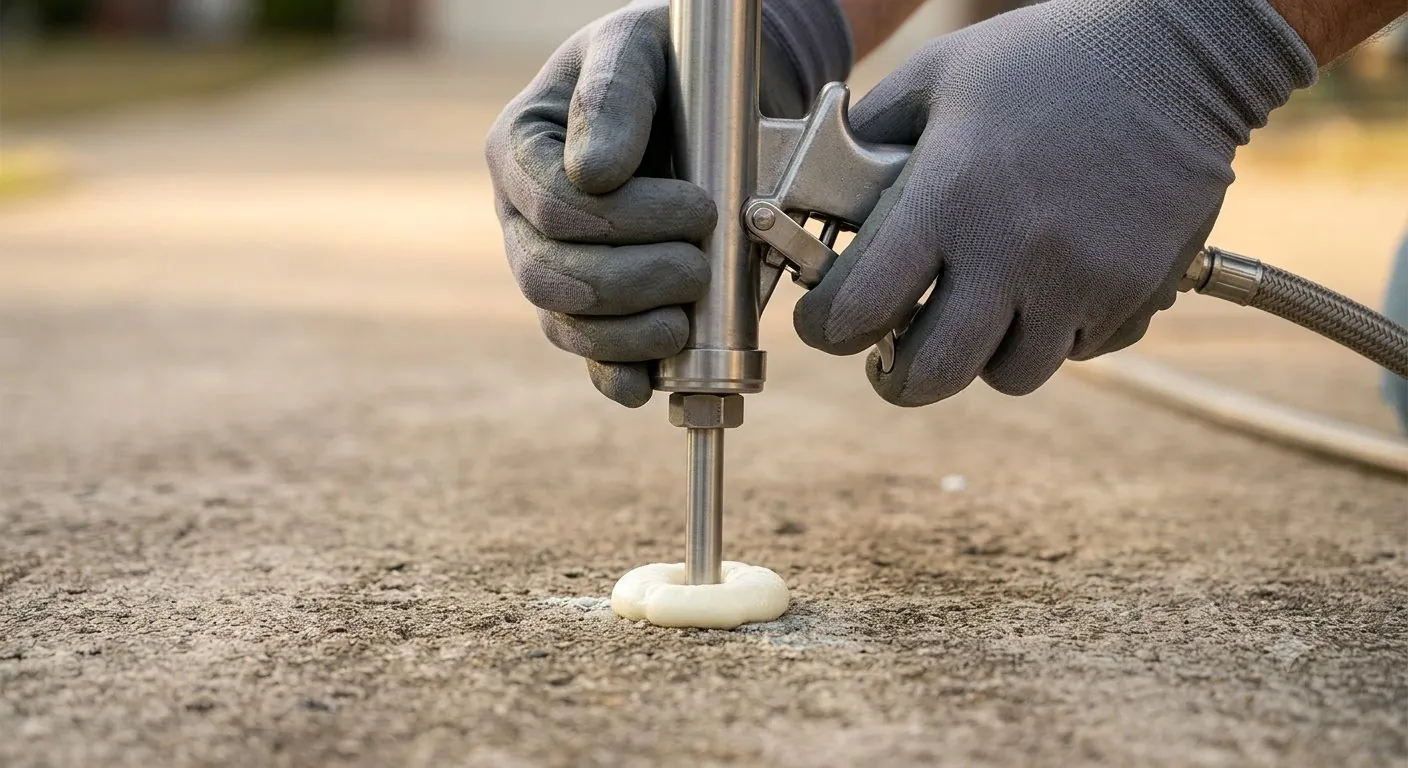
 Illustrative
Garage Floor Leveling in Kansas City: Fixing a Sinking Garage Slab
PolyJacks levels a settled garage floor slab by injecting waterproof polyurethane foam through dime-sized holes, lifting concrete back into place without tearing out or replacing the slab. Most Kansas City garage floor jobs take 2-4 hours, with the garage ready to use within hours. PolyJacks offers a free on-site estimate across the Kansas City metro, at a fraction of replacement cost.
Salt Season Is Your Garage Floor’s Worst Season
Every winter, your car pulls into the garage trailing road brine. Missouri’s roads get pre-treated with salt solution before each storm, and after a snow event the road surface is saturated with chloride compounds. That brine clings to your tires and drips off your undercarriage. By the time you park, it’s pooling on your garage floor.
MoDOT runs through roughly 160,000 tons of road salt and 2.1 million gallons of salt brine in a single winter season across Missouri roads. A fraction of all of it ends up on KC driveways, and from there onto garage floors. In a city where winter lows regularly hit the 20s°F, that salt-saturated slab surface cycles through freeze-thaw all season long. The result is a concrete floor being attacked from above by chloride ions and from below by the clay soil movement and void formation the rest of KC concrete deals with too: concentrated under the one surface you park on every day. Left unchecked, that void formation is what starts a garage floor sinking.
How Salt Brine Finds Its Way Under the Slab
Concrete is porous. Chloride ions from road salt don’t just sit on the surface. They break down the cement paste that holds concrete together, opening micro-cracks in the surface layer. Once a crack is open, salt brine drains through it. The construction gap between your garage floor and the footing wall is another entry point: poured separately from the house foundation, that joint is often the widest gap in the slab.
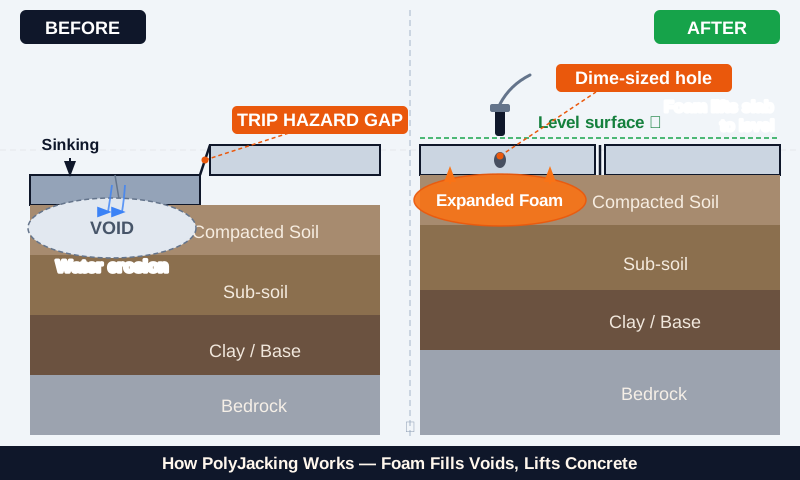
Once the brine reaches the Wymore-Ladoga clay subbase beneath. The heavy clay soil common across the KC metro (commonly 35 to 55 percent clay, per USDA-NRCS). The chloride-saturated moisture accelerates what the clay is already doing on its own. The clay shrinks when dry and swells 10–15% in volume when wet, and each cycle leaves the soil slightly less compact than before. Salt brine keeps the subbase saturated longer and erodes the contact between soil and slab. Voids form under a brine-exposed garage floor faster than under a dry, covered slab would ever produce them.
Salt brine is the garage-specific piece; why concrete sinks across Kansas City covers the clay, freeze-thaw, and drainage causes behind settling slabs everywhere else.
Slowing the Next Cycle: What You Can Do About the Brine
An absorbent or rubber drip mat at the garage door threshold catches brine before it pools on the slab surface. The construction gap between the garage slab and the footing wall, identified above as the widest entry point for brine, can be sealed with a polyurethane or polyurea sealant; it is a small job a contractor or a competent DIYer can handle in an afternoon. Directing all gutter downspouts at least six feet from the slab keeps meltwater and storm runoff from saturating the subbase from the outside. None of these steps replaces the lift if voids have already formed, but they reduce the rate at which the next void develops under a slab that has been brought back to level.
If a floor coating is also on your list, plan it for after the lift, since a coating follows the slab's shape and will not raise a section that has dropped; our guide on leveling before you coat a garage floor explains why.
Temperature Swings Inside a KC Garage
A garage floor is partially sheltered, but that partial shelter creates its own problem. The center of the slab may hold just above freezing on a cold night while the concrete near the door: where cold air rushes in every time you arrive or leave: drops well below. Kansas City averages roughly 80 freeze-thaw days in a typical winter (NOAA KCI records), and the edge of a garage slab near the door catches a disproportionate share of them.
That thermal gradient is why the gap almost always opens at the front first: the concrete near the garage door cycles the most, contracts the most, and pulls away from the driveway apron slab soonest. The apron outside settles from full exposure. The garage floor edge settles from this combination: temperature differential, repeated freeze-thaw at the joint, and salt brine working into the gap all winter.
Why Waterproof Foam Outlasts the Problem
When the subbase has been repeatedly saturated with salt brine, the repair has to be impervious to moisture. Polyurethane foam is closed-cell and completely waterproof: salt water runs off it, not through it. That matters here because the conditions that created the void don’t stop after we lift the slab. Cars keep coming in with winter brine. The soil keeps cycling.
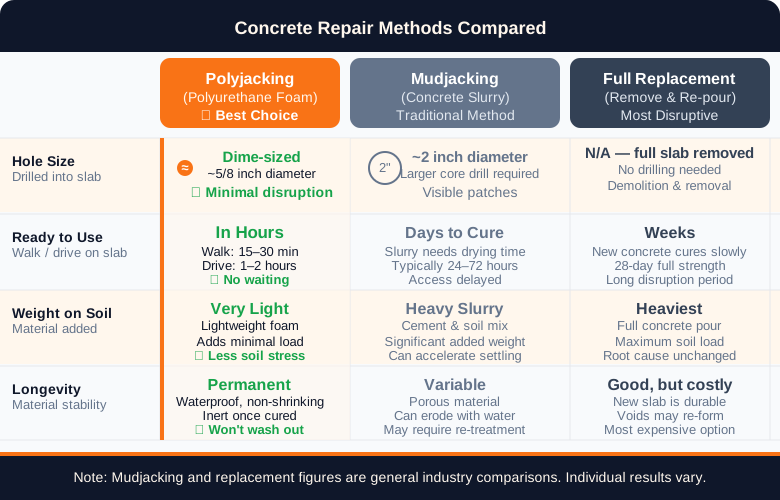
Traditional mudjacking uses a water-based cement-and-soil slurry. In a wet, chloride-heavy environment under a garage floor, that mix can absorb groundwater over time and gradually break down. Our foam cures rigid within minutes and doesn’t soften when moisture returns, which it will.
Cure time is the other practical difference: our foam is walkable in 15 to 30 minutes and driveable in 1 to 2 hours. Mudjacking requires 24 to 72 hours before the space is usable again. A full tear-out and repour puts your garage out of commission for close to a week, with full concrete strength at 28 days.
How We Lift and Level a Garage Floor
The process starts with a free on-site inspection: we map how much the slab has settled, locate where the voids are sitting, and identify anything that would make a lift the wrong call.

The lift itself:
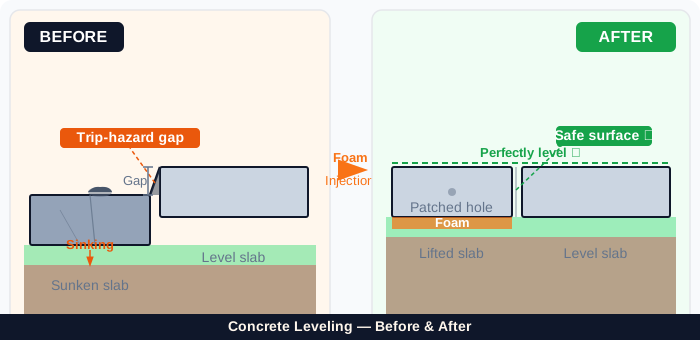
- Dime-sized holes drilled through the slab — 4 to 12 depending on the size and configuration of the settled area
- High-density polyurethane foam injected through the holes
- Foam expands 30 to 40 times its liquid volume, filling voids and lifting the slab back toward level
- Holes patched, site cleaned up
Most garage floor jobs run 2 to 4 hours start to finish. Walk on the floor in 15 to 30 minutes. Standard vehicles can drive on it in 1 to 2 hours. Heavy loads (RVs, trailers, dually trucks) need 48 hours for the foam to reach full cure strength.
If your garage door track is bolted to the slab, it moves with the lift and typically needs no adjustment. If it is anchored to the wall, we check the track-to-slab clearance after the lift and flag any gap that needs attention. We will confirm which applies to your setup during the free inspection, and if a track re-anchoring is needed we can refer you to a garage door service.
Before the crew arrives, clear the settled area of vehicles, storage bins, and the garage door track if it is anchored to the slab. You do not need to empty the entire garage. We bring our own dust collection and leave the floor broom-clean when we finish.
On-site visit. No charge, no obligation.
FREEFrom your field specialist. Exact scope, exact price.
NO HIDDEN FEESMost jobs: 2–4 hours. Walk on it in 15–30 minutes.
USABLE IN HOURSWe lift your slab from underneath. In hours, not days
A dime-sized hole. Waterproof foam. Your concrete rises back to level.
- 1. Drill dime-sized holes
- 2. Inject expanding foam
- 3. Slab lifts back to level
Level. Done. In Hours.
2–4 HOURS · WALK ON IT IN 30 MIN · WATERPROOF FOAM
The foam is lightweight. It re-supports your slab without overloading the soil, and it’s waterproof, so it won’t wash out like mudjacking.
What Garage Floor Leveling Costs in Kansas City
What a garage floor lift costs is driven by the square footage of the settled area, the volume of foam required to fill the voids, and the number of injection points the job needs.
A real example: a single-car garage in Shawnee, settled 2 to 3 inches at the back corner, came in at a fraction of the full tear-out-and-repour quote the homeowner had already received. The lift took about three hours. They drove in the same afternoon.
Final price is only possible after a free, no-obligation on-site inspection. Every void beneath a slab is different. What we can tell you: garage floor lifts consistently cost a fraction of replacement, and you’re not losing your garage for a week while concrete cures.
For a breakdown of what drives cost across all slab types in the KC metro, see what polyjacking costs in Kansas City.
Warranty: What’s Covered and What Isn’t
Every garage floor lift comes with a 5-year limited warranty, written to the owner who paid for the work at that address, and it ends if the house is sold.
If the slab settles more than 1/2 inch within 5 years because of our work, we come back and re-lift it at no charge.
What the warranty doesn’t cover: drainage or gutter issues not addressed before the lift, backfill or grading neglect, tree root damage, loads beyond normal residential use, acts of God, or cosmetic surface cracks present before the lift. We walk through all of this before we start so there are no surprises.
When Foam Isn’t the Right Call
We tell you when polyjacking won’t hold, even when it costs us the job.
- A slab that is structurally broken (cracked through in multiple places, chunks loose) needs replacement, not lifting. Foam fills voids under the slab; it can’t repair the slab itself.
- If there’s an active plumbing leak under the floor, the soil will keep washing out regardless of what we inject. The leak gets fixed first.
- If tree roots are heaving the slab from below, the roots need to be addressed before a lift will hold.
- Slabs that have severely deteriorated from salt-driven rebar corrosion may not be structurally sound enough to lift safely.
We’ll give it to you straight at the inspection, whether the answer is a lift or a referral to someone who does tear-outs.
Get a Free Garage Floor Estimate
That gap at the door or the settled corner in the back isn’t going to close on its own, and every winter adds another season of salt brine working under the slab. Most garage floor lifts finish in an afternoon, and you’re parking back on it within hours.
Book your free on-site estimate, or call (913) 713-7794 to get a crew out to take a look.
Before you book, check your address on our KC Settlement Risk Index to see how your soil and climate profile stack up against the rest of the metro.
If you are not certain whether your garage floor is settling or simply cracked, run our free diagnostic before booking an estimate. It walks you through the visual checks that distinguish a void under the slab from surface deterioration, and it takes a few minutes.
What the work actually looks like
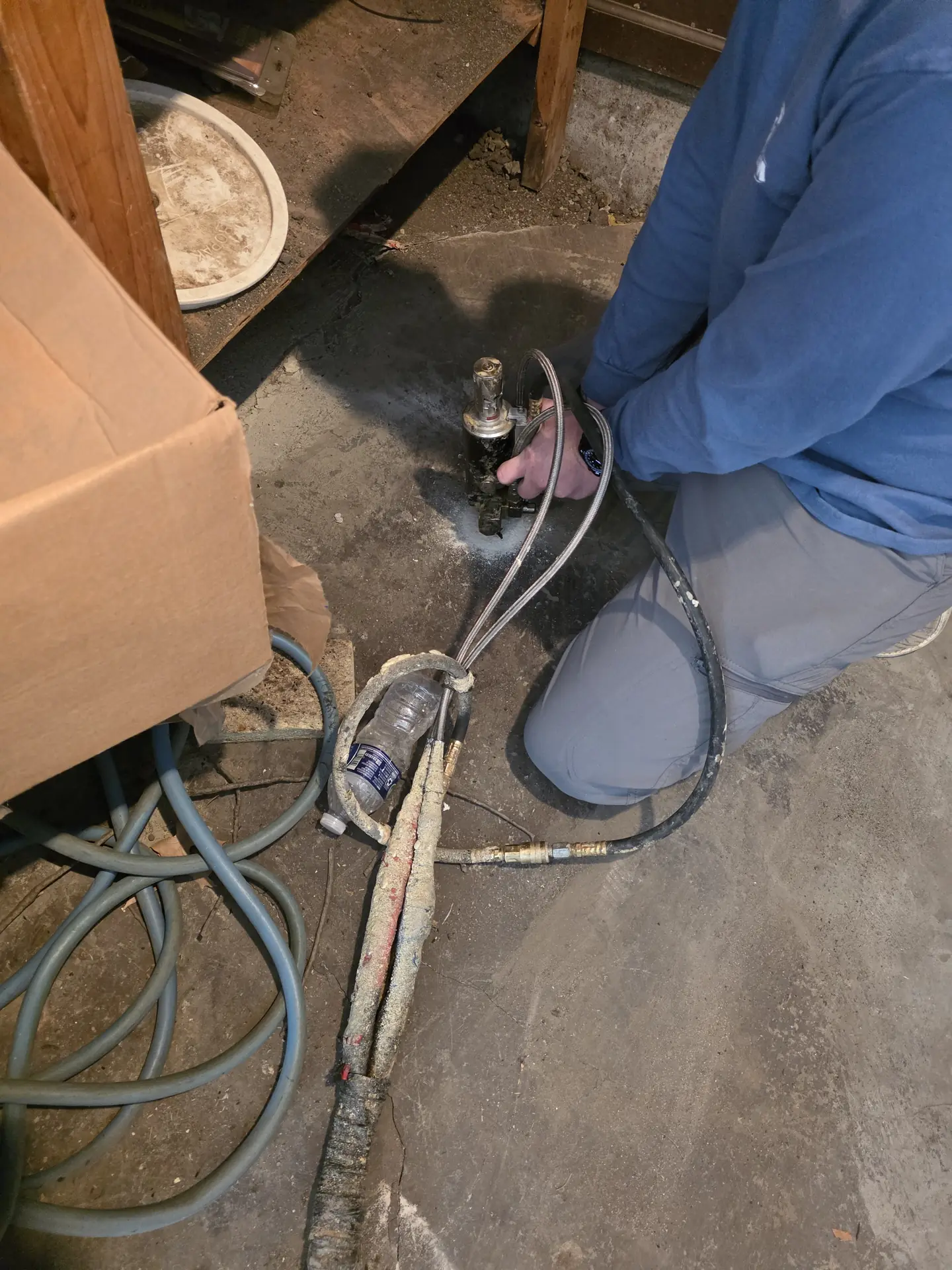
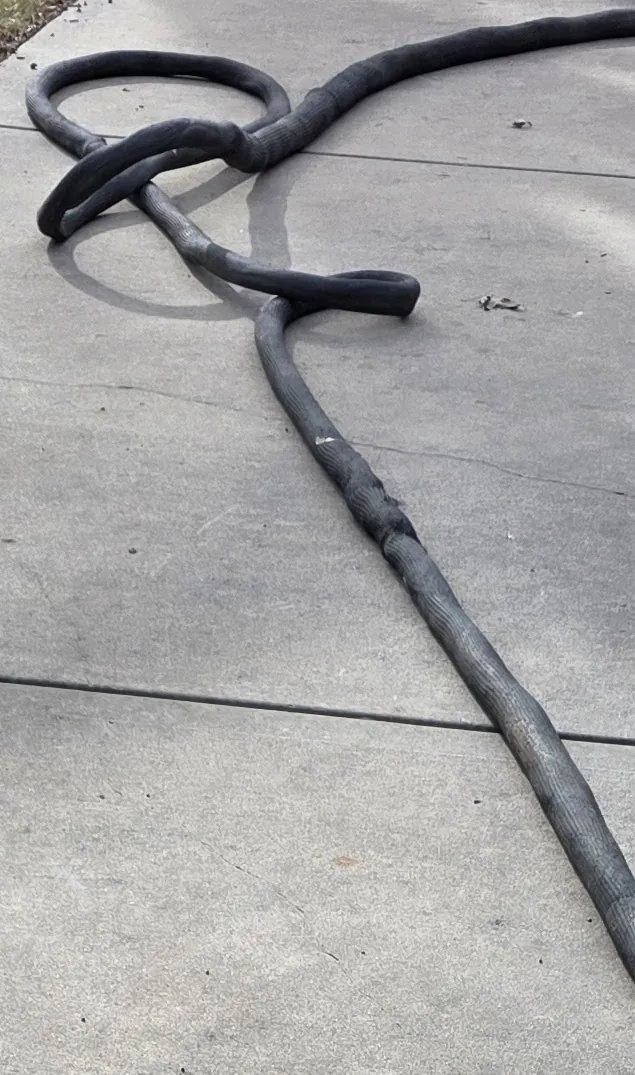
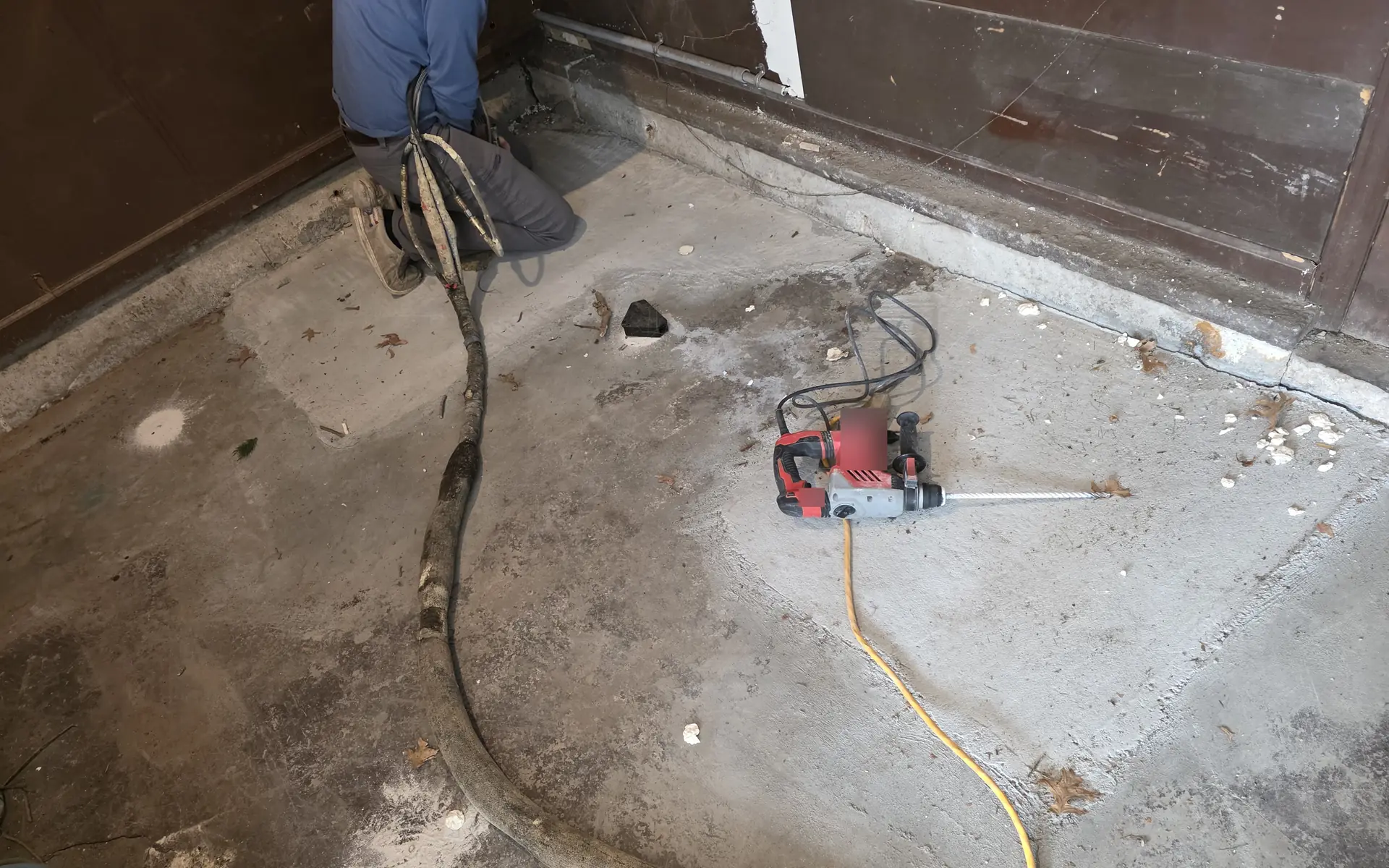
How polyjacking works in 90 seconds
Our team walks you through the three-step process: dime-sized holes, high-density polyurethane foam that fills every void and compresses the soil beneath your slab, and use within hours with no heavy trucks. Call (913) 713-7794 or book a free estimate below.
Frequently asked
Can you work on garage floors in winter, or do I have to wait until spring?
We work year-round with one exception: if the ground immediately under the slab is frozen solid, foam injection won’t work correctly. The material can’t expand into frozen soil. That usually requires sustained temperatures of 10°F or below for several days in a row. Most KC winters, the subbase under a sheltered garage floor never reaches that threshold. We check during the free inspection and tell you straight if conditions rule it out.
Does the road salt my car tracks in damage the concrete and make it sink?
Yes, in two ways. Chloride ions from road salt break down the cement paste that binds the concrete, opening surface micro-cracks over time. More critically for settling: once those cracks are open, salt brine drains through to the subbase, keeps the clay soil saturated, and accelerates the void formation that lets the slab drop. The salt attack works from the top down while the clay-soil cycle works from the bottom up.
Can you close the gap between my garage floor and the driveway apron?
Most of the time, yes. That gap appears because the garage slab and the driveway apron are separate pours on different fill, and they settle at different rates. We lift whichever slab has dropped, bring it back toward the other, and close the gap, which also eliminates the water and brine entry point at the joint. If both slabs have settled, we can address both in the same visit.
How soon can I park in my garage after the lift?
You can walk on the floor in 15 to 30 minutes. Standard vehicles can drive on it in 1 to 2 hours. We ask that you hold off on heavy vehicles (RVs, trailers, dually trucks) for 48 hours while the foam reaches full cure strength.
My floor is cracked, not just settled. Can foam still fix it?
Settlement cracks are standard. The slab moves and the surface cracks along the stress lines. Foam lifts the slab back toward level, which stops those cracks from widening further, but it doesn’t resurface or patch the visible crack lines themselves. If the slab is structurally intact under those cracks, a lift holds well. If the slab is broken through in chunks, that’s replacement territory, and we’ll tell you so at the inspection.
What exactly does the 5-year warranty cover?
If the slab settles more than 1/2 inch within 5 years because of our work, we re-lift it at no charge. The warranty is written to the owner who paid for the work, at that address, and it ends if the house is sold. It doesn’t cover drainage or gutter neglect, backfill or grading issues not addressed before the lift, tree root damage, loads beyond normal residential use, or acts of God. We go through all of it before we start.
Get your free concrete leveling estimate
No obligation, and if foam isn't the right fix, we'll tell you straight.
Pick a time that works for you
Book right here on this page. Prefer to talk? Call (913) 713-7794.