
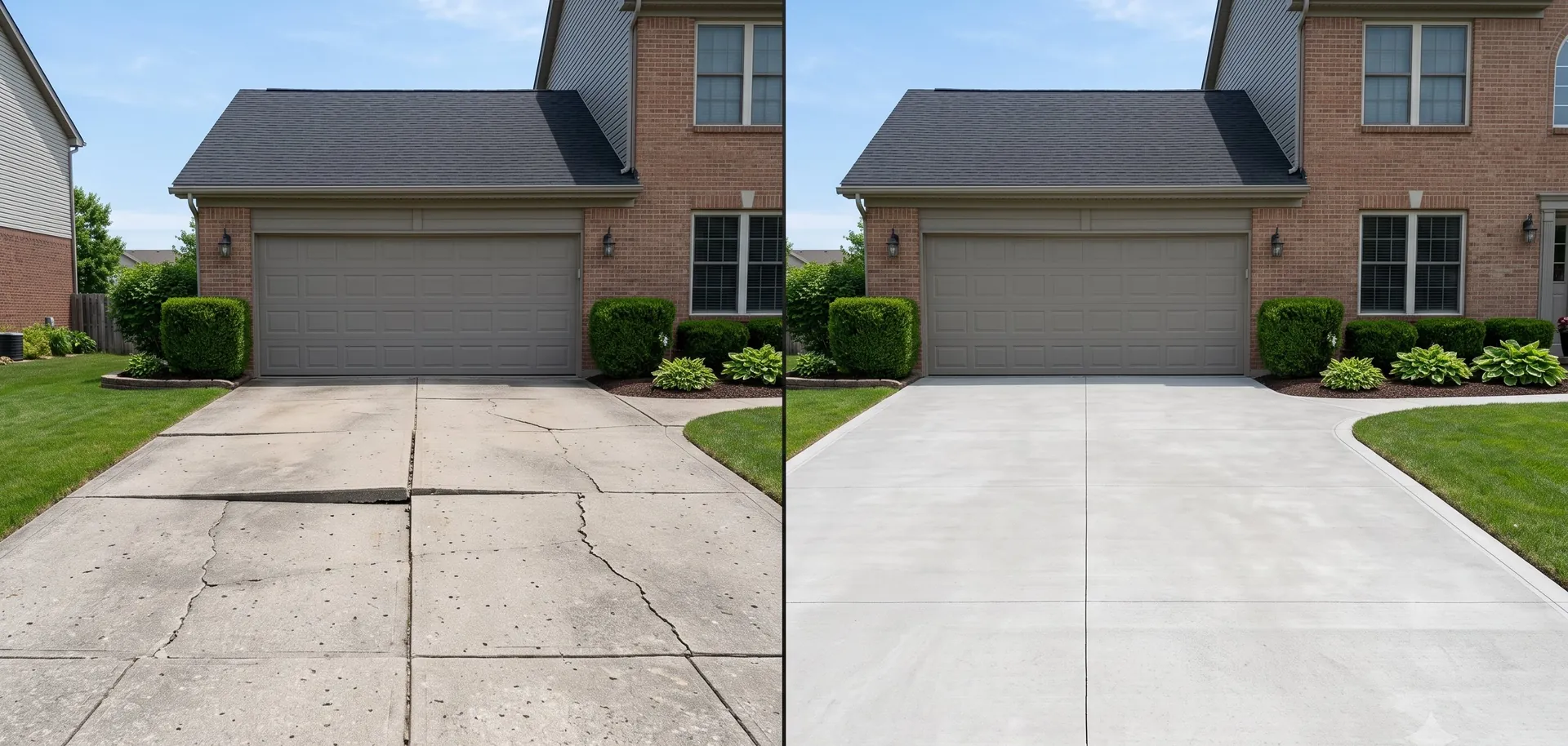
 Illustrative
How Long Foam Leveling Really Holds in Kansas City Soil
Foam leveling is long-lasting: polyurethane does not wash out or break down, so the lift itself holds. What it cannot do is stop new soil movement; major erosion or drainage problems can settle a slab again. Addressing drainage alongside leveling is what makes the result last in Kansas City's clay soil.
What "Permanent" Really Means
When we say concrete leveling is a long-term fix, here's what we mean in plain terms: once we lift and support a sunken slab with polyurethane foam, that slab isn't going anywhere on its own. The foam doesn't compress, rot, or dissolve. But "permanent" shouldn't be confused with "nothing will ever move again". We don't promise that. Concrete sits on soil, and soil is not static, especially the expansive clay common through the Kansas City metro. What concrete leveling actually promises is that the slab you had leveled stays stable and supported, because the material holding it up doesn't break down the way older repair methods do over time.

Why Waterproof Polyurethane Foam Holds Up
The foam we inject is polyurethane that cures into a rigid, waterproof structure within minutes. Unlike loose fill dirt or gravel, it doesn't settle or compact further under the slab's weight over time. Unlike mudjacking's mud-and-cement slurry, it doesn't stay wet, doesn't erode, and won't wash out if water works its way underneath the slab later. Once cured, it's chemically inert. It doesn't rot and doesn't react to temperature swings the way water-based fill can. That's the core reason concrete leveling with foam is considered a lasting fix rather than a temporary patch. You can read more about how the polyjacking process works and why the material matters as much as the technique itself.
What Can Still Cause Movement Later
Being honest here matters more to us than sounding bulletproof. The foam under a leveled section won't fail on its own. But a slab has multiple sections, and soil conditions vary across a single driveway or patio. If a downspout dumps water next to an untreated area, or another section sits over softer fill dirt, that spot can settle independently later. That's a new problem, not the old fix failing. We walk every property and explain exactly what we're seeing before we quote anything, because understanding why concrete sinks in the first place is how you avoid repeat trips down the road.
For how winter fits into why concrete sinks in the first place, see what freeze-thaw cycles do to the soil under a slab.
How This Stacks Up Against Mudjacking
Mudjacking has been around a long time, and it does lift concrete. But the slurry mix is heavy, stays porous, and can reabsorb water over the years, which is part of why mudjacked slabs have a track record of settling again sooner than foam-lifted ones. Foam weighs a fraction as much, so it doesn't add extra load to soil that's already struggling to support the slab, and it doesn't hold water the way slurry can. We wrote a full comparison of polyjacking versus mudjacking if you want the side-by-side, but the short version is: less weight and no water absorption is why foam tends to hold up longer.
We also put together a deeper look at why foam outlasts mudjacking over time if you want the longevity angle spelled out in more detail.
Backed by a Warranty
PolyJacks stands behind the work we do. Every concrete leveling job comes with workmanship warranty coverage, and we'll walk you through exactly what's included during your free, no-pressure estimate. Nothing vague, nothing buried in fine print. If a soil issue outside our control causes new settling somewhere else on the property, we'll tell you plainly what we're seeing and what your realistic options are, rather than guessing or overselling a fix that isn't the right one for that situation.
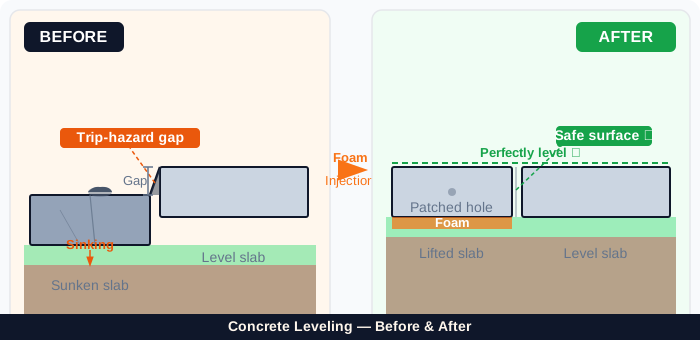
If you want the terms in writing before the estimate, the full warranty terms spell out what's covered, what isn't, and how to file a claim.
Where We Use Foam Around Your Property
This isn't a one-surface fix. We level driveways, sidewalks and walkways, patios, garage floors, pool decks, porches, and steps, and we fill voids under slabs before they ever turn into a visible problem. The same waterproof foam and the same "permanent means stable, not immortal" honesty applies across every surface we touch, whether it's a single sunken step or a full driveway panel that's pulled away from the garage floor.
Getting a Straight Answer for Your Slab
The only way to know if concrete leveling is the right permanent fix for your specific situation is to have someone look at it in person. We offer a free on-site estimate across the Kansas City metro, and if foam isn't the right call for your slab, we'll tell you that too. Call (913) 713-7794 or use our diagnose tool to get a read on what's likely going on before we even show up at your door.
What "Permanent" Really Means for a Lifted Slab
It helps to separate the two things people mean by permanent: the material and the ground. The polyurethane foam is inert and structurally stable. It doesn't rot, dissolve, or lose its lifting strength over time, so as a material it's effectively permanent. The soil beneath any slab, by contrast, is never truly static; it responds to moisture, drainage, and what's happening around it. That's why a lasting result depends on correcting the cause of the original movement, not just the symptom. When the void is filled and the water source that created it is fixed, a leveled slab commonly stays put for the remaining life of the concrete. If a new problem later appears (a fresh leak or a drainage change) that's a new cause, not the old repair failing.
How polyjacking works in 90 seconds
Our team walks you through the three-step process: dime-sized holes, high-density polyurethane foam that fills every void and compresses the soil beneath your slab, and use within hours with no heavy trucks. Call (913) 713-7794 or book a free estimate below.
Frequently asked
Does the foam ever break down over time?
No. Once cured, polyurethane foam is inert and waterproof; it doesn't rot, compress, or dissolve the way soil fill or mudjacking slurry can.
Will my concrete sink again after leveling?
The leveled section stays supported by the foam. Other parts of your slab can still settle later if soil conditions change nearby, which is a separate issue we'll flag honestly.
How is this different from replacing the slab?
Replacement means demo, disposal, and a new pour with real downtime. Concrete leveling lifts and supports the slab you already have, usually in a matter of hours.
Is there a warranty on PolyJacks' work?
Yes, every job includes workmanship warranty coverage. We'll walk through the specifics during your free estimate.
What if my soil keeps shifting?
We'll tell you if that's what we're seeing. Sometimes a drainage fix alongside leveling makes a real difference, and we won't sell you a repeat repair without saying so.
Can a slab that's already been foam-leveled be lifted again later if it's ever needed?
Yes. If a new cause, say a plumbing leak or a drainage change: moves the soil again years later, more foam can be injected to re-level the same slab. Because the original foam is inert and stable, it doesn't interfere with a future lift. In practice that's uncommon once the underlying water source has been corrected.
Have a sinking slab?
Book a free on-site inspection. Honest advice, usable within hours.
Pick a time that works for you
Book right here on this page. Prefer to talk? Call (913) 713-7794.