
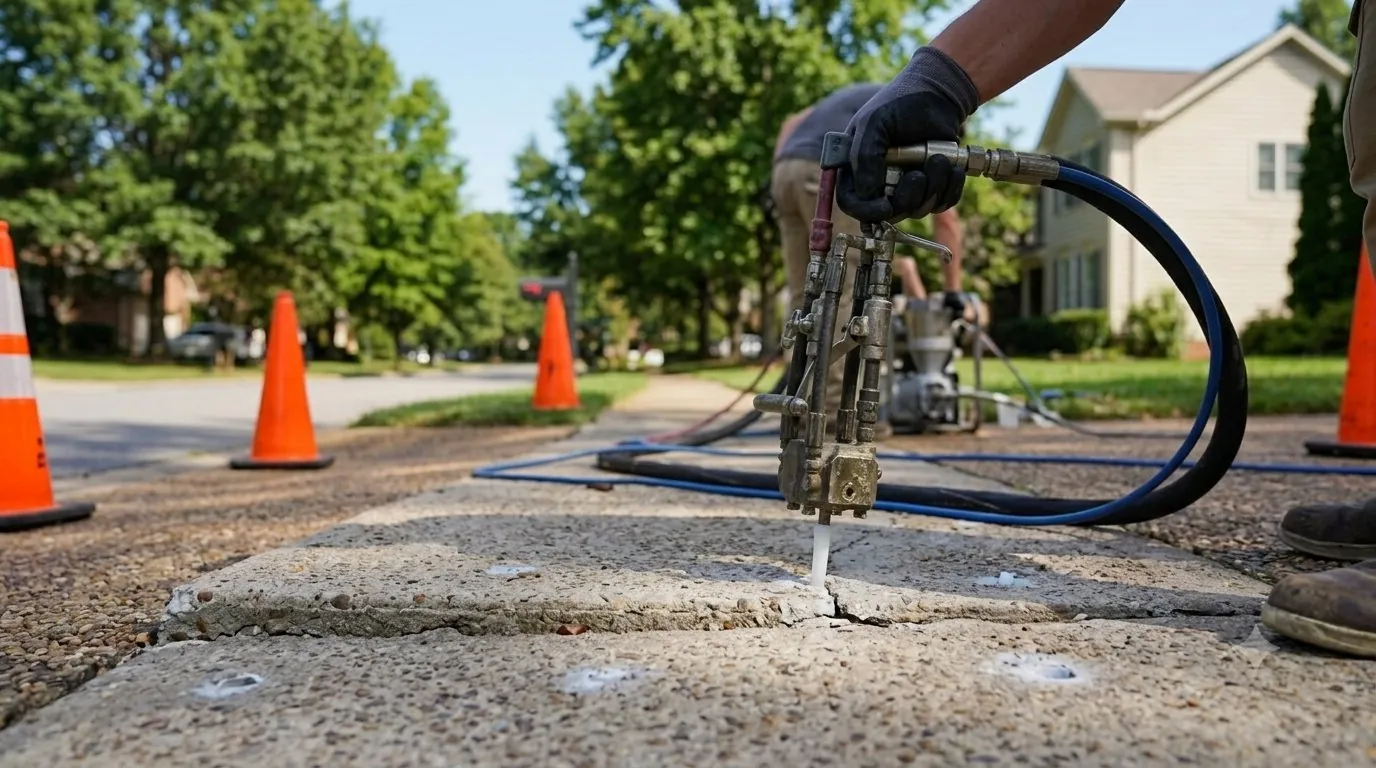
 Illustrative
Cracked & Sunken Sidewalk Leveling in Kansas City
PolyJacks fixes uneven sidewalk panels and trip hazards by injecting waterproof polyurethane foam through dime-sized holes, lifting sunken concrete back to level without any tear-out or replacement. Most sidewalk leveling jobs are finished in 2-4 hours, with the surface ready to use within hours. PolyJacks offers a free on-site estimate throughout the Kansas City metro, at a fraction of replacement cost.
The Half-Inch Rule: One Number That Triggers Violations, Claims, and Falls
Sidewalk inspection programs (from HOA boards to city public-works departments) commonly cite a half-inch vertical offset as the threshold that turns an uneven panel into an actionable trip hazard. That standard tracks the accessible-route guidelines that govern public walkways: a quarter-inch lip can still catch a wheelchair caster, a walker foot, or a stroller wheel. Those programs take their cue from the accessible-route rules in the 2010 ADA Standards for Accessible Design, Section 303 (Changes in Level), which allows a vertical change of up to 1/4 inch, requires a bevel no steeper than 1:2 between 1/4 and 1/2 inch, and treats anything over 1/2 inch as a ramp. At half an inch, a pedestrian who doesn't see the lip coming will catch a toe on it.
Once a sidewalk panel sinks or heaves enough to create that offset, it doesn't level itself. It stays exactly where the soil shifted it until someone lifts it, and in the meantime, it stays in the inspection cycle and on your liability exposure.
PolyJacks lifts the low panel back flush with waterproof polyurethane foam. No demolition, no curing week, no caution tape. Most sidewalk jobs run a few hours and are walkable within 30 minutes.
One number, two different jobs. Code thresholds say when a public walkway is out of compliance: over 1/4 inch it needs a bevel, over 1/2 inch it needs a fix. Our warranty trigger is a separate term for the slabs we lift: if a panel we leveled settles more than 1/2 inch within 5 years, we re-level it at no charge. A drop under that line that you want closed, whether for an inspection, an HOA notice or peace of mind, we re-level as quoted work. Either way, we measure it and tell you which it is. Full terms are on the warranty page.
Who Owns the Sidewalk? What KC Homeowners Get Wrong About Right-of-Way Liability
The sidewalk strip between the curb and your property line is often public right-of-way: technically city or county infrastructure. Many homeowners assume that means the municipality is responsible for upkeep. In most Kansas City metro municipalities, that assumption is wrong.
Local ordinances in Johnson County cities and Jackson County cities routinely assign sidewalk maintenance to the adjacent property owner, not the city. The right-of-way designation controls what you can build there, not who maintains what's already there. If the concrete panel in front of your house trips a mail carrier, a neighbor's child, or a delivery driver, the claim lands with you, and your homeowner's insurance.
Leveling the panel is the slab repair that closes that exposure. It removes the physical offset that trip-and-fall claims get built around.
For who is most at risk from that offset and how fast it can be fixed, see the real dangers of an uneven concrete trip hazard.
Why KC Sidewalk Panels Keep Sinking: Clay, Rain, and Freeze-Thaw
Much of the Kansas City metro sits on heavy, expansive clay soils. That clay expands when it absorbs moisture and contracts when it dries. Kansas City gets roughly 40 inches of annual rainfall, arriving in heavy spring bursts and tapering off in late summer, so the soil under every sidewalk panel in the metro cycles through swelling and shrinking year after year.
Winters compound it. Dozens of freeze-thaw transitions in a typical KC winter push water into every micro-crack, expand it by about 9% when it freezes, and leave a small void when it thaws. Repeat that process through a single winter and the soil under a concrete panel shifts substantially.
Unlike a house foundation, a sidewalk slab has no deep footings. It rests directly on whatever grade was prepared when the neighborhood was developed. When the soil beneath it moves, the slab moves with it. The most common culprits: clay-void formation under the panel, fill dirt that was never properly compacted, and downspouts or grade directing water toward the slab edge.
Cracked or Sunken Sidewalk? How to Tell What Foam Can Fix
A cracked sidewalk and a sunken sidewalk aren't the same problem, and the difference decides whether leveling is the right fix. A sunken panel has dropped as a whole because the soil under it gave way. That lip between panels is exactly what foam corrects, lifting the low slab back flush. A crack, on the other hand, is a symptom, and what caused it decides the fix.
Here's the honest read on a cracked sidewalk for a Kansas City homeowner. If a sidewalk panel has cracked because it settled unevenly (one half riding lower than the other) leveling the panel back to a single plane takes the stress off it and keeps the crack from working wider. If a panel has cracked clean through into separate pieces, foam can't knit broken concrete back together, and that panel needs replacing instead. We tell you which one you're looking at during the free estimate.
Hairline cracks that aren't tied to any height change are cosmetic. They just need a sealant to keep water out, which you can handle yourself. We don't sell standalone crack filling or resurfacing; our job is lifting settled slabs. But when a crack in a sidewalk comes with a trip-hazard lip between panels (the classic cracked sidewalk that's also a fall risk), that's exactly the case foam was made for.
Not sure which side of the line your panel falls on? These signs you need concrete leveling, not replacement walk through the difference.
HOA Violation Notices: What the Notice Means and What Fixes It
HOA inspection programs typically flag raised or sunken sidewalk panels using language that references trip hazards, accessible-route conditions, or a specific vertical offset measurement. A 30-day remediation window is common before re-inspection.
The fix the notice is looking for is the same thing foam leveling delivers: eliminating the offset. Tearing out and repouring a concrete panel can meet that standard, but it takes a week of cure time and a significant portion of your remediation window just for the concrete to set. Foam lifts the panel and is walkable within 30 minutes.
We schedule around re-inspection deadlines. If you have a notice with a specific date, let us know when you call and we'll work backward from it. We also handle common-area sidewalks for HOA boards directly. One inspection visit covering every flagged panel on the property, single quote for the full scope.
HOA board or property manager? Call (913) 713-7794 and ask for a common-area walkthrough. We schedule around resident foot traffic and work section by section if closing an entire walkway isn't practical.
Real KC Job: Overland Park Sidewalk Leveled for a Fraction of the Replacement Quote
A homeowner on 143rd Street in Overland Park came to us after getting a steep replacement quote to tear out and repour the sunken sidewalk panels in front of their home. The panels had dropped enough to create a visible offset. The kind that gets flagged on a city inspection.
We leveled the panels in a single visit for a small fraction of that quote. The concrete was walkable the same afternoon.
That's the kind of gap polyurethane foam leveling produces versus replacement: the material and method are different, but the result (level concrete, no trip hazard) is the same. The price difference is not a cut corner. Foam lifts a structurally sound slab; it doesn't try to replicate a new pour.
How We Level a Sunken Sidewalk Panel
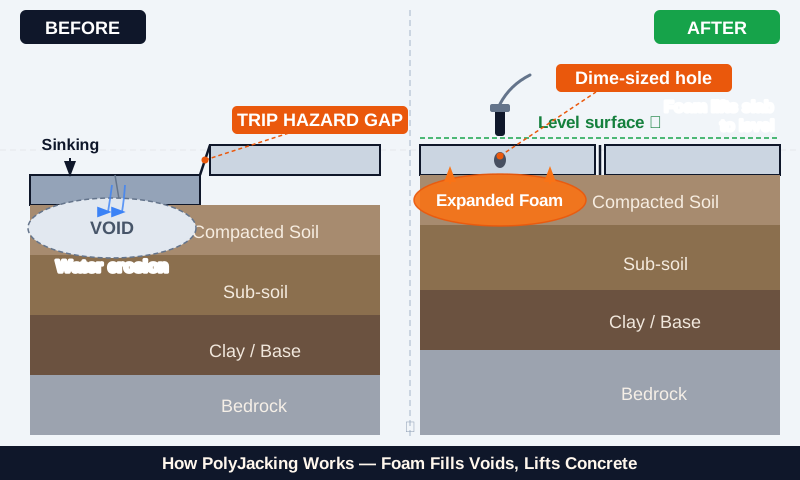
We drill a series of dime-sized holes straight through the low panel. Typically 4 to 12 holes depending on the slab's square footage and how far it has settled. Through those holes, high-density polyurethane foam gets injected beneath the slab, where it expands 30 to 40 times its liquid volume, fills the void, and lifts the concrete back to level from below.
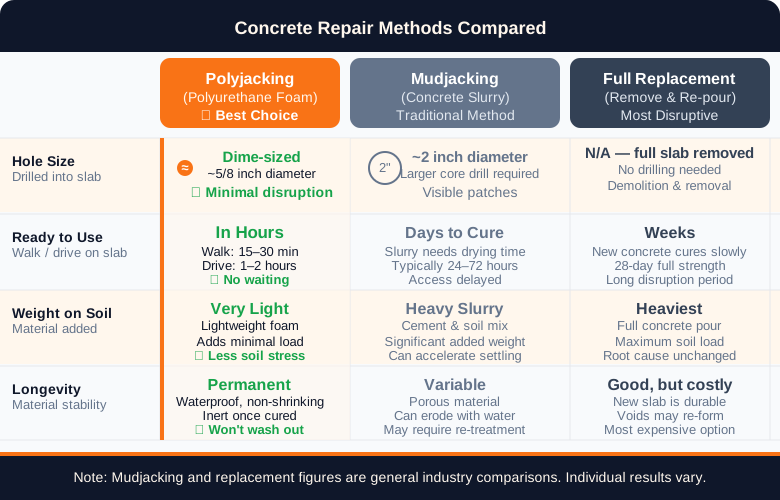
The foam is waterproof and chemically inert once it cures. It won't wash out, compress further under normal foot traffic, or degrade from soil moisture. Curing takes minutes. You can walk on it in 15 to 30 minutes.
Most sidewalk jobs run from setup to cleanup in 2–4 hours. The injection holes are small and patched after the lift. Nothing close to the demolition footprint of a replacement job. Vehicle traffic on any adjoining section. A driveway apron next to the walk, for example: is fine within 1 to 2 hours. We ask that heavy vehicles stay off for 48 hours while the soil re-settles around the foam.
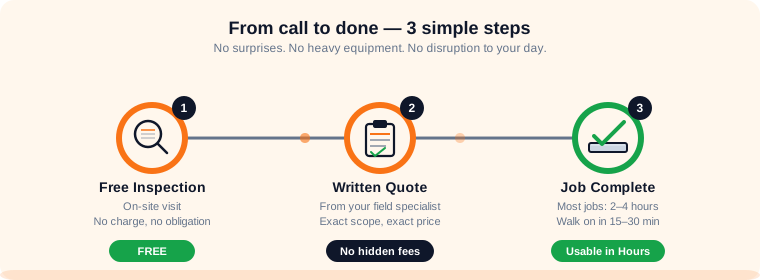
On-site visit. No charge, no obligation.
FREEFrom your field specialist. Exact scope, exact price.
NO HIDDEN FEESMost jobs: 2–4 hours. Walk on it in 15–30 minutes.
USABLE IN HOURSWe lift your slab from underneath. In hours, not days
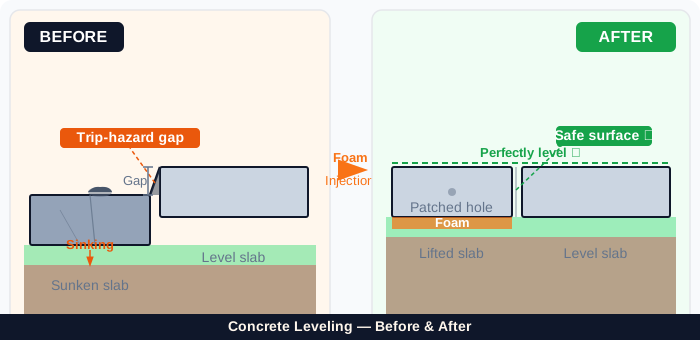
A dime-sized hole. Waterproof foam. Your concrete rises back to level.
- 1. Drill dime-sized holes
- 2. Inject expanding foam
- 3. Slab lifts back to level
Level. Done. In Hours.
2–4 HOURS · WALK ON IT IN 30 MIN · WATERPROOF FOAM
The foam is lightweight. It re-supports your slab without overloading the soil, and it’s waterproof, so it won’t wash out like mudjacking.
Sidewalk vs. Driveway: Why Sidewalk Panels Are Often the Most Straightforward Lift
Driveways and garage floors carry heavier load requirements, more surface area, and sometimes more complex void geometry. Sidewalk panels are smaller, carry pedestrian loads, and usually have simpler void patterns, which is part of why sidewalk panels are typically the quickest surfaces we level.
Driveway leveling covers far more area than a sidewalk panel. A sunken sidewalk panel is almost always the smaller and faster fix of the two.
The process is the same (foam through dime-sized holes) but the scale difference matters when you're working against a remediation deadline or trying to get an accessible route cleared for a resident who relies on it. Sidewalk jobs rarely exceed a single-day window.
What the Warranty Covers and What We Need from You
Every sidewalk lift comes with a 5-year limited warranty on workmanship and materials. If a panel we leveled settles more than 1/2 inch within 5 years due to our foam work, we come back and re-lift it at no charge. It is written to the owner who paid for the work, at that address, for the full five years, and it ends if the property is sold. The half inch is the warranty trigger; the code thresholds in the first section decide when a public walk is out of compliance, and a smaller lip you want closed is re-levelled as quoted work.
What the warranty does not cover: drainage or grading issues that develop after the lift, downspouts that weren't addressed, plumbing or irrigation leaks, tree root activity, loads beyond normal residential use, work by others that disturbs the panel, or acts of God.
The customer duties that keep the warranty intact: keep gutters clean and running, extend downspouts at least 5 feet from the walk, maintain positive grade away from the slab edge, keep sprinklers off the panel edge, fix any leak promptly, keep joints and cracks in the repaired panel sealed, and complete any drainage correction we recommend in writing within 60 days. Those steps address the water management that opened the void in the first place.
When We Tell You the Panel Needs Replacement Instead
Foam leveling works on a structurally sound slab that has settled. It is not the right fix for every situation, and we say so.
Slab cracked through and broken apart. Foam can lift a solid panel; it cannot hold fractured concrete together. A panel in pieces needs to be replaced, not lifted. We'll tell you on the estimate if that's what you have.
Active plumbing leak under the walk. A leaking supply line or sewer lateral can wash out soil faster than foam can fill it. The source needs to be fixed first; then we can lift afterward if settlement has occurred.
Tree root heaving. If an active root is physically pushing a panel up from below, the root situation has to be resolved before lifting will hold.
We would rather tell you straight during the free estimate than inject foam under a panel that won't stay level.
Get a Free On-Site Estimate: We'll Walk the Full Property
Every job starts with a free inspection. We walk the sidewalk, or the entire common area if you're an HOA board or property manager: identify every sunken or heaved panel, and give you a firm quote before any drilling begins.
We cover the entire KC metro: Johnson, Wyandotte, Jackson, Clay, and Platte counties, roughly 35 suburbs within 50 miles of Spring Hill. Licensed and insured.
Call or text (913) 713-7794 or book online. If you have an HOA re-inspection deadline or a city remediation notice, tell us the date and we'll schedule around it.
What the work actually looks like
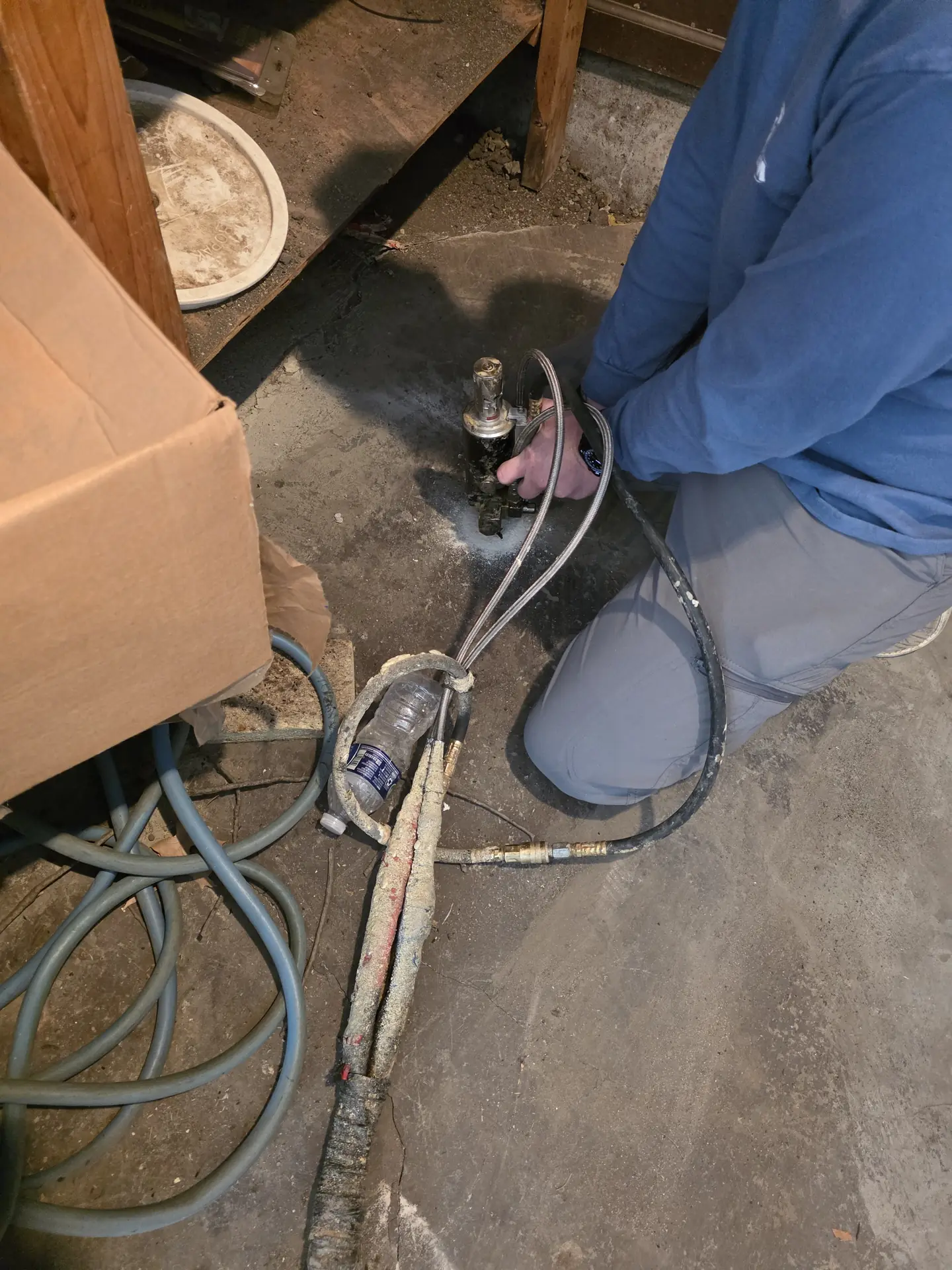
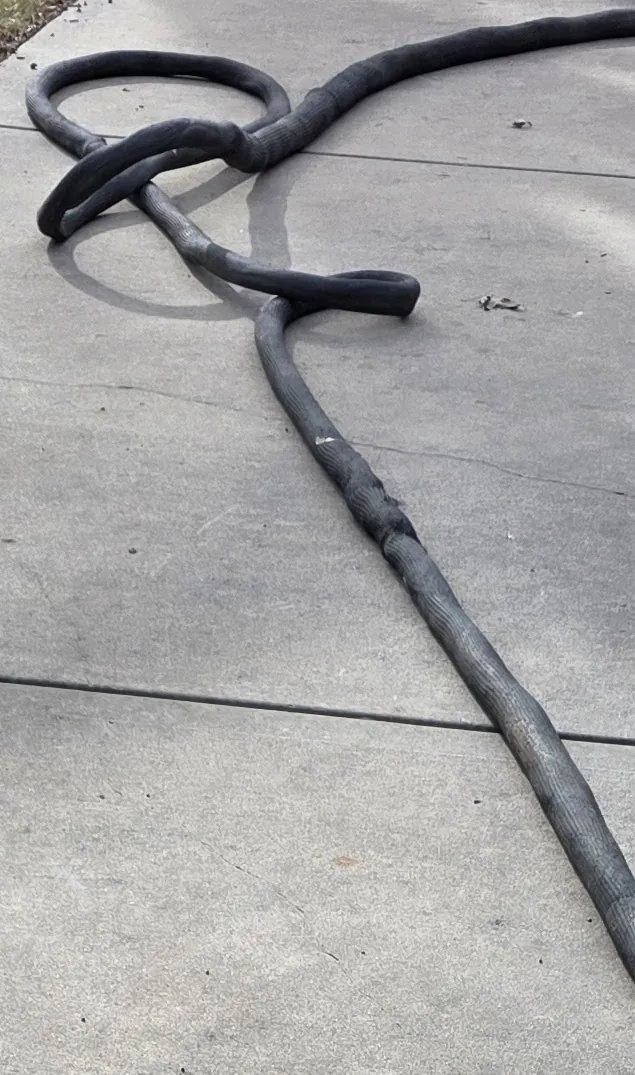
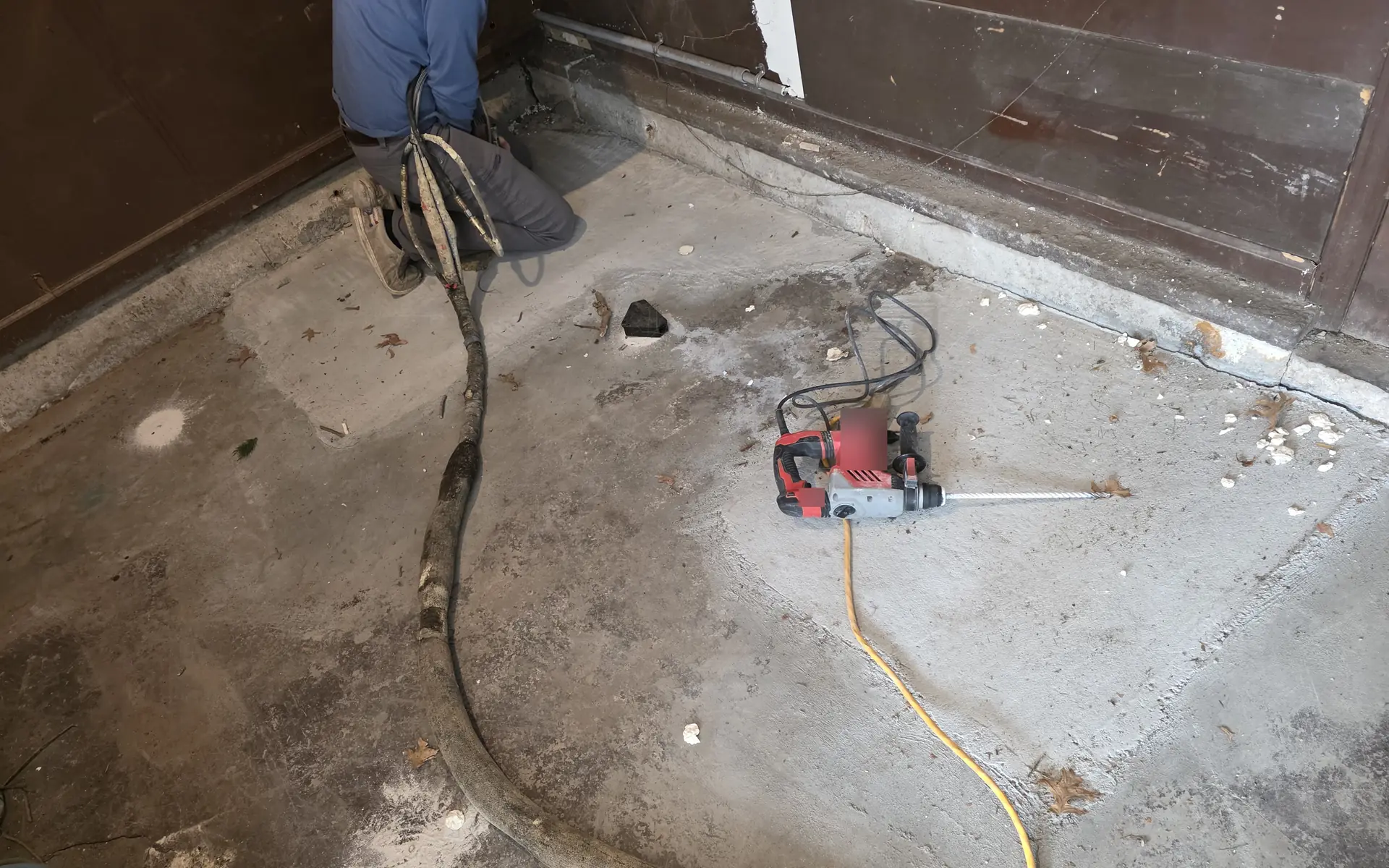
How polyjacking works in 90 seconds
Our team walks you through the three-step process: dime-sized holes, high-density polyurethane foam that fills every void and compresses the soil beneath your slab, and use within hours with no heavy trucks. Call (913) 713-7794 or book a free estimate below.
Frequently asked
Will leveling the panel satisfy my HOA violation notice or a city trip-hazard inspection?
Leveling removes the vertical offset the notice is referencing. That's the physical condition the inspector or HOA board flagged. Whether a specific notice is officially cleared depends on your HOA or municipality, but eliminating the trip lip is exactly the remediation they're asking for. We'll schedule around a re-inspection date if you give us the deadline when you book.
How much does sidewalk leveling cost in Kansas City?
What a sidewalk leveling job costs in the KC metro depends on how many panels need injection and how much void exists under each one. A recent Overland Park job (multiple panels on 143rd Street) came in at a small fraction of the replacement quote the homeowner had received. We don't quote without seeing the walk first. The estimate is free and firm before anything is drilled.
The sidewalk is in the right-of-way between the curb and my property line: am I actually responsible for it?
In most KC metro municipalities, yes. Right-of-way designation governs what you can build on that strip, not who maintains the concrete that's already there. Johnson County and Jackson County cities typically assign sidewalk maintenance to the adjacent property owner. If someone trips on the panel in front of your house, the liability generally falls to the homeowner, not the municipality. Check your local ordinance, but this is the rule more often than the exception in this metro.
How long until the sidewalk is safe to walk on after the lift?
Fifteen to thirty minutes. The foam cures fast. A panel leveled in the morning is back in full pedestrian service by mid-morning. Vehicle traffic on an adjacent section is fine in 1 to 2 hours. The only restriction is no heavy vehicles (delivery trucks, construction equipment) on the lifted panel itself for 48 hours while the soil re-settles around the foam.
One sidewalk panel is cracked through, not just sunken. Can you still fix it?
If the panel is cracked through and broken into pieces, foam won't hold it. A cracked-through panel needs to be replaced. If the panel has surface cracks but is still structurally in one piece, we can often lift it. We assess on the estimate. Every other panel in the run that's just sunken or offset. We'll level those the same visit.
Do you handle HOA common-area sidewalks and multi-property jobs?
Yes. One inspection covers every sunken or heaved panel along shared walkways in the common area, and we produce a single quote for the full scope. We work with HOA boards and property managers directly and can schedule around resident foot traffic, working section by section if closing an entire walkway at once isn't practical.
Get your free concrete leveling estimate
No obligation, and if foam isn't the right fix, we'll tell you straight.
Pick a time that works for you
Book right here on this page. Prefer to talk? Call (913) 713-7794.