
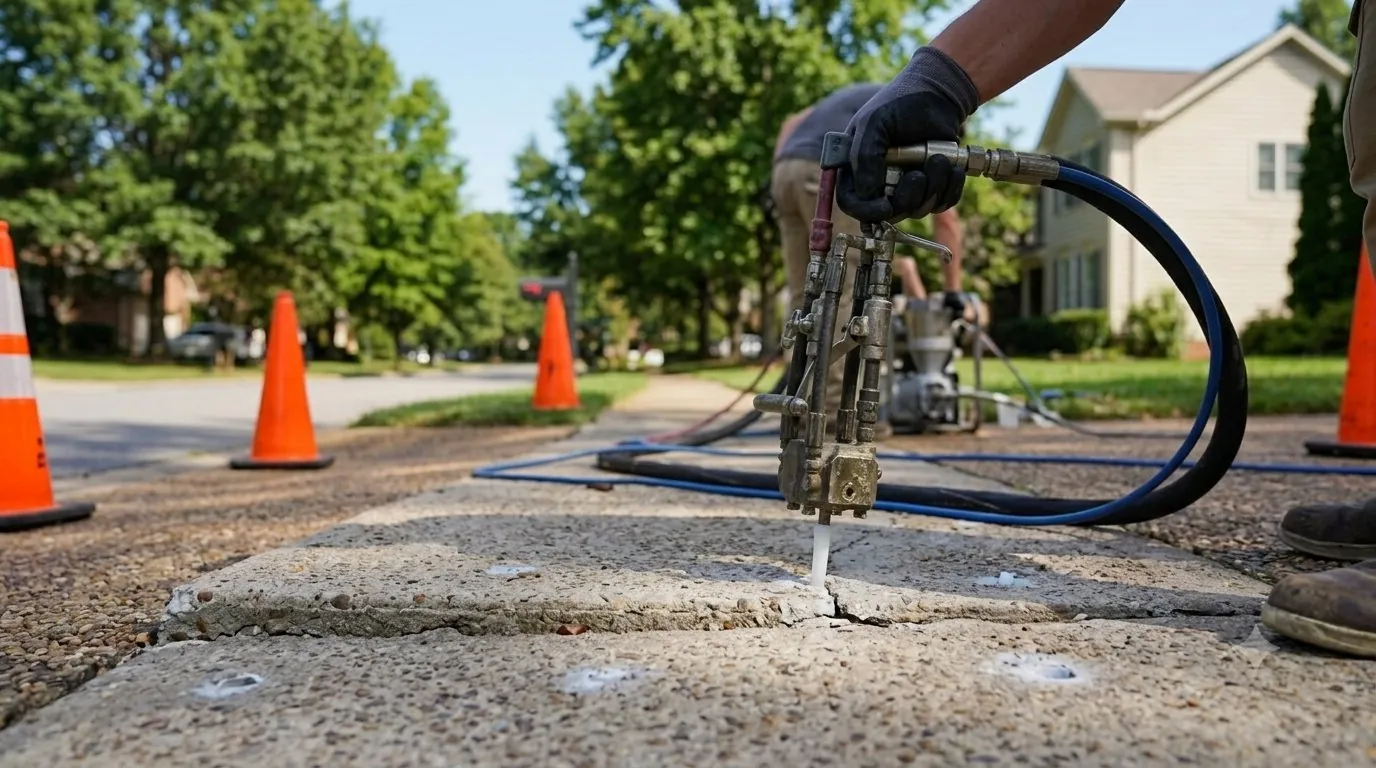
 Illustrative
An uneven sidewalk is usually caused by the soil beneath it moving — tree roots, settling from poor compaction, or Kansas City clay soil swelling and shrinking through freeze-thaw cycles. The rigid panels can’t flex, so they tip or drop at the joints. PolyJacks lifts sunken panels back to level with foam, ending the trip hazard without replacement.
A Common Problem on Almost Every KC Block
Walk down nearly any sidewalk in the Kansas City metro and you'll find at least one slab that doesn't sit flush with its neighbors - a lip, a dip, a corner poking up. It's one of the most common concrete problems we see, and it happens for a handful of specific, explainable reasons rather than random bad luck.
Sidewalks are poured in individual slabs separated by control joints, so each section can move independently of the ones next to it. When the soil under just one slab shifts - from a tree root, a drainage issue, or ordinary soil settling - that slab tips or sinks while its neighbors stay put, and you end up with the uneven, tripping-hazard sidewalk so many KC homeowners deal with. An isolated slab is usually a straightforward repair, not a full replacement.
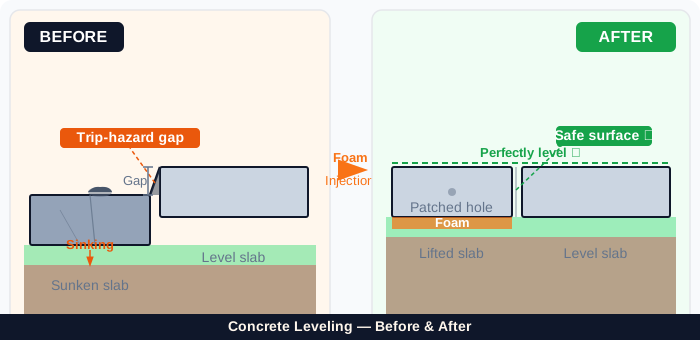
If you are still trying to figure out what you are looking at, the signs of uneven concrete page walks through the visual cues that separate a settling slab from a heaved one.
Tree Roots vs. Soil Settling
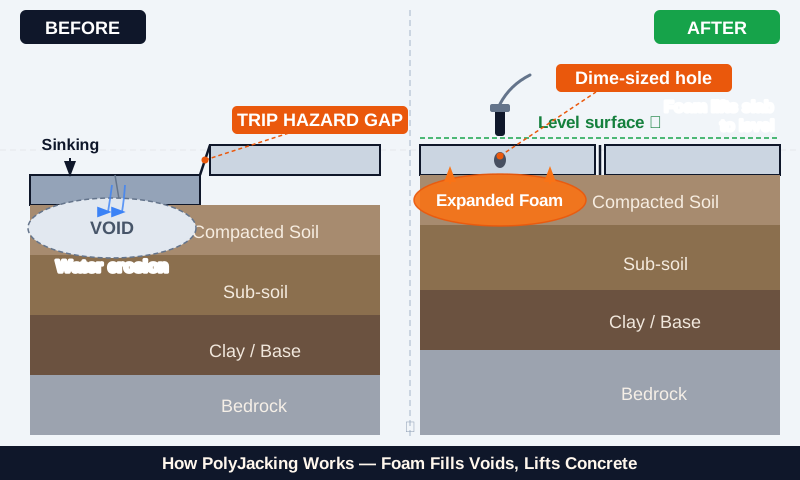
There are really two opposite culprits behind an uneven sidewalk, and they call for different fixes. Roots from mature trees - common throughout established KC neighborhoods - grow under a slab and physically push it upward from below, which is heaving rather than settling. You'll see a slab higher than the ones around it, sometimes cracked from the pressure.
Soil settling does the opposite: the ground under a slab compacts, erodes, or washes away, and the slab sinks below its neighbors instead of rising above them. Both create the same tripping hazard, but a heaved slab pushed up by a root needs a different conversation than one that's sunk into a void. A technician can tell the difference on sight during a free estimate.
KC Clay Soil and the Freeze-Thaw Cycle
Underneath most Kansas City sidewalks is expansive clay soil, which swells when it soaks up water and shrinks as it dries back out. That cycle repeats every time it rains and then doesn't for a while, and over enough seasons it reworks the soil under a slab unevenly - one section settles a little more than the one beside it.
Winter adds another layer: freeze-thaw swings cause the same soil to expand and contract even faster, opening small voids that widen over time. None of this means anything was done wrong when the sidewalk was poured - it's just how clay-heavy soil behaves here, which is why sidewalk settling shows up as a slow, gradual problem rather than all at once.
If the lip first showed up in late February or March, it may be the latest freeze-thaw cycle. Before scheduling a repair, watch the joint through the next wet-dry stretch, spring through summer. If the gap is the same or smaller by August, the movement was seasonal. If it's wider, the soil loss is progressive and the slab will keep dropping until it's addressed.
For a broader look at how clay content and freeze-thaw exposure affect settlement rates across the metro, see the KC Concrete Settlement Risk Index.
The three most common drainage culprits under KC sidewalks are a downspout or gutter discharge point directing water onto or beside the slab, a failed or clogged French drain or catch basin from the original construction, and regraded soil from adjacent new construction that redirects surface water under the slab.
Drainage is only part of it: what causes voids under a concrete slab covers how those small voids open up, and how KC freeze-thaw damages concrete covers the winter side.
Why an Uneven Sidewalk Is More Than Cosmetic
A sunken or heaved slab isn't just an eyesore - it's a genuine trip hazard for anyone walking the property, including kids, older guests, and delivery drivers who aren't watching for a lip in the concrete. On a public-facing sidewalk, that liability often falls on the property owner even when the underlying cause is soil movement outside anyone's control.
It's also a problem that tends to get worse, not better, left alone. A small height difference this year can become a larger one after another wet spring and dry summer, especially if the same drainage issue keeps feeding water under the slab. Addressing it while it's still a minor lip is usually a smaller job than waiting until it's a genuine hazard.
A quick test: lay a straightedge across the joint and measure the gap at the low side. Under 1/4 inch is cosmetic. At 1/4 inch or more, you're at the threshold the ADA uses for a trip hazard, and it's the level where a fall becomes a realistic liability risk.
Once the gap crosses that 1/4-inch threshold, sidewalk trip-hazard repair is the fix that closes the lip without tearing out and repouring the slab.
If you're preparing to sell, how uneven concrete affects home value covers how an inspector's trip-hazard note can come up in a sale.
Who Is Responsible for the Sidewalk in Front of Your House
In most KC metro municipalities, the homeowner is responsible for the sidewalk fronting their lot. If the city issues a repair notice, it will state a deadline that varies by municipality, so it's worth reading the letter carefully rather than assuming a fixed window. The notice process, what it means for your timeline, and what happens if you don't respond are all covered in what to do when you get a sidewalk repair notice in Kansas City.
How Concrete Leveling Repairs a Sunken Slab
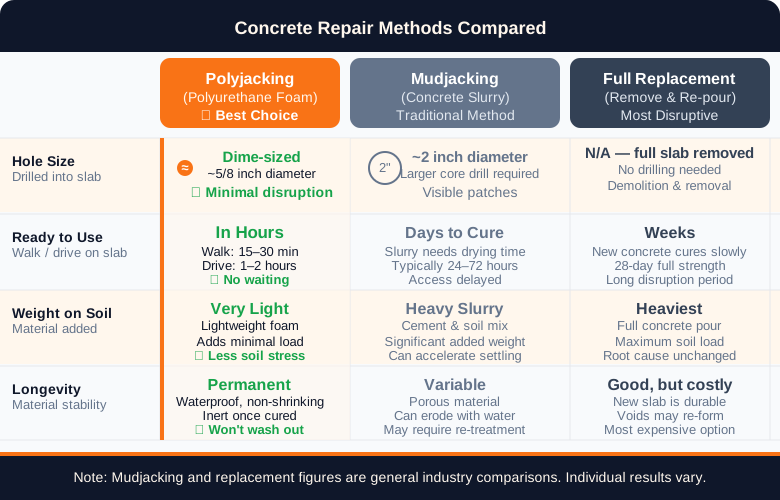
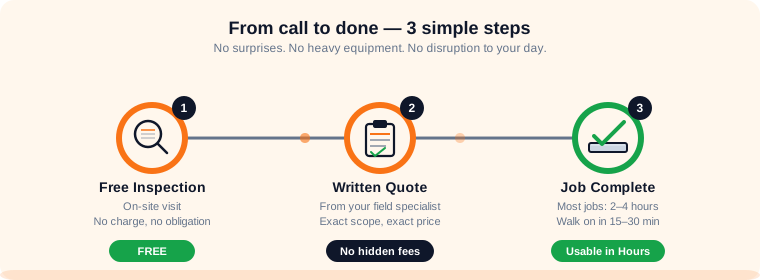
For sidewalks, concrete leveling means drilling a few small, dime-sized holes into the sunken slab and injecting expanding polyurethane foam underneath it. The foam fills the void left by lost soil and lifts the slab back to meet its neighbors, closing the trip-hazard lip without tearing out and repouring concrete.
This is the same polyjacking approach used on driveways and patios, scaled to a sidewalk's narrower slabs. Because the foam is waterproof and lightweight, it won't wash out the way mudjacking's heavier slurry can, and it won't overload soil that's already struggling to support the slab. Most sidewalks are ready for foot traffic 15-30 minutes after the foam is injected.
When a Slab Needs Replacement Instead
Foam leveling works when the slab itself is still sound and the problem is what's underneath it. If a slab is severely cracked, crumbling, or broken into pieces that move independently, lifting it won't hold - it needs to be replaced rather than raised, and we'll say so plainly rather than push a repair that won't last.
The same goes for slabs actively being pushed apart by an aggressive root system with no sign of stopping; in some of those cases, addressing the root is part of a lasting fix. An honest look during the free estimate is the fastest way to know which category your sidewalk falls into before any work starts.
Not sure whether the cracking you see is serious? Our guide on when cracks in concrete are worth worrying about can help you judge.
Getting a Free Estimate
Call (913) 713-7794 or use the contact form to schedule a free, no-obligation estimate. If you're not sure whether your sidewalk's problem is settling or a bigger structural issue, our Diagnose tool is a good place to start, or take a look at the rest of our services.
PolyJacks is a locally owned concrete leveling crew based in Spring Hill, KS, serving sidewalks, driveways, and walkways across the whole Kansas City metro on both sides of the state line. A technician will walk your sidewalk, check for hollow spots, and give you a straight answer on whether leveling makes sense. Before the technician arrives, take a photo of the lip from the side and note whether it's gotten worse since last season—it helps us compare and gives you a record if you need it for insurance or a city notice.
How polyjacking works in 90 seconds
Our team walks you through the three-step process: dime-sized holes, high-density polyurethane foam that fills every void and compresses the soil beneath your slab, and use within hours with no heavy trucks. Call (913) 713-7794 or book a free estimate below.
Frequently asked
Can I fix an uneven sidewalk slab without replacing it?
In most cases, yes. If the slab itself is intact and the problem is soil settling underneath it, concrete leveling lifts it back into place without replacement.
Are tree roots always the cause of a raised sidewalk slab?
No. Roots cause heaving (the slab pushes up), while soil settling causes sinking (the slab drops). Both are common in KC and look different up close.
Is an uneven sidewalk really a liability issue?
It can be. A trip-and-fall on a sunken or heaved slab is a real hazard, and property owners are often responsible for the public-facing sidewalk along their lot.
How quickly can a sidewalk be releveled?
Most single-slab sidewalk repairs are done in under an hour, with the foam cured and the walkway ready for foot traffic in 15-30 minutes.
Does PolyJacks work on sidewalks outside Spring Hill?
Yes. We serve the entire Kansas City metro, both the Kansas and Missouri sides. Call (913) 713-7794 to confirm service at your address.
How do you fix an uneven sidewalk?
It depends on which way the slab moved. If it sank because soil settled or washed out underneath, we drill dime-sized holes and polyurethane foam lifts it back flush with its neighbors. If an aggressive root system is still pushing the slab up, addressing the root may be part of a lasting fix. If the slab is broken into pieces, it needs replacing rather than raising.
Why is one slab of my sidewalk slanted?
Sidewalks are poured as separate slabs divided by control joints, so each one can move on its own. When the soil under a single slab shifts, from a tree root pushing one edge up or from settling and washout letting one edge drop, that slab tips while its neighbors stay put. A technician can tell which it is on sight during a free estimate.
How much of a height difference makes a sidewalk a trip hazard?
The clearest yardstick is Section 303 of the 2010 ADA Standards for Accessible Design, posted on ada.gov. On an accessible route, a lip of 1/4 inch or less may stay vertical. Between 1/4 and 1/2 inch, the edge has to be beveled no steeper than 1:2. Past 1/2 inch, the change has to be handled as a ramp. Those rules cover accessible routes, not every private driveway or backyard walk, but they are a sensible line to measure the lip in front of your house against.
Have a sinking slab?
Book a free on-site inspection. Honest advice, usable within hours.
Pick a time that works for you
Book right here on this page. Prefer to talk? Call (913) 713-7794.