
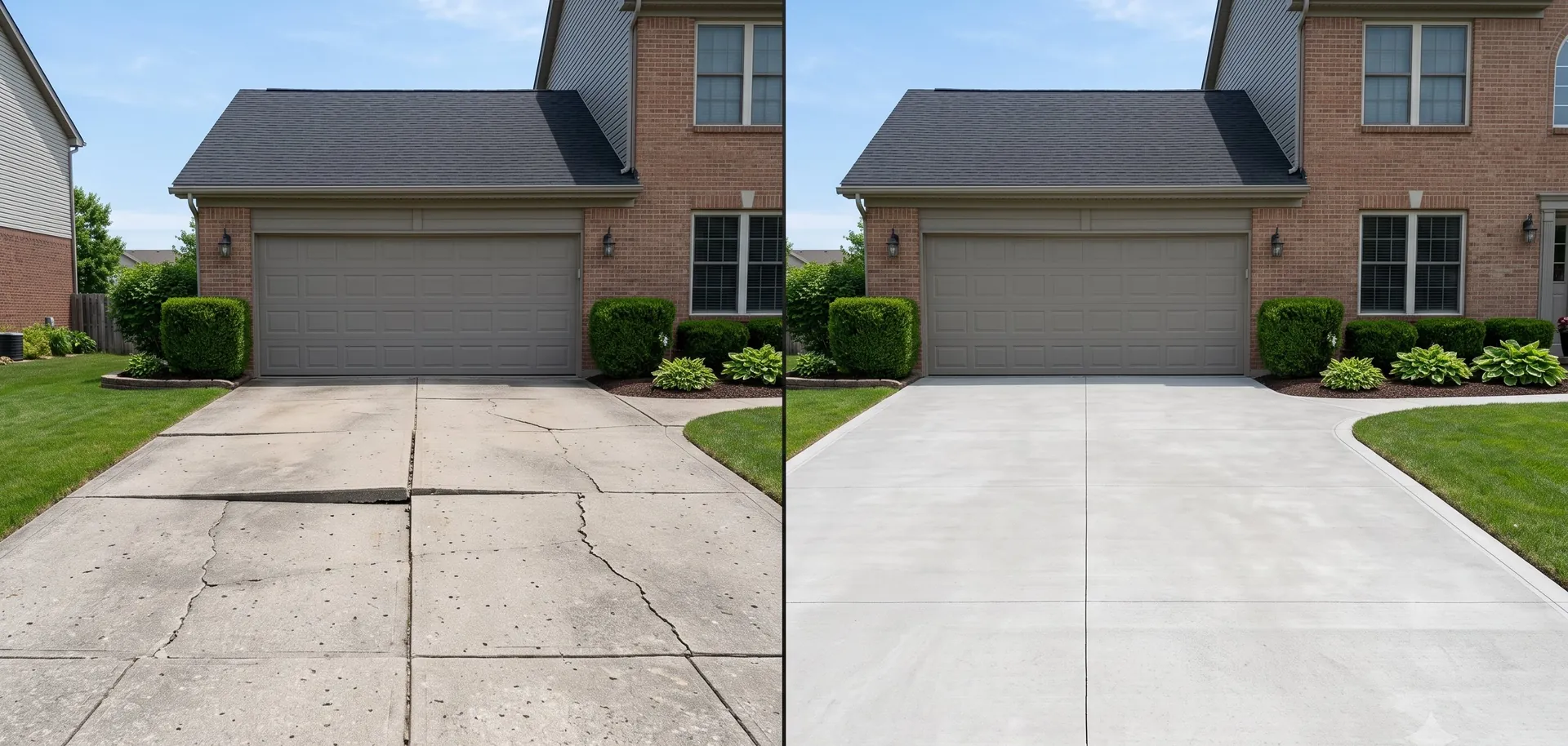
 Illustrative
Sinking or Rising? Telling Settling Apart From Heaving
Settling is a slab sinking as soil compresses or washes out beneath it; heaving is a slab pushed upward, often by expanding clay or frost. They look similar but have opposite causes. Foam leveling lifts settled slabs, while heaving needs the moisture or soil issue addressed first. A free estimate tells which you have.
Two Opposite Problems, Same Kansas City Soil
Settling and heaving look like opposite problems because they are - one is concrete sinking down, the other is concrete pushing up - but they usually come from the exact same source: Kansas City's expansive clay soil. That soil swells when it absorbs water and shrinks when it dries out, and depending on the season, the drainage nearby, and what's happening under a specific slab, that same soil can cause either problem on the same property, sometimes within the same year.
Knowing which one you're actually dealing with matters, because while both call for a professional look, they point to different underlying conditions. A slab that's sinking has lost support underneath it. A slab that's being pushed up has something adding force from below. Telling them apart is the first step toward the right fix.
What Settling Looks Like
Settling is the more common of the two, and the signs are fairly consistent:
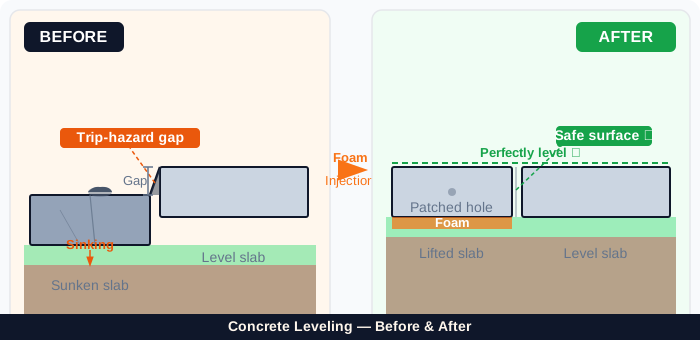
- A slab or section that sits noticeably lower than the ones around it
- A gap opening up at an expansion joint or where the slab meets a wall or step
- A slope that wasn't there before, sometimes pooling water after rain
- Cracks starting at a corner and running toward the middle, often widening
Settling happens because the soil under the slab has compacted, eroded, or been washed out by water, leaving a void the slab eventually sinks into. It's the same mechanism behind most driveway, patio, and walkway problems we see across the metro, and it's what concrete leveling is specifically built to correct.
What Heaving Looks Like
Heaving is less common but not rare in this region, and it looks like the opposite of settling: a slab or section pushed noticeably upward, sometimes cracked from the pressure, sitting higher than the concrete next to it rather than lower. It often shows up seasonally - worse after a wet spring, easing somewhat by late summer, though the exact timing varies with local drainage and how much water the specific slab receives - because it's usually driven by expansive clay swelling as it absorbs water and physically lifting whatever's on top of it.
Tree roots can cause a similar-looking bump, though that's a more localized, mechanical push rather than a broad soil movement. Either way, a heaved slab typically signals something below is expanding or growing, rather than a slab that's lost support the way a settled slab has.
If you notice a slab rising, here is what to do before a technician gets there. Do not try to jack or pry the slab back down. Forcing a heaved slab can crack it at the joint or break it along its length, and a slab that has already cracked badly from the pressure is a replacement situation, not a force-it-back-down situation. Check for standing water pooling on the high side of the slab. If water is now draining toward your foundation or an adjacent lower slab, the heave is redirecting flow and accelerating settling elsewhere. Note the date and take a photo with a straight edge — a level, a ruler, a book — laid across the slab so you have a reference for how much it has moved by the time we get there.
Why KC Clay Causes Both, Sometimes on the Same Driveway
It's not unusual for one slab to heave slightly in a wet spring and settle again by late summer as the same clay dries and shrinks back down, sometimes settling a bit lower than where it started because the cycle isn't perfectly symmetrical. Over several years of that seasonal swing, plus normal soil erosion and drainage issues, a driveway can end up with one section that's heaved and another, just a few feet away, that's settled.
This is why guessing from memory or a single visit isn't always reliable - what looks like settling in October might have looked like heaving back in April. A proper read usually means looking at the current condition of the slab itself rather than trying to reconstruct its history.
A major driver of both problems is water management. Downspouts that discharge close to a slab, grading that slopes toward the slab rather than away from it, and missing or clogged French drains all feed water into the clay. In a wet spring, that water swells the clay and pushes the slab up. In a dry summer, the clay shrinks and leaves a void the slab settles into. The same drainage problem causes both. Fixing the drainage — extending downspouts, regrading, or adding a drain — addresses the cause rather than the symptom, and is often the right first step before any slab repair.
Does the Repair Differ?
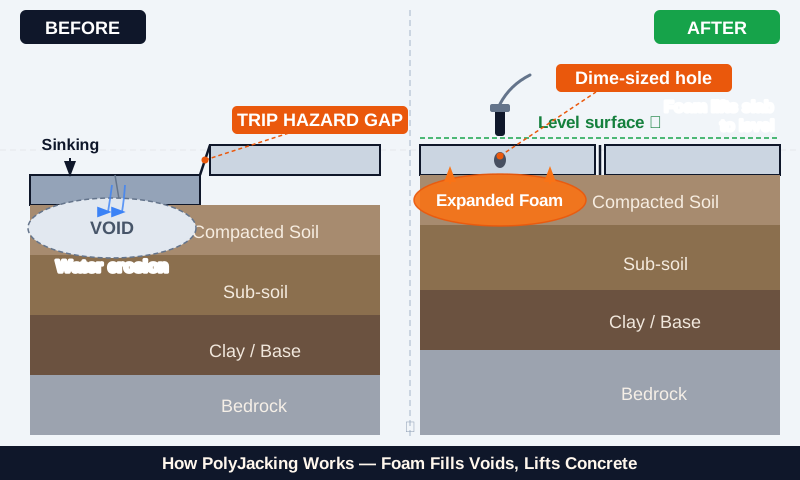
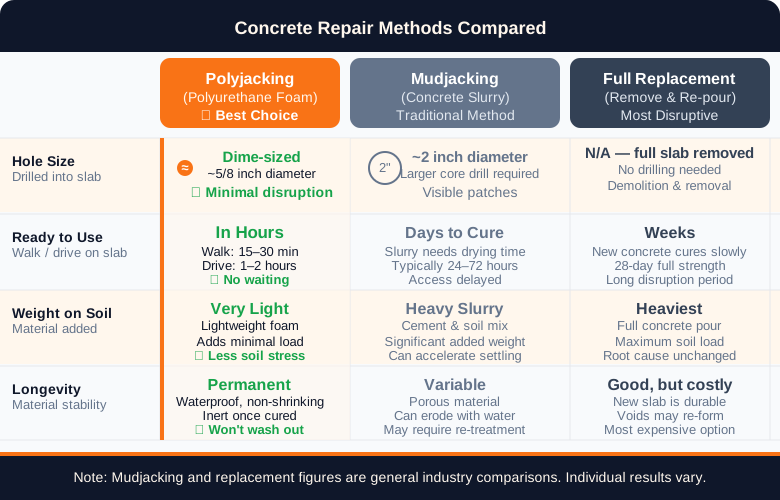
For settling, the fix is straightforward: polyjacking repair fills the void under the slab with waterproof polyurethane foam and lifts the slab back to level as the foam expands. That's the core of what concrete leveling does, and it's a single-visit repair in most cases.
Heaving is more case-by-case. Sometimes the right move is void filling to stabilize the soil and reduce further movement; sometimes it's addressing a drainage issue feeding the clay's swelling in the first place; and occasionally, if a slab has heaved and cracked badly enough, replacement is the more honest answer than trying to force it back down. We won't pretend foam is a universal fix for a problem that's pushing up rather than pulling down - we'll tell you which situation you're in.
Left unaddressed, a heaved slab does not just stay high. The repeated seasonal push-and-pull fatigues the concrete, and the slab will eventually crack at the joint or along its length. The high edge becomes a trip hazard. And because the slab is now directing water toward the lower adjacent slab or toward your foundation, it accelerates the settling problem on the other side. Heaving that is caught early is usually a drainage fix and a minor lift; heaving left unaddressed until the slab has cracked badly often ends up as a replacement.
Why Diagnosis Comes Before Any Repair

Because settling and heaving can look similar at a glance - both create uneven, uncomfortable concrete - and because KC clay can produce either one depending on the season and the spot, an accurate read of your specific slab matters more than a generic answer. Our Diagnose tool is a starting point for sorting out what you're likely looking at, but a technician walking the actual slab during a free estimate is the real diagnosis. And if you're not certain the trouble is the slab at all rather than your home's foundation, our foundation-or-slab checklist helps you rule that in or out first.
That visit costs nothing and comes with a plain explanation of what's happening underneath your concrete and whether it's settling, heaving, or a mix of both across different sections of the same driveway or patio.
As a rough guide: if the slab is only slightly out of level and the crack is not widening, it is a monitor-and-photograph situation. Take a photo with a straight edge across the slab each season and compare. If it is noticeably out of level, or the crack is widening season to season, or water is pooling on the slab, it is time for a professional look. If the slab has cracked and the pieces are moving independently, that is urgent — the slab is no longer acting as a single unit and the trip hazard is real.
Get a Free, Honest Assessment
PolyJacks is a locally owned concrete leveling company based in Spring Hill, KS, serving the entire Kansas City metro on both the Kansas and Missouri sides. Whether your slab is sinking, rising, or doing a bit of both depending on where you look, we'll give you a straight answer about what's causing it and whether concrete leveling is the right fix.
Call (913) 713-7794 or reach out through our contact page to schedule a free estimate, or browse our full services to see how we handle driveways, patios, walkways, and more across the region.
How polyjacking works in 90 seconds
Our team walks you through the three-step process: dime-sized holes, high-density polyurethane foam that fills every void and compresses the soil beneath your slab, and use within hours with no heavy trucks. Call (913) 713-7794 or book a free estimate below.
Frequently asked
Can the same driveway have both settling and heaving?
Yes. Different sections of the same slab can respond differently to the same seasonal clay movement, so it's possible to see a heaved spot and a settled spot just feet apart.
Is heaving more serious than settling?
Not necessarily - both can create trip hazards and cracking. Which one is more urgent depends on how far out of level the slab has gotten and what's causing the movement.
Will concrete leveling fix a heaved slab?
Sometimes, depending on the cause. If tree roots or void space are contributing, a technician can tell you during a free estimate whether foam injection or another approach fits your situation better.
How do I know if my slab is settling or heaving without an expert?
Compare it to slabs or sections around it - lower than its neighbors usually means settling, higher usually means heaving - but a technician's on-site look is the reliable way to confirm it.
Does PolyJacks handle both settling and heaving issues?
We evaluate both during a free estimate and recommend what actually fits your slab, being upfront if foam injection isn't the right match for a particular heaving situation.
Have a sinking slab?
Book a free on-site inspection. Honest advice, usable within hours.
Pick a time that works for you
Book right here on this page. Prefer to talk? Call (913) 713-7794.