
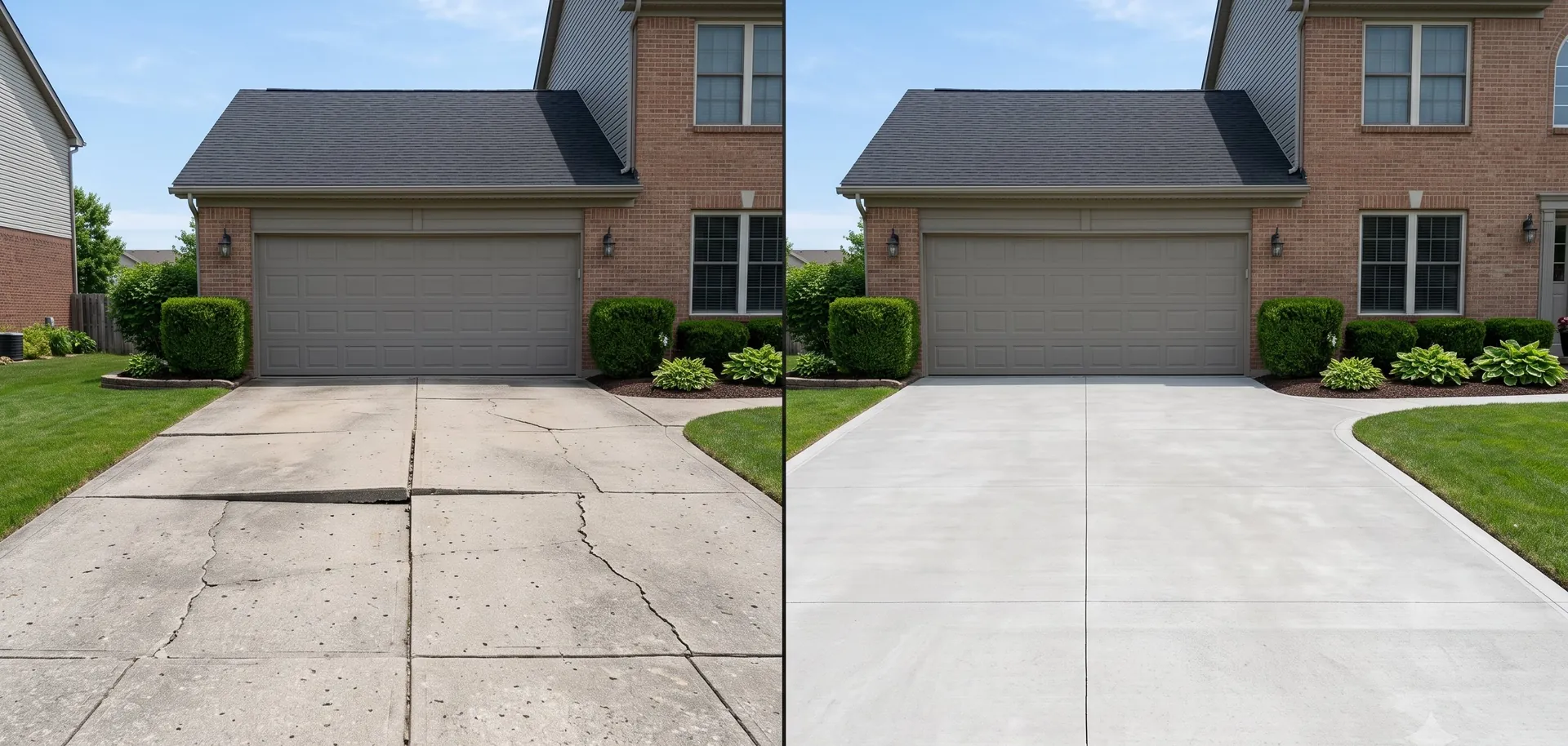
 Illustrative
Concrete Leveling or Replacement? Signs to Look For
Signs leveling will work instead of replacement: the slab is in one piece, cracks are minor or absent, and it has simply settled to sit low or unevenly. Foam can lift a sound slab back to level. When concrete is shattered, spalling, or crumbling, replacement is the better call; a free estimate decides.
Why This Decision Matters
Four signs tell you leveling will work instead of replacement: the slab sank as one piece, the cracks are cosmetic, the concrete itself is still sound, and the real problem is the soil underneath. If those describe your slab, foam can lift it back into place with no tear-out. Here's how to read each sign.
When a driveway or patio sinks, the first question homeowners ask is whether it needs to be torn out and poured fresh, or whether it can be raised back into place. It's a fair question, because the two jobs are worlds apart: replacement means demolition, trucks, curing time, and living with a construction zone for days. Concrete leveling with polyurethane foam usually takes a matter of hours and lets you walk on the slab again within hours. The trouble is, a lot of homeowners assume sinking automatically means replacement, when in most cases the concrete itself is fine. It's the ground underneath that failed. Before you get bids for full replacement, it's worth learning the signs that tell you which category your slab actually falls into. See our concrete leveling in Kansas City overview for how the process works.
Sign #1: The Slab Is Sinking as One Piece
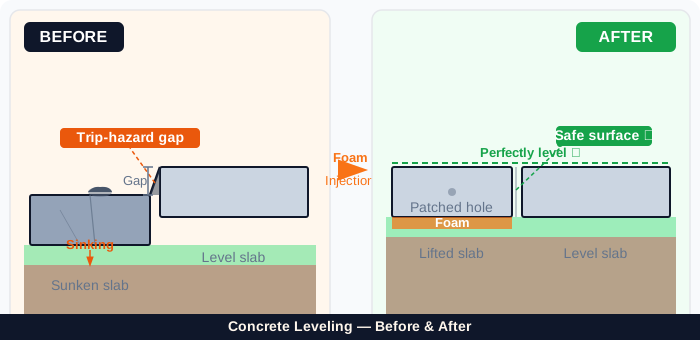
This is the biggest tell. If your driveway, sidewalk, or patio has dropped or tilted but is still largely intact (one solid panel that's just sitting lower than it used to, or lower than the panel next to it), that's a textbook leveling candidate. The concrete didn't fail; a void opened underneath it and gravity did the rest. Foam injection lifts that panel back toward its original grade without touching the surface finish. It's a different story when a slab has broken into several separate chunks that are each moving independently, rocking, or grinding against each other. At that point you're not raising one piece. You're trying to align several, and that's a much tougher, less reliable repair.
Sign #2: The Cracks Are Cosmetic, Not Structural
Hairline cracks, a few surface cracks from age, or cracking along a control joint are common on slabs that are otherwise solid, and they don't rule out leveling. Foam can still lift a slab with cosmetic cracking; the cracks may become slightly more visible after the lift, but the structure holds. What's different is a crack that runs the full depth of the slab in multiple spots, especially if you can see daylight through it, feel a sharp edge underfoot, or spot rebar or wire mesh poking through. That's a sign the concrete has lost structural integrity, not just position. For trip hazards specifically, see our sidewalk leveling and trip-hazard repair page.
For cosmetic cracks you plan to handle yourself, what hardware-store leveling products can and cannot do is worth a read first.
If you are unsure which category a particular crack falls into, our guide to when cracks in concrete are worth worrying about walks through what to look for.
Sign #3: The Concrete Itself Is Still Sound
Sinking is a position problem. Spalling, scaling, and crumbling are material problems, and no amount of lifting fixes those. Before recommending leveling, we look for flaking or pitting on the surface, soft or crumbly edges, exposed aggregate that's coming loose, and any spot where the concrete has started to disintegrate rather than just settle. Freeze-thaw cycles here in Kansas City are hard on older or poorly finished concrete, and years of salt exposure can accelerate scaling on driveways and steps. If the slab is structurally sound but out of position, foam lifting is usually the more efficient fix. If the material itself is failing, leveling would just be raising a slab that's on its way out anyway, and we'll say so.
Sign #4: The Real Cause Is the Soil, Not the Concrete
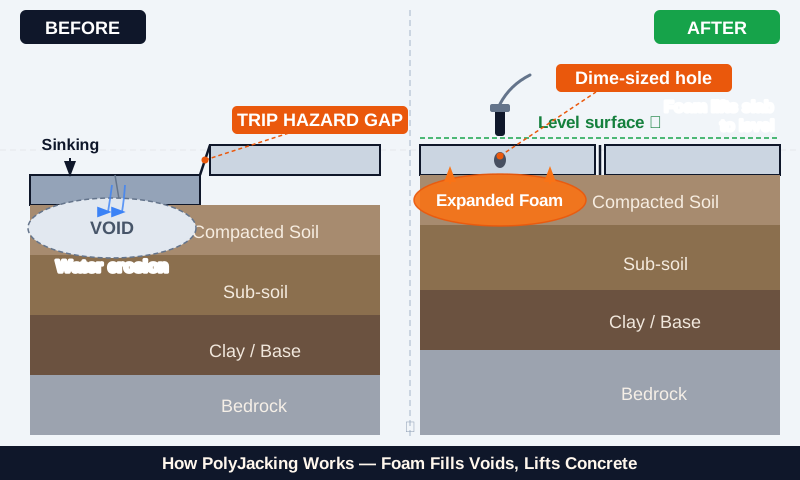
Most settling around Kansas City isn't really a concrete problem at all. It's a soil problem. The clay-heavy ground common across the metro swells when it's wet and shrinks when it dries out, and that constant movement, combined with winter freeze-thaw swings, opens small voids underneath slabs over time. Poor drainage and downspouts that dump water right next to a driveway edge or foundation wash soil out from under the slab even faster. None of that damages the concrete. It just leaves it unsupported in spots. That's exactly what foam injection is built to fix: filling the void and re-supporting the slab where the soil let it down. Read more on why concrete sinks in Kansas City.
Two related guides help you read your own slab: foundation problem or slab settling separates house movement from slab movement, and settling versus heaving covers a slab sitting higher than its neighbor.
When Replacement Really Is the Honest Answer
We're not going to tell you every slab can be saved, because that's not true. If a slab is broken into three or more separate pieces that move independently, if there's crumbling concrete or exposed rebar across a wide area, or if the subgrade underneath has washed out so severely there's little left to lift against, replacement is the more honest recommendation. Foam can still play a role even then. It's often used to fill voids and stabilize the base before new concrete goes in, so the next slab doesn't sink the same way. But if we walk your driveway and the smart move is a new pour, we'll tell you that plainly instead of trying to sell a lift that won't hold up.
Getting a Straight Answer for Your Slab
The fastest way to know which category your concrete falls into is to have it looked at in person. Every slab, soil condition, and crack pattern is a little different. Try our Diagnose tool for a quick read on what you're seeing, then schedule a free, no-obligation on-site estimate. We'll walk the slab, check the cracking and the edges, and give you a straight recommendation (leveling, or something else) the same way we compare it against mudjacking when that question comes up. Call (913) 713-7794 or use our contact form to get on the schedule.
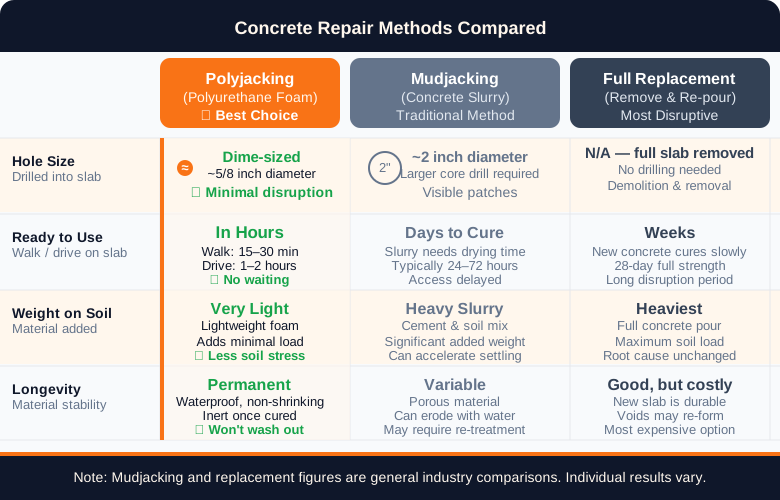
Concrete leveling vs. full replacement, side by side
| What is being compared | Concrete leveling (foam) | Full replacement |
|---|---|---|
| Time on site | Most jobs finish in a few hours, in one visit | Demolition plus a fresh pour, typically a full day of work or more |
| Curb & slab rip-out | None. The slab stays put; a few dime-sized holes are drilled and patched | The old slab is broken out and hauled away before new concrete goes in |
| Disruption & mess | A handful of small holes, no debris to haul | Demolition debris, forms, and a wet pour across the work area |
| Back in use | Walk on it in 15–30 minutes, drive on it in 2–4 hours | Light foot traffic in 24–48 hours, vehicles around 7 days, full strength at 28 days |
| Typical lifespan | Well-installed foam is engineered to last for decades when the drainage cause is fixed too | A new slab, but it still sits on the same soil that moved the original |
If the slab itself is broken apart or crumbling, foam can't make it sound again — that's when replacement is the honest call, and we'll tell you so on a free walk-through.
How polyjacking works in 90 seconds
Our team walks you through the three-step process: dime-sized holes, high-density polyurethane foam that fills every void and compresses the soil beneath your slab, and use within hours with no heavy trucks. Call (913) 713-7794 or book a free estimate below.
Frequently asked
Can a driveway with cracks still be leveled?
Often yes: hairline or surface cracks don't usually rule out leveling. What matters is whether the crack runs the full depth of the slab or the concrete around it is crumbling. We'll check both during your free estimate.
What if only part of my slab needs replacing?
That happens. Sometimes one panel is a clean lift candidate while the panel next to it is too far gone. It's reasonable to level part of a driveway or patio and replace another section separately.
How long does it take to know if leveling will work?
A walk of the slab during your free on-site estimate is usually enough. We look at how it's sinking, the crack pattern, and the material condition, then give you a straight recommendation on the spot.
Does foam leveling make cracks worse?
Existing cracks may become slightly more visible as the slab is raised back toward level, since the crack was likely there before the sinking. It doesn't create new structural cracking.
Will PolyJacks tell me if leveling isn't the right fix?
Yes. If your slab needs replacement instead, we'll say so plainly rather than recommend a lift that won't hold up long-term.
Have a sinking slab?
Book a free on-site inspection. Honest advice, usable within hours.
Pick a time that works for you
Book right here on this page. Prefer to talk? Call (913) 713-7794.