
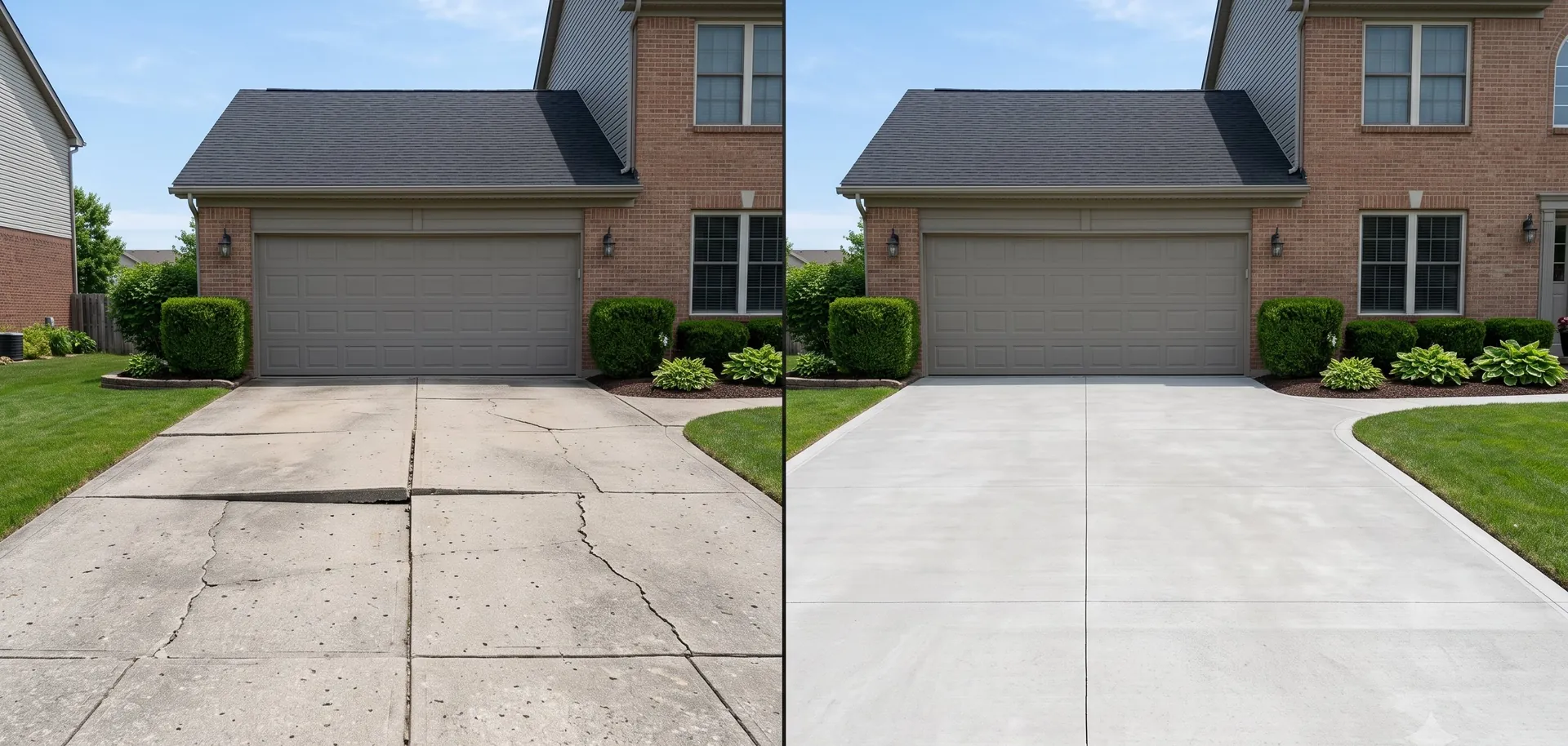
 Illustrative
Is It Your Foundation, or Just the Slab Settling? 6 Honest Checks
A settled slab such as a driveway, patio, or garage floor is separate from your home's foundation and is usually a soil problem foam leveling can fix. Signs it is the foundation instead include cracks in interior walls, sticking doors, and stair-step cracks in brick. Those need a foundation specialist, and we will say so.
The Honest 30-Second Answer
Here's the honest split: if your concrete is a free-standing slab — a driveway, patio, sidewalk, garage floor, or pool deck — foam leveling can usually raise it. If the problem is your home's structural foundation, that's a different trade, and PolyJacks will tell you to call a foundation company instead.
That distinction matters because the two failures look alike from the top — a crack, a drop, a gap — but they have different causes and different fixes. The six checks below sort your situation into the right lane before anyone spends a dime. None of them require tools, and most take under a minute.
Check 1 — Is the concrete attached to your house, or standing on its own?
Start here, because it settles most cases. A driveway, sidewalk, patio, garage floor, or pool deck sitting on soil is a candidate for foam leveling. A cracking basement wall, a bowing crawl-space wall, or a sinking porch tied into the house points to the foundation — a job for a foundation specialist.
The simple version: if it's a slab poured on the ground and separate from the structure, it's our lane. If it's holding your house up, it isn't. Everything else on this page is just refining that first read. If you want the soil-level explanation for why Kansas City concrete sinks, that context makes the rest of these checks easier to read.
Check 2 — Do your doors and windows suddenly stick?
Doors and windows that start sticking, or that won't latch the way they used to, are a foundation-movement signal — not a slab problem. When a home's footing shifts, the frame racks and the openings bind. If that's happening, get a foundation company out; foam under an exterior slab won't touch it.
One or two sticky doors in a humid Kansas City summer is usually just wood swelling. Several openings binding at once, along with new drywall cracks over door frames, is the pattern worth taking seriously as structural movement.
Check 3 — Are there stair-step cracks in brick or block?
Cracks that climb in a stair-step pattern through brick or a block wall follow the mortar joints as the wall moves — a classic foundation or structural sign. Straight, roughly horizontal cracks across a driveway or patio slab are a different story: those usually mean the soil under a slab washed out or shrank.
Stand back and look at the shape of the crack, not just its size. Diagonal stair-stepping in a load-bearing wall says foundation. A slab that simply dropped along a fairly clean line, with the concrete still in one piece, says settlement — and settlement is what foam is for.
If your cracks are in the concrete itself, our guide on when cracks in concrete are worth worrying about helps you judge which ones matter.
Check 4 — Is the floor inside your house sloping or bouncing?
A floor inside the house that slopes noticeably, bounces, or feels soft points at what's under the home — floor joists, piers, or the foundation itself — and belongs to a foundation contractor. Foam leveling works on the concrete slabs outside and in the garage, not on framed interior floors.
A quick test: set a ball or a round pencil on the floor of the room that feels off. If it rolls decisively and consistently toward one wall, note it and mention it to a foundation company. That's an interior-structure symptom, not something a slab lift addresses.
Check 5 — Where exactly is the crack — the slab, or where slab meets house?
Look at where the concrete separates. A gap that opens along the surface of a driveway, walkway, or patio — with one side dropping below the other — is settlement foam can lift. A crack running through the home's foundation wall, or a slab pulling away from the structure, needs a foundation evaluation first.

The location tells the story. Damage out in the field of a slab is almost always soil movement under that slab. Damage right at the seam between your concrete and your house is where you slow down and get a structural opinion before choosing a fix. If you are still sorting through the signs of uneven concrete, this check is the one that separates slab settlement from structural movement.
For the specific case of a slab separating at the seam, see why a driveway pulls away from the garage.
Check 6 — Did it drop evenly, or is one side pulling away fast?
Even, gradual settling of a slab across a season or two is the everyday case foam handles. Sudden, one-sided movement — a corner dropping quickly, a widening gap, water pooling where it never did — deserves a look at the bigger picture first, because fast movement can signal a drainage or structural cause under the concrete.
Speed and pattern are the tell. Slow, uniform sinking of an intact slab is textbook void formation. Rapid or accelerating movement is worth pausing on — sometimes it's an active water source washing soil out, which is worth finding before any lift so the fix actually holds.
Why we'll tell you to call a foundation company
This is the part most contractors skip. PolyJacks does not do foundation repair — we refer that work to a foundation repair company. That means we have no reason to talk you into a foam lift on a slab that actually needs structural work. When it's your foundation, the honest answer is to send you elsewhere.
A company that sells both leveling and foundation repair has a reason to lean one way on every visit. We don't. If your six checks lean structural, the most valuable thing we can do is say so and get you to the right specialist — which is exactly the advice you'd want if it were our own house.
If your checks lean structural, call (913) 713-7794 and tell us what you found. We will refer you to a trusted foundation repair partner.
When it really is just the slab
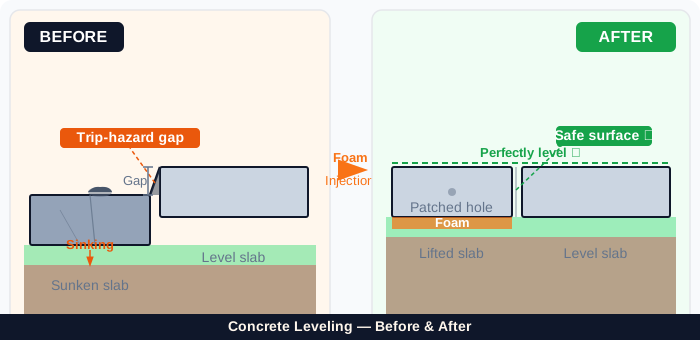
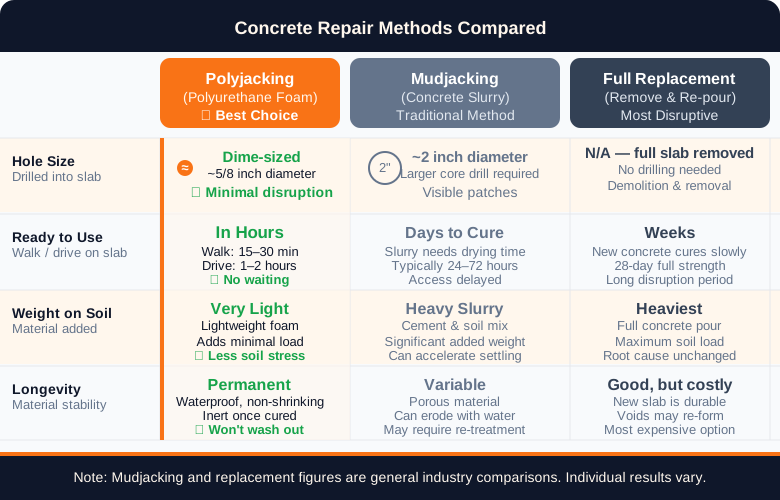
Most sunken concrete in Kansas City is exactly that — a sound slab sitting on soil that shrank, washed out, or settled. The KC concrete settlement risk index goes deeper into the soil conditions behind these checks. When the concrete itself is intact, foam leveling raises it back to level in a couple of hours, typically for 50–70% less than tearing it out and pouring new concrete.
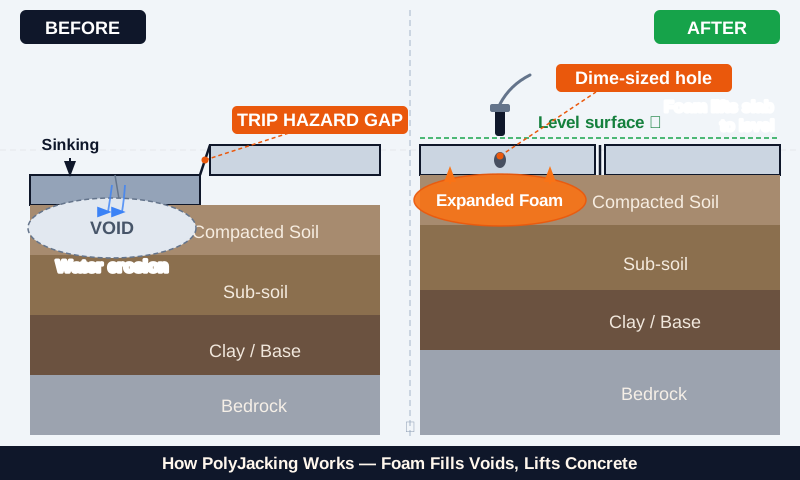
Here's how that works: we drill dime-sized holes, usually 4 to 12 of them, and inject high-density polyurethane foam that expands 30 to 40 times its liquid volume, fills the void, and lifts the slab. The foam is waterproof and non-shrinking, so it holds up in our clay and freeze-thaw winters. Most jobs run 2 to 4 hours, you walk on it in 15 to 30 minutes, and every lift carries a 5-year limited warranty. Not sure which lane you're in? A free inspection gives you a straight answer either way.
How polyjacking works in 90 seconds
Our team walks you through the three-step process: dime-sized holes, high-density polyurethane foam that fills every void and compresses the soil beneath your slab, and use within hours with no heavy trucks. Call (913) 713-7794 or book a free estimate below.
Frequently asked
Does PolyJacks do foundation repair?
No. We specialize in concrete leveling for free-standing slabs — driveways, sidewalks, patios, garage floors, and pool decks. If your problem is your home's structural foundation, we don't do that work, and we'll refer you to a trusted foundation company instead of trying to sell you a lift.
Can foam leveling fix a foundation problem?
No. Polyurethane foam raises a free-standing slab by filling the void in the soil beneath it. It doesn't repair, underpin, or stabilize a home's structural foundation — that's a separate trade with completely different methods and equipment. If it's your foundation, foam under an exterior slab won't touch the real problem.
How do I know for sure which one I have?
The six checks on this page get you most of the way. A free on-site inspection settles it for good — we look at the slab, the cracks, and the soil around it and tell you straight whether foam leveling is the fix or whether you need a foundation specialist.
What if it turns out to be both?
It happens, and we'll be honest about it. If a slab needs lifting and the home also shows real foundation movement, we'll level the concrete we can and point you to a foundation company for the structural part. No pressure, no upsell for work that isn't ours to do.
Is slabjacking the same thing as foundation repair?
No. Slabjacking, which PolyJacks does with polyurethane foam, raises a free-standing slab such as a driveway, patio, or garage floor by filling the void in the soil under it. Foundation repair deals with the structure holding up your home, and we refer that work to a foundation company.
Have a sinking slab?
Book a free on-site inspection. Honest advice, usable within hours.
Pick a time that works for you
Book right here on this page. Prefer to talk? Call (913) 713-7794.