
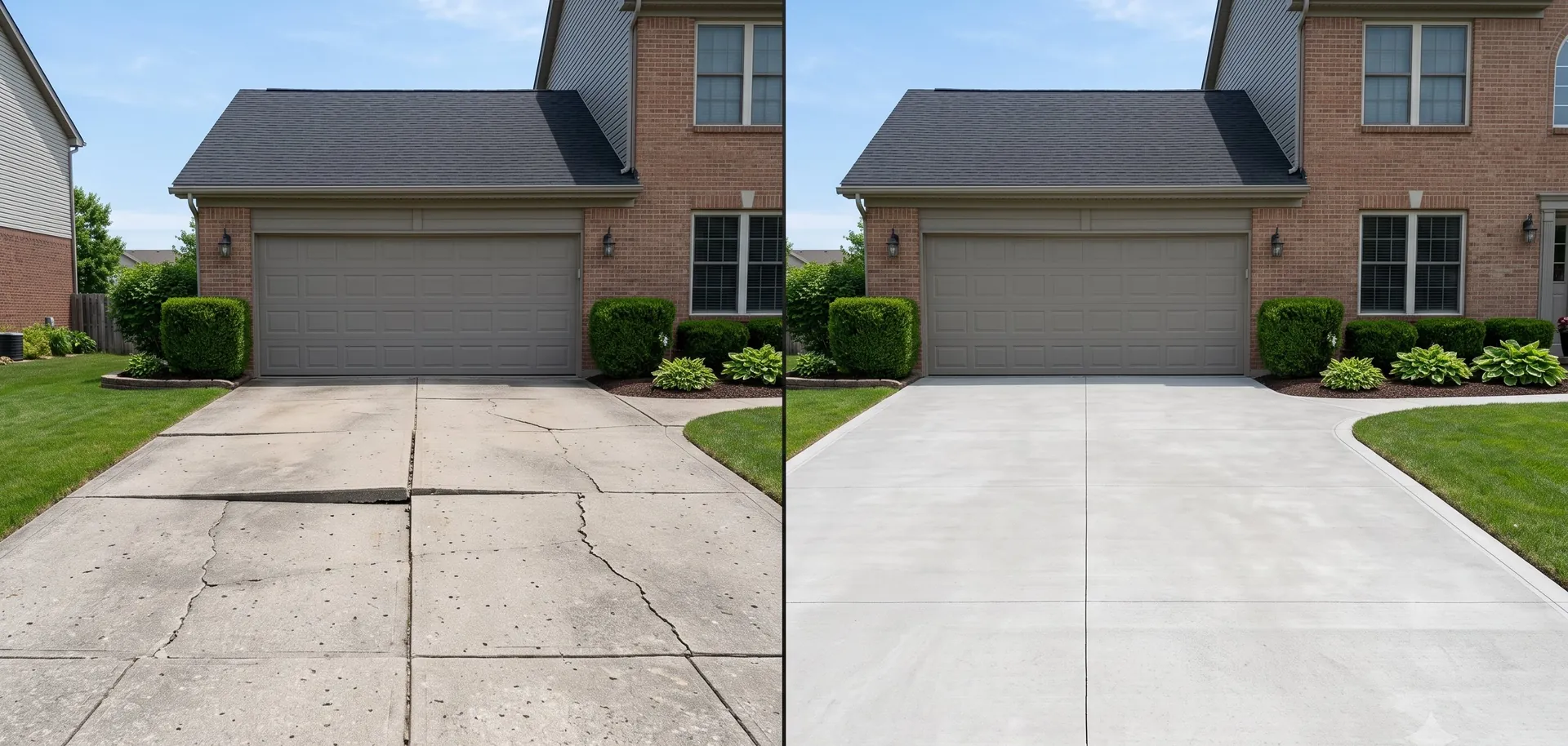
 Illustrative
Yes, Most Sunken Concrete Can Be Lifted, Not Replaced
Yes, most sunken concrete can be lifted back to level without replacement. Injecting polyurethane foam through dime-sized holes fills the voids underneath and raises the slab, as long as the concrete itself is still sound. Badly shattered or crumbling slabs are the exception and are usually better replaced than lifted.
The Short Answer: Yes, Most of the Time
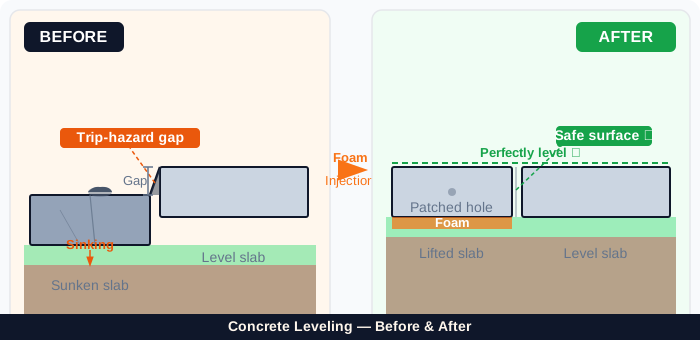
Sunken concrete doesn't automatically mean a full tear-out. In the large majority of cases we see across the Kansas City metro — Overland Park, Olathe, Lee's Summit, and the surrounding suburbs — the slab itself (the driveway, sidewalk, or patio) is still structurally fine. What sank was the ground underneath it, not the concrete. When that's the situation, the slab can be raised back to, or close to, its original position using polyurethane foam injection instead of demolition and a new pour. It's a faster, less invasive fix, and it works with the concrete you already have rather than replacing it. The real question isn't whether this can be fixed without replacing it. It's whether your particular slab qualifies, and that comes down to a quick on-site look. Learn more about the process on our concrete leveling in Kansas City page.
How the Lift Actually Happens
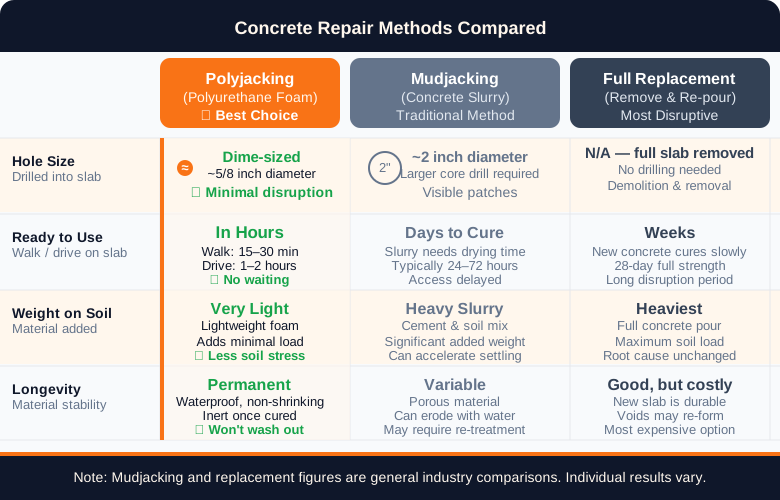
The process is more precise than most people expect. We drill a series of dime-sized holes through the sunken slab at planned points. Through those holes, we inject a two-part polyurethane foam that starts expanding within seconds of mixing. As it expands, it fills the void space underneath the slab and exerts steady upward pressure, lifting the concrete back toward level. We control the lift in small increments, checking elevation as we go, so the slab comes up evenly instead of overshooting. Once it's in place, the foam finishes curing in minutes, not days. The holes get patched, and the surface is ready to use again within hours. Full details are on our polyjacking in Kansas City page.
Why Skipping Replacement Is Often the Better Call
Replacing a slab means demolition, disposal, forms, a new pour, and days of cure time before you can drive or walk on it again, plus living with a construction zone in your driveway or patio in the meantime. If the existing concrete is sound, all of that disruption is solved by simply putting it back where it belongs. Lifting also means you keep the concrete you already have: same color, same finish, same age and weathering instead of a new slab that visibly doesn't match the rest of your driveway or walkway. And because the fix addresses the void underneath rather than pouring more material on top of the same unstable soil, it deals with the actual cause instead of just resetting the clock.
What Kinds of Concrete This Works On
Foam lifting isn't limited to driveways. We use the same process on sunken sidewalks and walkways, patios, garage floors, pool decks, porches and steps, and void filling under slabs that haven't sunk yet but have empty space developing underneath. Each of those surfaces settles for the same basic reason (soil movement or erosion under the slab) so the fix is consistent even though the surfaces serve different purposes. A pool deck near a below-grade pool wall settles differently than a porch stoop against a foundation, but the lifting method and the honest first step (a look at what's actually happening underground) are the same. See our pool deck leveling page for specifics.
How This Compares to Mudjacking
Mudjacking is the older method of raising sunken concrete, and it works on the same basic principle: pump material underneath to lift the slab. The difference is what gets pumped and how much of it. Mudjacking uses a heavy cement-based slurry, which means larger holes and more weight added on top of soil that may already be struggling to support the slab. Polyurethane foam is a fraction of the weight, goes in through much smaller holes, and won't absorb water or wash out over time the way a slurry mix can. For a full side-by-side, see polyjacking vs. mudjacking.
To see how the injection holes themselves differ in size, read mudjacking holes vs. polyjacking holes.
When Lifting Isn't the Right Fix
To be straight with you: not every sunken slab qualifies. If the concrete itself is crumbling, badly cracked into multiple independent pieces, or the subgrade has eroded so extensively there's little structure left to lift against, foam injection isn't going to hold. In those cases, replacement is the more honest recommendation, and we'll tell you that instead of pushing a lift that won't last. The good news is that most settling we see in Overland Park, Olathe, and Lee's Summit: caused by expansive clay soils and freeze-thaw cycles, not concrete failure: is exactly the kind of problem foam injection was built to solve.
If you're unsure which side of that line your slab falls on, our guide to signs you need concrete leveling, not replacement walks through what to look for.
Finding Out If Your Slab Qualifies
The only way to know for sure is to have your specific slab looked at. Soil conditions, crack patterns, and how far it's settled all vary block to block, even house to house. Use our Diagnose tool to get a quick sense of what you're dealing with, then schedule a free, no-pressure on-site estimate. We'll walk the slab and give you a straight answer on whether it can be lifted or whether something else makes more sense.
The scope of a lift varies from slab to slab. It depends on the area of concrete that needs to come up, how many voids are underneath and how large they are, how far the slab has settled, and whether the drainage that caused the settling in the first place needs to be corrected at the same time. Your free on-site estimate walks through all of that, so you'll know the full scope before committing to anything. If you want a sense of what a lift typically involves cost-wise, see what a lift typically involves cost-wise.
Call (913) 713-7794 or reach out through our contact form.
Concrete leveling vs. full replacement, side by side
| What is being compared | Concrete leveling (foam) | Full replacement |
|---|---|---|
| Time on site | Most jobs finish in a few hours, in one visit | Demolition plus a fresh pour, typically a full day of work or more |
| Curb & slab rip-out | None. The slab stays put; a few dime-sized holes are drilled and patched | The old slab is broken out and hauled away before new concrete goes in |
| Disruption & mess | A handful of small holes, no debris to haul | Demolition debris, forms, and a wet pour across the work area |
| Back in use | Walk on it in 15–30 minutes, drive on it in 2–4 hours | Light foot traffic in 24–48 hours, vehicles around 7 days, full strength at 28 days |
| Typical lifespan | Well-installed foam is engineered to last for decades when the drainage cause is fixed too | A new slab, but it still sits on the same soil that moved the original |
If the slab itself is broken apart or crumbling, foam can't make it sound again — that's when replacement is the honest call, and we'll tell you so on a free walk-through.
How polyjacking works in 90 seconds
Our team walks you through the three-step process: dime-sized holes, high-density polyurethane foam that fills every void and compresses the soil beneath your slab, and use within hours with no heavy trucks. Call (913) 713-7794 or book a free estimate below.
Frequently asked
Is foam injection permanent?
The foam is waterproof and won't break down or wash out, and it's been used in construction for decades. How long a lift holds also depends on whether the drainage issue that caused the settling in the first place gets addressed.
How long until I can use the surface again?
Most surfaces can be walked on in about 15 to 30 minutes and driven on in 1 to 2 hours, since the foam cures in minutes rather than the days a new concrete pour needs.
Will the holes be visible after the repair?
The injection holes are dime-sized, and get patched after the lift. They're far smaller than what mudjacking requires.
Does this work on concrete that hasn't sunk yet but sounds hollow?
Yes. That's often a sign of a void forming underneath, and foam can be injected to fill it before the slab actually drops, which is a good preventative step.
What if my slab can't be fixed without replacing it?
We'll tell you plainly during your free estimate. Foam can still be used to stabilize and fill voids under the base before a new pour, even if the old slab needs to come out.
Have a sinking slab?
Book a free on-site inspection. Honest advice, usable within hours.
Pick a time that works for you
Book right here on this page. Prefer to talk? Call (913) 713-7794.