
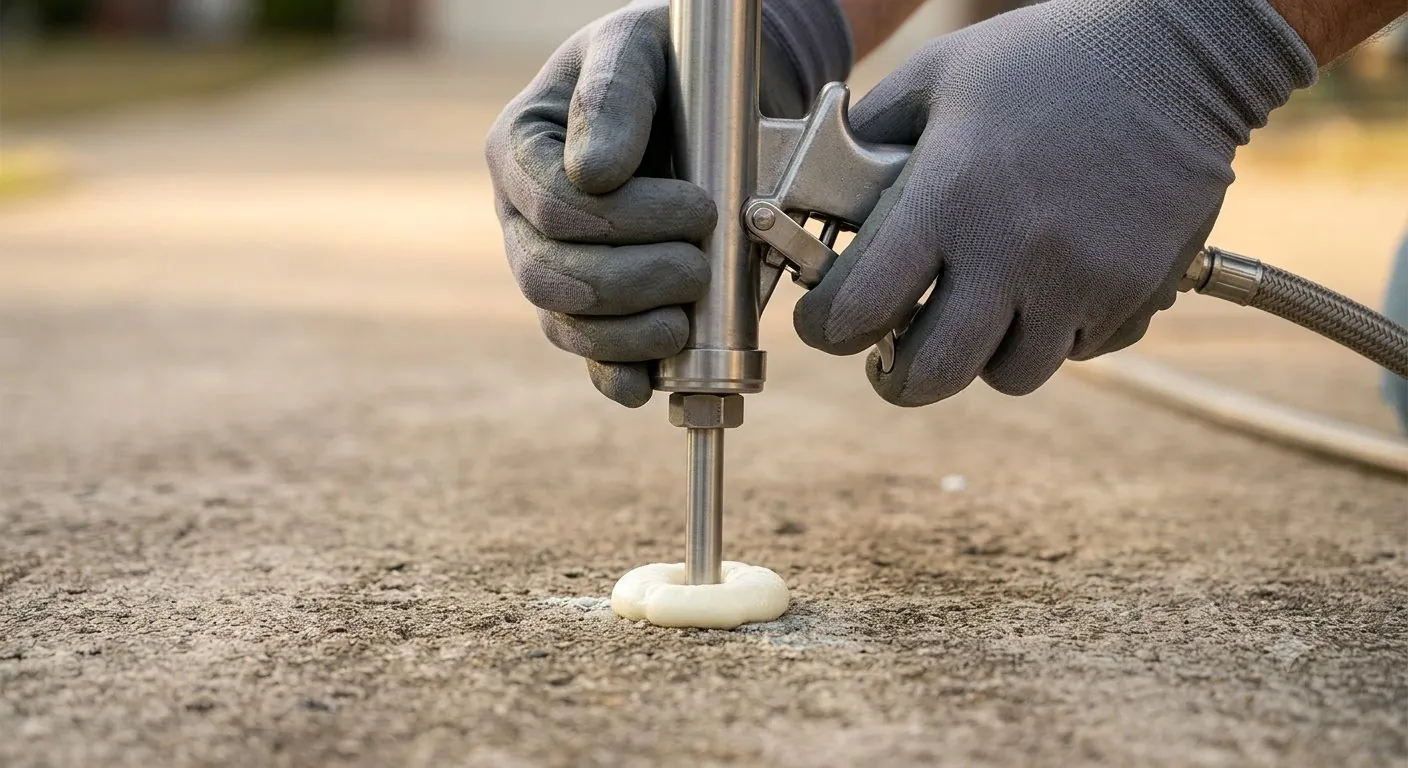
 Illustrative
Do DIY Concrete Leveling Products Actually Work?
Self-leveling compounds and small DIY foam kits can smooth minor indoor surface dips, but they will not lift a settled exterior slab or fill the large voids underneath it. They add topping without fixing the soil problem, so the slab keeps sinking. Professional foam injection addresses the void and raises the concrete itself.
What's Actually on the Hardware Store Shelf
Sometimes - but only for the small stuff. Hardware-store products can dress up a hairline crack or fill one shallow low spot, but none of them fix a slab that has actually settled, because that's a soil problem underneath the concrete, not a surface problem. Here's what's on the shelf and where each product's limits are.
Walk into any hardware store's concrete aisle and you'll find a few different products marketed loosely as "leveling" solutions: self-leveling underlayment compound, concrete resurfacer or patching compound, and increasingly, small two-part DIY polyurethane foam kits sold in caulk-gun tubes. They're not the same product solving the same problem, even though the marketing sometimes blurs the line. Self-leveling compound and resurfacer are surface treatments - they sit on top of existing concrete. DIY foam kits are the only one of the three that actually attempts what professional concrete leveling does: inject material underneath a slab to lift it. Knowing which product does what is the first step before anyone spends a weekend and real money on materials for a driveway or patio that's actually sunk, not just worn.
Self-Leveling Compound: Fine for Flat Floors, Not Sunken Slabs
Self-leveling compound (sold under names like Quikrete or Sakrete) is a cement-based mix that's poured out and flows to fill low spots, mostly used indoors before flooring goes down. It works well for minor unevenness on an interior slab that isn't structurally moving. What it can't do is fix an exterior slab that has actually settled - a driveway panel that dropped an inch because the soil under it washed out isn't a flatness problem, it's a support problem. Pouring compound over a sunken panel just adds a thin layer on top of the same underlying void; the panel is still unsupported, and the new material will crack or wear unevenly right along with it. This product answers a different question than "why is this slab lower than it used to be," which is the question that actually matters outdoors.
Concrete Resurfacer and Patch: Cosmetic, Not Structural
Resurfacers and patch compounds are meant to restore the look of worn, pitted, or spalled concrete - they fill surface texture, not gaps underneath the slab. They're genuinely useful for concrete that's structurally fine but ugly: scaling, minor cracks, faded color. Applied to a settled panel, though, a resurfacer just recoats the same tilt or dip that was already there. It can make a sunken driveway or walkway look slightly better in photos while doing nothing about the trip edge, the pooling water, or the gap opening at the joint. Worse, a thin resurfacing layer on a slab that's still actively settling tends to crack again quickly, since it has no way to address the void or soil movement happening underneath. It's a finish product, not a fix for a slab that's moved.
Small DIY Foam Kits: Same Idea, Smaller Scale
This is the closest hardware-store analog to professional injection: two-part polyurethane foam mixed and dispensed through a small hand-pump kit into a drilled hole. In concept, it's the same idea as professional polyjacking - foam expands underground and lifts the slab. In practice, the scale is very different. Consumer kits mix small batches by hand, which makes it hard to control expansion rate and pressure evenly across a large void, and there's no way to verify how far the foam actually traveled or whether it filled the whole gap versus just the space right under the hole. For a small step or a single isolated low spot, a careful DIYer with realistic expectations can get a usable result. For a full driveway panel or a slab with a large or unclear void underneath, the margin for an uneven, partial lift goes up fast.
The ways a kit goes wrong are specific enough to be worth naming before you buy one. Why store-bought foam kits don't hold covers over-lift and under-lift from eyeballing the rise, picking the wrong foam for the slab, and why you cannot fill a void you have no way to see.
Why the Underlying Cause Doesn't Go Away on Its Own
Whatever DIY product gets used, there's a bigger issue none of them solve: the reason the slab settled in the first place. Around Kansas City that's usually expansive clay soil swelling and shrinking with wet and dry seasons, poor drainage washing fines out from under a slab edge, or a void that was never fully compacted when the concrete was originally poured. If you want to see how your specific neighborhood compares, our KC Settlement Risk Index breaks down settlement risk by area. A surface patch or a small hand-mixed foam pour might improve the look or close a gap for a while, but if the soil is still moving or the void is still open, the same spot tends to come back. That's not a knock on DIY effort - it's just the nature of the problem being underground, invisible, and often larger than what's visible at the surface crack or dip. We go deeper on what causes voids under a concrete slab in a separate guide.
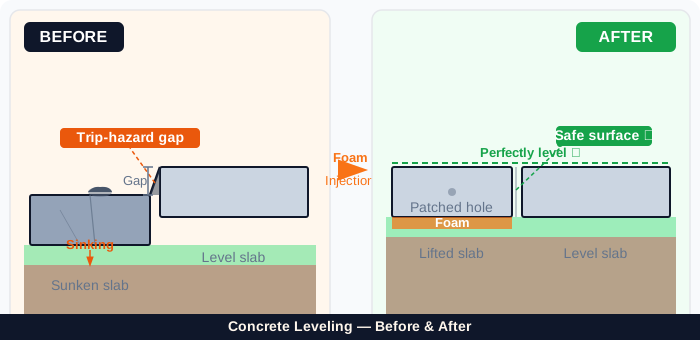
Lasting sinking concrete repair means dealing with the void and soil movement underneath, not the surface. If you are weighing methods, polyjacking vs mudjacking shows how foam leveling compares.
When DIY Makes Sense, and When It Doesn't
Honestly: a hairline crack, minor pitting, or one small low spot on a low-traffic area is a reasonable DIY project, and there's no reason to call a crew out for cosmetic work. Where it stops making sense is anything involving a full panel that's visibly tilted, a trip edge over a quarter inch, standing water that didn't used to pool there, or a slab near a structure where uneven support could be doing ongoing damage. Those situations usually mean a real void underneath, and getting the lift wrong - too much in one spot, not enough in another - can crack the slab further or leave it worse than before. If you're not sure which category your project falls into, that's exactly what a free look from someone who does this daily is for.
If you've already applied a resurfacer or a small foam pour and the spot is still low, the patch cracked within a season, or water still pools in the same place, the product did what it was designed to do and then stopped. It addressed the surface, not the void underneath the slab, so the soil movement or open gap that caused the settling is still active. The next step is a free look from someone who can check whether a void is still open under that panel and whether the slab needs a real lift or just another coat of finish. In the KC metro, the best time to check whether a slab is still moving is after a full wet-and-dry cycle has completed, once the clay has finished swelling and shrinking and any new settlement is visible. If a slab looks level in one season but dips after the next, that often indicates a seasonal settlement pattern rather than a one-time event - worth a second look before the next cycle.
What Professional Injection Does Differently
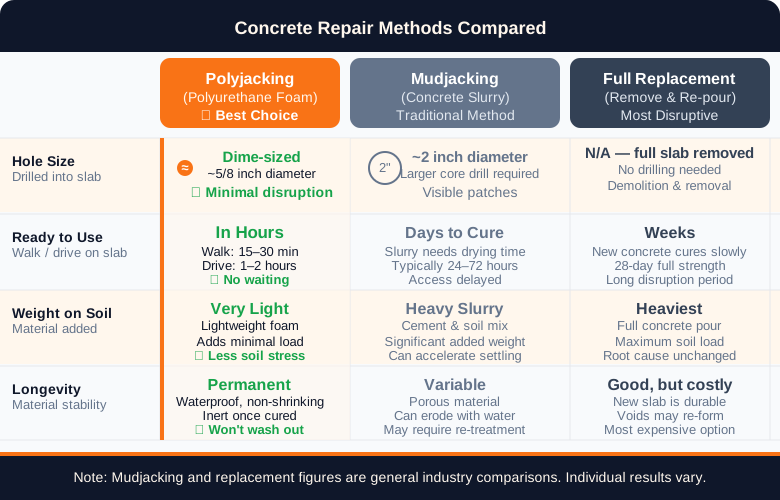
The core difference isn't the material - it's control and verification. A professional rig mixes and pumps the polyurethane foam at controlled pressure and volume through a few dime-sized holes, and the lift is measured in real time as it happens, panel by panel, so the slab comes up level instead of guessed at. The foam itself is waterproof, so it won't wash out or break down the way soil or unstable fill can, and it's lightweight enough not to add new stress to already-weak ground. For a driveway, patio, or void fill job that's more than a small cosmetic patch, that level of control is what keeps a lift even and lasting instead of a guess with a caulk gun. A free estimate at (913) 713-7794 will tell you honestly which category your slab is in.
How polyjacking works in 90 seconds
Our team walks you through the three-step process: dime-sized holes, high-density polyurethane foam that fills every void and compresses the soil beneath your slab, and use within hours with no heavy trucks. Call (913) 713-7794 or book a free estimate below.
Frequently asked
Can I use a DIY foam kit to lift my whole driveway?
Small kits can work for a single isolated low spot, but they're not built to evenly lift a full driveway panel - controlling pressure and volume across a large void by hand is difficult, and an uneven lift can crack the slab further.
Will self-leveling compound fix a sunken patio?
No. Self-leveling compound is a flooring product meant for minor interior unevenness; it doesn't address a void underneath an exterior slab and won't stop a settled panel from continuing to sink.
Is concrete resurfacer the same as leveling?
No, resurfacer is a cosmetic coating for worn or pitted concrete. It won't correct a slab that's actually tilted or dropped, since it doesn't reach the space causing the settling.
What's the real difference between a DIY foam kit and professional injection?
Scale and control. Professional equipment mixes and pumps foam at monitored pressure with real-time lift measurement, which is hard to replicate with a small hand-pumped kit on anything larger than a minor spot.
How do I know if my project is DIY-friendly or not?
If it's cosmetic - minor pitting, a hairline crack, one small dip - DIY is reasonable. If there's a visible trip edge, new pooling water, or a tilted panel, that usually means a real void, and a free estimate can tell you which you're dealing with.
Have a sinking slab?
Book a free on-site inspection. Honest advice, usable within hours.
Pick a time that works for you
Book right here on this page. Prefer to talk? Call (913) 713-7794.