
Horse Barn Insulation: Stopping the Roof Drip Without Sealing In the Moisture
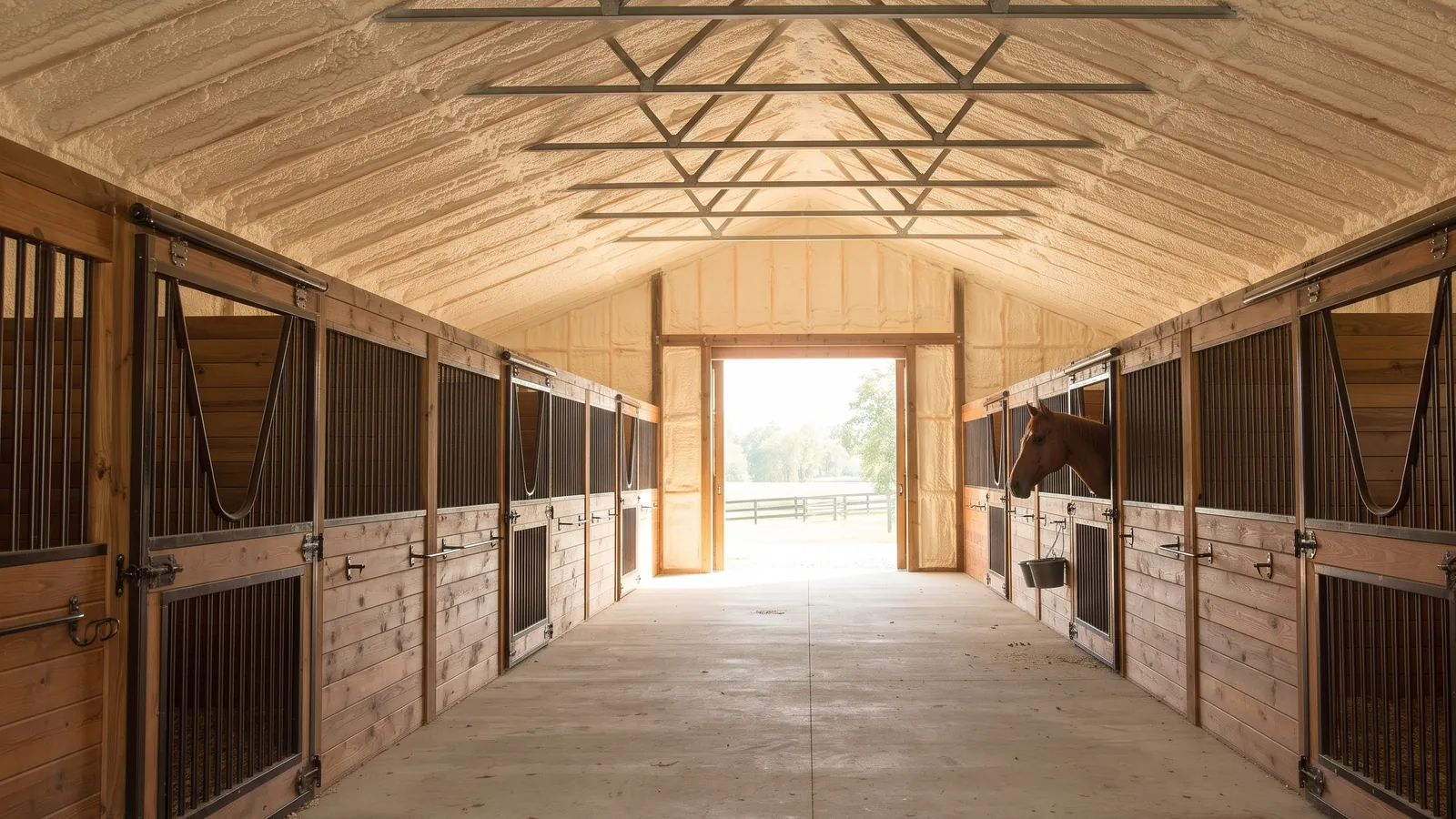
Should you insulate a horse barn?
Horse barn insulation is worth doing for one job above all: keeping the underside of the roof steel from dripping. Insulating the whole stall area to hold a set temperature is rarely worth it, and ventilation stays no matter what you insulate. A horse barn is a set of zones with different jobs, so this page goes zone by zone instead of treating it as one box.
Horses are a heavy moisture source. A post-frame builder's advice column puts it this way: "An average 1100 pound horse intakes 5 to 10 gallons of water a day – all coming back out in one form or another" (Hansen Pole Buildings, April 2021). That water leaves as breath, urine and manure moisture, and some of it ends up as horse barn condensation on the coldest surface overhead. Where the University of Minnesota Extension lists what insulation does for a horse barn, it says it "prevents moisture condensation" (UMN Extension, ventilation systems for horse barns, 2021).
Two of the sources here come from Minnesota and Ontario. Horse physiology and the way damp air meets a cold surface do not change at the state line, so they apply in Kansas. Local code and which of your buildings count as what do change, and the building official decides those.
What PolyJacks does: closed-cell foam only, sprayed inside buildings within about 35 miles of Spring Hill, KS. We do not remove old insulation, we do not do open-cell or blown-in, and we do not spray outdoors. How closed-cell foam is built and what its data sheet lists is on closed-cell spray foam.
Horse barn insulation zones: what to do in each
| Zone | The job | Foam? | Watch for |
|---|---|---|---|
| Roof underside over the aisle and stalls | Stop the steel dripping | Often yes, continuous and bonded | The foam must be thick enough to keep its room-side surface above the dew point; see the foam-surface condensation check |
| Stall walls, lower part | Kicks, leaning, wear | Not as an exposed surface | Horses lean, kick and some chew wood. Foam left bare at that height is a poor surface for any of it; ask what will cover it |
| Stall walls, upper part and gable ends | Heat loss and drip from steel | Possible | Same covering question as the rest of the barn; see what must cover spray foam |
| Aisle | Traffic, dust, doors | Not a surface of its own | Doors and gaps leak air before they leak heat |
| Tack and feed room | Saddles, leather, feed, medicines | Yes, as its own conditioned box | Walls, ceiling and door line; the room can be warmed or dehumidified separately from the barn |
| Hay loft or hay storage | Fire load, hay moisture | Building official decides | Never assume foam on or near stored hay is acceptable |
| Floor, drains and wash stall | Water | Not foamed | Wet areas are a drainage and ventilation question |
The upper part of the stall wall and the roof are where foam does the most for the least trouble. The lower stall wall is the place a horse can reach, and it is outside what spray foam does well.
Roof drip and ventilation
Condensation in a barn forms the way it does in a shop: moist air meets a surface colder than its dew point. The mechanics are covered once on why a metal building sweats, and you can run your own temperature and humidity on the dew point calculator. This page covers what is special about horses.
A sealed, insulated barn can be wetter. The Hansen column describes a barn with batt insulation and drywall that had been closed in around its horses, and says the answer was mechanical ventilation, with an HVAC professional designing it (Hansen Pole Buildings, April 2021). The writer's point is that tightening a barn without moving air out leaves the moisture inside. Foam on the roof steel is not a substitute for moving that moisture out.
Foam fixes where the water lands, not where it comes from. If foam is continuous and bonded to the roof steel, damp air cannot reach cold metal, so the steel stops dripping. The air in the barn is still full of horse. The University of Minnesota Extension says air exchange "removes dust, pathogens, ammonia, fumes and other compounds" and controls moisture, and it gives a cold-weather figure of "25 cubic feet of air per minute (cfm) per 1,000 pounds of horse" (UMN Extension, 2021). It gives a far larger figure for hot weather. Sizing fans, inlets and ridge openings is a ventilation design job, not a foam job.
What the Ontario factsheet adds. OMAFRA's horse barn ventilation factsheet says that when "warm, moist air rises to be evacuated out of the barn, it comes in contact with the cold surfaces of the roof, creating condensation" (OMAFRA factsheet 23-063, 2023). That is the path that closed-cell foam interrupts, as long as the ventilation exit stays open.
Practical order for a dripping horse barn:
- Check the ventilation: inlets low or at the eaves, an exit high at the ridge, and nothing blocked by hay, tarps or a lean-to that was enclosed later.
- Reduce the wet load: dry bedding, manure removal, no hose-down inside the barn on a cold night.
- Insulate the roof underside so the steel is no longer the coldest surface.
- Measure again before judging the result, with the same tool.
If the barn is wood post-frame, the wood framing adds its own issues, covered on pole barn condensation. The post-frame side of foam is on foam in a pole barn, and the roof-versus-ceiling choice is on roof or ceiling in a pole barn. If the barn is a full indoor arena, see indoor riding arena insulation. Other animals have other needs: livestock barn insulation.
The tack and feed room as its own box
A tack and feed room is the one place in many horse barns where a conditioned, closed box makes sense. It is small, it holds things that suffer from damp (leather, rugs, medicine, feed), and it can be built as a separate room inside the barn.
Questions to settle before foam goes on there:
- Is it a room within the barn, or just a corner? Foam goes on the room's own walls and ceiling line, and the door and gaps are sealed, so it behaves as a box.
- What heat or dehumidifier will it have? A conditioned box without a plan for its air still gets damp.
- What covers the foam? Rules for covering foam in an occupied room are on what must cover spray foam, and the building official sets the answer for your barn.
- Is feed stored there? Feed and chemicals leave the room on spray day.
Because the room is its own box, you can often insulate it without changing how the rest of the barn breathes. That is the most useful distinction on this page.
Hay loft and stored hay
Stored hay is a fire load in the building, and a loft is where it sits. We do not give a code answer here. Whether foam can be left exposed above a hay loft, or what must cover it, depends on the construction type, the occupancy and the code edition, and the building official decides. The answer for a barn can differ from the answer for a shop next door. Take these to the office:
- How is this building classified for use, and does hay storage change it?
- What must cover foam over or beside stored hay?
- Does the insurer require anything more than the code does?
The moisture side is different: hay curing in a closed barn gives off water vapor and heat, as the University of Nebraska notes in its hay article (UNL CropWatch, 2015). Keep fresh hay ventilated whether or not the roof is foamed.
Horses out for spray day
During installation the building is cleared. EPA's page on re-entry after spray polyurethane foam says "Building/home occupants and other workers should vacate during SPF installation" (EPA, vacate and safe re-entry time, archived). It adds that re-entry should wait until the product has cured, the building is ventilated and it has been cleaned. It gives no figure for animals, and the maker's written re-entry time is the one that counts. How spray day runs is on how closed-cell foam is installed, and the health side is on spray foam safety and re-entry.
For a horse barn, plan this way:
- Horses leave the building and stay out, not just out of the stall. Arrange turnout, a trailer or a neighbor's barn for the day and for the maker's re-entry period.
- Feed, hay, tack, blankets, buckets and medicine leave or are covered. This is our planning precaution, not a quoted rule.
- Plan the weather. Closed-cell foam has temperature limits for the surface and the air; spraying in cold weather is on spraying in winter.
- The barn is ventilated and cleaned before animals return, per the maker's guide.
FAQ
Should you insulate a horse barn?
Insulating the roof underside to stop the drip is often worth it. Fully conditioning the stall area rarely is, and ventilation stays. Horses add a lot of moisture, so a roof that drips is often a sign the air is not leaving, as the sources above explain.
Can horses be in the barn while you spray?
No. Horses are out of the building, and stay out until the maker's written re-entry time has passed. EPA says occupants and workers should vacate during installation and wait for cure, ventilation and cleaning (EPA, archived). It gives no figure for animals, so we follow the maker's.
Will foam stop my horse barn from sweating at night?
It stops steel from dripping if the foam is continuous, bonded and thick enough. It does not remove the moisture the horses put into the air. Ventilation does that.
Can you foam the whole barn?
Technically yes, in the right places. The question is what covers the foam and what it is for. For a horse barn, the roof and upper walls are the common answer.
Book a free on-site measurement
At the visit we look at the roof, the ventilation, the stalls, the tack room and the hay loft, and note how our lift would reach the roof. You get a written estimate after the visit. The visit is free. How it works: the free estimate visit.
Book a free on-site measurement
Pick "Spray foam insulation" on the booking form. We work within about 35 miles of Spring Hill, KS.
Spray foam insulation is a new PolyJacks service line run by its own crew and rig.
Who wrote this: PolyJacks spray foam team. How it was made: drafted with AI assistance from the sources below, then checked against each source.
Sources
- Hansen Pole Buildings, "Solving Horse Barn Condensation Challenges" (April 21, 2021): hansenpolebuildings.com
- Larry Jacobson and Chuck Clanton, "Ventilation systems for horse barns," University of Minnesota Extension (reviewed 2021): extension.umn.edu
- D. Ward, P.Eng., Horse Barn Ventilation, OMAFRA Factsheet 23-063 (September 2023): ontario.ca
- Bruce Anderson, "Preservatives and Hay Moisture," UNL CropWatch (June 5, 2015): cropwatch.unl.edu
- US EPA, Vacate and safe re-entry time, spray polyurethane foam application (archived): archive.epa.gov
Ready for a measurement?
Book a free on-site visit. We measure first, then quote in writing.
Book a free on-site measurement
We measure the building first, then you get a written quote. Prefer to talk? Call (913) 713-7794.