
Closed-Cell Spray Foam Insulation: What It Is and What Ours Does
Closed-cell spray foam insulation is a two-part polyurethane that is sprayed on site, expands, and cures into a rigid foam in which most of the cells are sealed. That structure is why it resists compression, blocks air movement, and, at the thickness its data sheet lists, can act as a vapor retarder. It is also why the data sheet matters more than the brochure: two products can both be called closed-cell and still differ in density, R-value per inch, permeance and the barrier that has to cover them.
PolyJacks sprays closed-cell foam only. We have not finished an insulation job yet, so this page makes no claims about past work. It shows you how to read any closed-cell data sheet and prints no figure for a specific product, because a number has to travel with its own document. Every figure below comes from a source you can open.
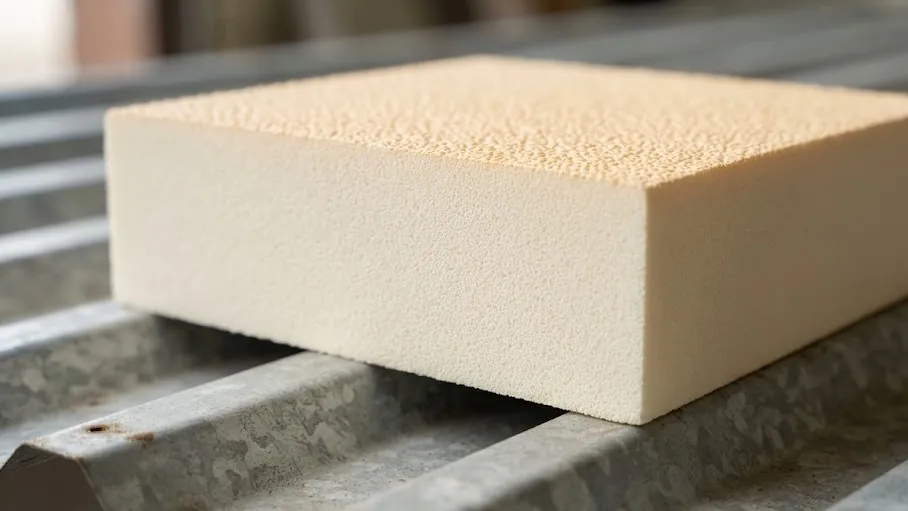
What closed-cell spray foam insulation is
Spray foam comes from mixing two liquids at the nozzle. One side is a reactive isocyanate (the Department of Energy guide names methylene diphenyl diisocyanate). The other side is a blend of polyol resin, catalyst, fire retardant and a blowing agent (DOE Building America spray foam guide). When the two meet they react, expand and set. The same guide says closed-cell foam expands roughly 35 to 50 times its liquid volume and is usually applied in layers (passes) a few inches thick, building up thicker totals in several passes.
The cell structure is what separates the two families of spray foam. That guide says over 90 percent of closed-cell foam's cells stay closed, with the gas trapped inside them, so the foam is rigid and hard to compress by hand. Open-cell foam is soft, expands much more, and lets vapor through. The full comparison belongs on open-cell vs closed-cell foam; this page stays with the product we spray.
One caution on dates. The DOE guide was written in 2009, and it describes the blowing agents of that time. Blowing agents have changed since, so treat its chemistry as background and its property ranges as a starting point. The current blowing-agent story is on spray foam blowing agents.
Typical closed-cell properties, as one federal guide lists them
The table below is generic. It is not the data sheet for our product, and it is here so you can see what kinds of numbers a real data sheet should contain. Every value is from the DOE guide's table of typical closed-cell properties.
| Property | Typical value in that guide | Why you ask for it on the real data sheet |
|---|---|---|
| Density | about 2 lb per cubic foot, nominal | Density changes strength, R-value and how the foam is rated |
| Thermal resistance | about R-6 per inch, aged, "variable within range" | Aged value, not the fresh one, is what counts over time |
| Vapor permeance | under 1 perm at 2 inches thick | A thickness has to be attached to any permeance claim |
| Closed-cell content | over 90 percent | Tells you how much of the foam is sealed cells |
| Flame spread and smoke development | under 25 and under 450 | The ratings that feed code limits on where the foam can go |
This is an out-of-state, federal source, and the physics it describes (what a closed cell does to air, vapor and heat) is the same in Kansas. It does not tell you what a specific product sold in Kansas will do. Only that product's own documents can.
A closed-cell data sheet, line by line
The way to judge any closed-cell foam is to ask for three documents from its maker: a technical data sheet (TDS), a safety data sheet (SDS) and, where the foam goes in a building that is regulated, an evaluation report (ESR) that records its barrier listings. Here is what to look for on each line.
| Line on the data sheet | What a good entry looks like | A red flag |
|---|---|---|
| Core density | A stated value and the test standard, such as ASTM D 1622 | A range with no standard named |
| R-value per inch | A value with its test standard (ASTM C 518 is the one the DOE table uses) and whether it is aged | "Up to" figures, or a fresh value only |
| Vapor permeance | A perm value tied to a stated thickness | A permeance with no thickness |
| Minimum substrate temperature | A number for the steel or wood the foam bonds to | No mention of the surface at all |
| Maximum pass thickness | A thickness in inches per pass | "Spray as thick as you like" |
| Flame spread and smoke index | Both indices, from ASTM E 84 | One index without the other |
| Barrier requirements | The thermal or ignition barrier named in the ESR, with the report number and date | A statement that no barrier is needed, with no report behind it |
The R-value line is a place where the law gets involved. The Federal Trade Commission's insulation rule requires that R-values in labels, fact sheets and advertising rest on stated tests (16 CFR 460.5, Cornell LII). We do not quote an R-value for our product here, because the number has to travel with its own document, so this page quotes none. A related page, aged R-value of spray foam, covers per-inch values and what the final receipt must show.
Barrier status line
This page makes no barrier claim for any product. Ask the building official or the maker for the specific thermal- and ignition-barrier listings.
What the code means by a thermal barrier and an ignition barrier is explained on thermal and ignition barriers. The DOE guide makes a point worth carrying into any conversation about barriers: foam products have not all been tested the same way, so an application that is acceptable for one product's evaluation report may not be for another's, and the foam cannot be treated generically.
The rig
Our equipment is the POLY 10 rig with a PMC PH-2 proportioner and 200 feet of heated hose, run by employees. The crew and rig are described on our crew and rig.
Cure time, re-entry and covering the foam
Two clocks run after the foam is sprayed, and people mix them up. One is the re-entry time: how long the building must stay clear of everyone except protected workers. The other is the cure and cover time: how long until a covering such as drywall may go over the foam.
For re-entry, the EPA's guidance says that only applicators and helpers with protective equipment and ventilation should be present during and for a period afterward, and that occupants and other trades should stay out until the maker's re-occupancy procedures are met (EPA, archived Safer Choice page on SPF). That page is an archived federal page, and the principle (follow the maker's written time) is the same in any state. The full safety discussion belongs on spray foam safety and re-entry.
For covering, the time comes from the product's own guide and nowhere else. A covering is not always the thermal barrier. Whether drywall counts depends on the code path for your building, which is why the question goes to the building official.
Common questions
What is closed cell spray foam insulation?
A two-part polyurethane foam sprayed on site that cures into a rigid foam whose cells are mostly closed. The density and closed-cell percentage of a given product come from its data sheet, not from an estimate here.
Is closed cell spray foam a vapor barrier?
At the thickness its data sheet lists, it can act as a vapor retarder. It is not one at any thickness. In the DOE table, a figure under 1 perm is tied to 2 inches, and the same foam sprayed very thin may not reach it. The rules for metal buildings are on vapor barriers in metal buildings.
Does closed cell spray foam add strength to a metal building?
Treat foam as insulation, not structure. It gets no design credit on this page, and nobody here promises that it stiffens a building. The DOE guide reports that some studies found gains for foam in certain wall and roof assemblies, but those are tests of particular assemblies, not a statement about your building. Ask the building's engineer. We will only repeat a maker's own test data with its assembly, thickness and test standard stated.
What should a closed-cell foam data sheet tell me?
Density, R-value per inch with its test standard and whether it is aged, vapor permeance with the thickness it applies to, the lowest surface temperature it may be sprayed on, the thickest single pass, flame spread and smoke indices, and the barrier named in the evaluation report. The table above sets these out line by line.
When can drywall go over spray foam?
After the product's guide says the foam has cured. That time comes from the guide, not from a rule of thumb. Drywall is the thermal barrier only where your code path says so. See the cure section above and thermal and ignition barriers.
How foam ages and what goes wrong on bad jobs have their own pages: how long spray foam lasts and spray foam problems to avoid.
Book a free on-site measurement
At the visit we measure the building and look at the surface the foam would bond to. You get a written estimate afterward. The visit is free. Book a free on-site measurement explains the steps.
Book a free on-site measurement
Pick "Spray foam insulation" on the booking form. We work within about 35 miles of Spring Hill, KS.
Spray foam insulation is a new PolyJacks service line run by its own crew and rig. For the whole service, start at our spray foam insulation service, or see how it applies to spray foam for metal buildings.
Who wrote this: PolyJacks spray foam team. Last updated: October 27, 2026. How it was made: drafted with AI assistance from the sources below, then checked against each source.
Sources
- U.S. Department of Energy, Building America, spray foam guide (Consortium for Advanced Residential Buildings / Steven Winter Associates, updated 2009): www1.eere.energy.gov
- U.S. Environmental Protection Agency, "Spray Polyurethane Foam (SPF) Insulation and How to Use it More Safely" (archived Safer Choice page): archive.epa.gov
- 16 CFR 460.5, R-value claims, Cornell Legal Information Institute: law.cornell.edu
Ready for a measurement?
Book a free on-site visit. We measure first, then quote in writing.
Book a free on-site measurement
We measure the building first, then you get a written quote. Prefer to talk? Call (913) 713-7794.