
Is Spray Foam Insulation Safe? Isocyanates, Re-Entry and Cured Foam
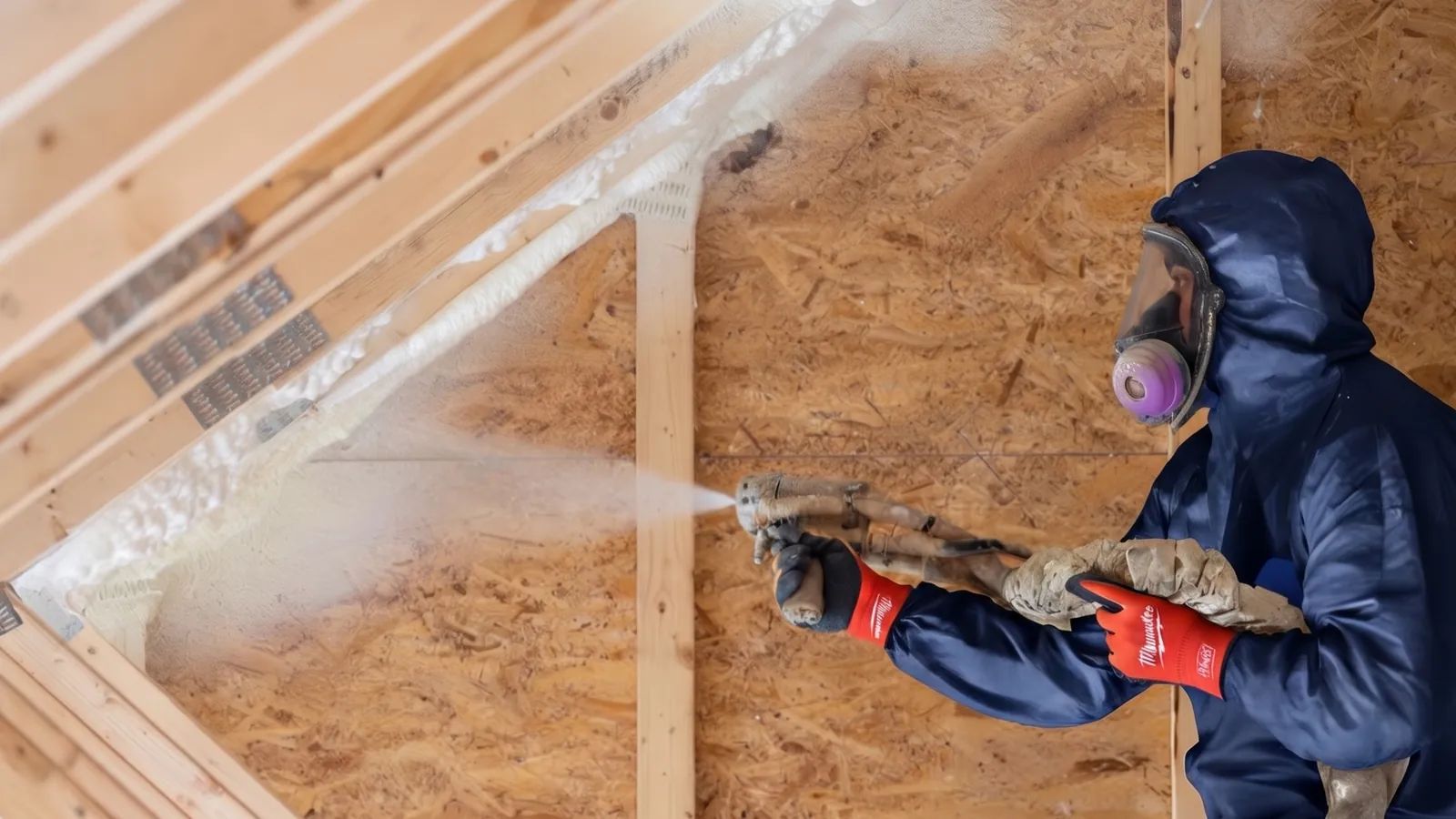
Is spray foam insulation safe? The short answer
Spray foam insulation is a chemical process during installation and a finished material afterward, and the safety question has different answers for the two. The hazard is concentrated while the two liquids are sprayed and while the foam cures. The U.S. Environmental Protection Agency's guidance says building occupants and other workers should vacate during installation, and that re-entry should wait until the product has finished curing and the building has been ventilated and cleaned (EPA, Vacate and Safe Re-Entry Time for SPF Application, archived page).
So the honest answer to "is spray foam insulation safe" is: it is a material that needs a trained crew, protective equipment and a waiting period, and then the foam sits in the wall. What the cured foam gives off, and for how long, is a question for the maker's own documents, not for a general statement. This page lays out the sources and says what we cannot yet quote. PolyJacks sprays closed-cell foam only, inside buildings within about 35 miles of Spring Hill, KS. We have not finished an insulation job, so nothing here describes past work.
These are federal sources. They describe the chemistry and the exposure, which are the same in Kansas and Missouri as anywhere. They are also archived pages, so ask the maker for its current guidance.
When the hazard is
Spray foam is made at the nozzle from two parts. The A-side contains isocyanates, a class of reactive chemicals. EPA's health page states that exposure may cause skin, eye and lung irritation, asthma and "sensitization," and says isocyanates are a leading chemical cause of work-related asthma (EPA, Health Concerns about SPF, archived page). The same page says symptoms may be delayed by several hours and that there is no recognized safe level of exposure for sensitized individuals.
Three practical points follow from that:
- The risk is highest to the people spraying. That is why the crew's respiratory protection matters more than anything on a brochure. What a program has to contain is on spray foam crew and equipment.
- Nearby people are exposed through vapors, aerosols and dust. EPA's re-entry page says unprotected people can be exposed by skin contact and by breathing the chemicals during application, and that later entrants can meet residual vapors from uncured foam and dust that carries isocyanates if the foam is cut or disturbed.
- Some people are more vulnerable than others. EPA says anyone with a history of skin conditions, respiratory allergies, asthma or prior isocyanate sensitization should carefully review product information and may want to consider alternatives. If that is you or someone in the building, tell us before the visit.
Vacate and re-entry
The vacate rule is simple: everyone not in protective equipment is out of the building during spraying. The re-entry rule is the one people want a number for, and a number is the wrong thing to give.
EPA's re-entry page says the recommended time varies, that professional two-component systems commonly come with a 24-hour figure, and that the reader should contact the manufacturer or supplier for guidance on ventilation time, re-entry time and re-occupancy time for the specific product. EPA's quick safety tips for occupants say the same thing in other words: do not enter until the manufacturer's re-occupancy procedures have been satisfied (EPA, Quick Safety Tips, archived page).
That is why this page gives no hour count of its own. Our rule is the maker's written re-entry time for the product we spray, and nobody goes back in before it, whatever a web page says. The product, its re-entry time and the document that states it are not on this page yet:
How ventilation and clean-up fit into a spray day is on how spray foam is installed, so this page does not repeat the sequence.
Cured foam: what the sources do and do not say
This is the part where claims drift, so each one is separated into what a source states and what it does not.
| Question | What an opened source says | What it does not say |
|---|---|---|
| Is cured foam chemically stable? | EPA's occupant tips call properly applied, fully cured foam "typically considered relatively inert" | That every installation cures properly, or that it never emits anything |
| Can foam off-gas? | The same page says unreacted chemicals can off-gas over time in some conditions, and that SPF chemicals may migrate onto other surfaces | A time limit, or a level that is safe |
| Do people report smells after installation? | The U.S. Consumer Product Safety Commission staff fact sheet says some occupants have reported lingering odors or respiratory symptoms after application | How common it is, or what caused any particular case |
| What should someone do about it? | Seek medical attention for breathing problems; talk to the contractor; consider an independent indoor-air consultant; report a product problem on SaferProducts.gov | That any one explanation fits every case |
The CPSC fact sheet is staff commentary and says it has not been reviewed or approved by the Commission (CPSC, SPF Insulation: Health and Safety Recommendations for Consumers).
The installer's side of an odor complaint, such as what records are kept per job, is on spray foam problems and how they are prevented. Our own records cannot be described yet, because we have not sprayed a job.
Reading a maker's SDS and emissions statement
The documents that answer cured-foam questions for a particular foam are its safety data sheet (SDS) and any emissions statement the maker publishes. When we name our product, this section will quote them, within 25 words each, with the date and the test standard.
Until then, here is what to look for when you read any maker's emissions statement:
- The test method and date. A claim of "low VOC" means little without the standard it was tested to and when.
- The scope. A statement about the cured foam under test conditions is not a statement about every building.
- The wording. "Meets" a named limit is a measurable claim. "Non-toxic," "zero emissions" and "safe once cured" are not, and we do not use them.
Is there a non toxic spray foam insulation?
No spray foam is presented here as non toxic. The A-side contains isocyanates, and EPA describes them as sensitizers. Products sold as low-VOC or as having a different blowing agent change one part of the chemistry; they do not remove the isocyanate step or the vacate-and-wait rule. The blowing-agent story is on low-GWP HFO spray foam. If a product's maker states "low VOC," ask for the test basis behind it.
Is spray foam safe for pets and animals?
The sources we opened speak about people. The CPSC fact sheet's checklist tells owners to vacate the building and to relocate occupants, including pets, during installation. EPA's archived re-entry page addresses occupants and sends readers to the manufacturer. We did not find a published re-entry standard for animals.
So here is our practice, stated plainly. Animals, feed and bedding are moved out before spraying. They return only when the maker's written guidance for animals allows it, the building has been fully ventilated, and you decide it is ready. We do not present the human re-entry time as safe for animals.
This matters most for barns. Planning insulation for a livestock building is on insulating a livestock barn.
What to do if something seems wrong
- Breathing trouble or other symptoms: seek medical attention first, as the CPSC fact sheet says.
- A smell that does not fade: call the contractor and the product's maker. The CPSC fact sheet suggests an independent indoor-air consultant for diagnosis.
- A product problem you believe a foam caused: the fact sheet points to the CPSC's online incident report on SaferProducts.gov.
Questions to ask any crew before the day
Ask for the maker's written re-entry time and the SDS in advance, how the work area is isolated and ventilated, what protective equipment the crew wears, and what the plan is for people and animals. A longer list is on how to choose a spray foam contractor.
FAQ
How long after spray foam can I go back inside?
After the maker's written re-entry time has passed, plus ventilation and clean-up. That time comes from the maker's written document for the product used; there is no generic hour count here.
Is there a non toxic spray foam insulation?
No product is described as non toxic on this page. The A-side contains isocyanates, which EPA calls sensitizers during application. Ask any maker for its SDS and for the test basis behind any "low VOC" claim.
Is spray foam safe for pets?
Pets and animals leave the building for installation. The maker's written guidance for animals has to allow it before they return, and the human re-entry time is not treated as an animal one.
Does spray foam off-gas?
Emissions are highest during spraying and curing, which is why people vacate. EPA's tips say unreacted chemicals can off-gas in some conditions. Any statement about cured foam comes from the maker's emissions statement, scoped to its test, so this page claims nothing about cured foam beyond the sources cited.
Book a free on-site measurement
If you have a health condition, animals in the building or a feed room, tell us when you book. We measure the space, note who and what uses it and write that into the estimate you receive after the visit. The visit is free.
Book a free on-site measurement
Pick "Spray foam insulation" on the booking form. We work within about 35 miles of Spring Hill, KS. How the visit works is on book a free on-site measurement. The foam itself is described on closed-cell spray foam insulation.
Spray foam insulation is a new PolyJacks service line run by its own crew and rig. We have not yet finished an insulation job, so this page makes no claims about past jobs. This page gives general information and is not medical advice.
Who wrote this: PolyJacks spray foam team. How it was made: drafted with AI assistance from the sources below, then checked against each source.
Sources
- EPA (archive), Vacate and Safe Re-Entry Time for Spray Polyurethane Foam Application: archive.epa.gov
- EPA (archive), Health Concerns about Spray Polyurethane Foam: archive.epa.gov
- EPA (archive), Quick Safety Tips for Spray Polyurethane Foam Users: archive.epa.gov
- U.S. Consumer Product Safety Commission staff, Spray Polyurethane Foam Insulation: Health and Safety Recommendations for Consumers: cpsc.gov
Ready for a measurement?
Book a free on-site visit. We measure first, then quote in writing.
Book a free on-site measurement
We measure the building first, then you get a written quote. Prefer to talk? Call (913) 713-7794.