
Why Your Metal Building Sweats (and How to Stop the Dripping)
When the underside of a steel roof drips, or the walls run with water on a cool morning, the cause is metal building condensation: damp air touching steel that is colder than that air's dew point. The steel is not leaking. The water came out of the air inside the building. The fix starts with finding where that water is coming from, because insulation alone does not help much if the building keeps filling with damp air.
This page walks through the usual moisture sources, how to tell them apart, and the order of fixes, from free to the most work.
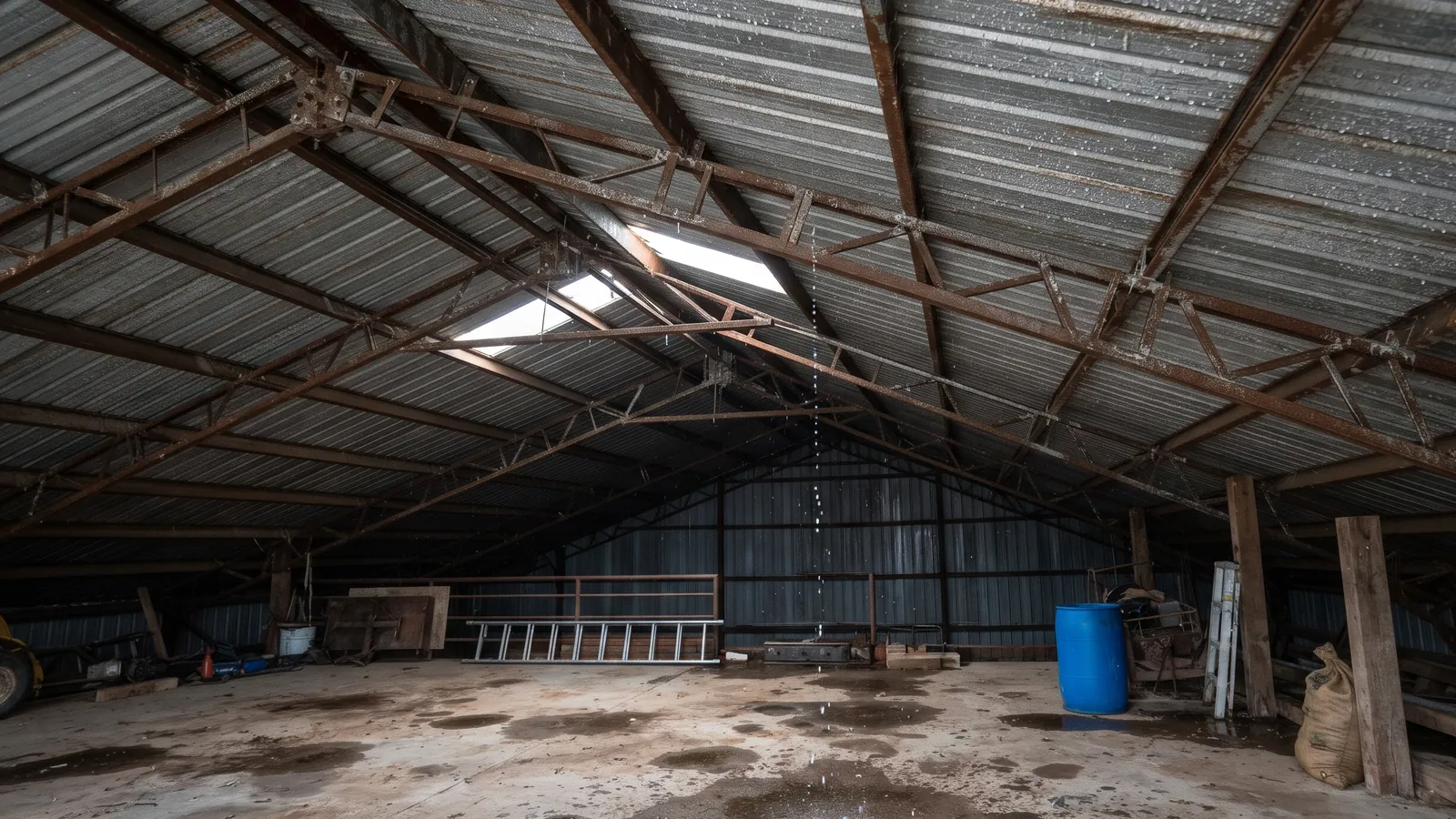
Why steel sweats: how metal building condensation forms
Every batch of air holds some water as vapor. Cool that air enough and it can no longer hold it all, and the extra turns to liquid on the coldest surface it touches. The temperature where that starts is the dew point. In the words of the Reflective Insulation Manufacturers Association, condensation "will occur on any surface when the surface air temperature is at or below the 'dew point temperature'" (RIMA condensation FAQ).
An example: air at 70 F and 50% relative humidity has a dew point of about 50.5 F (Magnus formula with the Alduchov and Eskridge 1996 constants). Any steel in that building colder than about 50 F will collect water. You can run your own numbers on the dew point and frost point tool.
Steel is usually the coldest surface in the building at night. It is the thin layer between the inside air and the outdoors, and on a clear night a roof can drop below even the outdoor air temperature (more on that below). So the fix has two sides: less water in the air, and steel that the damp air cannot reach while it is cold.
Find your moisture source
Most dripping buildings have more than one source. Use the signs to narrow it down.
| Moisture source | Signs it is yours | What fixes it |
|---|---|---|
| New concrete slab that is still curing | Dripping started after a slab was poured inside | Ventilate the building during and after the pour; as the slab cures, its water goes into the air (Hansen Pole Buildings, 2014) |
| Slab with no vapor retarder under it | Damp-looking slab; dripping that never really stops in humid weather | Moving damp air out (rung 2 below). For a new slab, ask the concrete contractor about a vapor retarder under it. Metal buildings often sit on slabs with no vapor barrier under them (GreenBuildingAdvisor, 2013) |
| Unvented propane, natural gas or kerosene heater | Dripping is worse on the days the heater runs | A vented heater, or heat that does not burn fuel inside the room. Burning a hydrocarbon fuel produces water vapor and carbon dioxide, and an unvented heater leaves both in the room (GreenBuildingAdvisor, 2009) |
| Animals housed inside | Drip over the pens or stalls, worst in cold weather with the building closed up | Ventilation sized for the animals. Animals breathe moisture into the air, and when warm, moist air rises to a cold roof it condenses (OMAFRA horse barn ventilation factsheet, 2023) |
| Freshly baled hay stored inside | Dripping in the weeks after hay goes in | Airflow while the hay goes through its "sweat"; heat in a curing bale forces moisture out of it (UNL CropWatch, 2015) |
| Warm, humid outside air coming in | Dripping on a humid morning after a cool night, worse with big doors open | Close the building up while the steel is cold; seal the gaps; insulate the steel (rung 3). Damp air on a cold roof deck is what condenses (RIMA) |
| Clear-night roof cooling | The roof drips but the walls stay dry, after clear, calm nights | Insulation on the roof steel, or a factory drip membrane on a new roof (see below) |
| Air leaking through gaps in old insulation | Water inside or behind a faced blanket; wet spots at the seams | Air leaks through the seams of the facing cause condensation against the metal (GBA, 2013); the old layer usually has to come out before foam goes on |
The first five put water into the air. The last three are about cold steel and how the damp air gets to it. Fix the first group first where you can, because that part costs the least.
The fix ladder
Work from the bottom rung up. Each rung makes the next one work better.
Rung 1: Cut the water at its source. Vent the heater outdoors or switch the heat source. Give a new slab time and airflow to dry. Do not close up a building full of curing hay. These steps cost little and can cut the dripping on their own.
Rung 2: Move damp air out. Air exchange is how livestock barns control moisture, and the same physics applies to a shop: warm air holds more water, so swapping damp inside air for drier outside air carries the water out (OMAFRA, 2023). After a concrete pour, ventilation is the simplest step (Hansen Pole Buildings, 2014). This rung has limits: on a humid summer morning the outside air may be the damp air.
Rung 3: Keep damp air off the cold steel. This is where insulation comes in, and how it goes on matters more than what it is called. Answers on GreenBuildingAdvisor to a sweating metal roof include rebuilding the roof over a solid deck, or spraying closed-cell foam on the underside of the metal (GBA, 2012; GBA, 2013). For foam to stop the drip it has to be:
- continuous, with no gaps at laps, purlins or eaves, because damp air finds the gap;
- fully bonded to the steel, so no air sits between foam and metal;
- thick enough that the foam's room-side surface stays warmer than the dew point of the inside air. That check is on the foam-surface condensation check.
Other options at this rung: a drip-stop membrane is a factory-applied option for a new or replacement roof, compared on drip-stop vs spray foam. Whether a separate vapor retarder is needed with closed-cell foam is covered on vapor retarders and closed-cell foam. The roof-specific plan for foam is on foam on the underside of a metal roof, and the full building approach is on metal building spray foam.
Rung 4: Check the numbers. Measure the inside temperature and humidity, and if you can, the steel's surface temperature. The dew point and frost point tool tells you whether that steel will sweat.
If you are still deciding what kind of insulation to use, metal building insulation options compared lays them side by side.
Machine shed condensation: the unheated case
Machine shed condensation is the hardest case to fix, because nobody heats the shed and the big doors are often open. The damp air is mostly outside air. The Australian Steel Institute notes that under roofs where outside night air circulates freely, such as open sheds and carports, condensation on the underside of the cold roof sheeting "is expected" (ASI Factsheet #1, Metal Roofing and Condensation, 2020). The physics of a cold roof under open night air is the same in Kansas.
The pattern is warm, humid air meeting steel that cooled overnight. That happens most on mornings after a clear, cool night that follow humid weather.
What that means for a machine shed:
- If the shed stays open-sided, you cannot control the air, so the only lever is the steel: foam on the roof panels puts a warmer surface between the cold metal and the air under it. A shed that drips on equipment only a few mornings a year may not need anything beyond moving equipment or covering it.
- If the shed can be closed up, rungs 1 and 2 matter again: no unvented heaters, no fresh hay stored with the doors shut, and air exchange when it is humid inside.
- If equipment is rusting or you are adding heat, the building is moving toward the heated-shop case, and the foam on the steel needs the thickness check from rung 3.
Containers and small steel garages drip for the same reasons, with their own details: see insulating a shipping container and detached steel garage insulation. If your building is wood post-frame rather than steel, wet purlins and new slabs play out differently; see why a pole barn drips.
Rust: what foam does and does not do
Water sitting on steel speeds up corrosion. The fiberglass industry's own moisture guide says "water in contact with metals can contribute to corrosion and degrade the service life of the building" (NAIMA MB306). So stopping the drip helps the steel.
What foam does not do:
- It does not reverse rust that is already there. Rusted panels or fasteners are a roofing repair question first.
- It does not protect steel it does not cover, so gaps and missed laps stay exposed.
- It does not come with a promise about how long a given panel will last. That depends on the panel's coating, the exposure and the moisture you keep in the building.
FAQ
Why is my metal building sweating?
Moist air is touching steel colder than its dew point.
Does spray foam stop metal roof condensation?
It can, under three conditions: closed-cell foam that is continuous, fully bonded to the steel, and thick enough that its inner surface stays above the dew point of the inside air. Any thin spot, open lap or eave gap is a place the drip can come back, so no one should promise it stops all condensation. The product side, what closed-cell foam is and what its data sheet shows, is on closed-cell spray foam; the thickness check is on the foam-surface condensation check.
Why does my metal roof drip on clear, cold nights?
On a clear, calm night the bare roof loses heat to the open sky and ends up colder than the outdoor air. GreenBuildingAdvisor explains that roofing can get colder than the outdoor air "on a clear, windless night" (GBA, 2017), and the Australian Steel Institute says clear night skies can drop a metal roof below the dew point (ASI, 2020). The underside then drops below the dew point of the inside air. Neither source gives a fixed number of degrees, so allow a safety margin when you use the dew point and frost point tool.
Why does my shop drip when I run a propane heater?
An unvented heater puts water vapor into the air with its exhaust. Burning propane or natural gas makes water vapor and carbon dioxide, and an unvented heater leaves both in the shop (GreenBuildingAdvisor, 2009). A vented heater sends that water outside. Heating choices and where a shop loses its heat are on where the heat goes in a metal shop.
Can a sweating roof rust through?
Repeated wetting speeds corrosion; how fast depends on the panel coating and how exposed it is. No one can tell you from a page how long your panels have. Stopping the drip helps, but it does not undo rust that is already there, so have badly rusted panels looked at as a roof repair.
Book a free on-site measurement
At the visit we measure the building, look at the slab, heaters, doors, animals or storage, and the old insulation if there is any, and talk through which rungs of the ladder make sense before foam. If foam is part of the answer, you get a written estimate. The visit is free. More on how it works: the free estimate visit.
Book a free on-site measurement
Pick "Spray foam insulation" on the booking form. We work within about 35 miles of Spring Hill, KS.
Spray foam insulation is a new PolyJacks service line run by its own crew and rig.
Who wrote this: PolyJacks spray foam team. Last updated: October 27, 2026. How it was made: drafted with AI assistance from the sources below, then checked against each source.
Sources
- Reflective Insulation Manufacturers Association International, Condensation FAQ: rimainternational.org
- Martin Holladay, "Night-Sky Radiation," GreenBuildingAdvisor, May 26, 2017: greenbuildingadvisor.com
- Australian Steel Institute, Building with Steel Factsheet #1, "Metal Roofing and Condensation," v1.1, December 9, 2020: steel.org.au
- Alex Wilson, "Avoid Unvented Gas Heaters," GreenBuildingAdvisor, September 23, 2009: greenbuildingadvisor.com
- Hansen Pole Buildings, on concrete curing and ventilation, August 2014: hansenpolebuildings.com
- GreenBuildingAdvisor, "Metal building and condensation" (Q&A, January 14, 2013): greenbuildingadvisor.com
- GreenBuildingAdvisor, "How can I prevent my roof from sweating?" (Q&A, November 27, 2012): greenbuildingadvisor.com
- D. Ward, P.Eng., Horse Barn Ventilation, OMAFRA Factsheet #23-063, September 2023: ontario.ca
- Bruce Anderson, "Preservatives and Hay Moisture," UNL CropWatch, June 5, 2015: cropwatch.unl.edu
- NAIMA, Insulation Facts #26, Moisture and Fiber Glass Metal Building Insulation (MB306): insulationinstitute.org
- O. A. Alduchov and R. E. Eskridge, "Improved Magnus Form Approximation of Saturation Vapor Pressure," Journal of Applied Meteorology 35 (1996), 601-609 (constants a = 17.625, b = 243.04 C): doi.org
Ready for a measurement?
Book a free on-site visit. We measure first, then quote in writing.
Book a free on-site measurement
We measure the building first, then you get a written quote. Prefer to talk? Call (913) 713-7794.