
Pole Barn Condensation: Wet Purlins, New Slabs and Dripping Roofs
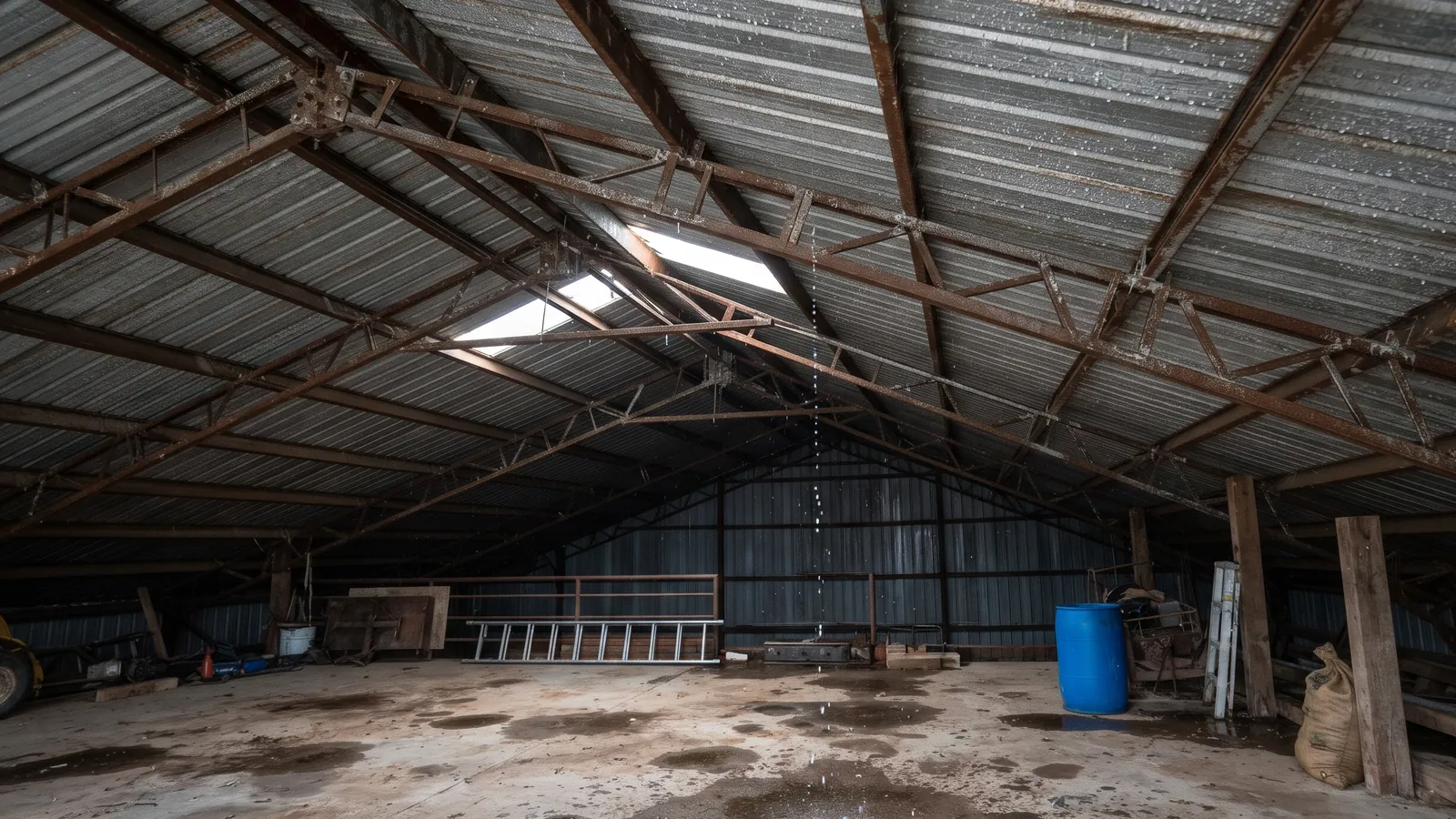
Why pole barn condensation happens
Pole barn condensation has the same cause as a steel building's: damp air meets steel colder than its dew point, and the water runs. The full mechanism is explained once on why a metal building sweats, and the numbers are on the dew point calculator. This page covers what a wood-framed barn adds.
A pole barn has a steel skin on a wood frame, and the wood changes three things:
- The wood holds water. Purlins and trusses under the roof steel soak up the drip, release it later, and can stay wet long enough to decay.
- The floor is often not sealed. Many pole barns have gravel or dirt floors, or a slab poured over gravel, and the ground gives off water.
- A new barn is wet. New lumber and a new slab release water for a season or more, and there is usually a brand-new roof to receive it.
If your barn has been dripping since it was built, or since the slab went in, this page is the place to start. The first read on what to do about the roof steel is the ladder on the steel-building page. The wood check below is the part that only applies here.
Pole barn sweating, as people also call it, is the same condensation seen from inside a wooden frame. PolyJacks sprays closed-cell foam only, inside buildings within about 35 miles of Spring Hill, KS. We do not remove old insulation, we do not do crawl spaces, and we do not do open-cell or blown-in.
Sources special to post-frame
| Source | How you know it is yours | What helps | Evidence |
|---|---|---|---|
| New concrete slab | Dripping began when the slab went in | Ventilate during the pour and the weeks after | A typical 24 by 24 foot, 4 inch slab "contains approximately 138 gallons of water" (Hansen Pole Buildings, 2014) |
| Slab poured over gravel with no retarder | The slab stays damp-looking | A vapor retarder and rigid foam laid on top, with a subfloor, was the advice given to one owner (GreenBuildingAdvisor, 2015) | Forum Q&A; one editor's answer |
| Dirt or gravel floor with no ground cover | Dripping all year, worst in winter | Remove the top layer of soil, lay a heavy vapor barrier with overlapping seams, cover it with sand, seal to the columns | Reader advice from a pole-building supplier (Hansen Pole Buildings, October 2022) |
| Wet wood framing | Dark purlins, rust-stained fasteners, damp wood after a cold night | Find what is wetting it; do not cover it | See the wood section below |
| Old blanket or fabric under the steel | Water in or behind the facing | The old layer usually comes out before foam | See below |
| Animals, curing hay, an unvented heater | Worse on the days of use | Ventilate or change the source | Covered on why a metal building sweats and on horse barn insulation |
The order matters. The first three rows put water into the air. The wood and blanket rows are where the water lands. Fix the first group first.
Dirt and gravel floors
A dirt or gravel floor is a moisture source because the ground is wet and the building is warmer than the ground in winter. The Hansen reply describes the building as "a cork pulled out of a genie's bottle" when ground outside is frozen and the moisture has nowhere to go but into the building (Hansen Pole Buildings, October 2022). The same reply says a mechanical dehumidifier may be needed in an insulated building where the problem persists.
Why a ground cover helps is physics, not region. GreenBuildingAdvisor's Martin Holladay writes that "water vapor can enter a basement or crawlspace by evaporating from the interior surface of a damp wall or slab," and that polyethylene greatly limits that migration (GBA, April 2022). The article is about basements and crawl spaces, which we do not insulate. We cite it only because the evaporation from damp ground is the same in a barn.
A pole barn may not need a slab. What it does need is a decision about the ground. Before foam goes on the roof, find out whether the floor is giving off water. Foam on the roof with a wet floor underneath is the situation described on vapor retarders and closed-cell foam.
The first season of a new barn
No source we opened gives a drying time for a new pole barn, because it depends on the slab, the weather and the ventilation. What the sources do agree on is the order of events. This table is the order, not a calendar.
| Stage | What is happening | What to do |
|---|---|---|
| Before the steel goes on | Lumber is exposed and dries; the ground is open | Choose the floor: slab with retarder, or ground cover and gravel; see new pole barn insulation decisions |
| Slab pour and the weeks after | The slab is giving off the most water it ever will | Keep the building ventilated; "Ventilation is the simplest way to reduce humidity and vapor pressure" (Hansen, 2014). Hansen also advises slowing the rate at which concrete dries, to protect its strength |
| First cold nights after the roof is on | Steel cools, the building is full of moisture, drips start | Expect drips. Do not close the building up tight to heat it |
| First winter with heat | Heating raises the dew point if the heater is unvented | Vent the heater to outside or change the source |
| The decision on foam | The structure has dried | Meter the wood (below) before spraying |
Most owners ask whether to foam at once. The better question is whether the building has finished giving off water. A foam layer bonds to what is on the steel and the wood on the day it goes on.
Wet wood: where the drip lands
Wood does not rot because it is damp for an hour. It rots when it stays wet. The USDA Forest Service's study of above-ground decay says that for most decay fungi, optimum moisture conditions are above fiber saturation, "usually around 25 to 30% mc," and the authors found nothing in the research to contradict the 20 percent rule for the application they studied (Carll and Highley, 1999, USDA Forest Service). Their work is about wall cladding, not barn roofs, so read the number as a rule of thumb for how wet wood has to be, not as a verdict on your barn. The same paper says the fungi do best at about 21 to 32 degrees C.
What that means for a barn:
- Purlins and trusses under a dripping roof are the first suspects. Water that runs down a purlin wets the wood for the length of the run.
- A new barn's lumber can start wet. Wood moisture is checked on the day, not assumed.
- Rot shows late. The place that is wet now may not look damaged for years. If you see soft wood, call a builder before you call us.
Wet wood is also the reason foam can make things worse if it is sprayed too early. Foam over damp wood leaves the moisture nowhere to go but into the wood. The longer discussion of trapped moisture is on spray foam and wood rot.
Before foam: the wood check
Closed-cell foam makers publish limits for what they will bond to. One maker's application guide we opened lists substrate moisture content as under 19 percent, and says surfaces must be clean, dry and free of dew or frost (Foamsulate Closed Cell application guide, Carlisle, 2021). That is one product's guide. The product we spray has its own.
At the visit the check runs like this:
- Read the wood with a moisture meter at the purlins, trusses and girts, on several points, including the places under the worst drips.
- Compare the readings with the maker's limit for the product, not with a general rule of thumb.
- Look for the cause of any reading above the limit. If it is a floor, a leak or a heater, that gets fixed first.
- Come back when it passes. We would rather return in the dry season than spray over wet framing.
A passing reading does not promise anything about the future. It says the surface is within the maker's limit on the day.
If there is a condensation blanket
Many pole barns went up with something under the roof steel to catch drips. One builder lists options such as rigid board, vinyl-backed insulation, felt over OSB, a moisture-control membrane and radiant foil, and says these should be used in addition to other moisture controls (FBi Buildings, "Pole barn condensation tips," March 2019). When one has failed, water sits between the fabric and the steel, and the wood above it may be wet. The fabric usually comes out before foam, and you arrange that, because we do not remove insulation. How foam fits a post-frame barn after that is on foam in a pole barn, and the membranes themselves are compared on drip-stop vs spray foam.
Where foam fits in the order
- Cut the moisture at the source: floor, new slab, heaters, animals.
- Ventilate, especially the first season.
- Let the wood dry and meter it.
- Then seal the roof steel with continuous, bonded closed-cell foam, thick enough to keep its room-side surface above the dew point; the check is on the foam-surface condensation check.
- Decide roof or ceiling: roof or ceiling in a pole barn.
- Decide what covers the foam: what must cover spray foam.
If a horse or livestock barn is your case, the animals are an added source: horse barn insulation and indoor arena condensation cover them.
FAQ
How do I stop condensation in my pole barn?
Cut the moisture source first (floor, new slab, animals), then seal the roof steel with continuous closed-cell foam once the wood passes the moisture check. If the barn has a ceiling, ventilation above it matters too, and you can check the dew point numbers on the dew point calculator. The wood check is in the section above, and the sealing question is on vapor retarders and closed-cell foam.
Why does my new pole barn drip?
The new slab or gravel floor is giving off moisture onto cold steel. A slab holds a lot of water when it is new, as the Hansen figure above shows, and a ground floor gives off more in winter. The fix order is the one above: the source first, ventilation, then the wood, then foam. Repeated dripping from a new barn is common enough that you should not take it as a defect in the roof.
Is my pole barn sweating because of the steel panels?
Usually not. The panels are where the water shows up, not where it comes from. Check the floor and the ventilation first.
Will spray foam make my wood rot?
Foam on dry wood is a different situation from foam on wet wood. Foam over wet framing can keep the wood wet. That is why we meter the wood first, and the longer answer is on spray foam and wood rot.
Book a free on-site measurement
At the visit we meter the wood, look at the floor, find the old fabric if there is any, and note the vents and doors. You get a written estimate after the visit. The visit is free. More on how it works: the free estimate visit.
Book a free on-site measurement
Pick "Spray foam insulation" on the booking form. We work within about 35 miles of Spring Hill, KS.
Spray foam insulation is a new PolyJacks service line run by its own crew and rig.
Who wrote this: PolyJacks spray foam team. How it was made: drafted with AI assistance from the sources below, then checked against each source.
Sources
- Hansen Pole Buildings, "Concrete & Rain in My New Pole Building" (August 20, 2014): hansenpolebuildings.com
- Hansen Pole Buildings, "Moisture Reduction, Window Sizes on a Building, and Frost Heave" (October 2022): hansenpolebuildings.com
- GreenBuildingAdvisor, "Moisture on my pole barn concrete floor" (Q&A, November 18, 2015): greenbuildingadvisor.com
- Martin Holladay, "Vapor Retarders for Basements and Crawlspaces," GreenBuildingAdvisor (April 1, 2022): greenbuildingadvisor.com
- C. G. Carll and T. L. Highley, "Decay of wood and wood-based products above ground in buildings," Journal of Testing and Evaluation 27(2), 1999, USDA Forest Service: research.fs.usda.gov
- Carlisle Spray Foam Insulation, Foamsulate Closed Cell Application Guide (2021): sprayez.com
- FBi Buildings, "Pole barn condensation tips" (March 25, 2019): info.fbibuildings.com
Ready for a measurement?
Book a free on-site visit. We measure first, then quote in writing.
Book a free on-site measurement
We measure the building first, then you get a written quote. Prefer to talk? Call (913) 713-7794.