
How Thick Should Spray Foam Be? Closed-Cell Thickness by Building Use, With the Condensation Check
How thick should spray foam be? There is no single number. The answer depends on what the foam has to do: keep a steel roof from dripping, hold heat in a shop, meet an energy code, or act as a vapor retarder. Each of those sets a different floor, and the largest of them wins. This page gives the method for each, with worked numbers for the first one, the condensation check, because that is the one steel and pole buildings fail first.
PolyJacks sprays closed-cell foam only, inside buildings, so everything here is about closed-cell. Where a thickness depends on the product, the product's own data sheet decides and this page says so rather than guessing.
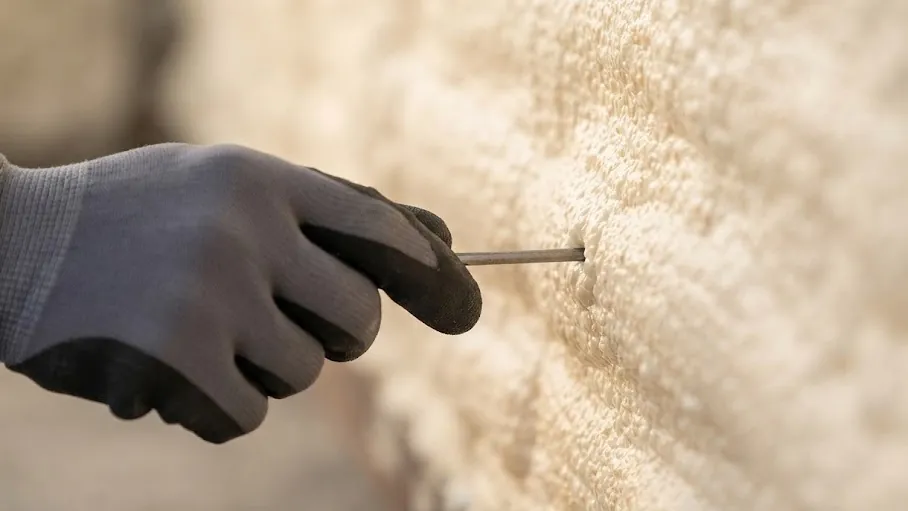
Thickness depends on the job: spray foam thickness by use
| What the foam must do | What sets the thickness | Where the method is |
|---|---|---|
| Stop a steel or metal-clad roof and walls from sweating | The foam's room-side face must stay above the dew point of the room air | The condensation check, below |
| Keep a heated shop warm enough, or cut heating load | Heat loss at the temperature you hold, and what you will pay to heat | Where the heat goes in a metal shop and the heat-loss calculator |
| Satisfy an energy code for a conditioned building | The R-value the adopted code requires for that assembly, divided by the product's R per inch | Heated and conditioned buildings, below, and R-values by code edition |
| Act as a vapor retarder | The thickness at which the product's tested permeance reaches the limit | Vapor retarder thickness, below |
| Be covered by a thermal barrier or an ignition barrier | Not a thickness question for most buildings; a covering question | Spray foam for metal buildings |
A common mistake is to ask for "2 inch closed cell" because a neighbor had it. Two inches of closed-cell foam at roughly R-6 per inch (the figure the Department of Energy's Building America guide gives for closed-cell, DOE Building America) works out near R-12, and one spray foam dealer's FAQ puts it at R-12 to R-13 (sprayfoam.com FAQ). Whether that is too much, too little or about right is exactly what the rest of this page lets you test. The dealer is in Texas; R per inch is a property of the material and does not change with the state.
The condensation check
Condensation forms on a surface at or below the dew point of the air touching it (RIMA condensation FAQ). Foam on the underside of a roof or wall moves the surface that the room air touches from cold steel to the foam face. The foam face is warmer than the steel, and the thicker the foam, the warmer it is. The check asks one question: is the foam's room-side surface above the room air's dew point?
The formula
In steady state, heat flows from the room through a series of resistances: the film of still air on the inside surface, the foam, and the film of moving air on the outside surface. The steel is thin and conducts so well that we treat it as zero. The surface temperature is then:
surface = T_in - (T_in - T_out) x R_film_in / (R_film_in + R_foam + R_film_out)
with temperatures in F and R in the usual units (hr x sq ft x F / Btu). The film values are the standard ones: 0.68 for the inside of a vertical wall, 0.61 for the inside of a ceiling with heat flowing up, and 0.17 outside in a 15 mph winter wind (H2X Engineering, summarizing ASHRAE Fundamentals). The same 0.17 outside and 0.61 ceiling film appear in the notes to the Seattle Energy Code's roof tables (Seattle Energy Code 2021, Appendix A, notes to Table A102.2.6). Seattle is outside our market, but a film of air resists heat flow the same way in Kansas; the outside temperature in the formula is yours to choose, and this page does not assume a local design temperature.
The dew point comes from the Magnus formula, the same one the dew point and frost point tool uses.
One worked case
A wall with 50 F air inside at 60% relative humidity and 0 F outside. The dew point of that air is 36.7 F.
| Wall build-up | Foam R | Surface temperature | Against the 36.7 F dew point |
|---|---|---|---|
| Bare steel | 0 | 10.0 F | 26.7 F below: it sweats or frosts |
| 1 inch, at an assumed R-6 per inch | 6.0 | 45.0 F | 8.3 F above: dry |
| 0.5 inch, assumed R-3 | 3.0 | 41.2 F | 4.5 F above: dry |
| Thin or missing foam, R-1 | 1.0 | 31.6 F | 5.1 F below: sweats |
The steel row is the point of the whole exercise. Bare steel is almost at the outdoor temperature, because there is nothing between it and the cold. A little foam does the most work in the first fraction of an inch.
What R does each condition need?
Solve the formula for the smallest foam R at which the surface just reaches the dew point, then add a 3 F cushion (our design choice, not a standard). Inches assume R-6 per inch and are shown only to give a sense of scale; your product's data sheet sets the real inches.
| Room air | Outside | Dew point | Wall: minimum foam R | With a 3 F cushion | About, at R-6 per inch |
|---|---|---|---|---|---|
| 50 F, 60% | 0 F | 36.7 F | 1.7 | 2.4 | 0.3 to 0.4 in |
| 68 F, 50% | 0 F | 48.7 F | 1.5 | 2.0 | 0.3 in |
| 70 F, 50% | 0 F | 50.5 F | 1.6 | 2.0 | 0.3 in |
| 70 F, 50% | 20 F | 50.5 F | 0.9 | 1.2 | 0.15 to 0.2 in |
| 55 F, 70% | 0 F | 45.4 F | 3.0 | 4.8 | 0.5 to 0.8 in |
| 40 F, 90% | 0 F | 37.3 F | 9.2 | cannot be met | about 1.5 in |
Two things in the table are worth stopping on. First, the minimum is small. A film of foam is enough to bring the surface above the dew point under these steady conditions, and the thickness you see in real jobs is set mostly by the other rows: heat, code and vapor. So the check is a floor, not a target. Second, the last row shows what happens as the room air gets close to saturation. The margin between room temperature and dew point shrinks to under 3 F, and a 3 F cushion cannot be met at any thickness. At that point the answer is to remove moisture from the room, not to add foam. Moisture sources are on why metal buildings sweat.
Why a passing number can still fail
The check is steady-state and one-dimensional, and a real building is neither.
- Air leaks and thin spots. The check assumes a continuous layer. A gap, a missed lap or a thin pass on a rib puts damp air against cold steel regardless of the average thickness.
- Bare framing. A purlin or girt the foam does not cover is the bare-steel row of the table, over a strip. Whether the frame is sprayed is a cost and a condensation question at once; see steel-specific cost factors.
- The roof is colder than the air. On a clear night a roof can fall below the outdoor air temperature, so the "outside" in the formula should be lower than the air reading. The reason is on why metal buildings sweat; neither source we opened gives a number of degrees, so allow a cushion.
- Unheated buildings have no steady inside. The check needs a room temperature held above the outside by a heater, animals or equipment. An unheated shed follows the weather, and no single thickness can be computed. We do not claim one.
- Surface condition. The check says nothing about whether the foam bonds. Prep rules for a given product come from its data sheet, and the roof process is on foam on the underside of a metal roof.
Check vectors
Anyone can test the formula by hand. Each line is room air at 50 F and 0 F outside, with the 0.17 outside film.
| Inside film | Foam R | Surface temperature |
|---|---|---|
| 0.68 (wall) | 0 | 10.0 F |
| 0.68 (wall) | 3.0 | 41.2 F |
| 0.68 (wall) | 6.0 | 45.0 F |
| 0.61 (ceiling) | 6.0 | 45.5 F |
Dew point of 50 F air at 60% humidity: 36.7 F, from the Magnus constants of Alduchov and Eskridge (1996).
Insulating a shipping container? It is steel too, with its own details; see container spray foam.
Heated and conditioned buildings
A heated shop and a conditioned building have an extra requirement on top of condensation: heat loss. The method is arithmetic: choose the R you want from the foam, then divide it by the product's R per inch to get inches.
For a building where an energy code applies, the R comes from the code the local authority adopted, for that type of wall or roof, and the building official has the last word on whether it applies to a shop or a farm building. That is not the same in every county, and the table by code edition is R-values by code edition. We do not state a required R on this page because the answer depends on the adopted edition and the occupancy.
For a shop you heat by choice, there is no code number, only a tradeoff between foam you buy once and the fuel you burn. The tool for that is the shop heat-loss calculator, and the cold-shop explanation is on where the heat goes in a metal shop.
Thickness also has a ceiling that comes from fire rules rather than from physics. The one-story route in the 2018 IBC for foam covered by thin metal limits the foam to 4 inches, among other conditions (IBC 2603.4.1.4, as shown on the UpCodes Kansas viewer); the whole route and its conditions are on spray foam for metal buildings, and the building official decides which route applies.
Vapor retarder thickness
Closed-cell foam is a vapor retarder only at or above a certain thickness, and that thickness belongs to the product, not to the foam family. The model codes divide vapor retarders into three classes by permeance, and Class II covers 0.1 to 1.0 perm (Huntsman Building Solutions, Design Note BES-102, 2022). That maker's note says its closed-cell products were tested to find the minimum thickness at which permeance reaches 1.0 perm or less, typically between 1 and 2 inches, and lists one product's permeance falling as the foam gets thicker:
| Thickness | Water vapor permeance (perms), one maker's table |
|---|---|
| 1.0 in | 1.25 |
| 1.5 in | 0.83 |
| 2.0 in | 0.63 |
| 3.0 in | 0.42 |
| 4.0 in | 0.31 |
The same note gives the method of dividing the permeance at 1 inch by the applied thickness to estimate the rest. The lesson is the shape of the curve, not the numbers: for that product, 1 inch is just over the Class II line and 1.5 inches is under it. Another product, ours included, can sit elsewhere. The thickness at which our product becomes a vapor retarder must come from our product's tested data.
The note is a manufacturer's document and is written around code sections for frame walls. Whether a separate vapor retarder is needed in a metal building is a different question, covered on the vapor retarder page for metal and pole buildings, and a building official or the product's evaluation report decides applied cases.
FAQ
How thick should spray foam be in a pole barn?
Enough that the foam's room face stays above the dew point for your use, or the code R if it is conditioned. For a barn, the inside air is set by animals or by a heater, and the method is the check above with your temperatures. Wood framing adds its own details; the building-type page is spray foam for pole barns, and the drip case is on why a pole barn drips.
What thickness stops condensation on steel?
The thickness that passes the foam-surface check for your inside and outside design conditions. Run the method, then leave a cushion; air leaks or thin spots defeat it. For cool, moist air the number rises fast, and for air close to saturation, no thickness is enough.
Is more foam always better?
No. Past the thickness that passes the check, meets your code and reaches your heat target, additional foam adds material and spray time and nothing else. Past 4 inches it may also change which fire-code route is open. A written estimate should state the thickness per surface so you can see what you are buying.
Book a free on-site measurement
We measure the building, ask how it is heated and used, check the steel and the old insulation, and give a written estimate after the visit that states the thickness for each surface. The visit is free. How it works: the free estimate visit.
Book a free on-site measurement
Pick "Spray foam insulation" on the booking form. We work within about 35 miles of Spring Hill, KS.
Spray foam insulation is a new PolyJacks service line run by its own crew and rig. We have not yet finished an insulation job, so this page makes no claims about past jobs.
Who wrote this: PolyJacks spray foam team. How it was made: drafted with AI assistance from the sources below, then checked against each source.
Sources
- Reflective Insulation Manufacturers Association International, Condensation FAQ: rimainternational.org
- H2X Engineering, "What Is Air Film Resistance and Why Does It Matter for Load Calculations?" (summarizing ASHRAE Fundamentals): h2xengineering.com
- Seattle Energy Code 2021, Appendix A, notes to Tables A102.2.6 (film values 0.17 and 0.61): seattle.gov
- U.S. Department of Energy, Building America, "Which Spray Foam Is Right For You?" (2009): www1.eere.energy.gov
- sprayfoam.com, FAQ for technical spray foam topics (dealer FAQ, Texas): sprayfoam.com
- Huntsman Building Solutions, Design Note BES-102, Vapor Retarders and Vapor Permeance (2022): huntsmanbuildingsolutions.com
- IBC 2018 chapter 26 (Plastic), UpCodes Kansas viewer, section 2603.4.1.4: up.codes
- O. A. Alduchov and R. E. Eskridge, "Improved Magnus Form Approximation of Saturation Vapor Pressure," Journal of Applied Meteorology 35 (1996), 601-609: doi.org
Ready for a measurement?
Book a free on-site visit. We measure first, then quote in writing.
Book a free on-site measurement
We measure the building first, then you get a written quote. Prefer to talk? Call (913) 713-7794.