
How Is Closed-Cell Spray Foam Installed? Spray Day, Step by Step
How is spray foam installed?
How is spray foam installed in a shop, barn or attic? Closed-cell foam is sprayed from inside the building by a crew that works from a rig parked outside. Two liquids travel through a heated hose to the gun, meet there and expand into foam on the surface. The crew sprays in thin layers called passes until the planned thickness is reached, takes readings between steps, and leaves you a dated record. Before any of that, you and the crew each have a list of jobs.
This page is the single, complete spray foam installation process for PolyJacks jobs. It covers what you do before we arrive, what happens on spray day, how long you stay out and what you receive. Who will be in your building is on who sprays your building. The visit that comes first is on the free estimate visit.
A note on numbers. Temperatures, humidity limits, pass thickness and re-entry times are set by the data sheet and application guide of the product used, and they differ from product to product. This page therefore prints none of them as ours. It says which readings are taken and why.
Preparing for spray foam: the before-we-spray checklist
This is the one full spray foam prep checklist on our site. Go down it with the crew at the visit and again the day before.
| Item | What we ask of you | Why |
|---|---|---|
| People, pets, food | Out of the building for the whole time the product's maker says, see the re-entry section | The EPA says occupants and other workers should leave during installation (EPA, Vacate and Safe Re-entry Time for SPF) |
| Stored goods, tools, vehicles | Moved out of the spray area, or tell us what cannot move so we can cover it | Anything left uncovered in the spray zone can pick up overspray |
| Electrical boxes, wiring and light fixtures | Point them out at the visit. Our rule is that boxes and fixtures are covered or fitted as planned before foam goes on | The wiring page, wiring and boxes before foam, explains the options |
| Old cloth-covered wiring, called knob-and-tube | Have an electrician look at it before spray day. We do not spray over it unless that electrician has cleared it | Our rule; the electrician decides what is safe |
| Electrical panels and gas shutoffs | Kept accessible. We leave working clearance around them | You may need to reach them during or after the job |
| Sprinkler heads and smoke or heat detectors | We never spray them. They are covered or masked and uncovered before we leave | A coated head or detector may not work as designed; a fire protection contractor can advise |
| Flues, vents and combustion-air openings | Clearances kept as the appliance or code requires. Tell us what burns fuel in the building | Foam must not block air that equipment needs |
| Existing insulation | Already removed. PolyJacks does not remove it, see the free estimate visit | The foam must bond to the surface, not to old insulation |
| Vermiculite or unidentified fill | Stop. Neither you nor we disturb it until it is tested and dealt with by a professional | Possible asbestos, see the EPA guidance on the estimate page |
| Foam clearance near the ground | Ask us at the visit | Needed before the rule can be printed |
| Surface condition | Dry, free of frost, loose rust, grease and dust as the product's guide requires | The foam only holds a surface it can bond to |
| Power and parking | Power for the rig and a flat place for it near the door | Rig and lift need both |
If any line on this table is unclear for your building, the visit is the time to say so. The crew will write what stays, what moves and what gets covered into the estimate.
On spray day: setting up, masking and readings
Here is the spray-day sequence, in order.
- Arrival and walk-through. The crew walks the building with you and checks it against the list above. Anything that is not ready is dealt with now, or the job moves. We would rather reschedule than spray a surface that will not hold the foam.
- Rig and lift in place. The rig sits outside, the hose runs in, and the lift goes where the spray area needs it.
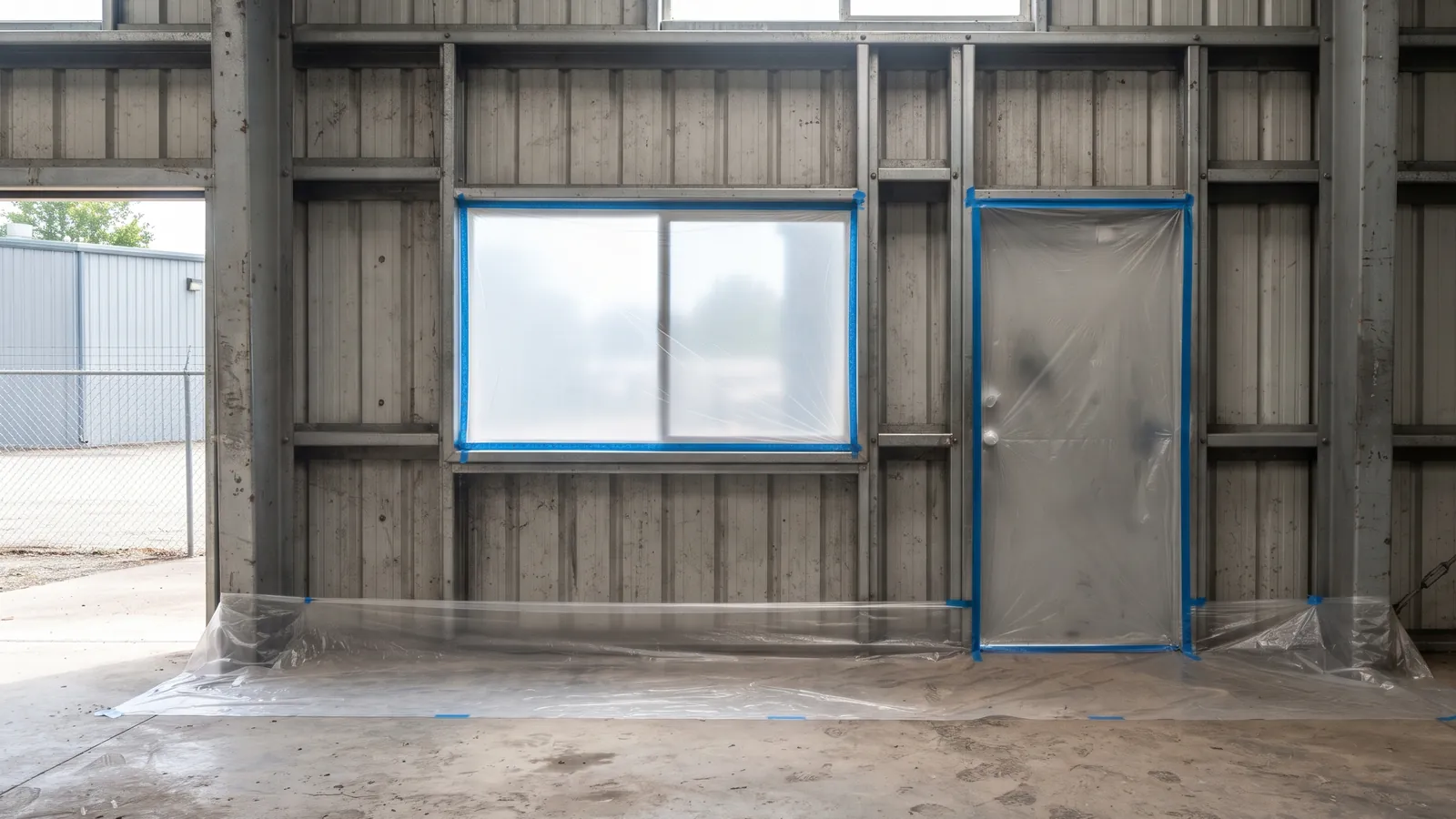
- Masking and covering. What cannot move is covered, and the edges of the spray zone are masked. Foam sticks to what it touches and does not wipe off cleanly, so this step decides how tidy the building looks afterward.
- Readings before spraying. The crew checks the surface temperature of the steel or framing, the air temperature and humidity, and works out the dew point. The reason is simple. Product guides generally call for a surface free of frost and moisture, and a cold surface at or near the dew point is where that moisture collects. If the numbers are outside the product's limits, we do not spray. How those numbers are worked out from a thermometer and a hygrometer is on the dew point and frost point tool.
- Test spray. Does the product's guide require the crew to spray a test patch and check the foam's appearance before starting?
In cold weather there is an extra limit on top of these. A building that cannot be brought up to the product's minimums, or steel that is wet or frosted, gets rescheduled. The winter details are on cold-weather spray foam limits, and the hot-steel side of the year is on hot steel limits.
Spraying in passes
Closed-cell foam is not sprayed all at once. The Department of Energy's Building America guide says closed-cell foam is typically limited to layers of about 2 to 3 inches per pass, with greater thicknesses built from several layers, while open-cell can go on at full thickness in one pass (Building America, "Which Spray Foam Is Right For You?"). That guide is a general reference. On our jobs the limit is whatever the named product's guide says, and the crew sprays no pass thicker than that.
What the passes look like in a steel building:
- Roof and wall steel first. The crew works across the panel faces, around purlins and girts and into the laps and eave gaps where air gets in.
- Layer by layer. A pass goes on, the crew lets it settle as the product's guide allows, checks the depth, and adds the next pass until the planned thickness is reached on each surface.
- Depth checked as it goes. Thickness is read against the number on your estimate, surface by surface. This is how the thickness printed on the final paper is the thickness that is actually there.
- Trimming. If foam rises above its planned depth in a spot where something has to fit, it is trimmed back. Trimming makes dust that stays in the air until the area is cleaned, which is one reason people stay out until the building is cleared.
Why the thickness matters in a building that drips is on the foam-surface condensation check.
Ventilation and re-entry: when you can go back in
Two things happen after the spraying stops: the crew ventilates, and everyone stays out for a set time.
The EPA's ventilation guidance says to continue ventilating after application until the material has cured, off-gassing has stopped and vapors have been removed (EPA, Ventilation Guidance for SPF Application). It also says to exhaust to a safe location outside, away from people and from the air intakes of neighboring buildings. The same guidance says the crew should wear protective equipment, typically including full-face or hooded supplied-air respirators.
For re-entry, the EPA reports that some makers recommend 24 hours after application of the two-component professional system, and that the time varies by product (EPA, Vacate and Safe Re-entry Time for SPF). The U.S. Consumer Product Safety Commission advises that occupants leave during application, that pets be removed too, and that people allow adequate reentry time and ventilation before returning (CPSC, SPF Insulation Health and Safety Recommendations for Consumers). Those are federal sources and apply in Kansas and Missouri as they do anywhere.
Our rule follows from them. We give you the maker's written re-entry time for the product we spray, and nobody goes back in earlier. If a strong odor lingers after that time, tell us. The health and re-entry questions have their own page, spray foam safety and re-entry.
Clean-up and the dated record you receive
When the passes are done and the ventilation has started, the crew cleans up: masking comes off, overspray and trimmings are removed, covers are lifted from detectors and sprinkler heads, and the rig and hose are packed.
You receive a dated record of the job. The estimate fields are covered on the estimate page; the spray-day record adds what the crew read and wrote down while working:
| Record | Why it is kept |
|---|---|
| Surface temperature and dew point before spraying | Shows the foam went onto a surface inside the product's limits |
| Thickness of each pass and the final thickness per surface | Matches what is installed against what was estimated |
| Lot numbers of the chemical used | Lets the maker or the crew trace the product if a question comes up later |
| The date and the crew | Ties the work to one day and one team |
What to expect in terms of time
We print no number of days on this page. How long a spray foam job takes depends on the area, the thickness, access and weather. Our own crew's production rate has not been measured yet, and we will not guess one. The estimate after the visit tells you how long your building will take, in writing.
FAQ
Do I need to move things out before spray foam?
Yes. People, pets and food go out for the time the maker states, and sensitive equipment is moved or covered. The full checklist is above. The crew masks and covers whatever cannot move.
What does the crew need from me on a winter job?
Power or access for heat, a building that can be brought to the product's minimums, and dry, frost-free steel. Winter spraying is possible with a winter-blend foam and heated steel. The minimums come from the named product's data sheet, and we reschedule when they are not met. More on cold-weather spray foam limits.
How long does it take to spray foam a building?
It depends on board feet, access and weather, and we print no day count until our production rate is measured. The visit gives you your job's estimate in writing: the free estimate visit.
Is spray foam installation messy?
Overspray is controlled by masking and covering what stays in the building. The rig stays outside with the hose run in. What you should move out is on the checklist, and the clean-up step covers the rest.
Can I stay in the building while it is sprayed?
No. The EPA and CPSC both advise that occupants leave during installation, and that applies to employees and visitors as well as the household. See the re-entry section above for when to come back.
Book a free on-site measurement
If you are comparing what happens on spray day against another company's description, the visit is when we walk your building against this page. We measure, note what would have to move, and send a written estimate. The visit is free.
Book a free on-site measurement
Pick "Spray foam insulation" on the booking form. We work within about 35 miles of Spring Hill, KS.
Spray foam insulation is a new PolyJacks service line run by its own crew and rig.
Who wrote this: PolyJacks spray foam team. Last updated: October 27, 2026. How it was made: drafted with AI assistance from the sources below, then checked against each source.
Sources
- U.S. EPA, Vacate and Safe Re-entry Time for Spray Polyurethane Foam Application (archive): archive.epa.gov
- U.S. EPA, Ventilation Guidance for Spray Polyurethane Foam Application (archived 2017 snapshot): 19january2017snapshot.epa.gov
- U.S. Consumer Product Safety Commission, Spray Polyurethane Foam Insulation: Health and Safety Recommendations for Consumers: cpsc.gov
- U.S. Department of Energy, Building America, "Which Spray Foam Is Right For You?" (Steven Winter Associates, 2009): www1.eere.energy.gov
Ready for a measurement?
Book a free on-site visit. We measure first, then quote in writing.
Book a free on-site measurement
We measure the building first, then you get a written quote. Prefer to talk? Call (913) 713-7794.