
Who Sprays Your Building: Our Spray Foam Applicator Crew and Rig
A spray foam applicator is the person holding the gun, and on a PolyJacks job that person is a PolyJacks employee, working from the POLY 10 rig and our own scissor lift. This page says who that is, what the equipment does, what a crew's respirator program has to contain, and the paperwork you can ask any crew for before they come into your building. Use the paperwork list with any crew you are considering, ours included.
We spray closed-cell foam inside buildings, within about 35 miles of Spring Hill, KS. We do not do crawl spaces, we do not remove old insulation, and we do not blow in fiberglass or cellulose or spray open-cell foam. Our service overview is on our spray foam insulation service.
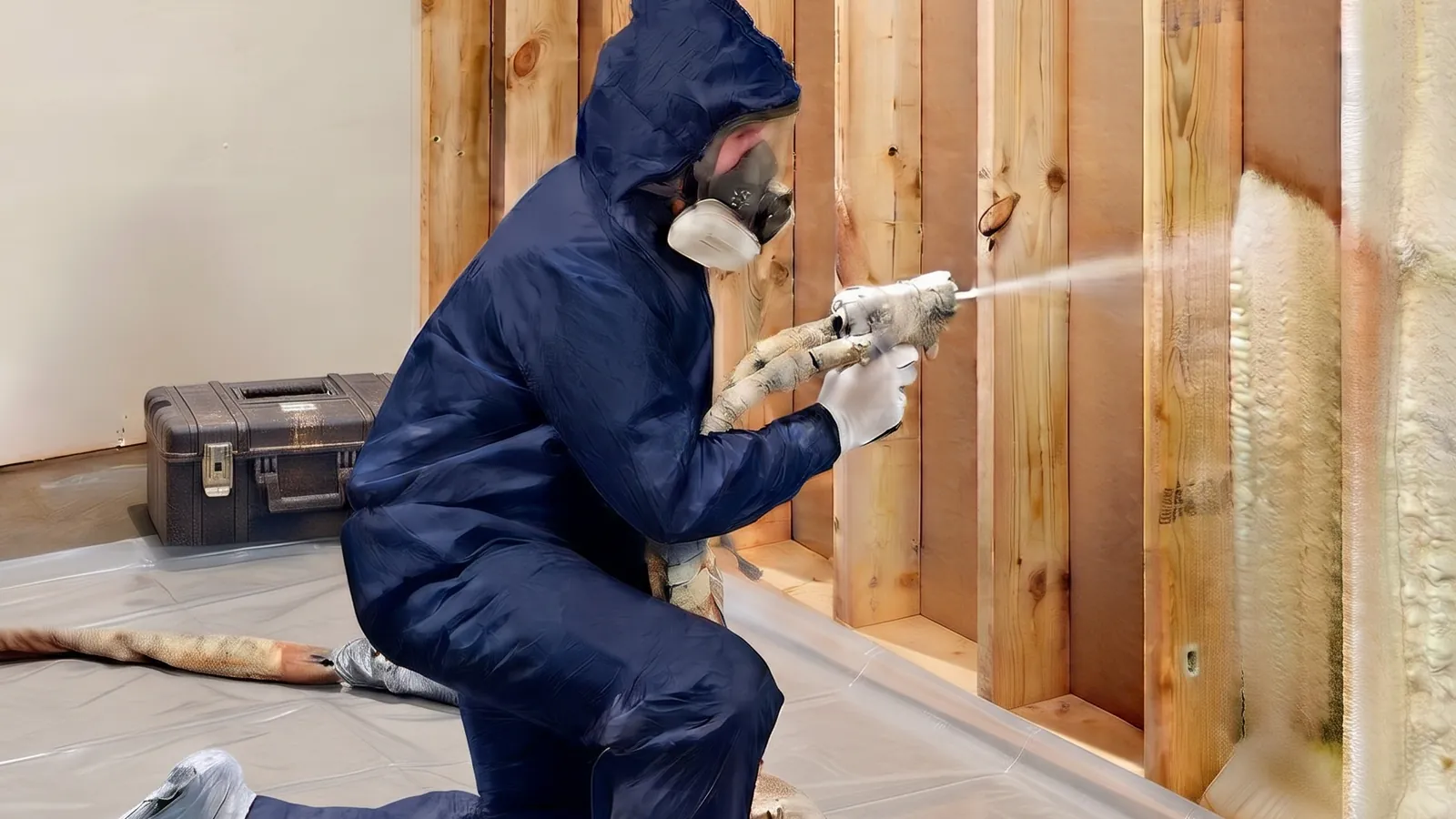
Who sprays: the spray foam applicator is an employee
The crews on the rig are PolyJacks employees. They are not subcontractors hired for the day, and no one is handed the job by a third party. For you, that means the person who answers questions on the day belongs to the company whose name is on your estimate.
What that does and does not tell you:
- It tells you who is responsible. One company writes the estimate, runs the rig and answers for the finished work.
- It does not tell you the crew is experienced. We are starting this service line, and we have not finished a spray foam job yet. We would rather say that here than let a page imply a track record. The sections below cover the paperwork to ask any crew for in place of a history.
- It does not name individuals. A crew lead appears on this page by name only if that person agrees in writing. Until then the page names the company and the rig.
Our spray foam crew and the work we take
A short list helps you judge whether we are the right call before you book.
| You have | We spray it? |
|---|---|
| A steel shop, metal building or machine shed | Yes, on the inside faces. See spray foam for metal buildings |
| A post-frame barn or pole building | Yes, inside. See spray foam for pole barns |
| A commercial roof deck | Yes, from inside the building |
| A house attic, garage or wall | Not yet. Residential work opens after our first finished job |
| A crawl space | No, we do not do crawl spaces |
| Old insulation that has to come out first | No. You arrange removal before spray day |
| A request for blown-in or open-cell | No. We spray closed-cell only |
The full service, from the first call to the written estimate, starts at spray foam insulation in the Kansas City area. Steel buildings are covered on spray foam for metal buildings.
The rig and the lift
Two-component spray foam is made on the job. The Department of Energy's insulation consumer guide describes the foam as a mixture of two chemicals that combine and are sprayed through a hot hose to form polyurethane (U.S. DOE, Energy Saver, Consumer Guide to Home Insulation). A Department of Energy Building America guide puts the two sides more specifically: an isocyanate on one side and a blend of polyol resins and additives on the other (Building America, "Which Spray Foam Is Right For You?"). Everything the rig does is about keeping those two liquids at the right temperature and ratio until they meet at the gun.
| Piece of kit | What it does | What we can state today |
|---|---|---|
| POLY 10 rig | The spray rig as a whole: the proportioner, hose and the chemical supply working together | It is our own rig, run by employees |
| PMC PH-2 proportioner | Meters the two components and pushes them to the gun | It is the proportioner on the POLY 10 |
| 200 ft of heated hose | Carries both components to the gun while keeping them warm | The rig stays outside and the hose runs in, up to 200 ft |
| Scissor lift | Puts the gun at the roof and upper wall steel without ladders | We own the lift for ceilings up to 24 ft; a taller building needs rented equipment, which we plan for |
Two plain consequences of the layout. First, the rig stays outside the building and only the hose goes in. Second, a 200 ft hose limits how far from the door we can park, so the visit measures the walk from where the rig will sit to the farthest wall. That distance is one reason we look at a building before writing an estimate; the visit is described on the free estimate visit.
The chemical we spray is a closed-cell product from a named maker, and its data sheet sets the temperatures, the pass thickness and the re-entry time we follow. What it is, and what its published properties are, is on closed-cell spray foam.
What a spray foam crew's respirator program has to contain
Spray foam components are chemicals that no one should breathe during application, so the rule that governs respirators matters to anyone choosing a crew. Federal respiratory protection rules require an employer whose people wear respirators to keep a written program. As the regulation lists it, the written program has to cover how respirators are selected, medical evaluations, fit testing for tight-fitting masks, use in routine and emergency situations, cleaning, storage and repair, the quality of any supplied breathing air, training on the hazards and on the equipment, and regular review of whether the program works. It also requires a qualified program administrator, and the employer pays for respirators, training and medical evaluations (29 CFR 1910.134(c), via Cornell LII).
The EPA's contractor checklist for high-pressure two-component foam covers the same ground in plainer words: training before work starts, protective clothing, respirators matched to the hazard, equipment checks, and keeping other people out of the work area until the building is safe to re-enter (EPA, Contractor Checklist: Safer Workplace Practices for Installing High-Pressure, Two-Component SPF). The EPA's workplace page adds that the crew should read the label and the safety data sheet and follow them (EPA, Safer Workplace Practices for SPF Installation). These federal sources apply in Kansas and Missouri alike.
This page describes the rule so you know what a written program contains. Ask any crew to show theirs before the day.
Certificate of insurance
Ask any crew for a certificate of insurance before the day. The insurer issues it, and it lists the kinds of coverage, the policy dates and the insurer's name. Check that the dates cover the day of the job.
What to ask any spray foam professionals before they spray
Use these questions with us or anyone else. A good crew will answer them without hesitation, and a vague answer tells you something.
| Ask | A usable answer sounds like | Our answer, or where to look |
|---|---|---|
| Are the people spraying your employees? | Yes, and by name of the company on the estimate | Yes: employee crews |
| Which foam, and may I see its data sheet? | A product name and a sheet you can read before the day | The data sheet lines are explained on closed-cell spray foam |
| Do you have a written respiratory program? | Yes, with fit-test and medical dates | The contents of a written program are listed above |
| Can I see a certificate of insurance? | A certificate from the insurer, dated and current | Read the policy dates and coverage types on the certificate itself |
| What do you want me to do before you arrive? | A written checklist | See what happens on spray day |
| What do I get in writing after? | The area, thickness, R-value and a date, signed | See the free estimate visit |
| Who comes back if something is wrong? | A named company and a phone number | Us: the same company that sprayed |
A longer vetting guide, with what to do with the answers, is on how to vet a spray foam crew.
FAQ
Who actually sprays the foam?
PolyJacks employee crews. We do not use subcontractors for the spraying, and we do not put a name on the page unless the person agrees to it in writing.
What equipment do you use for spray foam?
The POLY 10 rig with a PMC PH-2 proportioner and 200 ft of heated hose, plus our own scissor lift. The lift covers ceilings up to 24 ft; a taller building needs rented equipment, which we plan for that building. We make no claim beyond the facts listed in the equipment table.
Are your spray foam installers employees or subcontractors?
Employees. PolyJacks crews are on the company's payroll, not hired in by the job. For training and insurance, use the questions in the table above with any crew, ours included.
How do you keep the chemical warm in winter?
Closed-cell data sheets set two kinds of limits: how warm the drums must be before spraying, and the lowest air and surface temperatures for the work. The two maker sheets quoted on cold-weather spray foam limits put drum temperatures between 55 F and 80 F, and the heated hose holds the chemical at that temperature from the rig to the gun. Our product's own sheet decides the numbers on your job. Winter limits for the building itself are on cold-weather spray foam limits.
What safety gear does the crew use?
The EPA's contractor checklist lists the gear for this work: respiratory protection for indoor and outdoor spraying, chemically resistant gloves such as synthetic rubber, protective coveralls, eye protection, head coverings and foot protection. It also calls for a portable eyewash on site and says only protected workers stay in the work area during spraying, curing and cleanup (EPA, Contractor Checklist). The exact respirator type comes from the written respiratory program described above, matched to the product we spray. For what you should do about re-entry and ventilation after spraying, see spray foam safety and re-entry.
Book a free on-site measurement
If you want to see the rig's reach, the building's access and the work in person, the first step is a visit. We measure the building, note how the rig and lift would get to it, and send a written estimate afterward. The visit is free.
Book a free on-site measurement
Pick "Spray foam insulation" on the booking form. We work within about 35 miles of Spring Hill, KS.
Spray foam insulation is a new PolyJacks service line run by its own crew and rig.
Who wrote this: PolyJacks spray foam team. How it was made: drafted with AI assistance from the sources below, then checked against each source.
Sources
- U.S. Department of Labor, OSHA, 29 CFR 1910.134, Respiratory protection, paragraph (c), via Cornell LII: law.cornell.edu
- U.S. EPA, Contractor Checklist: Safer Workplace Practices for Installing High-Pressure, Two-Component SPF Insulation (archived, created January 26, 2015): archive.epa.gov
- U.S. EPA, Safer Workplace Practices for Spray Polyurethane Foam Installation (archived 2017 snapshot): 19january2017snapshot.epa.gov
- U.S. Department of Energy, Energy Saver, Consumer Guide to Home Insulation (DOE/EE-2476): energy.gov
- U.S. Department of Energy, Building America, "Which Spray Foam Is Right For You?" (Steven Winter Associates, 2009): www1.eere.energy.gov
Ready for a measurement?
Book a free on-site visit. We measure first, then quote in writing.
Book a free on-site measurement
We measure the building first, then you get a written quote. Prefer to talk? Call (913) 713-7794.