
How to Choose a Spray Foam Contractor: 12 Questions and What Good Answers Look Like
How to choose a spray foam contractor comes down to twelve questions, and the paper behind each answer. Ask and ask for the paper behind each answer: a certificate of insurance, the product's data sheet, a written respiratory program, proof of any certification, a re-entry time in writing, and a dated, signed receipt that states the thickness and R-value. A contractor who is happy to hand those over before you sign is usually easier to trust than one who talks well and sends nothing.
The list works on anyone, including us. PolyJacks is a new spray foam crew with no finished insulation job yet, so the section called Our own answers applies the list to us, and it covers only what is true today.
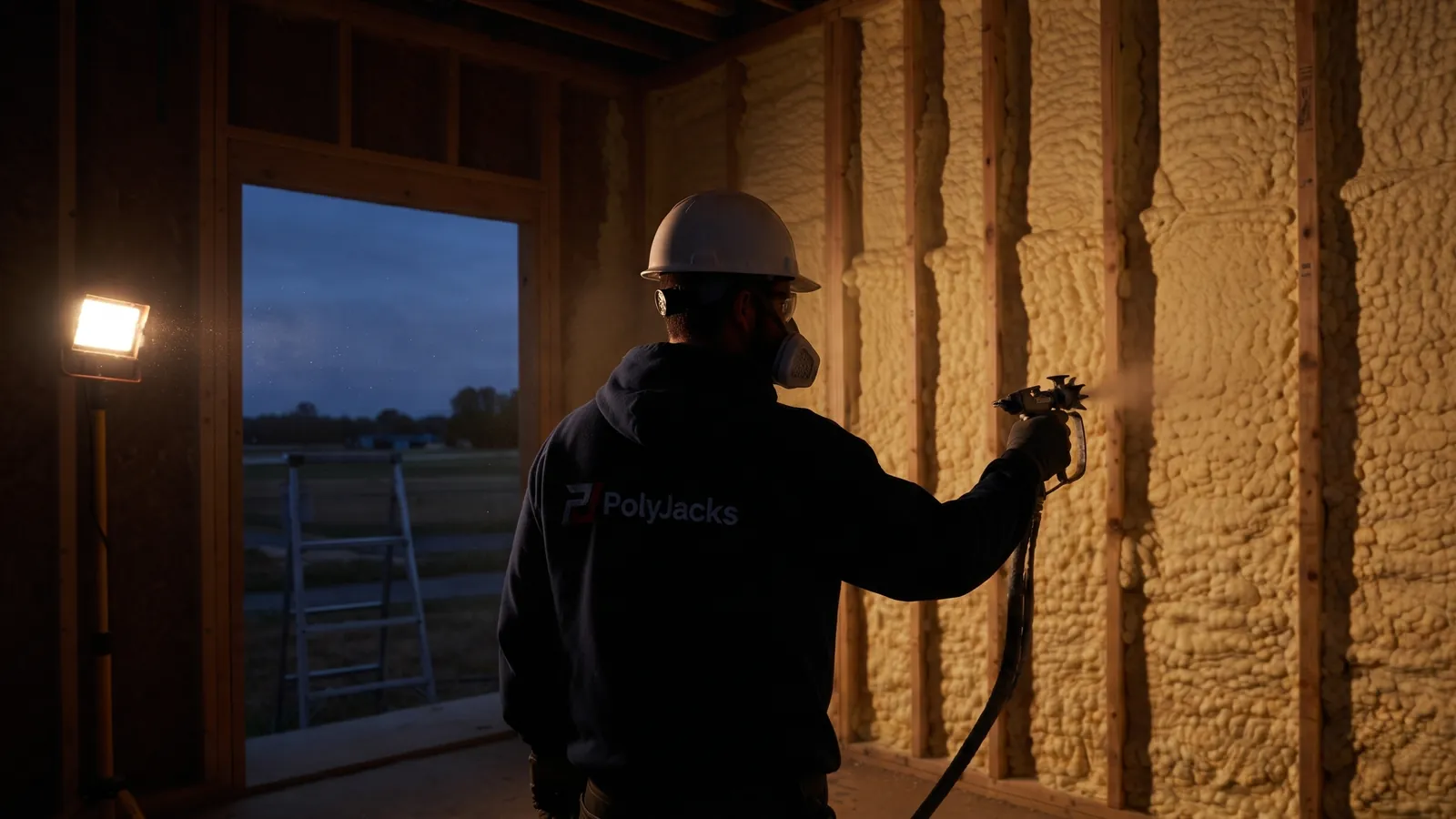
How to choose a spray foam contractor: the twelve questions
Use the table in order. The middle column describes an answer worth trusting, and the right column is what to ask to see.
| # | Ask | A good answer looks like | The proof to ask for |
|---|---|---|---|
| 1 | Which exact product will you spray, and who makes it? | A product name and maker, said without hedging | Its technical data sheet (TDS) and safety data sheet (SDS), as PDFs |
| 2 | Is it closed-cell or open-cell, and why for my building? | A reason tied to your building's moisture, heat and access | The data sheet lines for R-value per inch and permeance |
| 3 | What thickness will you spray, and how did you choose it? | A number in inches and a method, not "whatever it takes" | The thickness written into the estimate |
| 4 | What does the foam have to be covered with in my building? | "Ask the building official," plus the product's evaluation report | The evaluation report (ESR) page with the barrier listing |
| 5 | What insurance do you carry? | General liability, and a clear answer on pollution coverage | A current certificate of insurance naming you as certificate holder |
| 6 | Are your workers employees, and are they covered? | A direct yes or no about crew status and workers' compensation | A certificate that shows the coverage |
| 7 | What licence or registration applies where my building stands? | The office that issues it and the name of the permit or registration | The agency's own page or a number you can look up |
| 8 | Who is trained, by whom? | Named training from the product maker or an industry program | A certificate or a directory listing you can check |
| 9 | Do you have a written respiratory protection program? | Yes, with medical evaluation, fit testing and training | The program document, or its table of contents |
| 10 | When can people re-enter, and for whom? | A time stated by the product's guide, in writing | The product's re-occupancy language |
| 11 | What do you check before and during spraying? | Surface temperature, humidity, mix ratio, and thickness readings, logged | A sample log from a past job |
| 12 | What will the receipt show? | Coverage area, thickness and R-value, with a date and signature | A blank copy of the receipt |
What the questions are really testing
Questions 1 to 4 test whether the contractor knows the material. Questions 5 to 9 test whether the business can pay for a mistake and protect its own people. Questions 10 to 12 test whether anything will be written down. Wherever a contractor answers a question out loud but cannot put it on paper, treat the answer as unconfirmed.
The paper to ask for
A certificate of insurance, read carefully
A certificate is a summary of a policy, not the policy. Read three things on it. First, the policy period: it should be current on the day of the job. Second, the coverage types listed: general liability and, for employees, workers' compensation. Third, any note on pollution coverage, because spray foam is a chemical process. Ask the contractor to say in writing whether pollution is covered. Never accept "we're fully insured" as an answer on its own.
Workers' compensation rules differ by state and by payroll. Whatever the rule, ask for a certificate that covers the people who will be in your building.
The product's own sheets
A maker's TDS lists density, R-value per inch, permeance and temperature limits. The SDS covers hazards and personal protective equipment. The ESR, where one exists, records the barrier a building needs over the foam. A contractor who cannot name the product cannot give you any of these. What each line of a data sheet should say is walked through on closed-cell spray foam: what a data sheet should tell me.
A written respiratory program
Federal workplace rules say that where respirators are necessary to protect employees, the employer must run a written respiratory protection program with procedures specific to the worksite. The same rule lists medical evaluations, fit testing for tight-fitting respirators, and training on the hazards (29 CFR 1910.134, Cornell LII). This is a federal rule that applies in Kansas and Missouri alike, though a state with its own approved plan may add to it. Ask to see the program. A good contractor can show you one without fuss.
Training and certification
Certification in this trade is voluntary, and a missing certificate does not by itself mean poor work. The industry association for spray foam runs a Professional Certification Program (PCP) that tests the knowledge and skills of installers and contractors, and it points customers to a member directory and a phone line for verifying a name (SPFA PCP page). A maker's own installer training is another kind of training. The point is the same for both: ask for the document, then check it with the issuer, not with the contractor.
The receipt
Federal insulation rules say that a receipt for installed insulation must show the coverage area, thickness and R-value, and that it must be dated and signed by the installer (16 CFR 460.17, Cornell LII). That rule is aimed at home insulation, but the fields are the right ones to ask for on a barn or shop too. Ask for them up front. How R-value should read on that paper is covered on closed-cell R-value per inch.
Licences and registrations: it depends on the office
Ask your city or county which licence, if any, covers spray foam work, because the rules are set office by office. Two offices we opened show how much they vary:
- Kansas City, Missouri lists its licensed trades on its contractor licensing page: demolition, electrical, elevator, fire protection, gas-fired appliances, mechanical, operating engineers, plumbing, residential building and sign work. Insulation is not among them, so ask the office whether your job needs a permit or a license (City of Kansas City, MO, contractor licensing).
- Lawrence, Kansas licenses roofing contractors, and that license is described as covering installation of roof insulation panels or other roof insulation systems (City of Lawrence, contractor licensing). So foam on a roof can fall under a different category than foam on a wall.
Until you have the page for your own address, assume nothing: call the building or permit office and ask. The practical question to put to a contractor is "What does this office require for this job, and what number can I look up?"
Red flags
- A firm number before anyone has measured the building. Foam is sold by volume, and volume starts with measurements.
- No product name. "We use the best stuff" is not a product.
- A thickness chosen without any look at moisture, heat or code.
- A claim of being fully covered with no document to show.
- Pressure to sign today.
- No mention of who has to stay out, or for how long.
- A contractor who says no barrier or covering is ever needed. Only the building official and the product's report decide that.
None of these proves bad work on its own. Several together are a reason to move on.
Our own answers
Spray foam insulation is a new PolyJacks service line run by its own crew and rig. This section answers only what is true today: who sprays, and what we have finished.
- Crew: employees. The rig is the POLY 10 with a PMC PH-2 proportioner and 200 feet of heated hose. More on our crew and rig.
- Finished insulation jobs: none yet. We will not show a sample log or a past receipt until one exists.
Common questions
Do spray foam contractors need a license in Kansas?
It depends on the city or county where the building is, so check that office. Kansas does not appear to hand out one license for spray foam, but local rules vary, and roofing is treated separately in some places. We list the offices we opened above, and none replaces a call to your own permit office.
What insurance should a spray foam contractor have?
General liability that addresses pollution coverage, plus workers' compensation for employees. Read the certificate for the policy dates and the coverage types, and ask in writing about pollution. We name no insurer here.
Are spray foam installers certified?
Some are, and the main industry program is the SPFA's Professional Certification Program. Certification is voluntary, so ask for the certificate and check it with the issuer. This page makes no claim that PolyJacks is certified, and we will say "certified" only with a document to show for it.
Can I just do spray foam myself instead?
You can buy kits, but the work involves chemicals and protective gear, and the questions above still apply to a kit seller. A fuller comparison is on doing spray foam yourself. For things that go wrong when the work is poor, see what goes wrong with spray foam.
Book a free on-site measurement
A visit is the best way to test a contractor, because you can ask all twelve questions in person. Ours is free, and the estimate that follows is written. How to book the measurement visit explains what happens. For the service as a whole, see our spray foam insulation service.
Book a free on-site measurement
Pick "Spray foam insulation" on the booking form. We work within about 35 miles of Spring Hill, KS.
Who wrote this: PolyJacks spray foam team. How it was made: drafted with AI assistance from the sources below, then checked against each source.
Sources
- 16 CFR 460.17, insulation receipt requirements, Cornell Legal Information Institute: law.cornell.edu
- 29 CFR 1910.134, respiratory protection, Cornell Legal Information Institute: law.cornell.edu
- Spray Polyurethane Foam Alliance, Professional Certification Program: sprayfoam.org
- U.S. Environmental Protection Agency, SPF insulation safety (archived Safer Choice page), used for the re-entry question: archive.epa.gov
- City of Kansas City, Missouri, Contractor licensing: bizcare.kcmo.gov
- City of Lawrence, Kansas, Contractor licensing: lawrenceks.gov
Ready for a measurement?
Book a free on-site visit. We measure first, then quote in writing.
Book a free on-site measurement
We measure the building first, then you get a written quote. Prefer to talk? Call (913) 713-7794.