
Spray Foam on Metal Roof Panels: Spraying the Underside
Spray foam on metal roof panels goes on the underside of the panels, from inside the building, in thin passes that build into one continuous layer. The foam bonds to the steel, closes the laps and fastener holes against moving air, and keeps damp room air off cold metal. Three decisions come before anyone sprays: whether the foam also wraps the purlins, whether the roof is tight enough to foam over, and what you will do the day the roof is replaced.
PolyJacks sprays closed-cell foam only, inside buildings within about 35 miles of Spring Hill, KS. We do not do blown-in or open-cell, and we do not remove old insulation. This page is about the roof panel itself. For the whole-building view, start with spray foam for metal buildings. If the reason you are here is drips, the moisture side is on why metal buildings sweat.
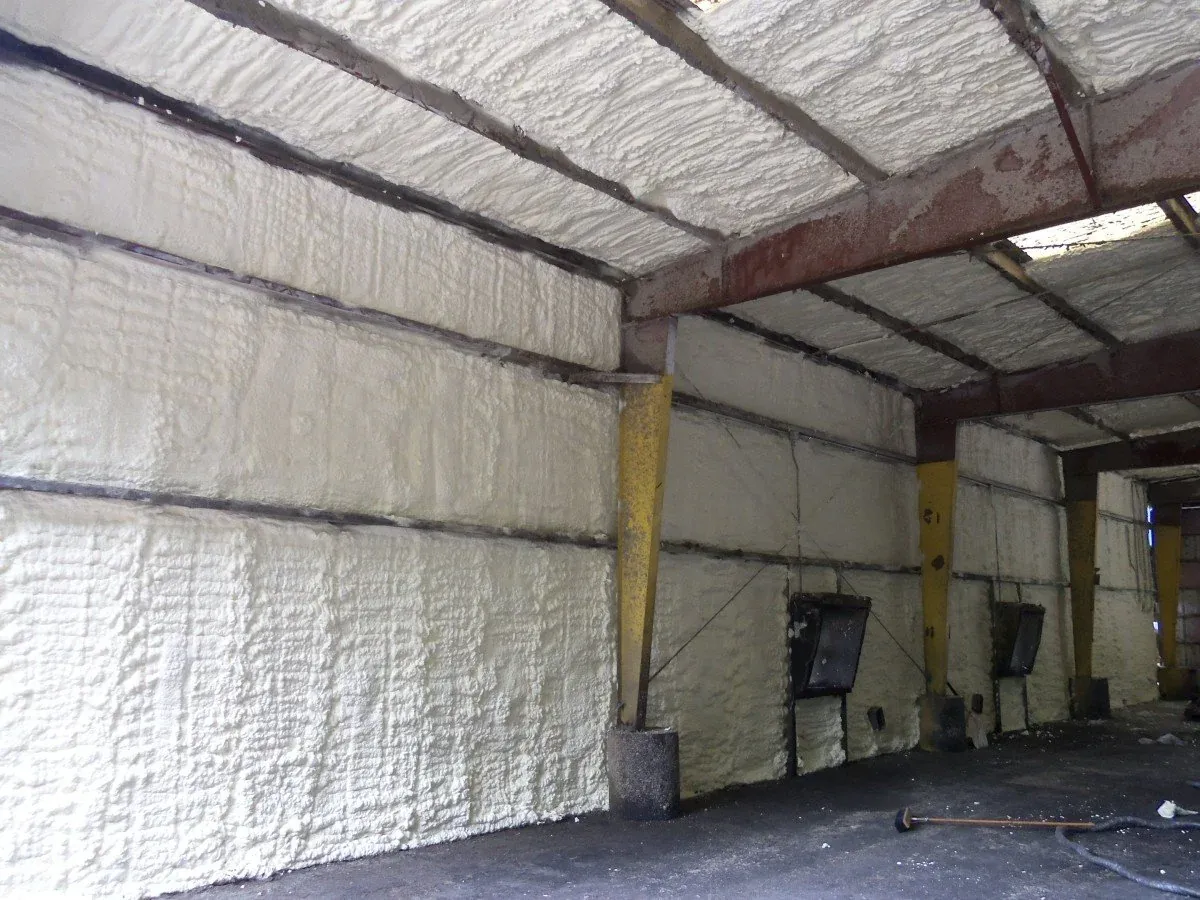
Spray foam on metal roof panels: what happens underneath
Steel roof insulation has one awkward feature: the panel is both the weather skin and the surface the foam grips. Whatever sits between foam and steel, such as dust, oil, or dew, becomes the weak layer.
The surface comes first. One closed-cell maker's application guide says surfaces must be clean, dry and free of dew or frost, and that metal must be free of oil and grease (Foamsulate Closed Cell application guide, Carlisle, 2021). We are quoting one product's guide to show the kind of rule that exists; the product we spray has its own guide and report.
The foam goes on in passes. The same guide says each pass has a maximum thickness, that the crew waits between passes for the foam to cool, and that spraying too thick in one pass can overheat the foam and cause charring or, in some conditions, combustion hours later. A roof is a place where that matters, because the foam is overhead and the crew works from a lift. PolyJacks owns a scissor lift for roof and high-wall work. It reaches ceilings up to 24 feet; a taller roof needs rented equipment, which we plan building by building.
The air and vapor path closes. A metal roof has long side laps, end laps, ridge closures and a long run of fastener holes. Each one lets room air touch cold steel. Continuous closed-cell foam covers them in one layer. Nobody can promise it seals a hole that already leaks rain, which is why the leak check below exists.
The panel is not the only surface. Eave struts, ridge closures, rake trim and the tops of walls where the roof meets the wall all matter. They are covered in the building guide linked above.
Fire code: what covers the foam
Exposed foam in an occupied building is a fire-code question before it is an insulation question. The 2018 IBC section 2603.4 says foam plastic must be separated from the interior by an approved thermal barrier, with half-inch gypsum wallboard as the example, except where 2603.4.1 or 2603.9 provides otherwise (2018 IBC Chapter 26, UpCodes Kansas viewer). Section 2603.9 allows an approved assembly based on large-scale tests, which in practice means the product's evaluation report lists the exposed assembly.
Section 2603.4.1.5 is titled "Roofing", and the text we opened reads as covering foam that is part of a Class A, B or C roof-covering assembly. That is a roof-cover assembly, not foam sprayed on the underside of an existing panel. Do not read it as permission to leave foam bare. Ask the building official which section applies to your roof, and see what must cover spray foam for the questions to take. This page does not tell you a barrier is unnecessary.
The code section numbers are for Kansas as printed by UpCodes. Your city or county may have adopted another edition, so ask which one; the permit pointer is insulation permits and adopted codes.
Cover the purlins or not
On a typical steel roof the panels sit on top of the purlins. From below you see the purlin faces and the panel between them. Foam always goes on the panel. The choice is what happens at the purlin.
| What is being compared | Foam the panel between purlins, leave purlins bare | Foam the panel and wrap the purlin face |
|---|---|---|
| Thermal bridging | Each bare purlin is a steel strip joined to the roof skin. It carries heat and cold straight through | The strip is covered, so the cold path is interrupted |
| Condensation | A cold purlin edge can still sweat where damp air reaches it | Fewer cold surfaces for damp air to reach |
| Inspecting the steel later | Purlin faces and fasteners stay visible | Purlins are hidden under foam |
| Board feet | Less foam | More foam, because the purlin faces and edges add area |
| Best fit | Unheated storage where the aim is only to stop drips | A building you heat or cool, where the cold strips would cost comfort |
Purlin bridging is not a rumor. The NAIMA install guide for fiberglass in metal buildings describes thermal blocks used to cut the loss where blanket insulation is compressed between purlins and the roof sheet (NAIMA MB316). That is a fiberglass publication, but the physics is the same for foam: a continuous steel member next to a thin layer is a short path for heat.
How we decide. The answer follows from how the building is used, not from a default. We measure the purlin spacing and depth on the visit, count what a wrap adds in area, and give you both versions in the written estimate when the choice is close. Wrapping adds foam, which changes the estimate; leaving purlins bare changes how cold the strip gets. If your goal is only to stop dripping, the foam-surface check on how thick closed-cell foam should be tells you whether the foam's room face stays above the dew point. If the answer is borderline, wrapping is the safer lean.
This page prints no thickness numbers on purpose. Thickness belongs to the method on the thickness page, because it depends on your inside air, not on the roof alone.
Leak check before foam
Closed-cell foam is not a roof repair. Foam stops moving air; a roofer stops rain. A roof that leaks should be fixed from above before anyone sprays below.
The reason is hidden damage. A Green Building Advisor reader thread about foam under a roof deck turned up two camps. Its editor wrote "Eventually, all roofs leak," and said a ceiling stain is the usual first sign. Another reader answered "You can't" when asked how to detect a leak once foam is on (GBA Q&A, March 2017). A metal-roof thread from 2022 shows owners asking the same thing, and whether they could still inspect or pull panels once foam bonds to the metal (GBA Q&A, March 2022). Those are forum posts, not studies, so we use them for what people ask, not for facts about rates. Those threads come from New York and Florida, but a bonded foam layer hides the steel in Kansas the same way.
The pre-spray hose test. On the visit, and before foam, the plan is a water test of the roof. One person on the roof wets the panel with a hose, starting at the eave and working up the slope, while another person inside watches with a flashlight. That is the method a home-repair publisher describes for finding roof leaks (HomeTips, roof leaks). We aim it at the places water enters a metal roof:
- Side laps and end laps.
- Fastener rows, especially where washers have aged.
- Ridge and eave closures, and any skylight or vent curb.
- Panel-to-wall flashings.
Stains are logged. Existing water stains on the underside, rust at fastener holes, and any drip seen during the test are photographed and written down with their location before spraying. That record protects you and us: it shows what was wet before foam, and it gives the roofer a map.
What we will not do. We do not repair roofs and we do not seal fasteners. If the test finds a leak, you arrange the roofer, and the foam waits. We do not claim foam stops screw leaks. A foam layer may bridge small gaps, but no source we opened says it fixes them, so we make no such claim. The longer discussion of foam problems is on closed-cell spray foam problems to avoid.
If the roof is old and tired, the better question is often whether to re-roof first. That decision is next.
Re-roofing a foamed roof later
The simplest reading is that foam bonded to a panel stays with that panel. If the panel comes off, the foam on it comes off with it, and the newly exposed steel or roof deck needs foaming again. That is our reading of how bonded foam works, not a tested claim, and the roofer's method decides the details.
Options to discuss with your roofer before spraying:
- Re-roof first if the roof is near the end of its life. Foam then goes under panels that will be there for decades.
- Plan for a re-foam of the affected area. Panels come down in sections, and the foam under each section is redone as part of the job.
- Ask whether a new roof can go over the old one. Some metal roofs can be recovered over existing panels, which leaves the foamed panel in place. Whether that is allowed on your building depends on the roof system and the building official.
- Keep a map of what was foamed. The foam record, with the photos from the leak check, tells the next contractor what is under the panels.
We do not print a cost for any of this, and we will not guess at it here. The written estimate after the visit covers the foam work. The roofer's work is quoted by the roofer.
One more point about timing: noise and heat are separate topics. Rain noise on steel is covered on rain noise on a metal roof, and a drip-stop membrane compared with foam is on drip-stop vs spray foam. Foam trapping moisture against wood is covered on spray foam and wood rot, and the dew-point side of a roof is easiest to work out with the dew point and frost point tool.
About PolyJacks
Spray foam insulation is a new PolyJacks service line run by its own employee crew and rig. We have not yet finished an insulation job, so this page makes no claims about past jobs. Our equipment is the POLY 10 rig with a PMC PH-2 proportioner and 200 feet of heated hose, plus a scissor lift for roof and high-wall work.
FAQ
Can you spray foam the underside of a metal roof?
Yes, as a service. Closed-cell foam can be sprayed on the underside of a metal roof panel, and it does not come with an automatic pass on the fire code. Foam left exposed in an occupied building normally needs a thermal barrier or an approved tested assembly under IBC 2603.4 and 2603.9, and the building official makes the call for your roof. This page makes no barrier claim; the product's evaluation report is the document to ask any contractor for. The question list is on what must cover spray foam.
Is 1 inch of spray foam enough under a metal roof?
Sometimes for condensation, rarely for heat. The test is whether the foam's room-side face stays above the dew point of your inside air on a cold night; if it does, the steel behind it stays dry. That depends on the named product's R-value at that thickness from its data sheet, on how warm and damp the room is kept, and on gaps. The check is steady-state, so it does not model a sudden warm-up, and a void or missed lap defeats it. The method is on the foam-surface condensation check.
Does spray foam stop a metal roof from leaking at the screws?
No. Foam is not a roof repair. A roofer fixes the leak before foam goes on, because foam can hide a leak after it does (see what goes wrong with spray foam). If the pre-spray hose test finds a wet fastener row, the plan is a roofer first and foam second.
Will spray foam on a metal roof cause problems when replacing it?
Foam bonded to the panel comes off with the panel, so a re-roof usually means re-foaming that area. The roofer and you choose how the panels come down, and whether a recover is possible over the old panels, before foam goes on. We do not publish a cost for a re-foam; the written estimate covers it when the time comes.
Book a free on-site measurement
A drive-by cannot see what is under a roof, so the estimate starts with a visit. We measure the roof area, note the purlin layout, check the laps and fasteners, and talk through how you use the building and whether a re-roof is coming. You get a written estimate after the visit. The visit is free.
Book a free on-site measurement
Pick "Spray foam insulation" on the booking form. We work within about 35 miles of Spring Hill, KS. How the visit works is on book a free on-site measurement.
Who wrote this: PolyJacks spray foam team. How it was made: drafted with AI assistance from the sources below, then checked against each source.
Sources
- International Code Council, 2018 International Building Code, Chapter 26 (sections 2603.4, 2603.4.1.5, 2603.9), via the UpCodes Kansas viewer: up.codes
- Carlisle Spray Foam Insulation, Foamsulate Closed Cell Application Guide (2021), an example of a maker's rules for surface, passes and ventilation: sprayez.com
- NAIMA, Recommendations for Installing Fiber Glass Insulation in Metal Buildings (MB316): insulationinstitute.org
- GreenBuildingAdvisor, "How to detect a roof leak after having the underside of the roof deck sprayed with closed-cell foam?" (Q&A, March 2017): greenbuildingadvisor.com
- GreenBuildingAdvisor, "Spray foam directly on underside of metal roof" (Q&A, March 2022): greenbuildingadvisor.com
- HomeTips, "Roof leaks" (water-test procedure): hometips.com
Ready for a measurement?
Book a free on-site visit. We measure first, then quote in writing.
Book a free on-site measurement
We measure the building first, then you get a written quote. Prefer to talk? Call (913) 713-7794.