
Insulating an Existing Metal Building That Already Has Old Insulation
Insulating an existing metal building that already has old insulation usually starts with taking the old layer out. A faced blanket, bubble foil or fabric liner sits between the steel and any foam you would add, and closed-cell foam is meant to bond to clean steel. PolyJacks does not remove insulation: you, or a contractor you hire, clear it before spray day, and the free visit records what is there so the written estimate is for bare surface.
This page is the triage. Find what you have in the table, see whether it comes out, and read what is checked on the steel once it is gone. The foam itself, the fire-code path and how it goes on are covered on spray foam for metal buildings.
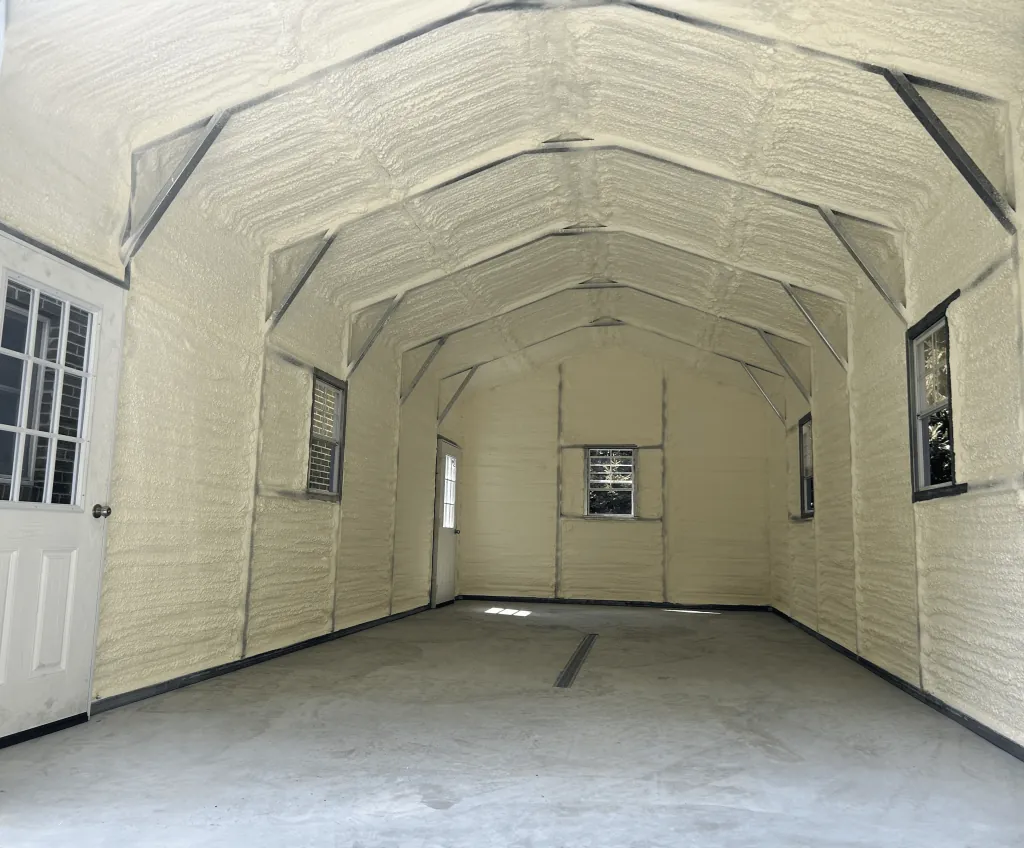
Insulating an existing metal building: what is up there now
A roof can look the same from the floor whether the blanket above it is merely sagging or is soaked. Walk the building on a dry day with a flashlight and match what you see.
| What you see | What it usually means | Does it come out before foam? | What is checked once it is out |
|---|---|---|---|
| Faced blanket, sagging between purlins, dry | The blanket has pulled off its supports or been compressed at the panels. Its facing still sits against the steel. | Yes. The facing is between the foam and the steel. | Rust where the blanket touched the panel; loose or backed-out screws |
| Faced blanket, torn or peeling facing, dry | The facing that works as the vapor retarder has failed, and one insulation seller lists peeling seam tape and holes at fasteners among its signs of a failed vapor barrier. | Yes, for the same reason | Same as above, plus any staining on the steel around the tear |
| Blanket that is wet, stained or moldy | Moisture has been getting in, from a roof leak or from condensation. | Yes, and find the water source first | The strongest check on this page: rust on panels, purlins and fasteners |
| Bubble foil or reflective film, hanging or pressed on the panel | A reflective product that depends on an air space. Foam over it would bond to the film, not to steel. | Yes | Clip or tape residue; punctures through the steel from clips |
| Fabric or plastic sheet stretched under the purlins | A vapor layer or liner fabric hung below the purlins | Yes | The purlin undersides and the screw heads the fabric hid |
| Nests, droppings or chewed insulation | Pests have used the blanket. Contaminated material is removal work, not something to foam over. | Yes, handled by whoever clears it | Gaps at the eaves and closures where animals came in |
| Loose fill of unknown type | Could be anything, including material that must not be disturbed | Not by us. Stop and read the removal rule | The visit decides what happens next |
| Interior liner panels over the old layer | A finished ceiling or wall hides the steel | Foam cannot reach the steel behind installed panels | See the liner panel section below |
Two limits on that table. The "usually means" column is a reading from the floor, and only a person standing at the roof line, with the layer pulled back, can say what the steel looks like. And a drive-by tells nobody what is inside a building, which is why the first step is a visit and not an opinion from the road.
The signs in the second row come from a trade blog written by an insulation seller (Bluetex, May 2026), so treat it as a checklist of symptoms, not as test data. It lists dripping ceilings, wet insulation, insulation that sags or separates from its attachment points, peeling seam tape and rust on the framing.
Why the old layer comes out
There are three separate reasons, and they are worth keeping apart because only the first is about foam.
Bond. A closed-cell foam maker's processing guide (Quadrant EnviroSeal CC Platinum Max, February 2025) says the foam adheres to materials such as wood, masonry, concrete and metal, and that surfaces must be clean, dry and free of dew or frost. For metal, the same guide wants the surface free of oil, grease, mill scale, rust or other contaminants. That is one maker's guide for a product we do not name as ours; it shows the kind of wording to find in any guide. A blanket facing is none of the listed surfaces. Foam sprayed onto it sticks to the facing and nothing guarantees it sticks to the steel behind.
Moisture. The same guide says foam should not go on surfaces that are wet or affected by rain, condensation, dew or frost. A blanket that holds moisture against steel is a wet substrate. The fiberglass industry's own moisture guide says water in contact with metals can contribute to corrosion (NAIMA MB306); the full account of how steel sweats is on why metal buildings sweat.
You cannot see what you foam over. Foam is rigid and hard to take back off. If the steel under a layer has rust or a leaking screw, foam hides the problem and does not fix it. The roof-leak check that matters before any foam goes on is on spray foam under a metal roof.
Forum answers to a steel-building owner asking about this question differ in what they recommend: one set suggests building a separate insulated room inside the shell, another exterior board with new cladding, another a mix of board and liner panels (GreenBuildingAdvisor, 2023). Those are different trades and different budgets from ours. We spray foam from inside, and only closed-cell. The way the choices compare is on best way to insulate a metal building.
Who removes it, and what to hand them
PolyJacks does not remove insulation, and this is true for every material in the table. The full rule, including the loose-fill hard stop, is on the estimate visit page. What you need here is the sequence.
- Book the visit before anyone starts pulling blanket. We look at what is up there and note the wiring, fixtures and any sprinkler heads. Seeing the old layer in place tells us how it was fastened and where it has pulled away.
- Hire the removal. A general contractor, a metal building crew or a clean-out service can do it. Ask them to leave the steel as they find it and not to cut into the panels.
- Have the steel looked at. The checks below belong to the stage after removal and before our crew arrives.
- Fix what the check finds. Roofing and panel repairs are not our work.
- Spray day. What happens then is on how spray foam is installed.
Because removal is outside our scope, its cost is outside our estimate. Get that price from whoever does the work, and keep it separate from our written estimate for foam.
Checks on the bare steel after removal
Once the blanket is down, the steel is visible from the inside for the first time, often in years. We look at four things, and you should have the same four looked at by whoever repairs the building.
Rust. Surface rust on a panel underside is common where moisture sat. The question is whether it is a stain or has eaten into the metal. The guide above wants metal free of rust at the surface before foam, so rusted patches need to be cleaned back to sound metal. Where rust has made a hole or thinned the panel, that is a roofing repair before insulation. Foam does not reverse rust, and the longer account is on what foam does and does not do for rust.
Fasteners. The screws that hold roof and wall panels are the weak points for both leaks and rust. Backed-out screws, ones with failed washers, and heads with rust bleeding around them are fixed from outside before foam closes over them.
Wetness. Steel that is damp on spray day is a reason to wait: the guide above says not to spray surfaces affected by condensation. A building that is damp every cold morning needs the moisture source found first.
Gaps. Open gaps at the eave and ridge closures show up now. A pole-building supplier's blog on condensation points out that humid air can still get into the roof system at the inside closures unless closures are fitted there (Hansen Pole Buildings, 2025). How large an opening foam may bridge is the named product guide's call, not ours to guess.
Wiring that was hung on the blanket
Cable, conduit and fixtures are often stapled or strapped to the facing, or simply rest on the blanket. Take the blanket away and nothing is holding them. That needs to be solved before foam, not after, because foam covers and fixes whatever is left in place, loose or not.
Your electrician decides how the wiring is supported, where it runs and where a junction box ends up. We mark where foam stops around fixtures and boxes; see wiring and boxes before foam. What we ask is that every cable is fastened to the steel or frame, and not to anything that is leaving.
Interior liner panels
Some buildings had a finished interior added: sheet-steel or white liner panels on the walls, sometimes on the ceiling, with blanket packed behind them. Foam cannot be sprayed through a panel. Three paths exist, and the first two are your decision on the visit:
- Take the panels off, spray the steel, and either leave the panels off or put them back. If they go back, a panel that covers foam has fire-code consequences, because a steel cover is not automatically a thermal barrier. The conditions are laid out on spray foam for metal buildings.
- Leave the panels and the old insulation behind them alone. That may be the right call if the walls work and the roof is the problem. Foam goes on the roof steel and the existing wall build-up stays as it is.
- Fill the cavity behind the panels. That means injecting or blowing material in, and we do neither. Other contractors do.
Other old insulation in the table
Fiberglass that is dry and well attached. A blanket that has not sagged and has an intact facing may be doing its job. Putting foam in is a choice, not a repair, and it still means the blanket comes out first. The fiberglass side of the argument is on spray foam vs fiberglass blanket.
Bubble foil. It is removed the same way. What it does and does not do compared with foam is on bubble foil vs spray foam.
A building not built yet. If you are still ordering the steel, none of this applies. Insulation decisions for a new steel building covers the choices at order time.
FAQ
Can you spray foam over existing metal building insulation?
Usually no. The faced blanket has to come out first, and PolyJacks does not remove it. The facing blocks the foam from bonding to the steel, and a blanket trapped under foam can hold moisture against the panel. Foam goes over an existing layer only where the named product's guide and evaluation report list that substrate, and we would quote that wording at the visit.
Who removes the old insulation in a metal building?
You do, or a contractor you hire. PolyJacks does not remove insulation. What must be out is the faced blanket, bubble foil and any fabric or plastic sheet between the steel and where the foam goes. Loose fill we cannot identify is never touched by our crew; see the removal rule.
What if my metal building has interior liner panels?
Foam cannot go behind installed liner panels unless they come off. At the visit we go through which panels are staying, and whether the roof or walls are the real problem. If only the roof drips, the panels on the walls may not need to move at all.
Book a free on-site measurement
Book the visit before you hire anyone to pull old insulation. We see the layer where it hangs, measure the building, and write down what the removal crew will find. You get a written estimate for the foam after the visit. The visit is free.
Book a free on-site measurement
Pick "Spray foam insulation" on the booking form. We work within about 35 miles of Spring Hill, KS.
Spray foam insulation is a new PolyJacks service line run by its own crew and rig.
Who wrote this: PolyJacks spray foam team. How it was made: drafted with AI assistance from the sources below, then checked against each source.
Sources
- Quadrant Performance Materials, EnviroSeal CC Platinum Max processing guide (closed-cell SPF, February 2025; example of one maker's wording, not our product): sprayfoamsys.com. Out-of-state (Texas) maker; adhesion and moisture limits are material behavior and are the same in Kansas.
- NAIMA, Insulation Facts #26, Moisture and Fiber Glass Metal Building Insulation (MB306): insulationinstitute.org
- GreenBuildingAdvisor, "Retrofitting a red iron framed building with insulation" (Q&A, January 2023): greenbuildingadvisor.com. Forum answers, used only to show the range of options; Zone 4A, same physics as Kansas.
- Bluetex Insulation, "Signs your metal building insulation needs replacement" (May 5, 2026; seller's blog): bluetexinsulation.com
- Hansen Pole Buildings, "Condensation Above Metal Building Roof Insulation" (2025; supplier blog): hansenpolebuildings.com
Ready for a measurement?
Book a free on-site visit. We measure first, then quote in writing.
Book a free on-site measurement
We measure the building first, then you get a written quote. Prefer to talk? Call (913) 713-7794.