
Spray Foam Over Electrical Wires, Boxes and Recessed Lights: Who Decides What
Spray foam over electrical wires is a question with two halves. The foam half is about the product and how it is sprayed. The electrical half is about heat, and heat is decided by the electrical code and by an electrician who has seen your wiring. We spray foam. We do not do electrical work, and nothing on this page replaces an electrician or the building official.
This page splits the questions by who decides. For how the whole spray day runs, see how spray foam is installed.
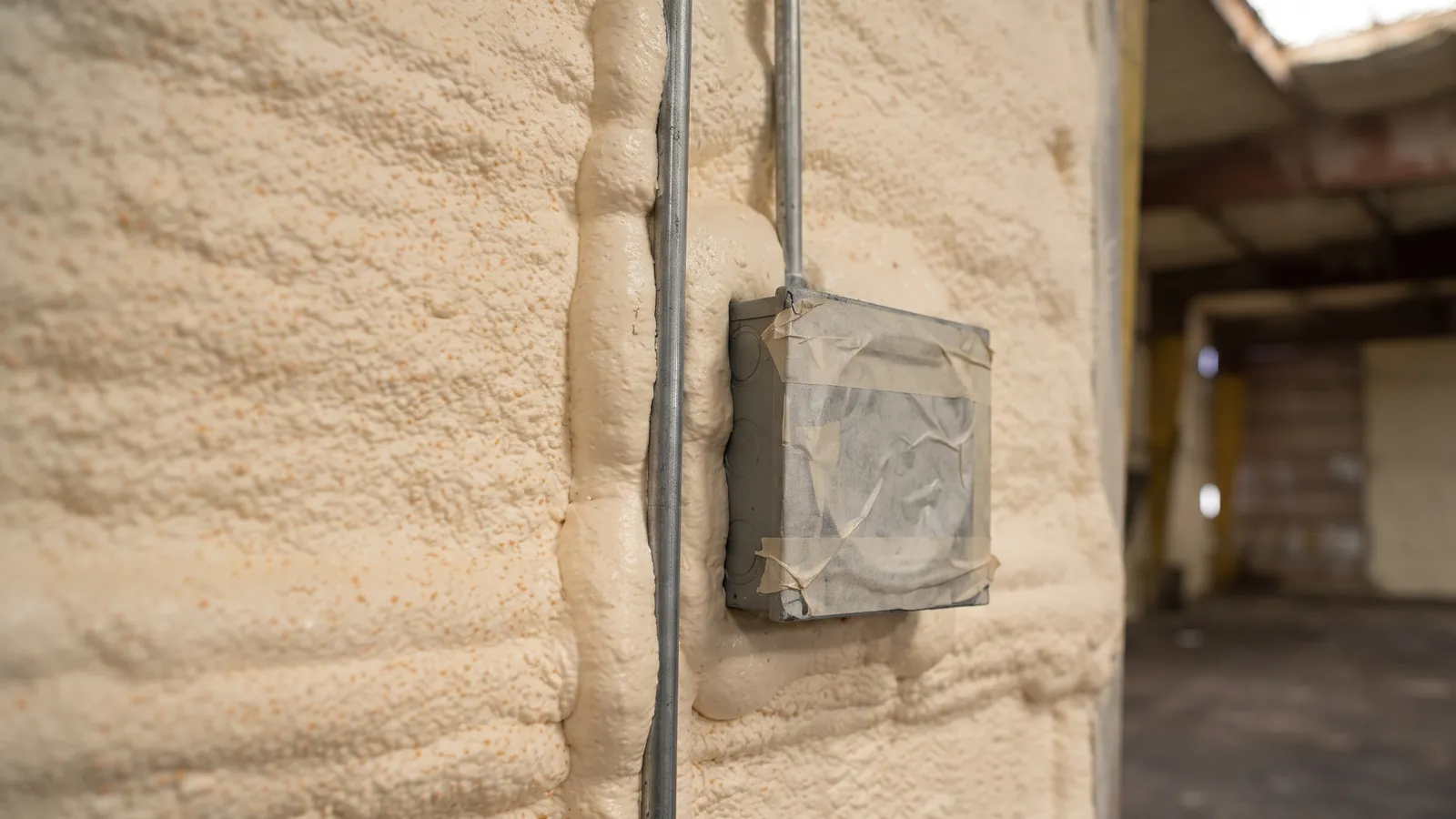
Spray foam over electrical wires: who decides what
Foam is hard to move once it has cured, so the electrical questions come first. This is the list we would settle before a crew arrives.
| Question | Who decides | What we do with the answer |
|---|---|---|
| Is any wiring knob-and-tube (old cloth-covered wires on porcelain)? | An electrician | Foam does not go over it. We mark it and plan around it |
| Are cables bundled together where foam will cover them? | An electrician, under the adopted electrical code | We follow the electrician's decision on spacing or re-routing |
| Which light fixtures are rated for insulation contact? | The fixture's label and maker, checked by an electrician | Non-rated fixtures are kept clear or replaced before we spray |
| Where do boxes, switches, panels and conduit stay accessible? | You, the electrician and the building official | We mark where foam stops |
| Does the permit or the inspector want anything inspected before it is covered? | The building official | You schedule the inspection before spray day. See permits and codes by city and county |
| Where does each new outlet or light go? | You, ahead of spraying | Boxes added after foam usually mean cutting foam out |
Cables and bundles: the ampacity question
Ampacity is how much current a wire can carry without overheating. Insulation traps heat, so the electrical code lowers the allowed current for some cable arrangements inside it.
The code article for nonmetallic-sheathed cable (the ordinary two- and three-wire cable often called Romex) is Article 334. A 2011 trade-magazine summary of that edition's changes says that bundled cables passing through framing holes filled with thermal insulation, caulk or sealing foam must have the ampacity of each conductor adjusted using the code's adjustment table; the author notes that a bored hole with foam or caulk in it falls under that section (EC&M, 2011 NEC revisions for cable). That is the 2011 edition. The edition and section number that apply to your building are set by the local adoption, and later editions may word this differently.
What that means in plain terms:
- A single run of cable lying in foam is the ordinary case, and the code expects wires to run through insulation. A building-science Q&A on GreenBuildingAdvisor, answered by Malcolm Taylor, put it this way: "The electrical code anticipates wires will be run though insulation" (GBA Q&A, February 14, 2023). This is a forum answer, not the code.
- Several cables bunched together, or crowded through one hole, are the case the derating rule is about. Whether a given bundle needs a smaller load, a different cable or a different route is the electrician's calculation, because it depends on the wire size, how many conductors carry current, and what the circuit feeds.
- Moving the cables apart before spraying is a common fix, and it is the electrician's job, not the sprayer's.
The maker's guide for the product we spray also matters. That guide does say the foam is combustible and that high-intensity heat sources such as welding or cutting torches must not be used close to it, which is why a shop's hot-work plan is on shop spray foam insulation.
Boxes and fixtures
Boxes and fixtures are where wiring and foam actually meet.
Junction boxes, switches and outlets. These must stay reachable. Foam that buries a box makes the next repair a demolition. If boxes are covered rather than left open, the covering and the cable access are electrical-code questions for your electrician and inspector. We plan the stopping line with you at the visit.
Recessed lights. Fixtures are made in two kinds. One vendor guide defines an IC-rated fixture as one "designed to be safely installed in direct contact with ceiling insulation without risk of overheating or fire", while a non-IC fixture needs clearance around its housing (PAC Lights, IC recessed can lights guide). That page is a lighting vendor's, not a standard, so check the label on your fixture and the maker's instructions. A non-IC fixture is not made safe by us spraying around it. Either the fixture is changed for a rated one by an electrician, or foam stays back by the distance the fixture's maker gives.
Heat-producing parts. Heaters, flues, exhaust fans and the like keep the clearances their makers and the code require. Clearances for the appliance come from the appliance maker, and we spray to them.
Metal buildings. In many steel buildings the wiring runs in conduit or is mounted on the steel. Whether foam goes around conduit and boxes as planned is part of the walk-through. The same rule applies to a fixture bolted to a purlin: the fixture's own label decides.
Old wiring: knob-and-tube is a hard stop
Knob-and-tube wiring is old cloth-covered wire run through open air on porcelain knobs and tubes. It was designed to shed heat into the air around it. A GreenBuildingAdvisor answer in the same Q&A says covering it with insulation is a fire risk because the insulation "cannot be counted on to keep the wire cool enough to prevent combustion" (GBA Q&A, 2023).
A weatherization best-practice note revised January 3, 2017 by the Texas Department of Housing and Community Affairs asks workers to keep insulation at least 3 inches from such wiring and not to insulate wall cavities that hold live knob-and-tube wiring (TDHCA Best Practice, Knob and Tube Wiring). That note is about fiber and cellulose, and it is from Texas, but heat does not behave differently in Kansas, and the note shows how cautious the weatherization field is about this wiring. Loose fill can be held back with a dam; sprayed foam bonds to what it touches, so the plan has to be made before spraying, not after.
Our rule is the one on the preparation page: we do not spray over knob-and-tube wiring, and an electrician looks at it before spray day. If the wiring has been replaced or removed by an electrician, the new wiring is handled as an ordinary cable run.
Photograph the wiring first
You can do this yourself before spray day. Photograph every wall, ceiling and roof area where you know wiring runs, with a tape measure or a labeled card in the frame. Photograph panels, junction boxes and any splice. Once foam covers them, the photographs are the only record of where things are. They help your electrician, a future owner and the inspector.
If you plan to add outlets later, put the box locations on the same photographs.
What we do and do not do
We spray closed-cell foam inside buildings. We do not do electrical work, we do not test or certify wiring, and we do not tell you a cable bundle is acceptable. We do not spray over knob-and-tube wiring. We mark where foam stops and we tell you when something at the visit looks like an electrician's question.
We also do not do insulation removal, crawl spaces, open-cell or blown-in insulation. If old insulation has wiring laid on it, who removes it and when is covered on insulating an existing metal building.
FAQ
Can you spray foam over electrical wires?
A single properly installed cable is the normal case for insulation, and the code expects wires to pass through it, but bundles and their allowed current are the electrician's call, not the sprayer's. Do not spray over knob-and-tube wiring.
Can spray foam touch recessed lights?
Only fixtures rated for insulation contact, and only by the fixture maker's instructions. Otherwise keep the clearance the maker gives. The checklist at the top of this page says who confirms each item.
Can foam go over a junction box?
Boxes have to stay accessible under the electrical code, so we plan to stop at them or leave them clear, as agreed at the visit.
Does foam need an inspection first?
Sometimes. Ask the building official whether your permit requires an electrical inspection before the wiring is covered. Permit practice varies by city and county; see permits and codes by city and county.
Does foam ever need a barrier over it?
That is a fire-code question, covered on thermal and ignition barriers.
Book a free on-site measurement
At the visit we walk the building with you, note the panels, boxes, fixtures and any old wiring, and say which items are an electrician's question. If foam is part of the answer you get a written estimate after the visit. The visit is free. More on how it works: the free estimate visit.
Book a free on-site measurement
Pick "Spray foam insulation" on the booking form. We work within about 35 miles of Spring Hill, KS.
Spray foam insulation is a new PolyJacks service line run by its own crew and rig.
Who wrote this: PolyJacks spray foam team. How it was made: drafted with AI assistance from the sources below, then checked against each source.
Sources
- EC&M, "2011 NEC Revisions for Cable," on Article 334.80 and thermal insulation: ecmweb.com
- GreenBuildingAdvisor, "Are these statements about wiring and insulation true?" (Q&A, February 14, 2023): greenbuildingadvisor.com
- Texas Department of Housing and Community Affairs, Weatherization Assistance Program, Best Practice: Knob and Tube Wiring (revised January 3, 2017): tdhca.texas.gov
- PAC Lights, "Introduction to IC Recessed Can Lights" (lighting vendor guide, opened 2026-10-25): paclights.com
- Carlisle Spray Foam Insulation, Foamsulate Closed Cell Application Guide (July 12, 2021): sprayez.com
Ready for a measurement?
Book a free on-site visit. We measure first, then quote in writing.
Book a free on-site measurement
We measure the building first, then you get a written quote. Prefer to talk? Call (913) 713-7794.