
How Long Does Spray Foam Insulation Last? What Degrades It and What No One Can Promise
How long does spray foam insulation last? Nobody can give you an honest number of years for a building they have not seen, and the pages that do give one usually print it without a source. Closed-cell foam that is protected from sun, water and damage is expected to hold up for a long time. What shortens that time is a short list of things, and most of them you can check yourself.
This page sets out what we found when we looked for a basis for a lifespan, what degrades foam, how to read a warranty, and what to look at once a year. For the product's properties on paper, see closed-cell spray foam insulation.
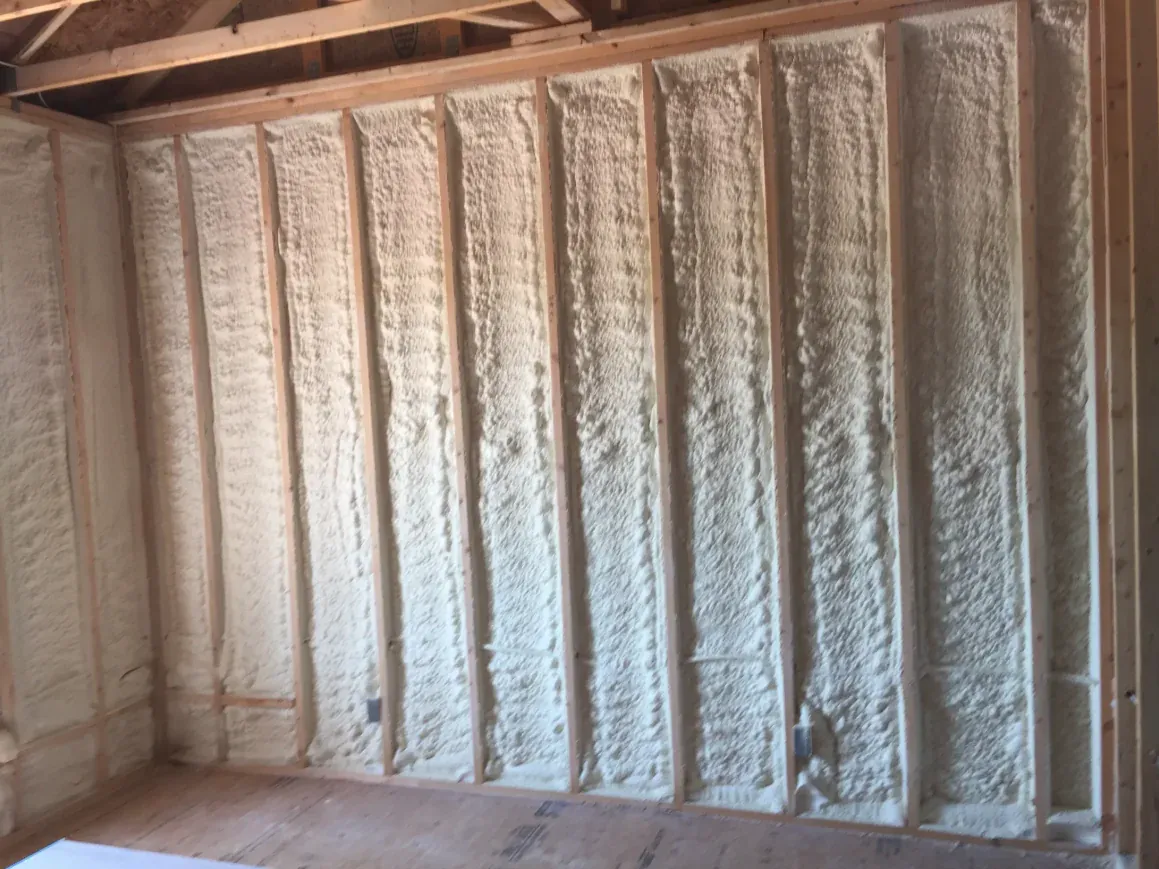
How long does spray foam insulation last: the honest answer
We looked for a published test or standard that turns a lab result into a number of years of service for spray foam. We did not find one on any official or maker page we opened. A year count on a web page is therefore a sales estimate, not a test result.
What does exist is narrower:
- Roofing guidance for foam that ties service to protection and upkeep. The IBHS-hosted RICOWI roof guide for spray foam states that foam surfaces "will degrade over time when exposed to the ultraviolet (UV) radiation of sunlight" (IBHS, RICOWI roof guide, spray foam). The same guide says coatings need to be reapplied over time. It covers roofs, so it tells you about sun and water, not about foam inside a wall.
- A maker's written warranty, which is a promise from the company about the product, with conditions. We show how one reads below.
- Your own inspection, which tells you more about your building than any average.
What degrades spray foam
| Factor | What it does | Source and limits |
|---|---|---|
| Sunlight (UV) on exposed foam | The surface darkens, then becomes brittle, and over time material is lost | IBHS roof guide. This is why foam on an outside surface is coated. Foam inside a building, out of sun, is not in this case |
| Standing water | The same guide says ponding water on a foam roof "should be avoided," with only small amounts tolerated | IBHS roof guide, written for low-slope roofs |
| Physical damage | Hail or windborne debris can mark an exposed surface; the guide says the thick membrane helps prevent water entry from that damage and that minor repairs are simple | IBHS roof guide |
| Animals | Persistent house sparrows can peck through hardened foam where it is reachable | Sialis, see indoor riding arena insulation for the setting |
| Fire and heat | Foam is combustible; the maker's guide we opened says to keep high-intensity heat sources such as cutting torches away from it | Carlisle Foamsulate Closed Cell Application Guide, 2021 |
| Poor installation | Too thick a pass, off-ratio mix or spraying under rising foam can make foam that fails early; the guide says such foam must be removed and replaced | Same Carlisle guide |
| Moisture trapped behind it | Water held against steel or wood is a separate failure of the building, not of the foam | See problems to avoid |
Two points about the table. First, the first four rows describe the environment, so a sheltered interior wall and an exposed roof edge are different cases. Second, the last two rows are about the work, not the material, which is why the spray-day record on how spray foam is installed exists.
Aged R: the long-term number that is published
If you want a number that does describe time, look for aged R-value. Closed-cell foam is blown with a gas, and over the first years some of that gas is replaced by air, so the measured R-value settles lower than the first reading. Published tests deal with this by reporting an aged value. How that works, and what a receipt should show, is on closed-cell spray foam R-value. Aged R describes where the R-value ends up in a lab test; it is not a promise about the year the foam fails.
How a warranty reads
A warranty is the only place where a year-style promise becomes a document. Reading one carefully tells you how much it promises. As an illustration of the wording, here is what one maker's closed-cell limited lifetime warranty said (Huntsman Building Solutions, document 21.00105, revision dated 04.08.21). It is another maker's document, not ours, and it is not our product's warranty.
- It says the foam, applied "in accordance to the product specification," will perform as stated in the product's technical data sheet.
- It is "in effect throughout the life of the building" only if the original purchaser registers within 90 days of application.
- The maker's responsibility is to repair or replace the defective product at the cost of the material only, and it excludes labor.
- It excludes damage from improper installation, fire, storms, floods, abuse, neglect, adjacent materials, and later alteration, and says that statements by contractors and installers do not make an express warranty.
So even a "lifetime" warranty is a limited promise by the maker about the material, with registration, exclusions and a remedy. If you are given one, check who is promising, what is covered, what it excludes and what you must do to keep it valid. Until then this page makes no warranty claim for our work.
A contractor's own workmanship terms are a separate document from the maker's. We make no workmanship promise on this page.
What no one can promise
- A number of years, for a building no one has inspected.
- That foam survives sun if it is left uncoated outdoors.
- That a roof or wall leak somewhere else will not wet the foam.
- That moving, drilling or cutting after the job will not leave gaps.
- That foam over rusted steel will stop the rust. That question is covered on what foam does and does not do for rust.
If a company states a lifespan without naming the document, test or warranty it comes from, ask for that document.
A yearly look-over
Once a year, in daylight, with a flashlight and a notebook. Do the check that fits your building.
| Look at | What to look for | If you see it |
|---|---|---|
| Any foam facing the sun, such as at a door, window or roof edge | Darkened, chalky or flaking surface | Ask a roofing or coating professional whether a coating is needed |
| Low corners, seams and eaves | Water marks, staining, or damp foam | Find the source of the water first; the foam is the victim |
| Steel behind or beside the foam | New rust at laps, fasteners and edges | A roof or panel repair question |
| Where animals can reach | Pecked or chewed holes | Close the access; patching is a separate job |
| Around fixtures, boxes and penetrations | Gaps, cracks or loose edges where something was added later | Photograph and call us or your electrician; see spray foam around electrical wiring |
| The records you were given | Estimate, receipt and spray-day record | Keep them with the building papers |
Write the date and take pictures. A photograph from this year makes next year's comparison honest.
FAQ
How long does spray foam last?
There is no published standard we found that gives its service life in years. Protected from sun, water and damage, it is expected to last a long time, but we do not print a year count unless a maker's written warranty states one, and then we quote it.
Does spray foam break down in sunlight?
Yes. The IBHS roof guide says that foam surfaces degrade over time when exposed to the sun's ultraviolet radiation. That is why foam outdoors is coated. Ask the product maker what their data sheet requires regarding UV exposure and coating.
Does spray foam last longer than fiberglass?
We have not opened a test that compares the two over decades, so we make no claim either way. A different question is whether each stays in place and dry. For fiberglass in a steel building, see metal building condensation.
Is a lifetime warranty a promise it lasts for life?
It is a promise from the maker with conditions. The warranty we read had a registration window, a materials-only remedy and a list of exclusions. Read yours.
Book a free on-site measurement
At the visit we measure the building, look at what the foam would bond to and what it would be exposed to, and tell you which of these factors apply. If foam is part of the answer you get a written estimate after the visit. The visit is free. More on how it works: the free estimate visit.
Book a free on-site measurement
Pick "Spray foam insulation" on the booking form. We work within about 35 miles of Spring Hill, KS.
Spray foam insulation is a new PolyJacks service line run by its own crew and rig.
Who wrote this: PolyJacks spray foam team. How it was made: drafted with AI assistance from the sources below, then checked against each source.
Sources
- IBHS, RICOWI roof guide, spray foam (no author or date shown on the page; opened 2026-10-25): ibhs.org
- Huntsman Building Solutions, Closed-Cell Spray Foam Limited Lifetime Warranty, document 21.00105, rev. 04.08.21 (opened 2026-10-25): huntsmanbuildingsolutions.com
- Carlisle Spray Foam Insulation, Foamsulate Closed Cell Application Guide, July 12, 2021: sprayez.com
- Sialis, house sparrows nesting in metal buildings (ledger J10, opened 2026-10-25): sialis.org
Ready for a measurement?
Book a free on-site visit. We measure first, then quote in writing.
Book a free on-site measurement
We measure the building first, then you get a written quote. Prefer to talk? Call (913) 713-7794.