
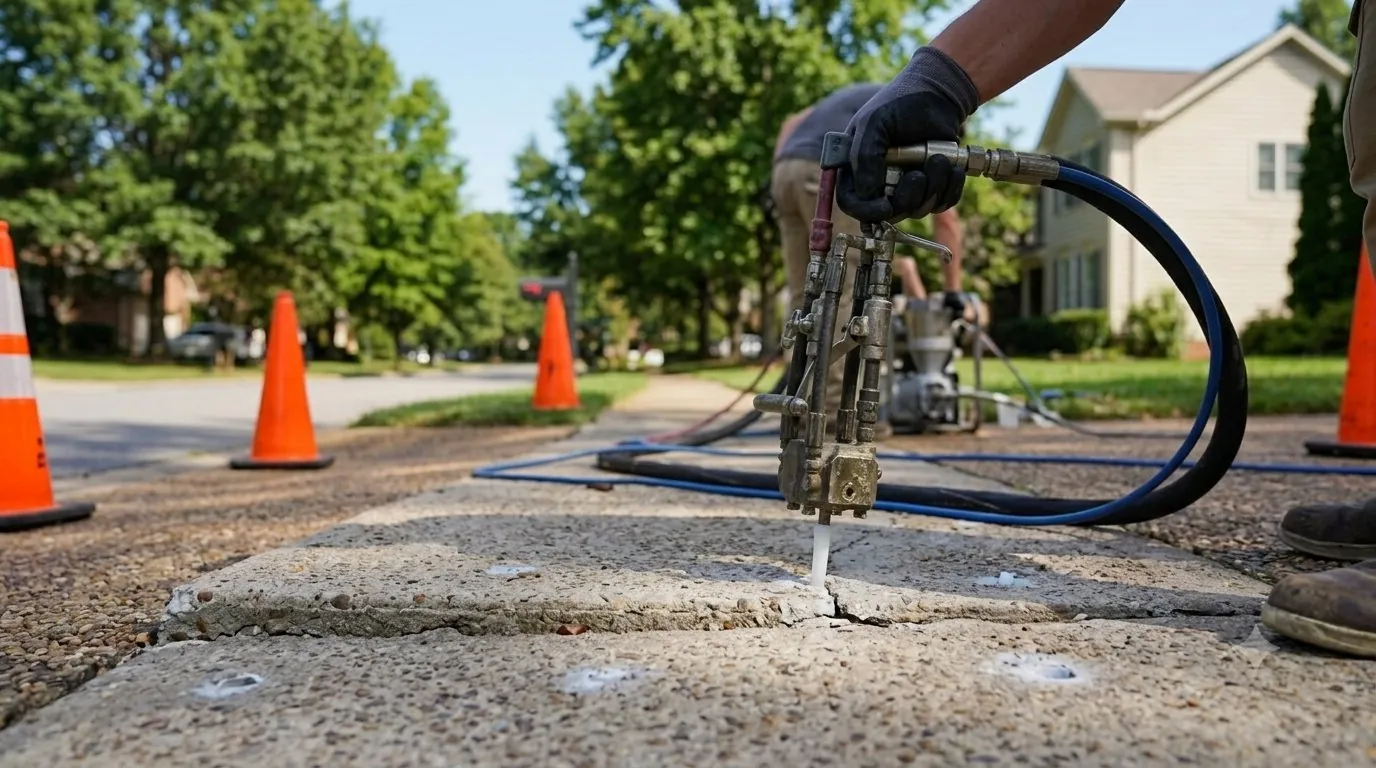
 Illustrative
The Real Dangers of an Uneven Concrete Trip Hazard
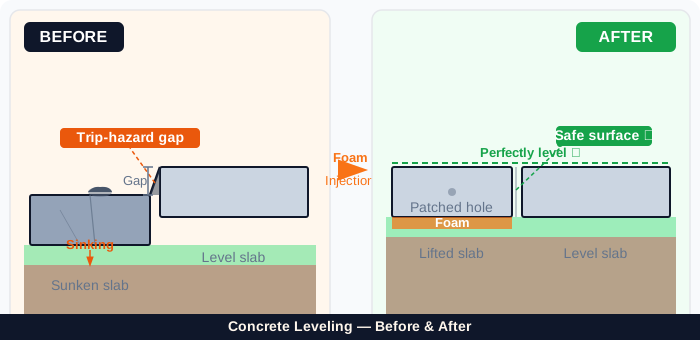
An uneven slab is more than an eyesore: a raised lip is a genuine fall risk for kids, older adults, and visitors, and a liability if someone is hurt on your property. Trip hazards come from slabs settling unevenly. Foam leveling brings the surfaces back flush, removing the lip through small holes.
What Actually Counts as a Trip Hazard
Not every uneven spot in a slab is dangerous, but there's a widely used rule of thumb in the industry: a height difference of around a quarter-inch to half an inch between two sections of concrete is enough to catch a shoe and cause a fall. Below that, most people step over it without noticing. Above it, especially at a sidewalk joint or a driveway approach, it's a real hazard - not just cosmetic. The federal rule for accessible routes is more exact. Section 303 of the 2010 ADA Standards for Accessible Design, on ada.gov, lets a lip of up to 1/4 inch stay vertical, requires a bevel no steeper than 1:2 between 1/4 and 1/2 inch, and treats anything over 1/2 inch as a ramp. Those limits are written for accessible routes rather than every home driveway, but they make a useful benchmark. The tricky part is that these differences creep up slowly, a fraction of an inch at a time, until one day someone actually trips. If you can see a shadow line or feel a lip when you walk across a joint, it's worth measuring. To check, lay a straightedge like a level, ruler, or long piece of cardboard across the joint and measure the gap between the straightedge and the lower slab. If that gap is a quarter-inch or more, you have a trip hazard that needs attention.
Who's Actually at Risk
Falls on uneven concrete aren't rare, and they're not limited to any one group - but older adults are especially at risk. A raised sidewalk panel that's a minor annoyance to a healthy adult can mean a broken wrist or worse for a grandparent walking to the mailbox or a toddler running across a patio. It's also worth thinking about anyone who visits your property regularly - delivery drivers, guests, contractors - who don't know where the uneven spots are the way you do. Front walkways and driveway approaches see the most foot traffic of any concrete on a property, which means they're also where people are most exposed to a trip.
The Liability Side Homeowners Don't Think About
Beyond safety, an uneven walkway can become a legal and insurance headache. If someone is injured on your property because of a known trip hazard you never addressed, that can turn into a homeowners insurance claim - or worse, a lawsuit. A note on responsibility: in most (but not all) KC-metro cities, the sidewalk in the public right-of-way in front of your property is the homeowner's to maintain, not the city's. If you've received a sidewalk repair notice from the city, our guide to KC sidewalk repair notices walks through what it means and what to do. Businesses face a sharper version of the same problem: commercial properties are expected to maintain accessible, even walking surfaces under ADA standards, and a customer or employee injury on an uneven parking lot or entrance can carry real liability exposure. If you manage rental property, a retail space, or an office, an uneven slab out front isn't just a maintenance item, it's a risk sitting in plain sight. We handle these for businesses too - see our commercial concrete leveling page for what that looks like. For the specific ADA thresholds that apply, see our guide to ADA trip-hazard compliance.
If you're wondering how a settled slab and a homeowners claim connect, our piece on sinking driveways and homeowners insurance covers it.
Why Panels Settle Unevenly in the First Place
Concrete is poured in separate panels precisely so it can move independently - that's normal. The problem is when the ground underneath one panel settles differently than the panel next to it. Kansas City's clay-heavy soil swells when wet and shrinks when dry, and repeated freeze-thaw cycles through winter make that movement worse year over year. Add a downspout draining next to a walkway, or a slope that channels water under a slab edge, and soil can wash out from beneath one panel while its neighbor stays put. The result is the classic tripping hazard: two slabs that used to be flush, now sitting at different heights. Our why is my concrete sinking page goes deeper into the soil side of this.
The Old Fix vs. the Modern Fix
For decades, the standard repair was mudjacking - pumping a heavy cement-and-soil slurry under the slab through large holes to push it back up. It works, but the slurry itself is heavy, which can be a problem on the same weak or saturated soil that caused the settling to begin with, and the holes it requires are considerably bigger. Polyurethane foam injection lifts the same slab through holes about the size of a dime, using a foam that expands to fill the void and is lightweight enough not to add stress to soft ground - and waterproof, so it won't break down the way soil-based slurry can over time. We break down the full comparison on our polyjacking vs. mudjacking page if you want the specifics side by side.
How Fast a Trip Hazard Gets Fixed
This is one of the more satisfying repairs to watch, because it happens quickly. We drill a few dime-sized holes near the low panel, inject expanding polyurethane foam beneath it, and use that expansion to raise the slab back toward level with its neighbor. The foam cures in minutes, not days, and most surfaces can handle foot traffic again within about 15 to 30 minutes - driveways typically need an hour or two before vehicles should drive on them. There's no jackhammering, no weeks of a torn-up walkway, and no slab replacement. For a hazard that's been sitting in front of your house or business for months, that's often a one-visit fix from start to finish.
Where We See This Most Around the KC Metro
Sidewalks and driveway approaches are the most common trip hazards we're called out for, but porch steps and patios cause just as many stumbles - especially when a step's landing settles and creates an unexpected height change right where someone's foot expects flat ground. We see it across the metro, from established neighborhoods in Overland Park to older streets in Kansas City proper, wherever clay soil and a few decades of freeze-thaw cycles have had time to work. On those older streets, the ground underneath has had enough cycles to shift the clay-heavy soil enough to drop one panel below its neighbor, and the gap keeps growing a fraction of an inch at a time. If you've got a specific spot in mind, our sidewalk and trip hazard repair and porch and step leveling pages cover those situations directly.
Don't Wait Until Someone Gets Hurt
A trip hazard rarely gets better on its own - the same soil movement that created it usually keeps going. The good news is that fixing it doesn't require tearing anything out or living with a construction zone for weeks. We're a locally owned crew based in Spring Hill, serving the whole Kansas City metro, and we'll walk your property, measure the height difference honestly, and tell you whether it's a quick foam lift or something else entirely. There's no cost for that visit. Until the repair is done, a strip of high-visibility tape across the lip or a small cone at the joint is a zero-cost way to flag the hazard for anyone who doesn't know it's there, especially if you have regular visitors or it's a commercial entrance. Call (913) 713-7794 or reach out through our contact form to get a free estimate on the calendar before that uneven spot causes a fall.
How polyjacking works in 90 seconds
Our team walks you through the three-step process: dime-sized holes, high-density polyurethane foam that fills every void and compresses the soil beneath your slab, and use within hours with no heavy trucks. Call (913) 713-7794 or book a free estimate below.
Frequently asked
How much height difference between slabs is considered dangerous?
A common industry rule of thumb is that around a quarter-inch to half-inch of height difference is enough to catch a shoe and cause a fall. For accessible routes, the 2010 ADA Standards (Section 303, on ada.gov) are stricter about form: up to 1/4 inch can be a plain step, 1/4 to 1/2 inch needs a 1:2 bevel, and taller changes count as a ramp.
Am I liable if someone trips on my uneven sidewalk?
It can create real exposure, especially for businesses under ADA standards or homeowners who knew about the hazard and didn't address it. It's worth fixing before it becomes a claim.
How long does a trip hazard repair actually take?
Most foam injection repairs are a one-visit job. The foam itself cures in minutes, and surfaces are typically walkable again within about 15 to 30 minutes.
Will the uneven spot just come back later?
Foam is waterproof and lightweight, so it holds up well against the same soil movement that caused the original settling, though no repair can promise the ground will never move again.
Do you fix trip hazards for businesses, not just homes?
Yes - we work with commercial properties across the KC metro. Check our commercial concrete leveling page for details.
Have a sinking slab?
Book a free on-site inspection. Honest advice, usable within hours.
Pick a time that works for you
Book right here on this page. Prefer to talk? Call (913) 713-7794.