
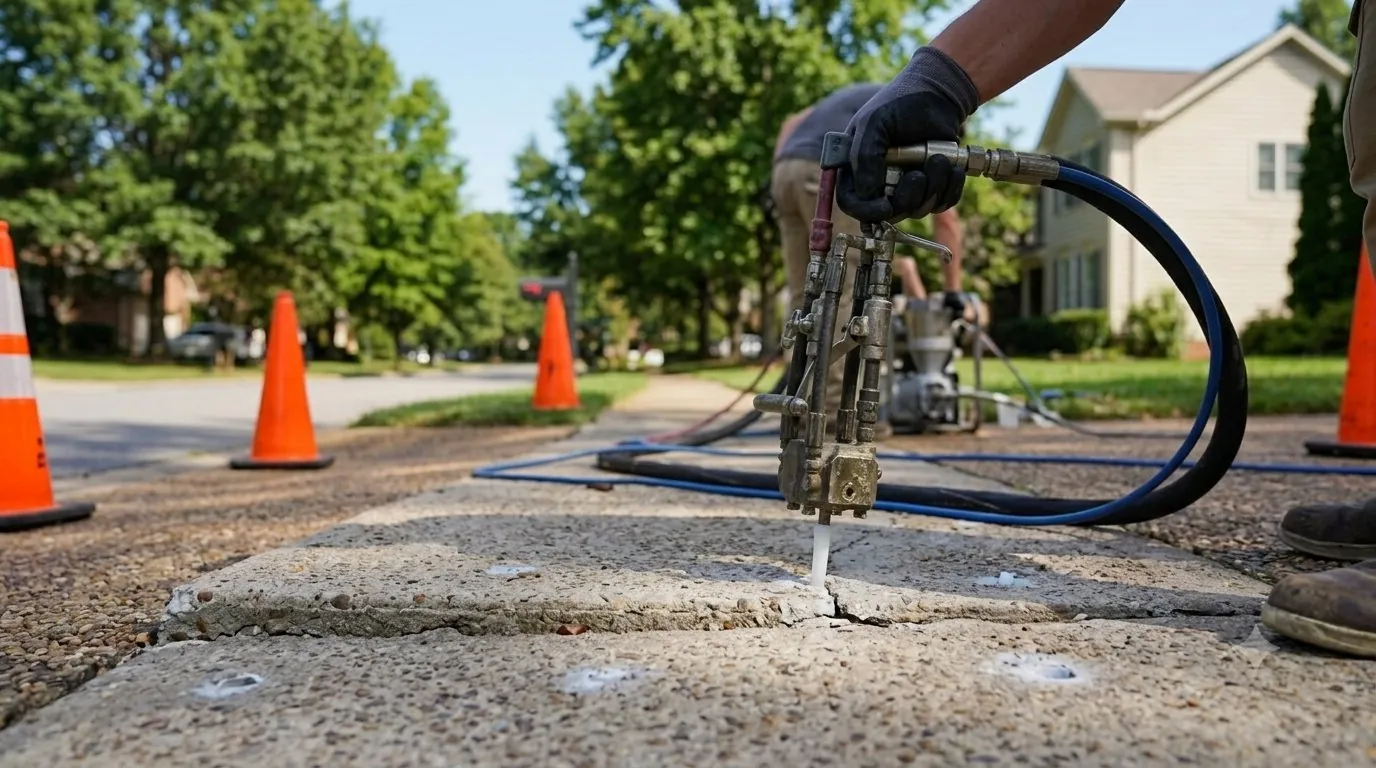
 Illustrative
ADA Trip-Hazard Compliance for Concrete in Kansas City
The ADA treats a vertical change over a quarter inch in a walkway as a trip hazard that must be repaired or beveled. For uneven concrete, foam injection lifts the low slab back flush through small holes, clearing the hazard in a single visit without tearing up and repouring the walkway.
The Quarter-Inch Rule, Explained
Section 303 (Changes in Level) of the 2010 ADA Standards for Accessible Design sets three bands for vertical displacement in a walking surface. A change of 1/4 inch or less is permitted to stay vertical. A change between 1/4 and 1/2 inch has to be beveled, with a slope no steeper than 1:2. A change over 1/2 inch has to be treated as a ramp. These limits apply to accessible routes, not to every private driveway. A quarter inch is a small number, but it adds up fast. A driveway apron, a sidewalk panel outside a storefront, or a step down from a loading dock can settle just enough over a season or two to cross that line without anyone noticing day to day - until someone catches a toe on it. For property managers, HOAs, and commercial owners across the Kansas City metro, that quarter inch is the difference between a walkway that's fine and one that's a liability sitting in plain sight. The full text of Section 303 is posted on ada.gov: 2010 ADA Standards for Accessible Design.
Why This Matters for KC Property Owners
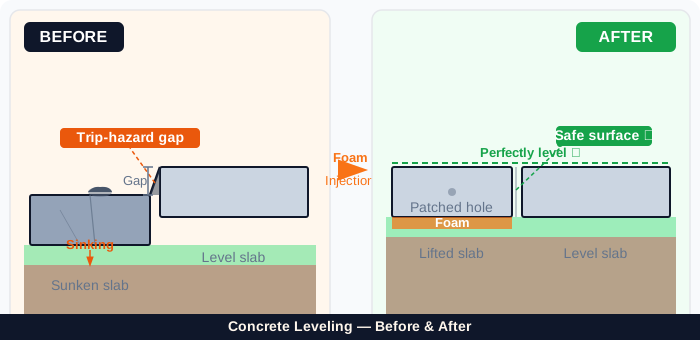
This isn't abstract. Cities inspect public-facing sidewalks, insurers ask about walkway conditions after a claim, and tenants notice before management does. A single trip-and-fall on a sunken slab outside a retail entrance, an apartment complex, or a medical office can turn into a real liability problem, and "we didn't know" isn't much of a defense once the height difference is measurable. For commercial concrete leveling work across Overland Park, Lee's Summit, Olathe, and the rest of the metro, we see the same pattern: entrances, parking lot walkways, and step-downs settle unevenly because the ground under them settles unevenly. The fix doesn't have to mean tearing out concrete and closing an entrance for a week - it means measuring the actual displacement and correcting it at the source.
In Kansas City, the enforcement path is a sidewalk repair notice from the city to the property owner when a walkway doesn't meet the applicable standard. The notice carries a set deadline for correction, and the obligation to address the hazard falls on the owner or their agent. For a property manager or commercial owner, that notice is the point where a sunken panel stops being a maintenance item and becomes a compliance obligation with a clock on it. Understanding the city's sidewalk repair notice process before a letter arrives is the difference between scheduling a fix on your own timeline and reacting to a deadline you didn't see coming.
If you manage entrances or walkways at a commercial property and aren't sure when a settled slab is worth a call, see when to call for commercial concrete leveling.
How We Measure a Trip Hazard
Before anything gets fixed, it has to be measured honestly. We walk the site with a straightedge and a tape measure, not a guess. Every panel edge, joint, and threshold gets checked against the 1/4-inch threshold, and we tell you plainly which spots are cosmetic, which are borderline, and which are genuine ADA compliance risks. Some sunken panels are ugly but not technically hazardous; others look minor but sit right at the edge of the standard. That distinction matters because it changes the fix - and because it means we're not going to talk you into work you don't need. If a spot doesn't need leveling, we'll say so. If it does, the diagnose tool or a quick call to (913) 713-7794 gets a real person out to look before anything is scheduled.
Why Foam Beats Full Replacement for Compliance Fixes
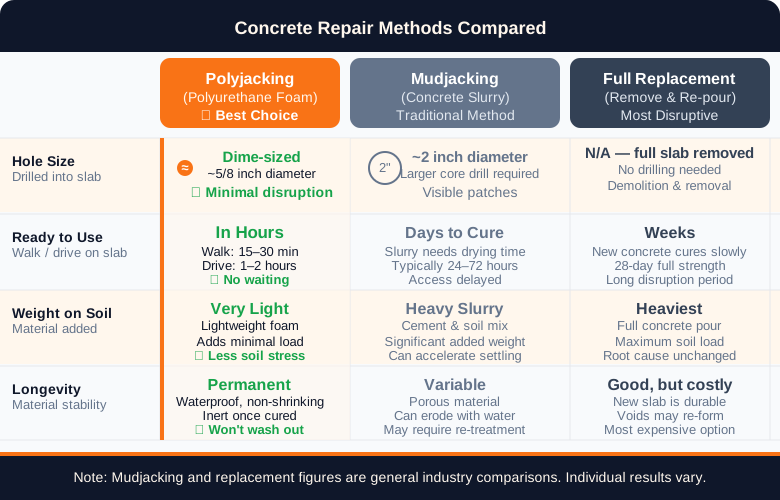
The traditional fix for a trip hazard is to grind the lip down, pour a new slab, or both - both mean equipment, downtime, and a section of walkway that's unusable while it cures. Commercial polyjacking takes a different approach: we drill a few dime-sized holes near the low panel and inject expanding polyurethane foam underneath it. The foam fills the void that let the panel sink in the first place, then lifts the slab back to grade. Because the existing concrete is being raised rather than replaced, there's no new pour, no curing week, and no mismatched patch of fresh concrete next to older material. For a compliance fix that needs to happen on a working commercial property, that's the practical difference - the walkway comes back into spec without becoming its own construction project.
Minimal Disruption to Tenants, Customers, and Employees
Foam cures fast - the treated area can typically handle foot traffic in about 15 to 30 minutes, and vehicle traffic in roughly 1 to 2 hours. For a retail entrance, an apartment walkway, or an office parking lot, that means the crew can be in, level the hazard, and be gone within the same visit, often before most people passing through even notice work happened. There's no cordoned-off section sitting under a tarp for days, no jackhammer noise running through a business day, and no need to reroute foot traffic around a fresh pour. That matters as much as the compliance fix itself - a trip hazard doesn't stop being a liability while you wait a week for concrete to set, and most commercial properties can't afford to close an entrance that long anyway.
Void Filling Prevents the Repeat Trip Hazard
Leveling a panel without addressing what's underneath it just buys time - if the soil eroded or the fill under the slab settled once, it can settle again in the same spot. That's why a proper fix includes void filling as part of the injection, not as a separate step. The same foam that lifts the panel also fills the empty space that caused it to drop, so there's solid support underneath instead of a hollow pocket waiting to open back up. This is especially relevant on properties with clay soil that swells and shrinks with the seasons, or with drainage issues sending water under the slab edge - both common causes of repeat settling across the metro. Fixing the void is what makes the leveling last instead of becoming an annual line item.
Getting a Compliant Walkway Back Without the Guesswork
If you manage a property and you're not sure whether a sunken panel actually crosses the ADA threshold, that's a reasonable thing to have looked at rather than guessed at. A free on-site estimate gets an honest read on which panels are compliance risks, which are cosmetic, and what fixing the real ones actually involves - no obligation, no pressure to fix things that don't need it. Call (913) 713-7794 or use the contact form to get a walkthrough scheduled. We're a locally owned crew based in Spring Hill, working properties across the whole Kansas City metro on both sides of the state line, and we'd rather tell you the truth about what's a real hazard than pad a job.
How polyjacking works in 90 seconds
Our team walks you through the three-step process: dime-sized holes, high-density polyurethane foam that fills every void and compresses the soil beneath your slab, and use within hours with no heavy trucks. Call (913) 713-7794 or book a free estimate below.
Frequently asked
What height difference actually counts as an ADA trip hazard?
Section 303 of the 2010 ADA Standards sets change-in-level limits for accessible routes: up to 1/4 inch may be a straight vertical edge, 1/4 to 1/2 inch must carry a bevel no steeper than 1:2, and anything taller than 1/2 inch must be ramped. On a commercial walkway, a lip past those limits is the kind of spot we flag during the walkthrough.
Can foam injection fix a sidewalk panel without replacing it?
In most cases, yes. Polyjacking lifts the existing panel back to grade by filling the void underneath it, so the original concrete is reused rather than torn out and repoured.
How long does a commercial walkway need to be closed off?
Not long. Foam cures enough for foot traffic in about 15-30 minutes and vehicle traffic in roughly 1-2 hours, so most areas are back in service the same visit.
Do you check every panel or just the one we flag?
We measure the full walkway or lot, not just the spot you point to, since a hazard a few feet away is often missed until someone measures it directly.
Is there a cost for the initial inspection?
The on-site estimate is free. We'll walk the property, measure what's actually out of spec, and explain what we find before any work is scheduled.
Have a sinking slab?
Book a free on-site inspection. Honest advice, usable within hours.
Pick a time that works for you
Book right here on this page. Prefer to talk? Call (913) 713-7794.