
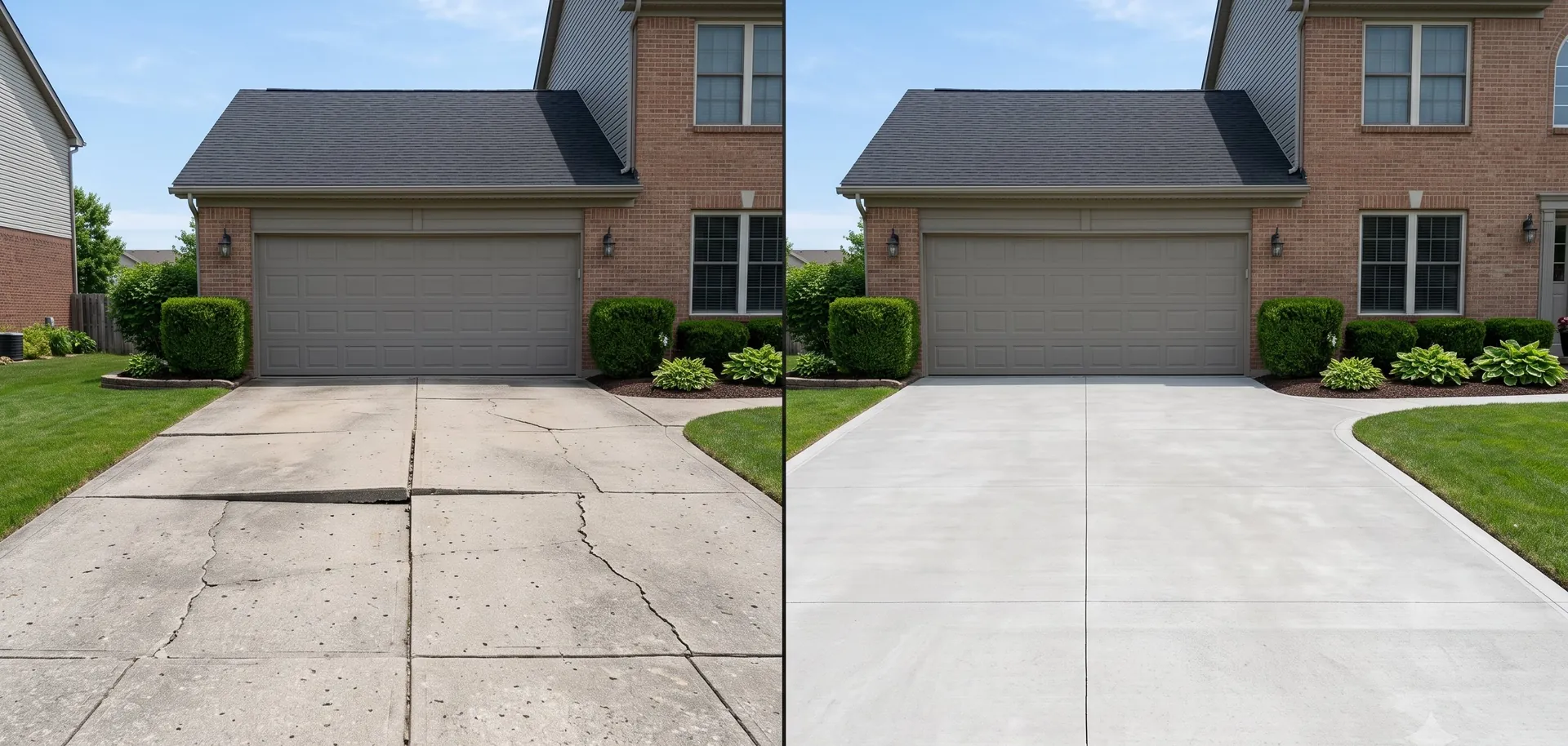
 Illustrative
How Kansas City Clay Soil Quietly Wrecks Your Concrete
Kansas City sits on expansive Wymore-Ladoga clay that swells when wet and shrinks when dry. That constant movement opens voids under driveways, sidewalks, and patios, and the rigid slab drops into them. Rather than replace the concrete, PolyJacks fills the void and lifts the slab back to level with waterproof polyurethane foam.
It's Not Bad Luck. It's Wymore-Ladoga Clay.
Under most Kansas City metro yards sits expansive clay soil, much of it in the Wymore-Ladoga family. This clay does something sand and gravel don't do. It changes volume with moisture. Add water and it swells. Dry it out and it shrinks. Your driveway, sidewalk, and patio slabs sit right on top of that movement, whether you notice it or not.
That's why two houses built the same year, a block apart, can end up with completely different concrete problems. It comes down to what's under the slab, not just what's on top of it.
Swell and Shrink, Season After Season
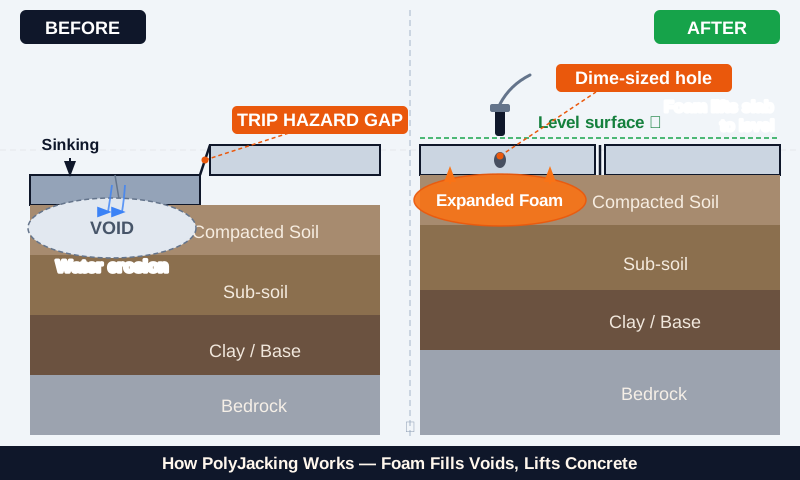
Spring rain soaks the clay and it expands, pushing up on whatever sits above it. Summer heat dries it back out and it shrinks, pulling support away from your slab. That cycle repeats every year: sometimes every few weeks during a wet spring or a dry August.
Concrete itself doesn't bend. It's rigid. So when the ground underneath keeps moving and the slab can't move with it, gaps open up. Voids form under the edges and corners first, then under the middle. Eventually the slab has nothing left to rest on, and it settles.
Then Winter Piles On
On top of that swell-and-shrink, Kansas City gets repeated freeze-thaw cycles all winter, and the two forces stack: the soil under your slab works against the concrete year-round, not just in one bad season. That freeze-thaw half of the story has its own guide - how Kansas City freeze-thaw wrecks concrete.
What This Looks Like At Your House
You've probably seen it: a driveway slab noticeably lower than the one next to it. A sidewalk section that trips people. A patio corner sinking a little more each year. A garage floor with a gap you can slide a hand under. A pool deck pulling away from the coping.
None of that means your concrete is bad. It means the ground under it lost volume, and gravity did the rest.
What Happens If You Leave It
Every wet-dry cycle enlarges the void under the slab, so the concrete settles further with each season. Water pools in the low spot, and in winter the freeze-thaw cycle spalls the concrete at the pooled edge, as detailed in how Kansas City freeze-thaw wrecks concrete. A tripping sidewalk or driveway lip creates a slip-and-fall liability if a visitor or delivery person is injured. The longer the slab sits unsupported, the more likely it cracks, at which point the When Polyjacking Isn't the Answer section applies and replacement becomes the only option.
The Fix: Lift It, Don't Replace It
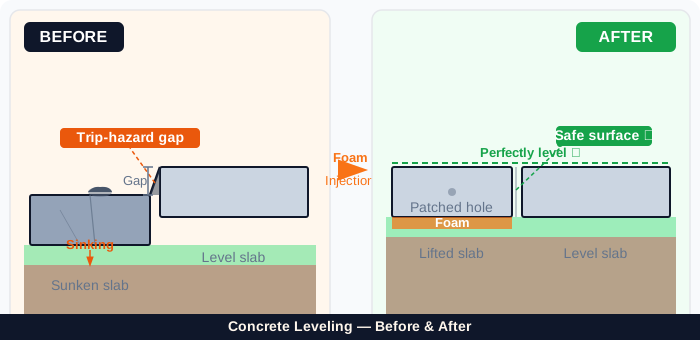
Polyjacking raises sunken concrete back to level without tearing it out. We drill dime-sized holes usually 4 to 12 depending on the slab, and inject a waterproof, high-density polyurethane foam underneath. The foam expands 30 to 40 times its liquid volume, filling the voids the clay left behind and lifting the slab as it goes.
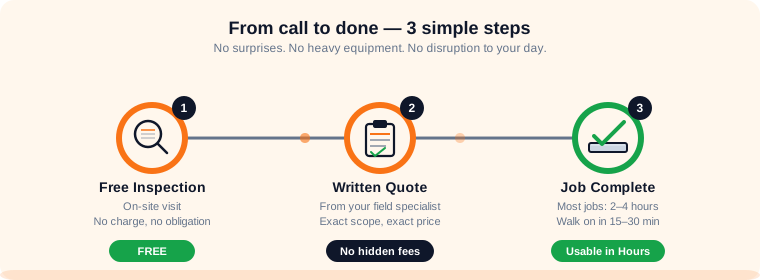
Most jobs take 2 to 4 hours. The foam cures in 15 to 30 minutes, so you're walking on it almost right away and driving on it in 1 to 2 hours (just no heavy vehicles for 48 hours). Compare that to mudjacking, which needs 24 to 72 hours before use, or full replacement, which takes about a week before you can walk on it and 28 days to fully cure.
The foam itself weighs far less than traditional mudjacking material. Less weight sitting on soil that's already struggling to hold your slab up matters, especially when that soil is Kansas City clay.
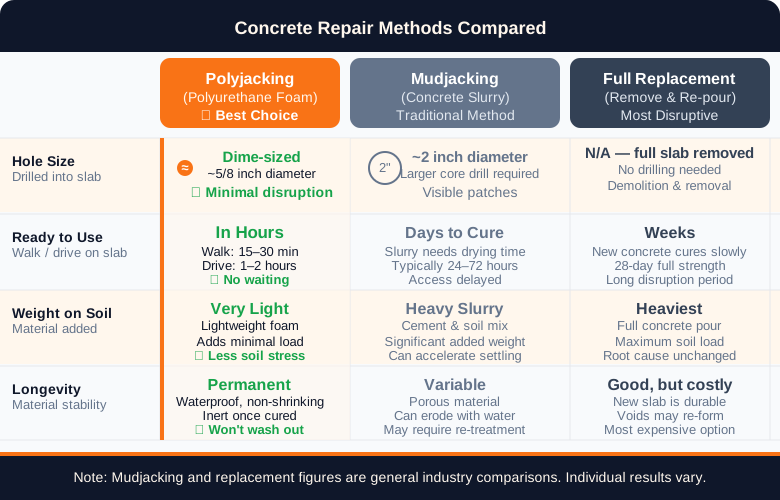
Curious what those dime-sized holes look like next to the older method? See mudjacking holes vs. polyjacking holes.
When Polyjacking Isn't the Answer
We'll tell you straight if lifting isn't the right call. A slab that's cracked or broken into pieces needs replacement, not lifting. Foam can't fix concrete that's structurally failed. If an active water leak is feeding the settling, call a plumber first; foam won't stop water from finding a new path. And if tree roots are heaving a slab up rather than settling it down, that's root work, not a lifting job.
A free inspection tells you which situation you're dealing with before anything gets drilled.
Why Homeowners Choose Polyjacking Here
Because Kansas City clay doesn't quit, a repair that works with it (instead of fighting it once and hoping) makes sense. Polyjacking runs far less than tearing out and replacing the same section of concrete. We price every job by how much foam it actually takes, after a free, no-obligation inspection. No guessing.
PolyJacks is locally owned and owner-operated, based in Spring Hill, and has served the Kansas City metro since 2024. We're licensed and insured. We lift driveways, sidewalks, patios, garage floors, and pool decks, residential and commercial. We don't do foundation repair. If that's what you need, we'll point you to someone who does.
How polyjacking works in 90 seconds
Our team walks you through the three-step process: dime-sized holes, high-density polyurethane foam that fills every void and compresses the soil beneath your slab, and use within hours with no heavy trucks. Call (913) 713-7794 or book a free estimate below.
Frequently asked
Why does concrete sink more in Kansas City than in other parts of the country?
It comes down to the soil. Much of the metro sits on expansive Wymore-Ladoga clay, which swells when wet and shrinks when dry. Add repeated freeze-thaw cycles most winters, and the ground under your slab is moving far more than the concrete itself ever will. That constant movement is what opens up the voids that let concrete settle.
How do I know if polyjacking will work for my slab, or if I need something else?
A free inspection is the fastest way to find out. If the slab is settled but still intact, polyjacking almost always works. If it's cracked into pieces, has an active water leak feeding it, or is being pushed up by tree roots, we'll tell you honestly and point you toward the right fix: replacement, a plumber, or root work.
How long before I can use my driveway or patio again after polyjacking?
The foam cures in 15 to 30 minutes. Most homeowners can walk on the surface within 15 to 30 minutes and drive on it in 1 to 2 hours, with no heavy vehicles for the first 48 hours. Most jobs are done start to finish in 2 to 4 hours.
Will the lift last, given how much the clay moves?
The foam itself is waterproof and non-shrinking, so it won't break down the way soil does. Every job comes with a 5-year limited warranty, written to the owner who paid for the work at that address and ending if the house is sold. If the area settles more than 1/2 inch within 5 years because of our work, we come back and re-lift it at no cost.
Have a sinking slab?
Book a free on-site inspection. Honest advice, usable within hours.
Pick a time that works for you
Book right here on this page. Prefer to talk? Call (913) 713-7794.