
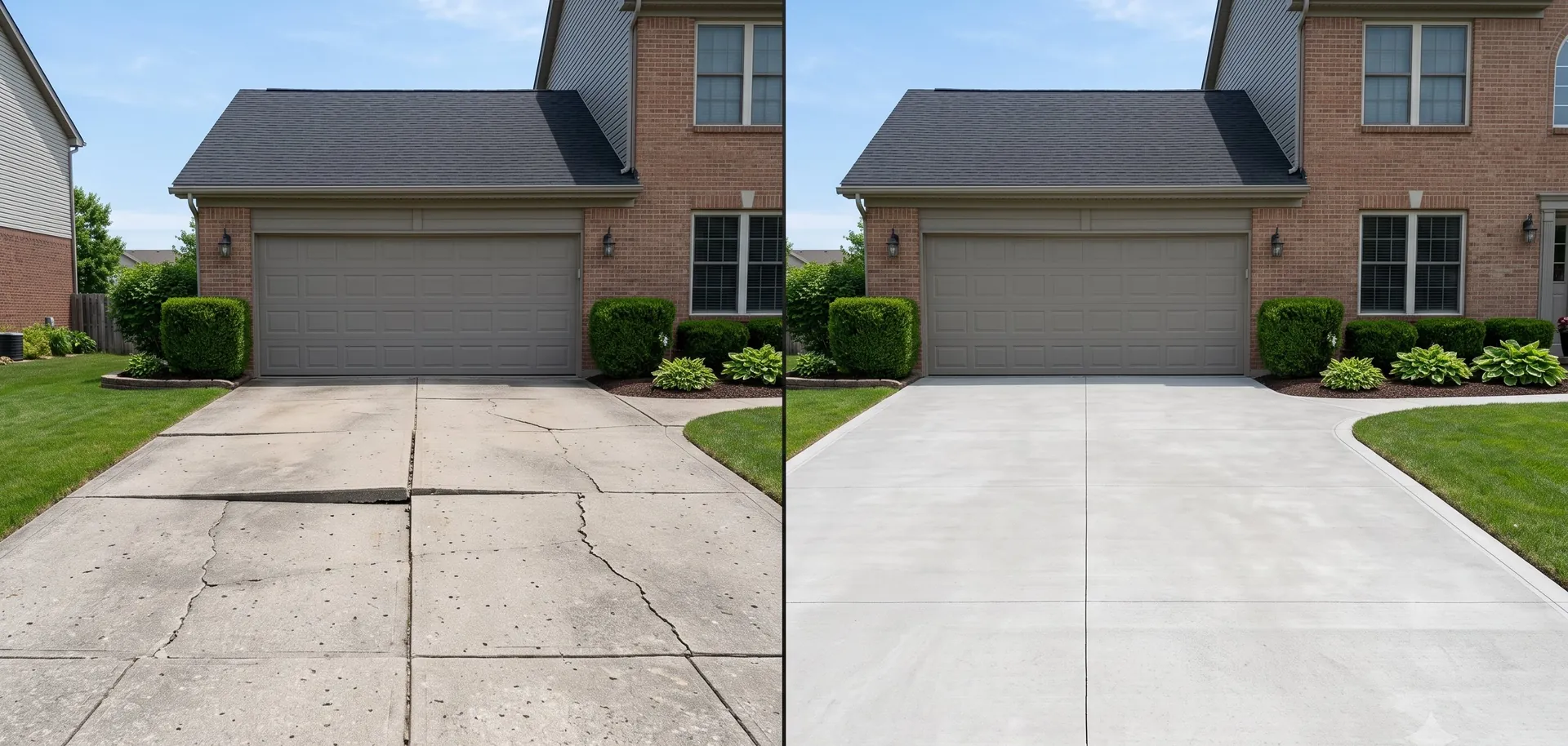
 Illustrative
How long concrete leveling lasts depends mostly on what caused the settling. The polyurethane foam itself is waterproof and doesn’t wash out, compress, or break down over time. When the underlying soil issue is addressed, a foam lift holds for years, and PolyJacks backs every job with a 5-year warranty against settling beyond the covered tolerance.
The Honest Answer: It Depends on What Caused the Settling
A properly done polyurethane lift lasts as long as the soil underneath stays stable - typically years, often the remaining life of the slab. The foam itself doesn't rot, shrink, or wash out, so longevity comes down to whether the original cause of the settling gets fixed too. Every PolyJacks lift also carries a 5-year warranty against re-settling.
PolyJacks is a locally owned concrete leveling company based in Spring Hill, working driveways, sidewalks, patios, garage floors, and pool decks across the Kansas City metro. The question we get most is how long a lift will hold, and the honest answer is: it depends on what made the slab sink in the first place.
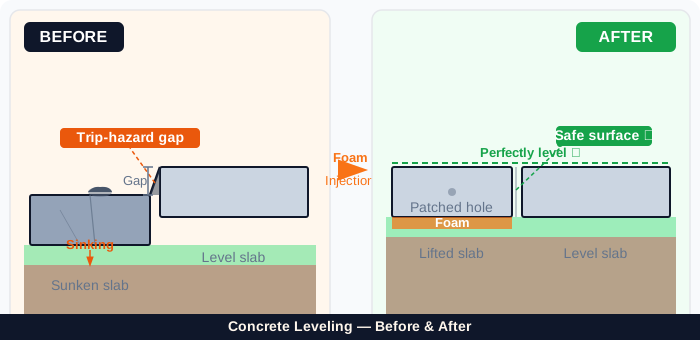
Leveling lifts your slab back to grade. It fills the void or compacted spot underneath it. If that void was a one-time thing (a settled fill area, an old utility trench, a dry spell that shrank the soil), filling it solves the problem for good. If the cause is still active — a downspout still dumping water next to the slab, roots still growing under it — the ground can shift again, and the slab can settle again, no matter what material is underneath it.
That's why we walk every site before quoting anything. A free inspection tells us whether we're fixing a one-time void or working against an ongoing condition, and we'll tell you straight either way.

How Long the Foam Itself Holds Up
The foam we use is waterproof and non-shrinking by design. It doesn't absorb moisture, doesn't wash out, and doesn't compress over the years the way loose soil can. It's light, so it isn't adding new weight for the soil to fight, which is part of why it stays put where it's placed.
Once it cures, which takes 15 to 30 minutes, it's done reacting. It's not slowly breaking down over the following years. If a repaired area ever moves again down the road, that's the surrounding soil shifting. Not the foam giving out.
Foam vs. Mudjacking: Why Weight Matters for Longevity
Mudjacking pumps a cement-based slurry under the slab. That mud is far heavier than our foam. All that extra weight sits on the same soil that already couldn't hold the slab up on its own. In Kansas City clay, that added load can speed up the next round of settling.
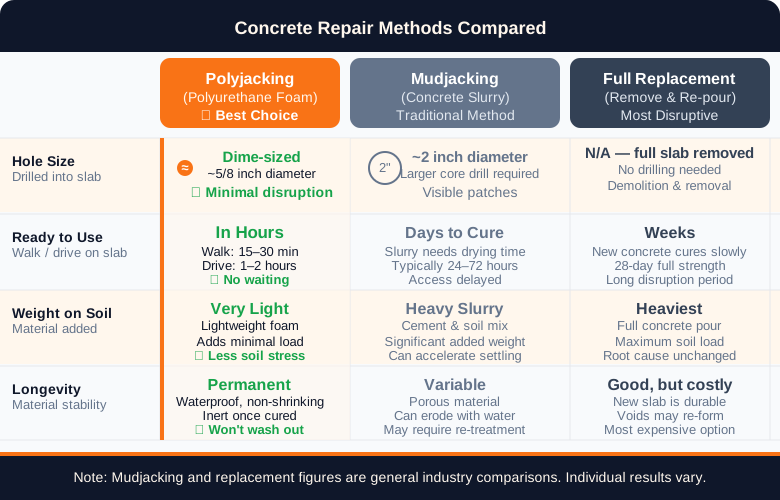
Mud also takes 24-72 hours to cure, so the slab sits out of use while it sets, and a wet slurry mix can be vulnerable to washout if water gets under it before it's fully cured. Our foam cures in 15-30 minutes and the surface is ready to use within hours (just keep heavy vehicles off it for 48 hours). Lighter material, faster cure, no wet mix sitting exposed. That adds up to fewer chances for the repair to fail while it sets.
Weight is the first half of the longevity question and water is the second. Why foam outlasts mudjacking long-term follows both through to the slow failure mode, where the void under a slurry-filled slab reopens and the concrete comes back down.
What Kansas City Soil Puts a Repair Through
From Overland Park to Olathe to Lee's Summit, the ground under every driveway, patio, and garage floor in the metro is mostly expansive clay. It swells when it's wet and shrinks when it dries, season after season. Add in repeated freeze-thaw cycles most winters, and you've got soil that's constantly moving under every slab in the area. That's the real test any repair has to survive, foam or mud.
A waterproof material that doesn't add weight and doesn't absorb moisture is built to handle that cycle better than a heavy, water-based mix fighting the same soil movement with a lot more mass on top of it.
Most of what keeps a lift holding is what you do in the first few weeks and the first few seasons. The two things that undo a repair fastest are water and weight, so the practical steps are straightforward.
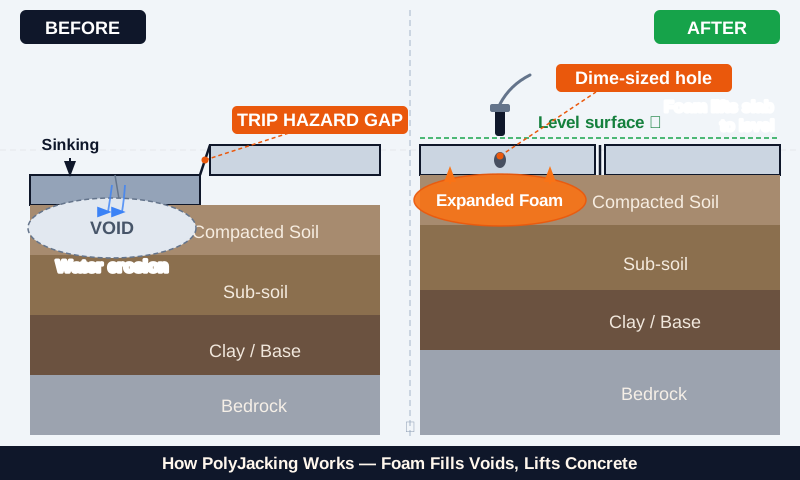
Keep downspouts and surface drainage directed away from the slab. The source of most repeat settling we see is a downspout or a grading issue that keeps pushing water into the same spot under the concrete. If you can re-point a downspout or add a few inches of slope away from the slab, you remove the ongoing cause that leveling alone can't fix.
For the first 48 hours after the lift, keep heavy vehicles off the surface. The foam is cured and the slab is level, but the surrounding soil is still adjusting to the new support. A pickup truck or delivery van parked on it for a day or two can compress the fresh fill before it fully seats.
Through the first few freeze-thaw cycles, watch for the early warning signs we list on our signs of uneven concrete page. A new crack, a small dip near a joint, or a section that no longer feels solid underfoot can all mean the soil is shifting again. Catching it early means a small re-lift instead of a bigger problem. If you notice movement, call us before it grows. The warranty covers re-settling over 1/2 inch within 5 years, but a small shift caught at the first sign is easier to address than one that has been growing for a season.
If the lift was done in late summer or fall, the first hard freeze-thaw cycle is the real test. Kansas City clay expands and contracts with every temperature swing, and the first winter after a repair is when you will know whether the soil has fully settled around the new support. If the slab is still solid through that first cycle, the odds of long-term stability are very good. Spring is when most of the seasonal movement shows up, so keep an eye on things through spring sinking season as well.
If you want to see where your address falls on the risk scale, our KC Settlement Risk Index breaks down soil vulnerability by neighborhood across the metro.
What Our Warranty Actually Covers
Every job comes with a 5-year limited warranty, written to the owner who paid for the work at that address. If the leveled area settles more than 1/2 inch within 5 years because of our work, we come back and re-lift it. That's tied directly to the workmanship and the material. Not a line in an ad.
The full terms, including what counts as a covered re-lift and what doesn't, are in our warranty policies.
When Leveling Isn't the Right Fix
We'll say this plainly, because it matters more than getting the job: leveling only works on a slab that's still structurally sound. A cracked or broken slab needs replacement, not a lift. An active water leak under a slab needs a plumber first. Foam doesn't stop a leak. And if tree roots are heaving a slab, that root issue has to be dealt with, or the movement keeps happening no matter what's underneath.
Foundation repair is also its own trade, and it's not something we do. If that's what your home actually needs, we'll connect you with a local partner who handles foundation work.
Not sure whether your slab is a lift candidate or a replacement job? Our guide to the signs you need concrete leveling, not replacement walks through the difference.
Get a Straight Answer for Your Property
The only way to know how long a repair will hold on your driveway, patio, sidewalk, garage floor, or pool deck is to have someone look at what's actually happening underneath it. We price every job by the foam volume it takes, after a free, no-obligation inspection. Far less than full replacement.
Book a free estimate and we'll walk the site, tell you what's really going on, and give you a straight read on what to expect. Call (913) 713-7794.
How polyjacking works in 90 seconds
Our team walks you through the three-step process: dime-sized holes, high-density polyurethane foam that fills every void and compresses the soil beneath your slab, and use within hours with no heavy trucks. Call (913) 713-7794 or book a free estimate below.
Frequently asked
Will the foam eventually break down or wash away?
No. Once cured, the foam is waterproof and non-shrinking, so it doesn't absorb moisture or degrade the way a mud-based fill can over time. If a repaired area moves again down the road, that's the soil underneath shifting. Not the foam failing.
Is foam leveling really longer-lasting than mudjacking?
The foam holds up better for two reasons: it's lighter than mud, so it isn't piling extra weight onto soil that already struggled to hold the slab. It also cures in 15-30 minutes, while mud takes 24-72 hours and can be vulnerable to washout while it's still wet.
What if my driveway or patio settles again later?
Our 5-year limited warranty covers a re-lift if the leveled area settles more than 1/2 inch within 5 years because of our work. Outside that window, give us a call. Most repeat settling traces back to a specific, identifiable cause.
How do I know if leveling will actually fix my problem for good?
That's what the free inspection is for. We check whether the slab itself is structurally sound and look for an ongoing cause (drainage, roots, an active leak) before we ever quote the job. If leveling isn't the right fix, we'll tell you plainly.
How long does polyjacking last?
Polyjacking is the polyurethane foam lift this page describes, so the answer is the same: a properly done lift lasts as long as the soil underneath stays stable, typically years and often the remaining life of the slab. Once cured, the foam is waterproof and non-shrinking, so it doesn't rot, shrink, or wash out. If the leveled area settles more than 1/2 inch within 5 years because of our work, our 5-year limited warranty covers a re-lift.
Related guides
Have a sinking slab?
Book a free on-site inspection. Honest advice, usable within hours.
Pick a time that works for you
Book right here on this page. Prefer to talk? Call (913) 713-7794.