
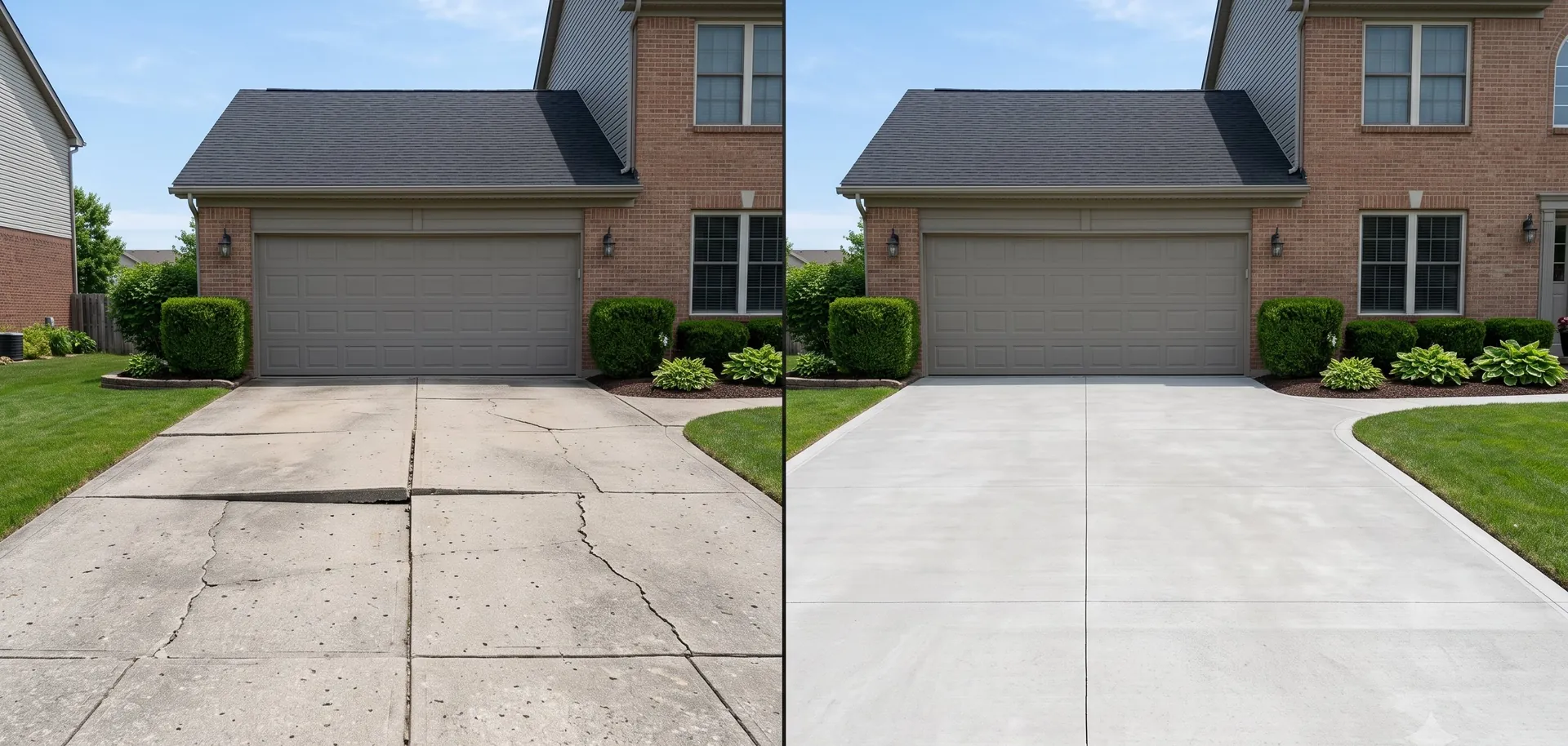
 Illustrative
Why Your Driveway Is Pulling Away From the Garage (And How to Fix It)
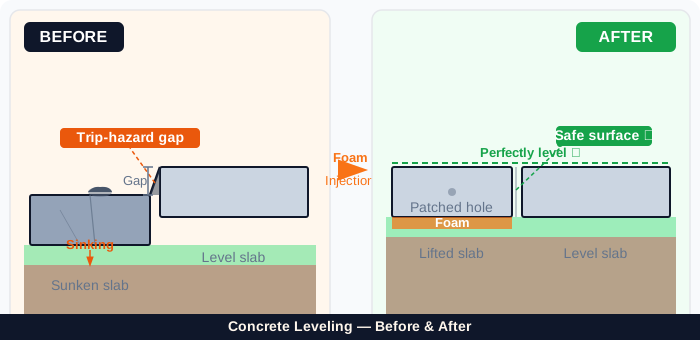
A gap or trip lip where the driveway meets the garage means the driveway slab has settled while the garage floor, tied to the foundation, stayed put. Loose or eroded soil under the driveway is the usual cause. Foam injection lifts the settled slab back level with the garage through small holes.
The Gap Nobody Warned You About
You back out of the garage one morning and there it is. A ledge where the driveway meets the garage floor that wasn't there last year. Sometimes it's a hairline crack. Sometimes it's a lip you catch with your toe or your car's front bumper scrapes over. Either way, the two slabs used to sit flush, and now they don't.
Here's what's actually happening: your garage floor sits on its own footing, usually poured deeper and more stable. The driveway slab in front of it is resting on plain soil. When that soil loses support underneath, the driveway drops while the garage floor stays put, and the gap between them opens up right at the seam.
Why This Is So Common in Kansas City
This isn't bad luck. It's the ground under your slab. Kansas City sits on expansive clay soil that swells when it's wet and shrinks when it dries out. Every wet spring and dry summer, that soil is moving underneath your driveway, and concrete can't flex to keep up.
Winter piles on more. The metro sees repeated freeze-thaw cycles every season. Water in the soil freezes, expands, thaws, and settles again: over and over. Concrete doesn't bend with that movement. It either holds its shape or it drops when the support underneath it disappears. The gap at your garage apron is usually the first place you notice it, because that's where two separately poured slabs meet.
Homeowners in Overland Park, Olathe, and Lee's Summit report this gap most often, but the expansive clay underlies the entire metro.
It's More Than a Trip Hazard
A gap or lip at the garage looks like a cosmetic problem, but it doesn't stay that way. Once there's an opening, rainwater and melting snow run straight into it and under the slab. Exactly the kind of moisture that feeds the next freeze-thaw cycle and erodes more soil out from underneath. The gap tends to get worse, not better, on its own.
There's also the everyday safety side: a raised or dropped edge where you walk in and out of the garage every day is a trip hazard for you, your kids, and anyone delivering a package. It's worth fixing before it grows.
Before you call for a lift, check the drainage at the garage-to-driveway transition. The driveway should slope away from the garage so that runoff moves off the slab and into the yard or a drain, not into the seam. If water pools at the apron after a rain, that standing moisture is accelerating the soil loss underneath and will keep widening the gap even after a lift. Making sure the grading at the transition directs water away, or adding a small drain if one isn't there, stops the cycle from restarting the moment the slab is back at level.
When Polyjacking Isn't the Right Fix
We'll say this plainly because it matters: foam lifting isn't the answer for everything. If the slab is actually cracked through or broken into pieces, lifting it won't hold. It needs to be replaced. If the sinking is caused by an active water leak, like a broken pipe washing out soil underneath, that needs a plumber first, or the ground will just wash out again. And if tree roots are heaving or undermining the slab, that root problem has to be addressed before any lifting will last.
We do this kind of work every day, and we'd rather tell you the truth at your free estimate than sell you a fix that won't hold.
The Foam Fix: How It Actually Works
When polyjacking is the right call, here's what a job looks like. We drill a series of dime-sized holes through the sunken slab, usually somewhere between 4 and 12 holes depending on the size of the area. Through those holes we inject a waterproof, high-density polyurethane foam directly under the concrete.
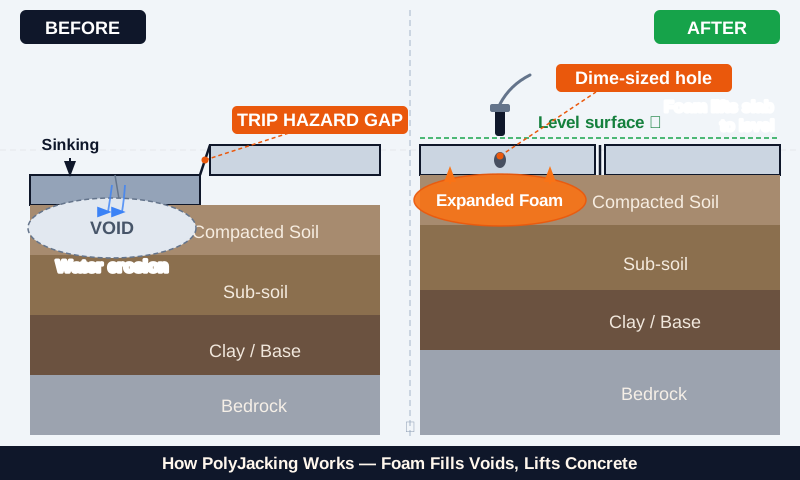
The foam expands 30 to 40 times its liquid volume, filling the voids left by eroded soil and gently lifting the slab back toward level. Most jobs take 2 to 4 hours start to finish. You're back on your feet on it in 15 to 30 minutes, driving on it in 1 to 2 hours, and it's ready to use within hours. Just keep heavy vehicles off it for 48 hours. This is the same driveway leveling process we use across the Kansas City metro.
Why Foam Beats Mudjacking or Tearing It Out
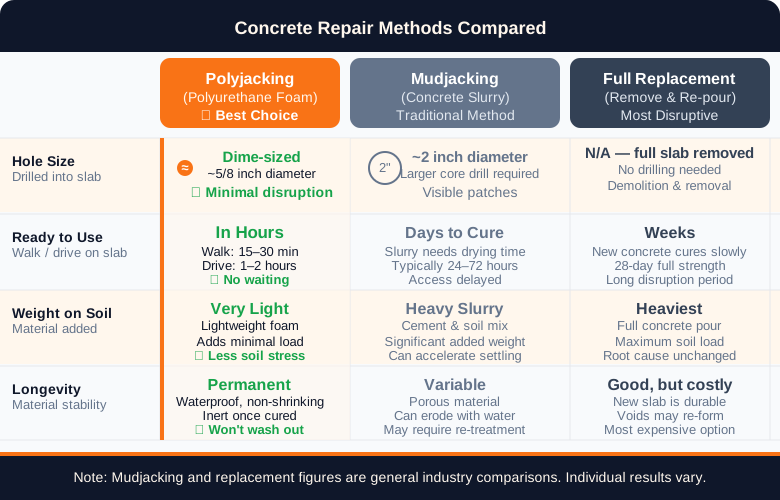
The old-school fix, mudjacking, pumps in a cement-based slurry that's far heavier. That's heavy enough to keep pressing down on the same soft soil that caused the problem in the first place. Our foam weighs far less, so it lifts the slab without adding a load the ground has to fight.
The foam is also waterproof and non-shrinking, so it won't break down or wash out over time the way mud slurry can. It cures in 15 to 30 minutes, versus 24 to 72 hours for mud, or about a week to usable and 28 days to full cure if you tear out and repour. And because we're not paying for demolition, disposal, forms, and a full repour, foam lifting typically runs far less than replacing the slab.
What Happens at Your Free Estimate
PolyJacks is a locally owned business based in Spring Hill, founded in 2024 and owner-operated, and we serve homeowners and businesses across the Kansas City metro. We're licensed and insured.
At a free estimate, we look at your gap, figure out whether it's a polyjacking job or something that needs a different fix first, and price it by the foam volume your slab actually needs. Not a guess. Every lift is backed by a 5-year limited warranty: if it settles more than 1/2 inch within 5 years because of our work, we come back and re-lift it. It is written to the owner who paid for the work, at that address, and it ends if the house is sold.
How polyjacking works in 90 seconds
Our team walks you through the three-step process: dime-sized holes, high-density polyurethane foam that fills every void and compresses the soil beneath your slab, and use within hours with no heavy trucks. Call (913) 713-7794 or book a free estimate below.
Frequently asked
How soon can I park in my garage after the foam is injected?
You can walk on the lifted slab in 15 to 30 minutes. Most vehicles can drive on it in 1 to 2 hours. Hold off on heavy vehicles (think box trucks or RVs) for 48 hours while the foam finishes settling in. Compare that to mudjacking, which needs 24 to 72 hours before you can use the slab, or full replacement, which runs about a week before it's usable and 28 days to fully cure.
Will the gap just come back next year?
The foam itself won't shrink or wash out. It's a waterproof, non-shrinking polyurethane, so it holds the lift. And every job is backed by a 5-year limited warranty: if the slab settles more than 1/2 inch within 5 years because of our work, we come back and re-lift it. Soil movement from clay and freeze-thaw is a fact of life here, but the foam is built to ride it out.
What does it cost to fix a sunken driveway slab?
We don't post prices because every gap is different. The cost depends on how much foam volume it takes to fill the void and lift the slab. What we can tell you: foam lifting typically runs far less than tearing out and replacing the slab, and you find out the real number from a free, no-obligation inspection, not a guess.
What if the driveway slab is actually broken, not just sunk?
Then foam isn't the right tool. A cracked-through or shattered slab needs to be replaced, not lifted. Same goes for an active water leak (call a plumber first) or heave caused by nearby tree roots (that needs root work before any lifting). We'll tell you straight at the free estimate if polyjacking isn't the fix for your situation.
Have a sinking slab?
Book a free on-site inspection. Honest advice, usable within hours.
Pick a time that works for you
Book right here on this page. Prefer to talk? Call (913) 713-7794.