
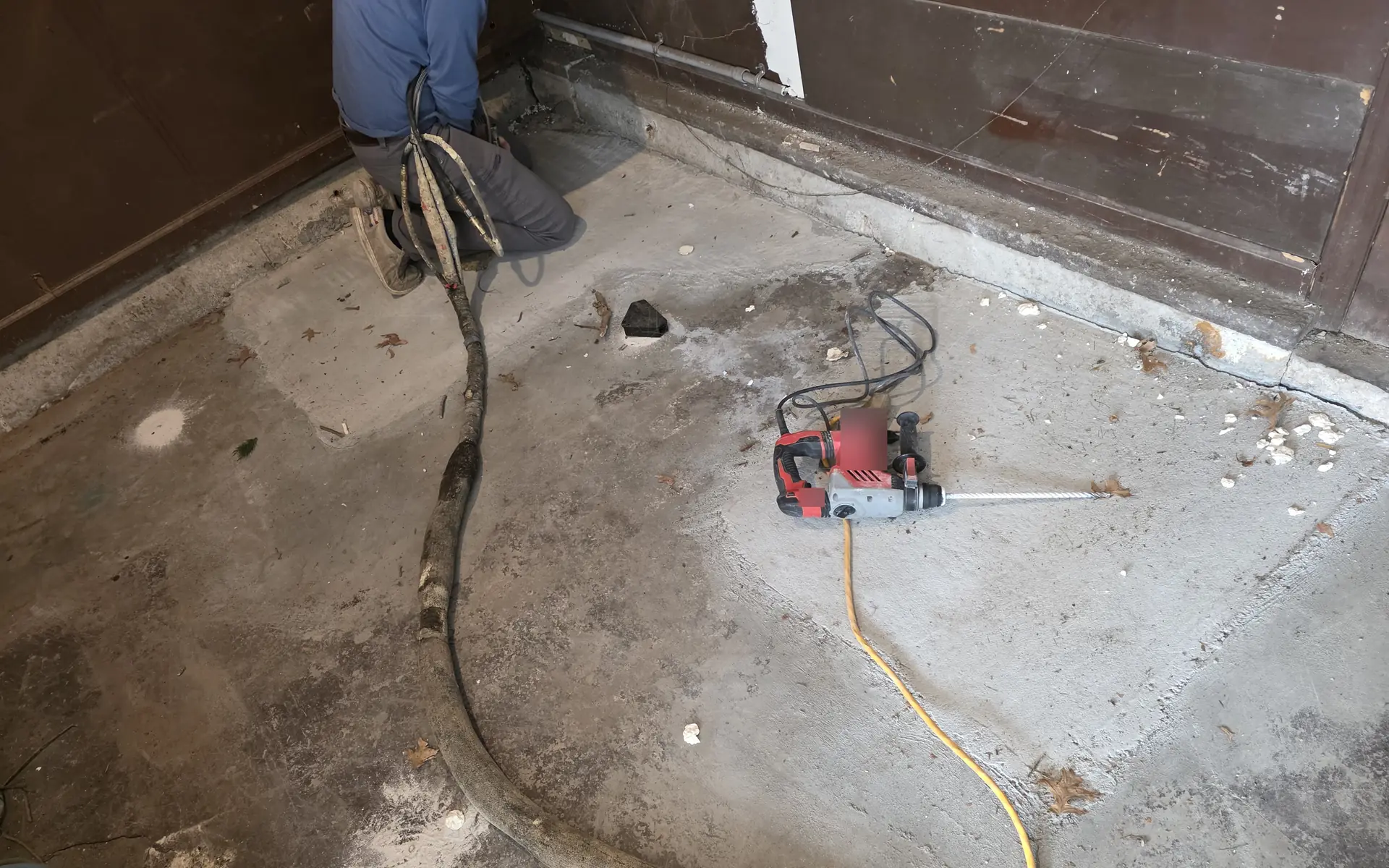
Mudjacking pumps thick slurry, so it needs large holes. Polyjacking injects foam, which flows through much smaller, dime-sized holes. The smaller polyjacking holes are less visible once patched and mean less disruption to the slab's surface. With either method, the holes are filled after the slab is lifted back to level.
Why Hole Size Actually Matters
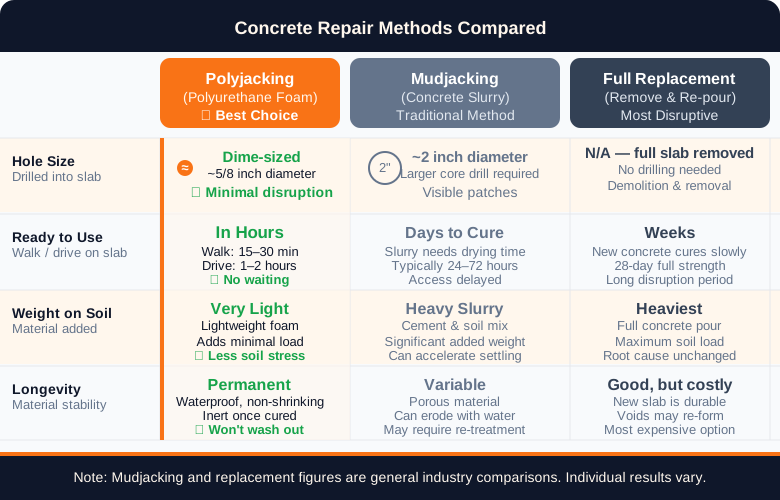
Polyjacking holes are about the size of a dime; mudjacking holes are several times wider. That single difference - driven by how thick each material is - changes how many holes a slab needs, how visible the patches are afterward, and how much the drilling risks the concrete.
Both mudjacking and polyjacking work the same basic way: drill holes into the slab, pump material underneath, lift the concrete back to grade, patch the holes. The lifting concept is old and proven either way. But the two methods use very different materials to do the lifting, and that difference shows up directly in how big the holes have to be, how many are needed, and what the driveway or patio looks like once the crew is packed up and gone. If you're comparing quotes or just trying to understand what a repair will look like afterward, hole size is one of the clearest ways to tell the two methods apart before any drilling starts. For a fuller side-by-side, see polyjacking vs. mudjacking.
| At a glance | Polyjacking | Mudjacking |
|---|---|---|
| Hole size | About the size of a dime | Several times wider |
| Holes per panel | Fewer | More |
| Patch afterward | Small dot, blends in over a season | Larger circle, stays visible |
| Drilling risk to the slab | Lower - less material removed | Higher - bigger, more numerous holes |
Mudjacking Holes: Bigger, Because the Material Is Heavier
Mudjacking pumps a cement-and-soil slurry underneath the slab - a heavy, thick material that needs a wider path to flow through and enough volume to fill a void and lift several tons of concrete. That means holes are typically drilled much wider, and often need more of them spaced across a panel to get the slurry distributed and the slab lifted evenly. The holes are noticeably visible even after patching, both because of their size and because the patch material rarely matches the surrounding concrete's color and texture exactly. On a driveway or patio with a lot of visible surface, that adds up to a repair that's functional but leaves a more visible fingerprint across the slab than most homeowners expect going in.
Polyjacking Holes: Dime-Sized
Polyurethane foam expands as a chemical reaction after injection rather than relying on volume alone to fill a void, so it doesn't need a wide path to get under the slab. That's why polyjacking holes run dime-sized. A fraction of the size mudjacking requires. Fewer, smaller holes also means less drilling into the slab overall, which matters for the long-term integrity of the concrete itself: every hole is a small structural interruption, and minimizing both the size and count reduces the chance of new cracking starting at a drill point down the road. For a driveway apron, a patio, or a walkway where appearance matters as much as function, this is usually the most visible day-one difference between the two methods.
What the Patched Holes Look Like Later
After lifting, both methods patch the drilled holes with a concrete-based filler, but the end result looks different mostly because of scale. A dime-sized polyjacking hole patches into something close to a small dot that blends into the surrounding surface fairly quickly, especially once it's weathered a season. A much wider mudjacking hole patches into a noticeably larger circle that tends to stay visible as a slightly different texture or shade, even years later, simply because there's more patch material sitting in a bigger cavity. Neither patch is invisible - concrete patching a hole into concrete rarely disappears completely - but the difference in scale is real, and it's worth asking to see finished examples of either method before deciding which matters more to you: the method itself or the long-term look of the surface.
Smaller Holes Mean Less Risk to the Slab
Every hole drilled into a concrete slab is a point where the material has been weakened slightly, even before it's patched. A smaller hole disturbs less of the surrounding concrete and any rebar or mesh reinforcement that might run through the slab, and fewer holes overall means fewer of those interruption points across a panel. This is part of why the lighter weight of foam matters too - not just for weak soil underneath, but because a smaller volume of injected material means less pressure is needed to achieve the same lift, reducing stress on already-settled concrete during the process itself. None of this means mudjacking is unsafe when it's done correctly; it just means the two methods carry a different amount of physical disruption to the slab in order to get the same end result.
Back in Use Within Hours After Either Method
One thing both methods share is a relatively fast return to use compared to a full replacement pour, which typically needs days to cure before any weight goes on it. With polyurethane foam specifically, the treated area generally handles foot traffic in about 15 to 30 minutes and vehicle traffic in roughly 1 to 2 hours, since the foam itself reaches usable strength almost immediately after it finishes expanding. That's a meaningful advantage over waiting out a multi-day cure window, especially for a driveway that is the only access to your garage, or a walkway that sees daily foot traffic. It's one of the practical reasons foam injection has become the more common choice for residential concrete leveling repairs across the metro in recent years.
Which Method Fits Your Concrete
Neither method is universally right - a slab with a very large void or extreme settling might genuinely need a different approach than a straightforward lift, and that's a conversation worth having honestly rather than assuming one method fits everything. What we can tell you plainly: for most residential driveways, patios, walkways, and garage floor slabs across the Kansas City metro, the smaller hole size, faster cure time, and waterproof, lightweight nature of foam make polyjacking the more practical choice, which is why it's what we do. If a slab's condition calls for something else, we'll say so rather than push a fix that isn't right. A free on-site estimate - call (913) 713-7794 or use the contact form - gets you a straight answer on what your specific concrete needs.
If your slab is a garage floor, our garage floor leveling guide explains what the repair involves.
How polyjacking works in 90 seconds
Our team walks you through the three-step process: dime-sized holes, high-density polyurethane foam that fills every void and compresses the soil beneath your slab, and use within hours with no heavy trucks. Call (913) 713-7794 or book a free estimate below.
Frequently asked
How big are polyjacking holes compared to mudjacking holes?
Polyjacking holes run dime-sized. Mudjacking holes are typically much wider, since the heavier slurry needs a wider path to be pumped underneath the slab.
Do the patched holes ever fully disappear?
Not completely - patched concrete rarely matches the surrounding slab perfectly. Smaller polyjacking patches tend to blend in more over time simply because there's less patch material and surface disruption to begin with.
Does hole size affect how strong the repair is?
It affects the slab's structural integrity more than the strength of the lift itself - fewer, smaller holes mean less material removed from the panel and less chance of new cracking starting at a drill point later.
Why does mudjacking need bigger holes in the first place?
The slurry mudjacking uses is heavier and thicker than polyurethane foam, so it needs a wider opening and higher volume to flow under the slab and achieve the same lift.
Can I request smaller holes with mudjacking?
Hole size with mudjacking is largely dictated by the material itself, not a preference - the slurry's viscosity requires a certain minimum opening to be pumped effectively, which is a structural difference from foam injection rather than a style choice.
Related guides
Have a sinking slab?
Book a free on-site inspection. Honest advice, usable within hours.
Pick a time that works for you
Book right here on this page. Prefer to talk? Call (913) 713-7794.