
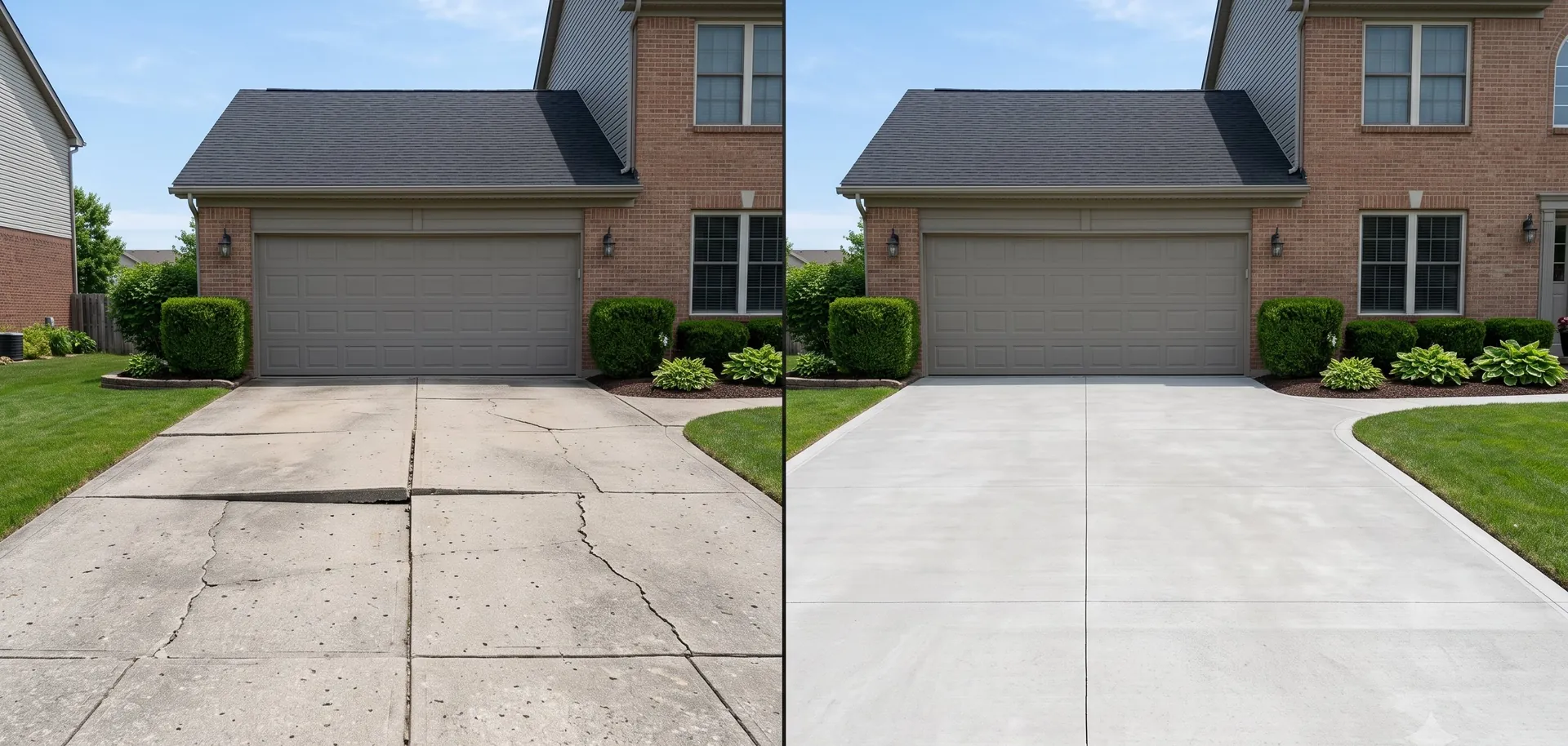
 Illustrative
5 Drainage Mistakes Quietly Sinking Your KC Driveway
The drainage mistakes that quietly sink KC driveways: downspouts dumping water beside the slab, ground graded toward the concrete instead of away, sprinklers over-soaking the soil, missing or crushed drains, and settled backfill along foundations. Each washes out or softens the soil supporting the slab. Fixing drainage protects a leveled driveway long-term.
Water is the real reason your driveway is sinking
Concrete doesn't sink on its own. It sinks because the soil underneath it washes away, and water is almost always what moves that soil. In the Kansas City metro, we've got two things working against every driveway, patio, and garage floor: expansive clay soil that swells when it's wet and shrinks when it dries, and repeated freeze-thaw cycles every winter. Add in water that's aimed at your slab instead of away from it, and you've got a void forming under the concrete before you ever see a crack on top.
The good news: most of the water problems below are easy to spot once you know where to look. Catching them early can save you a much bigger repair down the road.
Early signs can hide through winter, because voids from freeze-thaw cycles often stay out of sight until the ground thaws, which is why sinking concrete shows up every spring in Kansas City.
On this page
Jump to: Mistake #1 (downspouts) · Mistake #2 (grading) · Mistake #3 (sprinklers) · Mistake #4 (gutters) · Mistake #5 (splash blocks) · What happens once the void is already there · When polyjacking isn't the right fix · Get a free inspection
Mistake #1: Downspouts dumping water right at the slab
This is the most common one we see. A downspout that empties two feet from your driveway or patio is pouring gallons of water straight into the soil next to the slab every time it rains. That water saturates the clay, softens it, and over seasons of freeze-thaw, washes fine soil particles away entirely. The slab above that void has nothing left to rest on.
Walk your property after a hard rain and watch where each downspout actually discharges. If it's pooling against the foundation or running under the edge of your driveway, that's a mistake quietly working against you.
Mistake #2: Grading that slopes toward the house instead of away
Yards settle over time, and sometimes what used to slope away from a slab now tips back toward it. This is called negative grading, and it channels every rainstorm straight to the edges of your driveway or patio instead of away from it. It's slow and easy to miss because it happens gradually, a fraction of an inch at a time, over years.
A simple check: set a level along the ground near your slab edges. If water has a clear low point aimed at the concrete, that's grading working against you instead of for you.
We see this most often in older subdivisions where the original grading was done decades ago and the clay has shifted since.
Mistake #3: Sprinkler heads soaking the edge of the slab
Irrigation systems are convenient until a head is aimed wrong, leaking underground, or running longer than the lawn actually needs. A sprinkler head positioned near a driveway or patio edge can keep that strip of soil saturated all season long, which is exactly the kind of steady moisture that erodes support out from under concrete.
Check your zones during a normal watering cycle. If any head is spraying onto the slab itself, or if you notice a patch of ground near the concrete that's always damp even on dry days, that's worth fixing before it becomes a bigger problem.
Mistake #4: Clogged or disconnected gutters overflowing onto the drive
A gutter packed with leaves doesn't carry water to the downspout. It overflows straight down along the fascia and foundation line, often right where a driveway or walkway meets the house. Over a Kansas City winter with repeated freeze-thaw cycles, that repeated soaking and freezing breaks down the soil structure fast.

This one's easy to fix and easy to forget. A twice-a-year gutter cleaning does more for your concrete's foundation than most homeowners realize.
Mistake #5: No splash block or extension, so water pools instead of draining away
Even a downspout that's positioned correctly can cause problems if it just dumps water two feet down with nowhere to go. Without a splash block or an extension to carry water further from the slab, it pools right at the base and soaks straight down into the soil supporting your driveway or patio edge.
This is often the cheapest fix on this list, and one of the most overlooked.
What happens once the void is already there
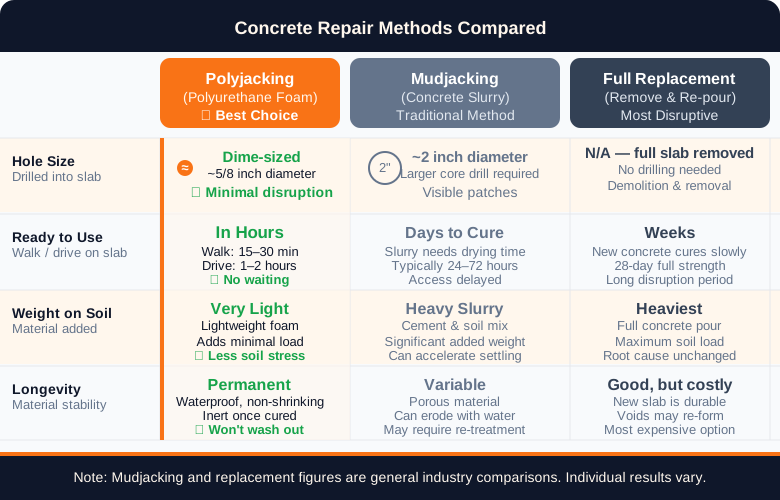
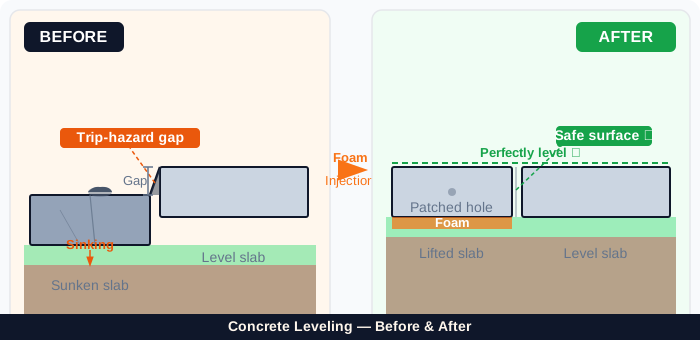
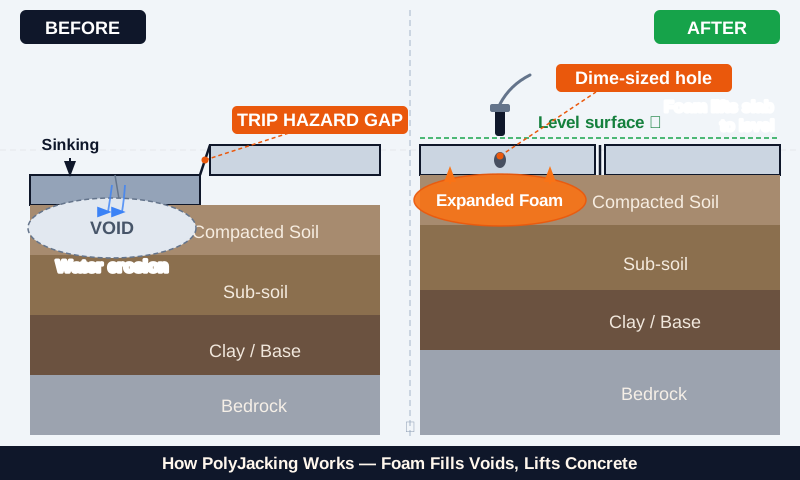
If soil has already washed out from under your driveway, sidewalk, patio, garage floor, or pool deck, fixing the drainage going forward won't lift the concrete back up. That's where polyjacking comes in. We drill dime-sized holes. Typically 4 to 12 of them depending on the slab, and inject a waterproof, high-density polyurethane foam. It expands 30 to 40 times its liquid volume, fills the void completely, and lifts the slab back to level.
The foam itself is waterproof and non-shrinking, so it won't break down if water reaches it again the way soil does. It's also light, a fraction of the weight of a heavy mud slurry, so it isn't adding dead weight the soil has to support. Most jobs take 2 to 4 hours. The foam cures in 15 to 30 minutes, you can walk on it in that same window, and drive on it in 1 to 2 hours. Just no heavy vehicles for 48 hours. Every job comes with a 5-year limited warranty, and we'll re-lift it if it settles more than 1/2 inch within those five years because of our work. It is written to the owner who paid for the work, at that address, and it ends if the house is sold. When that void is under a driveway specifically, driveway leveling lifts the slab back to grade without tearing it out.
For sinking concrete repair after a drainage problem, the lift is the part that restores the slab, while the drainage fixes above help keep the soil from washing out again.
When polyjacking isn't the right fix
We'll tell you straight if foam isn't the answer. A slab that's cracked all the way through or broken into separate pieces needs replacement, not lifting. Foam can't repair broken concrete, only raise it. If you've got an active plumbing leak feeding water under the slab, that needs a plumber first, or the ground will just keep moving. And if tree roots are pushing the concrete up rather than settling it down, that's root work, not a foam job. A free inspection tells you which situation you're actually in before anyone spends a dime on the wrong fix.
Not sure whether a crack means the slab is finished? Our guide on cracks in concrete and when to worry explains which ones are cosmetic and which point to a bigger problem.
Get a free inspection before it gets worse
Drainage problems don't announce themselves. They work quietly for a season or two before you notice a lip at a slab edge or water pooling somewhere new. Catching it early, or fixing the sinking that's already happened, is a lot simpler than most homeowners expect.
PolyJacks is a locally owned concrete leveling company based in Spring Hill, serving the Kansas City metro since 2024. We're licensed and insured. We price every job by foam volume after a free, no-pressure inspection. Far less than tearing out and replacing the slab.
Book your free estimate or call (913) 713-7794.
If you want to see how that foam-volume pricing plays out before you call, read how much concrete leveling costs in Kansas City.
How polyjacking works in 90 seconds
Our team walks you through the three-step process: dime-sized holes, high-density polyurethane foam that fills every void and compresses the soil beneath your slab, and use within hours with no heavy trucks. Call (913) 713-7794 or book a free estimate below.
Frequently asked
How do I know if my sinking driveway is a drainage problem or something worse?
Look at the pattern. A slab that dropped evenly, mostly near an edge, a downspout, or a sprinkler head usually points to washed-out soil underneath. A drainage problem. A slab that's cracked straight through, broken into separate pieces, or rocking when you drive over it is a different issue. The concrete itself has failed, not just the ground under it. A free inspection settles it either way. We'll tell you straight if foam is the right call or if you need something else.
Do I need to fix the drainage before you lift the slab?
Not to do the lift itself: polyjacking foam is waterproof and won't break down if water reaches it again. But if the water source that caused the sinking is still active, the soil under the slab can wash out again over time. We'll point out what we see during your free inspection so you know what to watch, even though grading and gutter work isn't something we perform.
How long does polyjacking take compared to waiting on a drainage fix?
Most polyjacking jobs run 2 to 4 hours, and the foam cures in 15 to 30 minutes. You can walk on it in 15 to 30 minutes and drive on it in 1 to 2 hours (just no heavy vehicles for 48 hours). Compare that to mud jacking, which needs 24 to 72 hours before use, or full replacement, which takes about a week before you can walk on it and 28 days to fully cure. If drainage caused the void, lifting the slab is the fast part. The drainage fix is the part worth doing right, on its own timeline.
Is polyjacking covered by a warranty if the slab settles again?
Yes. PolyJacks backs every job with a 5-year limited warranty. If the slab settles more than 1/2 inch within 5 years because of our work, we re-lift it.
Have a sinking slab?
Book a free on-site inspection. Honest advice, usable within hours.
Pick a time that works for you
Book right here on this page. Prefer to talk? Call (913) 713-7794.