
 Illustrative
Sidewalk Trip Hazards & Liability: What Kansas City HOAs and Property Managers Need to Know
Uneven sidewalk slabs are a real liability for HOAs and property managers: a raised lip over about a quarter inch is an ADA trip hazard and a fall-claim risk. Foam leveling clears the offset quickly through small holes, at far less cost and disruption than replacing panels. Documenting the fix helps limit liability.
The Liability Problem Nobody Budgets For
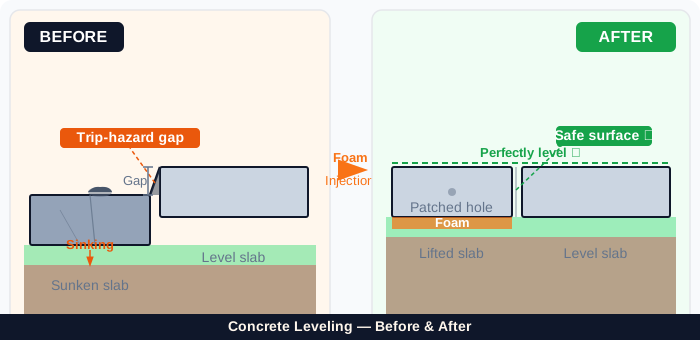
As an HOA board or a property manager, you're responsible for the ground people walk on, not just the buildings they live in. A raised slab edge or a dip that holds standing water looks like a minor cosmetic issue until a resident, a delivery driver, or a guest catches a toe on it and goes down. That's the moment "minor" turns into an insurance claim, a board meeting nobody wanted to have, and possibly a lawsuit naming the association or the management company directly.
Concrete in Kansas City doesn't fail all at once. It settles a little more every year, which means most trip hazards were visible (and knowable) long before anyone got hurt. In a liability review, that's the detail that matters most: not whether the sidewalk was uneven, but whether someone knew and didn't act.
Why Kansas City Sidewalks Move in the First Place
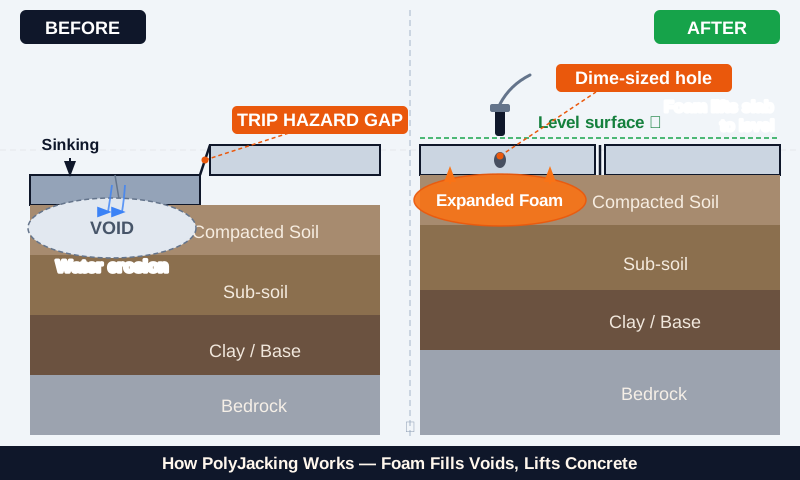
This isn't a one-time construction defect. Kansas City sits on expansive clay soil that swells when it's wet and shrinks when it's dry, so the ground under your sidewalks is never fully still. Add in repeated freeze-thaw cycles most winters, and you get repeated cycles of soil movement that hollow out voids under slabs and let panels settle unevenly, section by section, year after year.
That means a property that passes a walk-through this spring can develop a new hazard by next winter. Sidewalk maintenance for a KC-metro property isn't a one-and-done project. It's an ongoing part of managing the risk on your land.
If you want to understand how a settled panel differs from one that has been pushed up, see concrete settling vs. heaving.
ADA and the Baseline You're Responsible For
Accessible routes on your property need to work for everyone using them: residents and guests on foot, in wheelchairs, with walkers, or pushing strollers. Height differences and dips in a walking path are exactly the kind of thing that turns a routine sidewalk into an accessibility complaint or a code violation, on top of the fall risk itself.
We're not attorneys, and exact accessibility standards for your specific property are a conversation for your legal counsel or local code official. What we can do is walk your entire property, point out every spot where a slab has settled out of level, and give you an honest, documented picture to bring into that conversation instead of finding out about a problem when someone's already been hurt.
The Numbers Behind an ADA Change in Level
For walking surfaces on an accessible route, Section 303 of the 2010 ADA Standards for Accessible Design, published on ada.gov, draws three lines. An edge up to 1/4 inch high is allowed to stay vertical. From 1/4 inch to 1/2 inch, the edge needs a bevel with a slope no steeper than 1:2. Anything above 1/2 inch is treated as a ramp and has to meet the ramp rules.
Keep in mind these figures govern accessible routes, not every private driveway in the community. Which paths on your property count as accessible routes is a question for your counsel or code official. Our part is to walk the property and point out every spot that has settled out of level.
Documentation Is Your Best Defense
If a claim ever does happen, the strongest thing an HOA or property manager can have on file is a record showing you inspect for hazards and act on them. Photograph problem spots, date them, log when they were reported and when they were fixed. Insurers and courts both look at the same question: was reasonable care taken? A logged, dated repair history answers that question for you. A shrug doesn't.
Bulk and Portfolio Leveling: Fixing It Property-Wide, Not Panel-by-Panel
PolyJacks does commercial work, and for HOAs and property managers that usually means walking the entire property once, marking every trip point, and lifting the whole batch in as few visits as possible instead of sending a crew out one panel at a time every time a resident calls in a complaint.
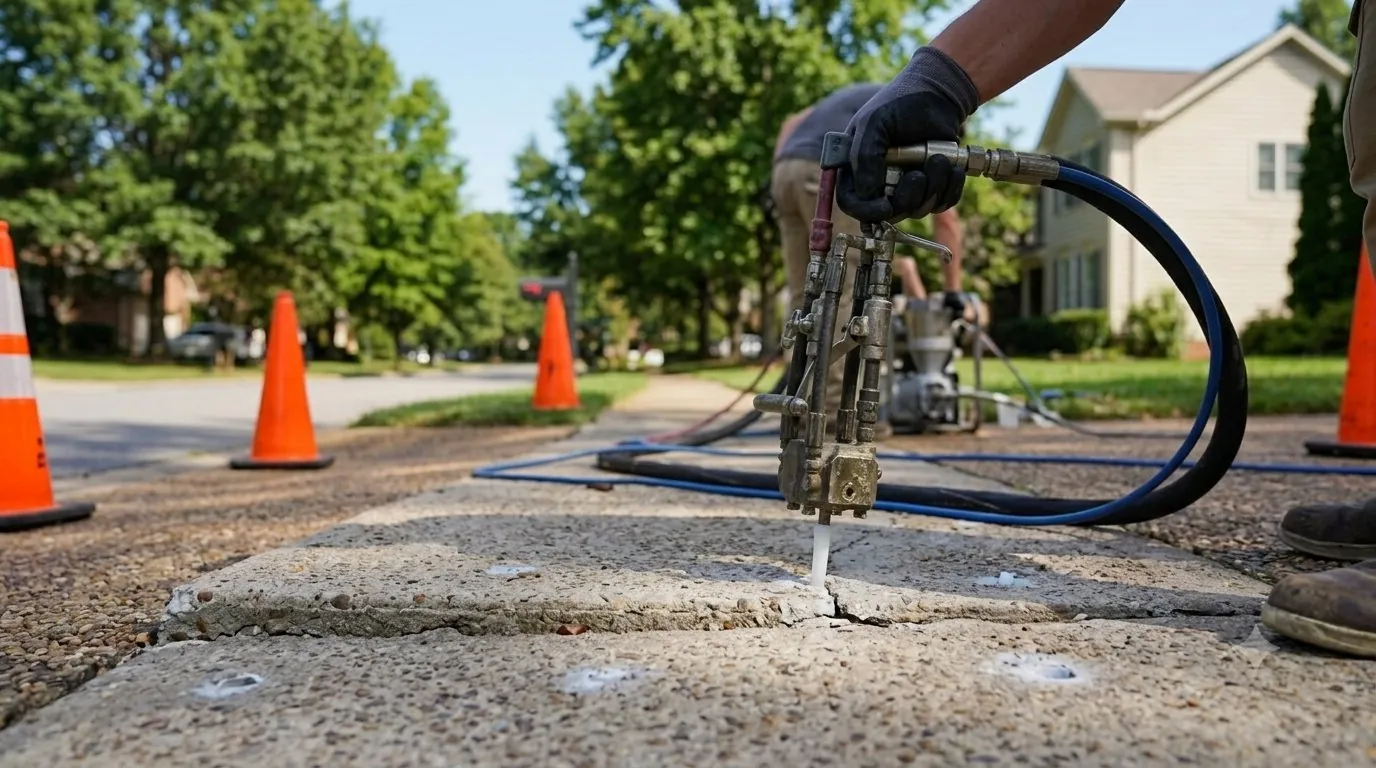
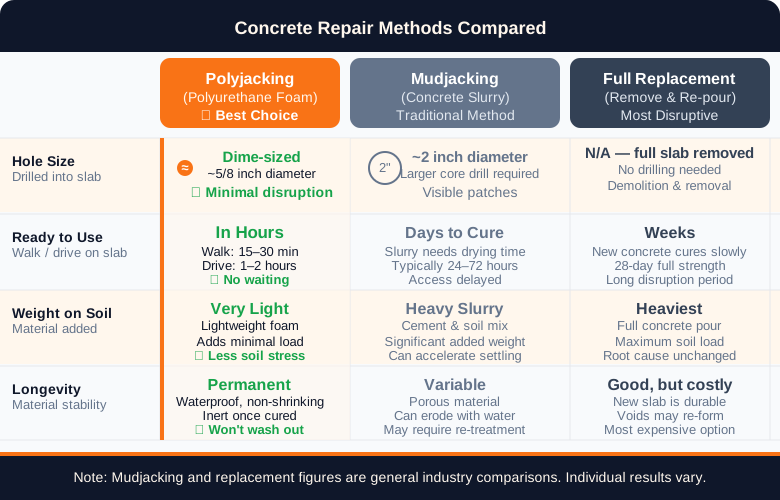
The process is the same waterproof, high-density polyurethane foam we use on driveways and patios. We drill dime-sized holes at each low spot. Usually 4 to 12 holes per section depending on size, and inject foam that expands 30 to 40 times its volume to fill the voids under the slab and lift it back to grade. Most individual jobs run 2 to 4 hours, and the sidewalk is walkable again in 15 to 30 minutes, which matters when you can't shut down a walking path for a week at a time.
The foam itself weighs far less than traditional mudjacking mix. That's less dead weight sitting on the same soft soil that caused the settling in the first place, and it's waterproof and non-shrinking, so it won't break down and re-create the same void a few seasons later.
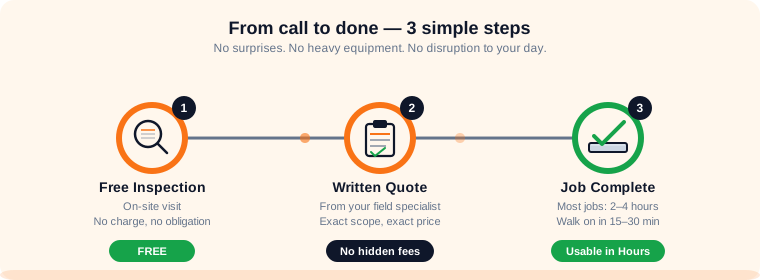
We don't quote flat prices. Every job is priced by the amount of foam it takes, based on a free, in-person inspection. As a rule of thumb, polyjacking runs far less than tearing out and repouring the same panels, which adds up fast across a whole property. Every job comes with a 5-year limited warranty covering a free re-lift if a section settles more than 1/2 inch within 5 years because of our work: worth having on file when a board or a management contract changes hands. It is issued to the property owner named on the invoice, at that address, and it ends if the property is sold. Code thresholds decide when a walkway is out of compliance; the half inch is where the free re-level starts, and a smaller lip the board wants closed is re-levelled as quoted work. PolyJacks is licensed and insured.
When Leveling Isn't the Right Fix
We'll tell you straight when foam isn't the answer, right there during the walk-through. A slab that's cracked, broken into pieces, or badly spalled needs to be replaced: lifting a broken panel doesn't make it safe, it just raises a hazard instead of removing one. If the real damage is coming from an active plumbing leak washing out the soil, that needs a plumber first. And if it's tree roots heaving a slab from underneath, that's root work that has to happen before or alongside any leveling. We flag all of this clearly so your board or your contractor can budget the right repair for each panel, not force one fix onto every problem. We also don't do foundation repair. If that's what a property needs, we'll point you to someone who does.
Get a Free Property-Wide Walk-Through
If your community or your properties haven't had a full sidewalk inspection lately, that's the place to start. PolyJacks will walk the property, mark every trip point, and give you a straight answer on what levels and what needs a different fix. No obligation, no pressure. We're locally owned, based in Spring Hill, and we work HOAs and property managers across the Kansas City metro.
Book My Free Estimate or call (913) 713-7794.
How polyjacking works in 90 seconds
Our team walks you through the three-step process: dime-sized holes, high-density polyurethane foam that fills every void and compresses the soil beneath your slab, and use within hours with no heavy trucks. Call (913) 713-7794 or book a free estimate below.
Frequently asked
Does leveling a sidewalk actually solve an ADA accessibility problem?
It solves the most common trigger. The raised lip or dip where a wheel or a toe catches. But ADA and local accessibility standards cover more than slab height, so we won't tell you a walk-through makes you compliant. What we will do is mark every trip point on your property, level what foam can fix, and flag anything that needs a broader accessibility review so you can take it to your attorney or code official with real information instead of a guess.
Can you handle an entire community's sidewalks in one visit, or does each panel need its own appointment?
We walk the whole property first and batch every hazard we find into as few mobilizations as possible, instead of sending a crew out separately every time a resident reports a spot. Most individual sections finish in 2 to 4 hours, and the sidewalk is safe to walk on again in 15 to 30 minutes. No lane closures dragging into next week.
What does bulk sidewalk leveling cost for an HOA or a multi-property portfolio?
We don't quote a number until we've walked the property. Pricing is based on how much foam it takes to lift each section, and we figure that during a free, in-person inspection. As a rule of thumb, polyjacking runs far less than tearing out and repouring the same slabs: worth knowing when you're budgeting across dozens of panels instead of just one.
What if a sidewalk panel is too far gone to lift?
We'll tell you straight, on the walk-through. A slab that's cracked, broken, or shattered needs to be replaced, not raised: lifting a broken panel doesn't make it safe, it just moves the problem. We'll flag those for your contractor. And if the real cause is a foundation issue rather than a settled slab, that's outside what we do and we'll point you to someone who handles it.
Have a sinking slab?
Book a free on-site inspection. Honest advice, usable within hours.
Pick a time that works for you
Book right here on this page. Prefer to talk? Call (913) 713-7794.