
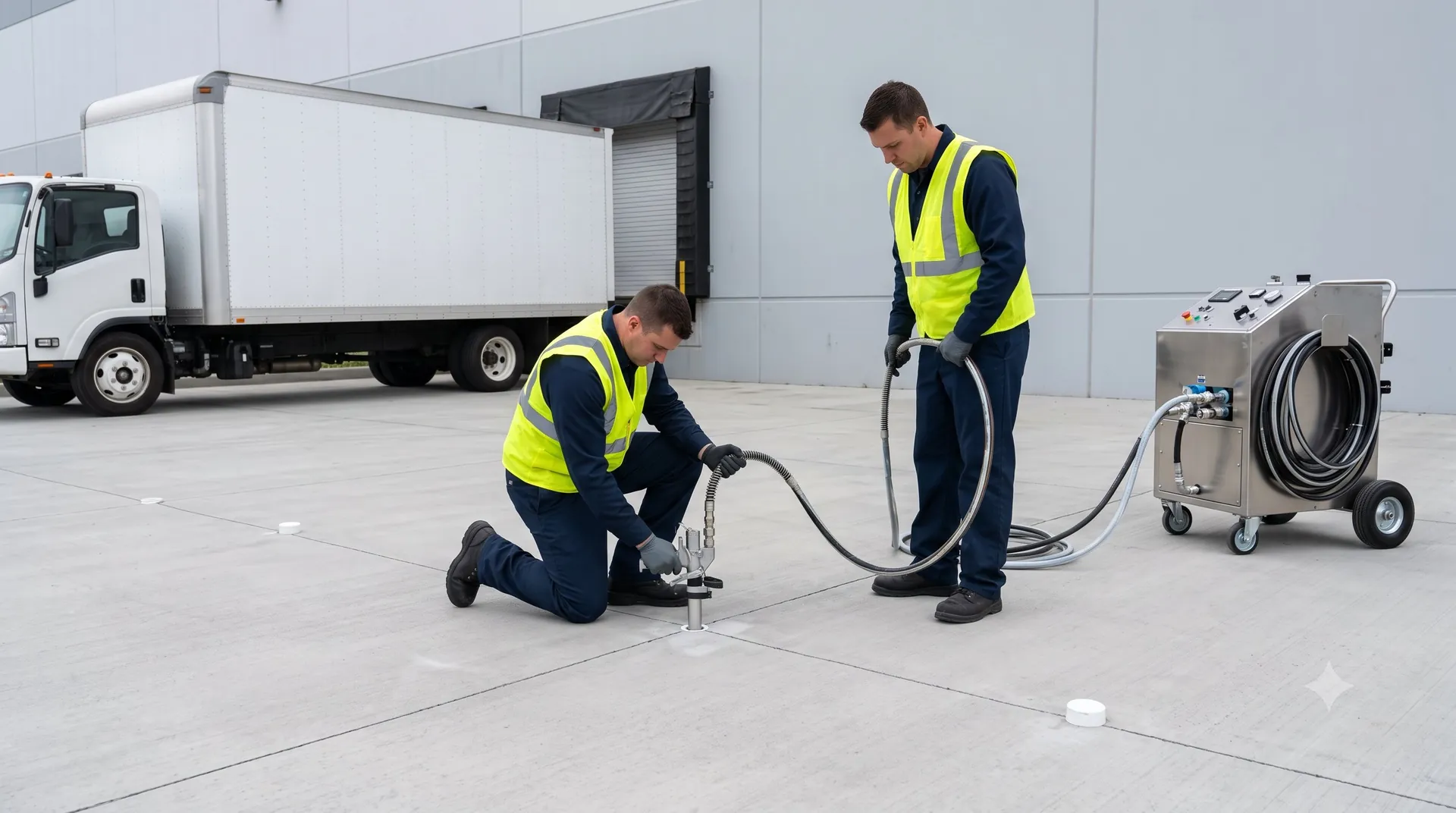
 Illustrative
When a Settling Warehouse Floor or Dock Means It's Time to Call
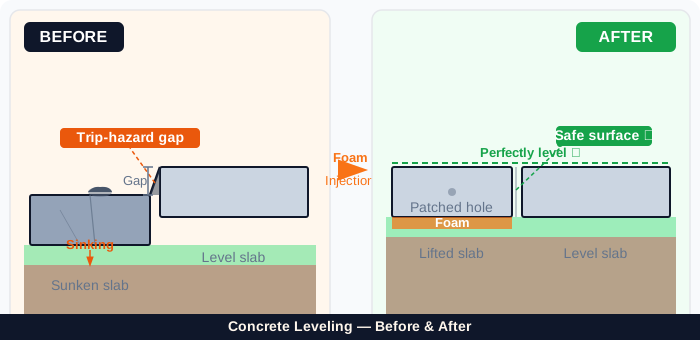
Call for commercial leveling when warehouse floors, loading docks, or parking lots develop trip lips, ponding water, or slabs that rock under traffic. Foam injection lifts them through small holes with little downtime; crews often work around operations, and the surface is usable within hours rather than the days a repour needs.
Commercial Concrete Settles Too
Sunken concrete isn't just a residential issue: warehouses, retail lots, office parks, and industrial buildings across the Kansas City metro deal with the same underlying cause: soil movement under the slab. The stakes are just different. A homeowner deals with a driveway that's annoying to look at; a business deals with forklift traffic on an uneven floor, water pooling in a parking lot, or a loading dock that no longer lines up with a trailer bed. Commercial concrete leveling uses the same polyjacking foam injection process as residential work, scaled to bigger slabs and heavier daily use, and it's worth knowing the signs that tell you it's time to call rather than wait. See our commercial concrete leveling page for an overview.
Warehouse and Loading Dock Floors
Warehouse floors take a beating that residential slabs never see: constant forklift and pallet jack traffic, heavy racking loads, and repeated point loads at the same spots day after day. When a section of floor settles even slightly, it shows up fast: equipment jars or bounces over the seam, racking can shift out of plumb, and dock levelers stop meeting trailer beds cleanly, which slows down loading and can be a real safety issue for anyone on a lift. Because operations often can't stop for a repair, foam injection is a practical fit. It's fast, generates minimal dust and disruption compared to demolition, and the floor is typically back in service within hours.
ADA Compliance and Trip Hazards
Commercial properties carry a different kind of liability than a private driveway. Uneven walkways, entries, and parking lot surfaces aren't just an inconvenience. They can be an ADA compliance issue, and a business is more exposed to a slip-and-fall claim than a homeowner typically is. A raised lip at an entrance, a settled section of sidewalk leading to a door, or an uneven spot in an accessible parking space are the kind of items that get flagged during a walk-through and are worth addressing before they become a liability claim rather than after. Leveling those spots is generally a faster, less disruptive fix than replacing entire sections of walkway or lot.
In a workplace setting, OSHA's walking-working-surface standard (29 CFR 1910.22) requires that floors be maintained in a condition free of trip hazards, and a settled slab that creates a lip or depression is a citable condition during an inspection. For warehouse and loading-dock environments, OSHA 1910.176 also requires aisles and passageways to be kept clear and in good repair. If a cited hazard isn't corrected by the abatement date, OSHA can assess additional penalties for each day it remains uncorrected, which is a different financial exposure than a one-time slip-and-fall settlement.
Parking Lots and Drive Lanes
Parking lots settle unevenly for a lot of the same reasons driveways do: soil movement, poor drainage, and water finding its way under slabs near curbs, catch basins, and expansion joints. On a commercial lot, that often shows up as water pooling in low spots (which then refreezes in winter and becomes an ice hazard), a curb or wheel stop pulled away from the surrounding pavement, or a noticeable dip customers comment on. Because commercial lots see more consistent, heavier traffic than a residential driveway, addressing settling before it spreads to neighboring sections tends to be the more practical long-term approach.
Why Minimal Downtime Matters
For most businesses, the real cost of a concrete repair isn't the repair itself. It's what happens to operations while it's underway. Tearing out and replacing a section of warehouse floor or parking lot means fencing off the area, waiting days for cure time, and routing traffic or staff around a construction zone. Foam injection cures in minutes rather than days, and most surfaces can handle foot traffic in about 15 to 30 minutes and vehicle or equipment traffic in roughly 1 to 2 hours. That difference is often the deciding factor for businesses choosing between leveling and a full tear-out, since it can frequently be scheduled around business hours with far less disruption.
Leveling vs. Other Commercial Options
Before committing to a repair method, it helps to understand what the other options actually involve and where they fit. Grinding or polishing a settled area flat is a surface-level fix: it works when the unevenness is minor, under a quarter inch, and there is no void or structural drop beneath the slab. The tradeoff is that the area has to be clear for the duration, and the process generates hours of dust and noise that can interfere with adjacent operations. A thin concrete overlay is a different tool: it makes sense when the slab is structurally sound but the surface is worn, spalled, or cosmetically degraded. It requires a 24 to 48 hour cure before the area can take traffic, and the zone has to be clear for that entire window. Polyurethane foam injection is the right call when the slab has actually dropped because of a void or soil settlement underneath. The surface is back under foot traffic in 15 to 30 minutes and under vehicle or equipment traffic in roughly 1 to 2 hours, and work can be phased section by section so the rest of the floor stays in use. For most commercial properties, the deciding factor is whether the problem is at the surface or below it: if the slab has dropped, no amount of grinding or overlay addresses the void that caused the drop.
Signs It's Time to Call
A few specific signs tend to show up in commercial settings before a slab visibly sinks: racking or shelving noticeably out of plumb, forklifts or pallet jacks that jar or bounce crossing a particular spot, water consistently pooling in the same area of a lot, a dock leveler that no longer sits flush with trailers, or a hollow sound when equipment crosses certain floor sections. Any one of those is worth a look before it turns into a bigger repair, a safety incident, or a compliance issue. A lip or step of more than a quarter inch at an accessible entrance or parking space is an ADA compliance issue under the 2010 Standards for Accessible Design. Void filling under slabs: addressing the empty space before the floor actually drops: is also worth discussing during an inspection. See our void fill page.
If you are still deciding whether a settled slab needs a lift or a full tear-out, our guide to signs you need concrete leveling, not replacement walks through what to look for.
Getting Started
Call (913) 713-7794 or use our contact form to set up a time that works around your operation, anywhere in the Kansas City metro. We schedule the walkthrough around your actual operating hours so the property doesn't have to stop running.
On site, we walk the property — warehouse floor, dock, lot, or walkway — and identify exactly which areas need attention and which don't. You receive a no-cost estimate with no obligation to move forward.
If you proceed, work is scheduled and the surface is back in service within hours.
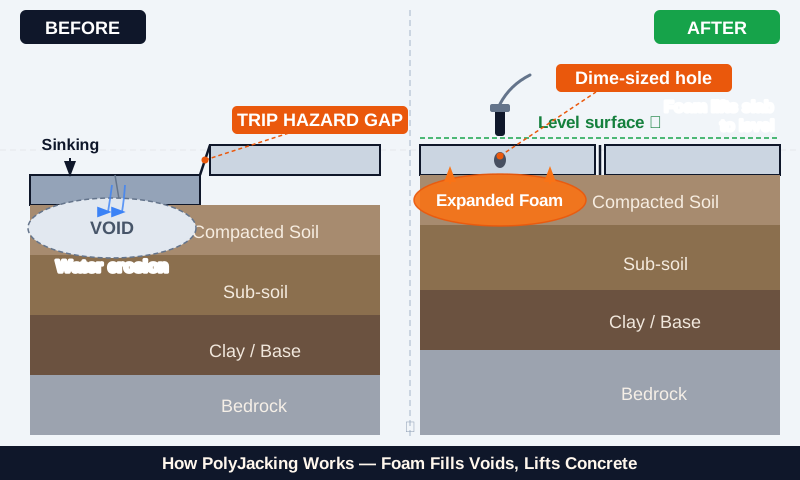
How polyjacking works in 90 seconds
Our team walks you through the three-step process: dime-sized holes, high-density polyurethane foam that fills every void and compresses the soil beneath your slab, and use within hours with no heavy trucks. Call (913) 713-7794 or book a free estimate below.
Frequently asked
Can commercial concrete leveling be done without shutting down operations?
Often yes. Jobs can typically be scheduled around business hours or off-peak times, and because the surface is usable again in 15 to 30 minutes for foot traffic and 1 to 2 hours for vehicles or equipment, disruption is minimal compared to a tear-out.
Does this work on warehouse floors with heavy racking?
Yes. Foam injection is commonly used to relevel sections of warehouse and industrial floors affected by settling, including areas near racking, provided the slab itself is structurally sound.
Is commercial concrete leveling different from residential?
The process: drilling small holes and injecting expanding polyurethane foam: is the same. Commercial jobs are typically larger in scope and scheduled around a business's operating hours.
Can void filling prevent a floor from settling in the first place?
In some cases, yes. If a void is detected under a slab before it drops, filling it can stabilize the area proactively rather than waiting for a visible settling problem.
How do I get a quote for a large commercial property?
Call (913) 713-7794 or use our contact form to schedule a free on-site estimate. We'll walk the property and scope out exactly what needs attention.
How do we decide between leveling the concrete now and budgeting for replacement later?
If the slab is structurally sound and simply out of level, leveling now is almost always the lower-disruption, lower-cost path, and it removes the trip-hazard liability immediately. Waiting usually lets the void keep growing and the drop worsen, which can turn a quick lift into a full replacement. A site walkthrough is the fastest way to learn which category a given slab falls into before you commit budget either way.
Have a sinking slab?
Book a free on-site inspection. Honest advice, usable within hours.
Pick a time that works for you
Book right here on this page. Prefer to talk? Call (913) 713-7794.