
Shop Spray Foam Insulation: Heated Workshops and Hobby Shops
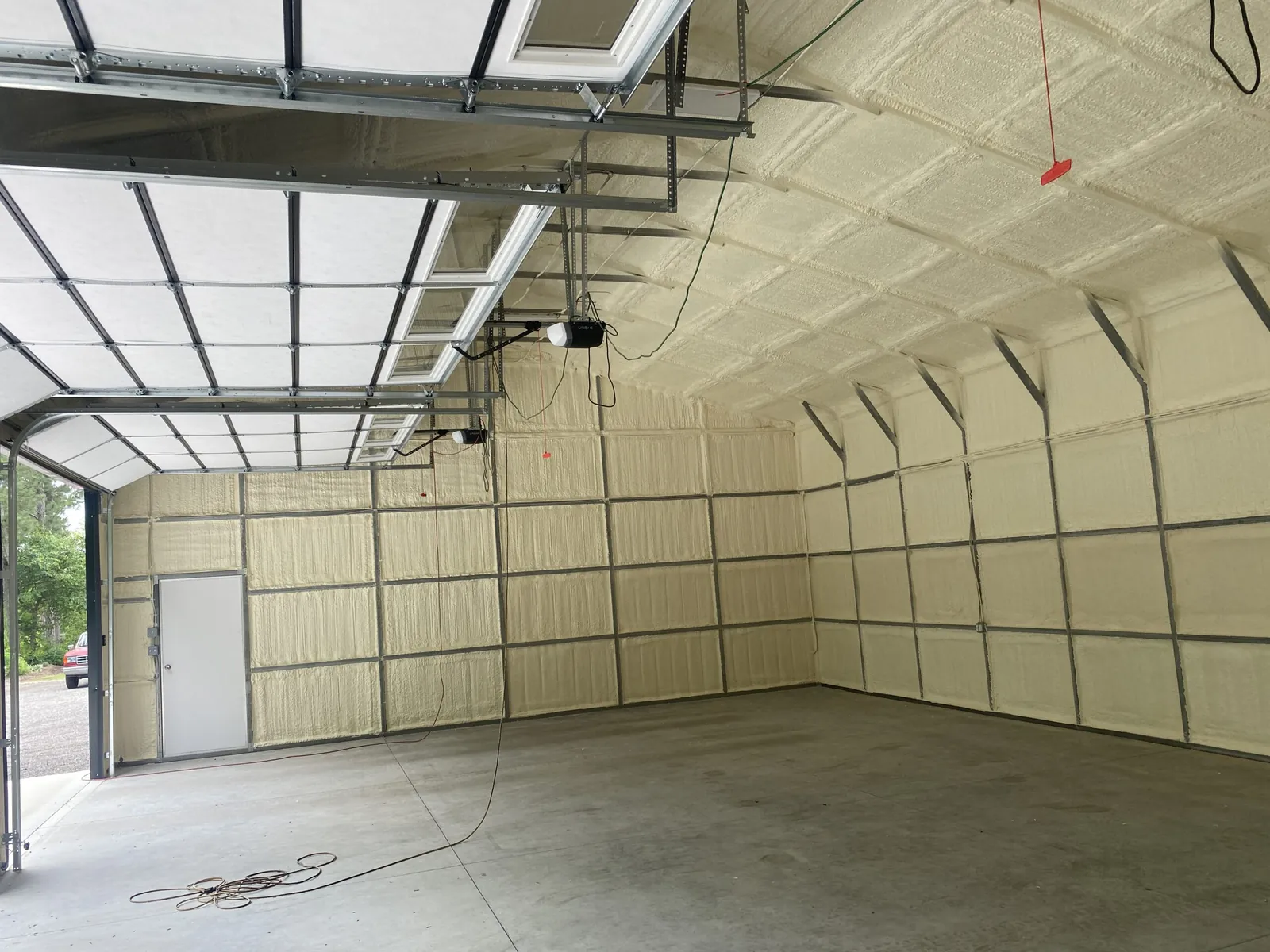
What changes when you work in the shop
Shop spray foam insulation is a different job from foaming a barn or a storage shed, because people are in the building, tools are running, and the heat stays on. A shed that only needs to stop dripping can be judged on moisture alone. A shop you weld, sand, wrench or paint in has to answer four more questions before anyone sprays: where hot work happens, what dust and vapors the work makes, where the wiring has to be, and what covers the foam once people are inside.
PolyJacks sprays closed-cell foam only, inside buildings within about 35 miles of Spring Hill, KS, and the same rules apply to a steel shop, a wood-frame shop or a post-frame shop. We do not do open-cell, blown-in or insulation removal. For the steel frame itself, see foaming a steel building. This page is about metal shop insulation when the building is also your work space.
The shop use decides the details. The table is a first pass, not a ruling for your building. The fire official or building official decides what covers the foam and what hot-work rules apply.
| What you do in the shop | What it means near foam | Covering question | Ventilation note |
|---|---|---|---|
| Welding, cutting, grinding | Sparks and flame reach foam within reach of the work | Ask what must cover the foam before the first arc | Fumes need exhaust whether or not the walls are foamed |
| Woodworking, sanding | Fine dust settles on exposed foam and on ledges | Ask the fire official about dust rules and covering | Dust collection is its own system |
| Auto, equipment, mechanical work | Fuel, solvents and hot exhaust parts | A lift or engine near a wall is a covering question | Exhaust extraction and heater clearances |
| Finishing and painting | Flammable vapors and ignition sources | Ask the fire official before choosing the wall finish | Spray finishing has its own code requirements |
Hot work and exposed foam
No welding or grinding near exposed foam without the maker's protection guidance. That is our rule for every job, and it is the safe default, not a loophole to work around. Polyurethane foam is combustible. Industry guidance written for contractors puts it plainly: fires involving this kind of foam on construction sites are rare, but they do happen (Six Steps for Fire Safety During Construction, Alliance for the Polyurethanes Industry). The trade group's own health and safety page says contractors usually post a "No Hot-Work" sign near foam until the protective covering is on (SPFA Health and Safety).
The six steps in the industry guide, in our words:
- Hold a safety meeting with every trade before, during and after the foam goes on.
- Post warning signs where the people doing hot work will see them.
- Move combustibles at least 35 feet from the hot work where possible. Exposed foam on the walls and roof is one of those combustibles, and it cannot move.
- Shield what cannot move with a fire blanket.
- Provide a fire watch where the guide says one is required, with an extinguisher and a phone nearby.
- Cover installed foam with a thermal barrier as soon as practical.
That guide is a trade-association document and is not a code. The standard it points to for hot work is NFPA 51B. Your own hot-work practices are your shop's call; our part is the sequence. On a job, the foam crew sprays, the building then stays hot-work-free until the covering decision is made, and you tell us ahead of time if you will be cutting or welding on or near a foamed wall. If you will do hot work later, the covering decision, not the foam alone, is what matters.
The foam also has its own safety limits during spraying. A maker's guide we opened says to keep each pass within the stated thickness because heat builds inside the foam, and that overly thick passes can cause charring or combustion hours later (Foamsulate Closed Cell Application Guide, Carlisle, 2021). The same guide calls for mechanical ventilation during spraying and for 24 hours after. For you, that means the shop is empty while we spray and for the re-entry time the maker's guide gives.
Plan wiring before foam
Foam goes around anything already on the wall, and it is hard to move later. So the wiring decisions come first.
- Outlets and switches. Decide where you want benches, welders, compressors, lifts and tools. Boxes placed after foam usually mean cutting or chipping foam.
- Lights. Fixtures mounted to the steel before foam get a different treatment from fixtures added after. The product maker's guide governs how foam is kept off hot fixtures and boxes.
- Panels and conduit. Run conduit where it should live. Foam then covers or avoids it as planned.
- Heater, flue and exhaust. These stay clear on every job, as on any foam job. Clearances come from the appliance maker and the code, not from us.
Your electrician decides the wiring. We mark where the foam stops. The full detail is on spray foam around electrical wiring. The visit is where you point out every spot.
Covering in a work area
In a shop where people work, the question is not whether the foam works. It is what protects the people from the foam if a fire starts. The 2018 IBC section 2603.4 says foam plastic must be separated from the building interior by an approved thermal barrier, with half-inch gypsum wallboard as the example, except as 2603.4.1 or 2603.9 provides (2018 IBC Chapter 26, UpCodes Kansas viewer). Section 2603.9 allows foam without that barrier where the exact assembly is approved based on large-scale tests, which usually shows as a listing in the product's evaluation report.
In plain terms, many occupied shops need a covering over the foam, and a few have a listed assembly or an exception that applies. We do not tell you a covering is unnecessary. The construction type, the use group, sprinklers and the product's listing all change the answer, and the building official decides. The questions to take are on what must cover spray foam.
Plan the covering as part of the job, not afterward. Gypsum board, steel liner or a listed coating each change the wall thickness, the cost of the project and the order of work. We do not apply a covering ourselves unless that is agreed in writing.
Code sections here are Kansas editions as printed by UpCodes. The edition your office enforces may differ, so ask which one it is.
Heating after insulating
Insulating changes the heater you need. The amount of heat a shop loses is the area times the temperature difference times the U-factor, which is physics that holds in Kansas as anywhere (Martin Holladay, Green Building Advisor, 2017). The full method, including air leakage, is on the shop heat-loss tool at the shop heat-loss calculator, and the physics of where the heat goes is on where the heat goes in a metal shop.
A worked example from that method, using its test numbers (the numbers are for one wall of 1,000 square feet with a 50 degree inside-outside difference, not a whole shop):
| Item | Heat lost, Btu per hour |
|---|---|
| Bare steel wall, counted as air films only | about 58,800 |
| The same wall with an R-10 foam layer | about 4,600 |
| Air leakage: 24,000 cubic feet of shop air at 0.5 air changes an hour | about 10,800 |
Two things follow. First, foaming a steel wall cuts its loss by an order of magnitude in this example, so a heater sized for the bare shop is probably too big for the foamed one. Second, air leakage does not vanish, and in this example it is bigger than the foamed wall's loss. Heater sizing is a job for the heater maker's chart and your installer, using your own numbers. We do not give a Btu-per-square-foot rule of thumb, because it hides the inputs that matter.
A bigger heater than the shop needs can also be the wrong choice for a different reason: unvented heaters that burn fuel add water vapor to the room air. Green Building Advisor explains why, and the moisture side is on why metal buildings sweat.
What we are and are not
Spray foam insulation is a new PolyJacks service line run by its own employee crew and rig. We have not yet finished an insulation job, so this page makes no claims about past jobs. Our equipment is the POLY 10 rig with a PMC PH-2 proportioner and 200 feet of heated hose, plus a scissor lift for high-wall and roof work.
If rain noise on a steel roof bothers you in the shop, see rain noise on a metal roof.
FAQ
Can you weld or grind in a shop with spray foam insulation?
Only with the protection that the maker's guidance and the fire code call for, so never "yes, it's fine." Exposed foam is combustible. The industry guidance we opened asks for signs, moved or shielded combustibles, a fire watch where required, and a thermal barrier as soon as practical, and it points to NFPA 51B for hot work. Tell your fire official what work you do before the covering is chosen.
Does spray foam in a shop need to be covered?
Often yes. Most occupied buildings need a thermal barrier over foam unless an exception or a listed assembly applies. IBC 2603.4 sets the barrier rule, and 2603.9 allows an approved tested assembly. The building official decides for your building, and the question list is on what must cover spray foam.
Does spray foam work in a wood-frame shop?
Yes, on wood studs and sheathing within the maker's wood-moisture limit. One closed-cell guide we opened gives the limit for the substrate as less than 19 percent moisture content (Foamsulate application guide); the product we spray has its own limit. We check the framing with a moisture meter on the visit. For wood post-frame walls, see insulating pole barn walls.
A concrete block shop or a cooler room is a different job; see concrete block buildings and spray foam for a walk-in cooler.
Book a free on-site measurement
A drive-by cannot see what is inside a shop, so the estimate starts with a visit. We measure the walls and roof, then walk the shop with you: where you weld, where the benches go, where the heater and panel sit, and what you plan to add. You get a written estimate after the visit. The visit is free.
Book a free on-site measurement
Pick "Spray foam insulation" on the booking form. We work within about 35 miles of Spring Hill, KS. How the visit works is on how to book the measurement visit.
Who wrote this: PolyJacks spray foam team. How it was made: drafted with AI assistance from the sources below, then checked against each source.
Sources
- Alliance for the Polyurethanes Industry (American Plastics Council), "Six Steps for Fire Safety During Construction" (hosted by Huntsman Building Solutions): huntsmanbuildingsolutions.com
- Spray Polyurethane Foam Alliance, Health and Safety page (hot-work sign, thermal and ignition barriers): sprayfoam.org
- International Code Council, 2018 International Building Code, Chapter 26 (sections 2603.4, 2603.9), via the UpCodes Kansas viewer: up.codes
- Carlisle Spray Foam Insulation, Foamsulate Closed Cell Application Guide (2021), as an example of a maker's rules (pass thickness, ventilation, wood moisture): sprayez.com
- GreenBuildingAdvisor, Martin Holladay, "All about U-factor" (May 5, 2017): greenbuildingadvisor.com
- GreenBuildingAdvisor, Alex Wilson, "Avoid unvented gas heaters" (Sept 23, 2009): greenbuildingadvisor.com
Ready for a measurement?
Book a free on-site visit. We measure first, then quote in writing.
Book a free on-site measurement
We measure the building first, then you get a written quote. Prefer to talk? Call (913) 713-7794.