
What Drives the Cost of Spray Foam Insulation: Board Feet, Prep, Access (No Price List)
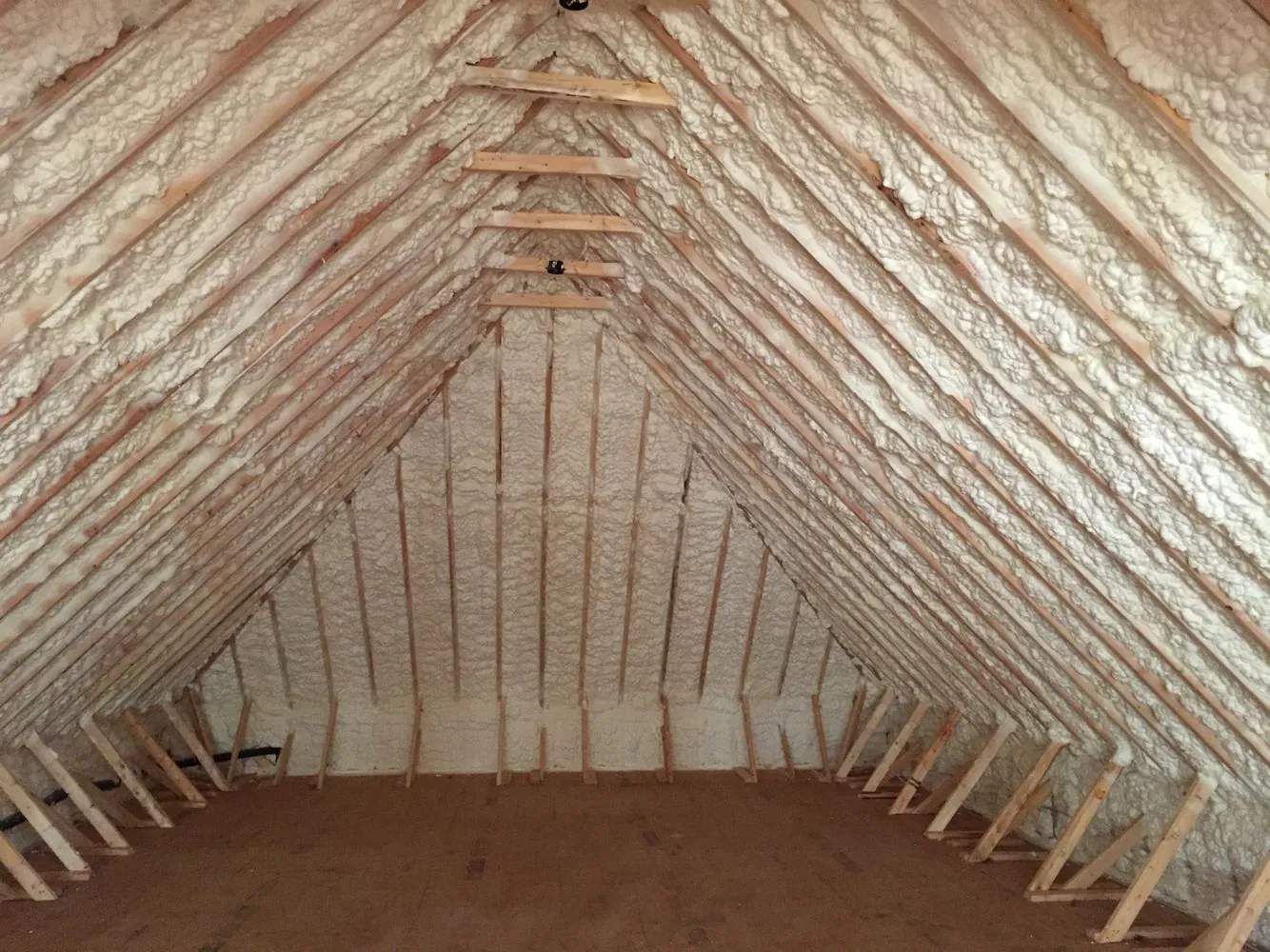
Why there is no price list on this page
Anyone searching for spray foam insulation cost wants a number, and this page does not print one. That is deliberate. A cost per square foot is meaningless for foam until you also know how thick it is, and thickness depends on what the foam has to do in your building. A page that quotes a single square-foot figure is guessing at all the rest.
So this page does the useful thing instead: it names every factor that moves the total, ranks them, shows how the arithmetic works, and tells you what a fair written estimate must contain so you can compare ours with anyone's. For the real figure for your building, we measure first. Nothing about a wall's insides or a roof's underside shows from the road, so we never judge insulation from the street.
PolyJacks sprays closed-cell foam only, inside buildings within about 35 miles of Spring Hill, KS. Open-cell, blown-in and crawl space jobs are not ours, which means everything here concerns closed-cell foam sprayed inside a building.
What sets the cost (the driver table)
These are ranked roughly by how much they move the total on a typical interior job. The order reflects our judgment of how interior spray work goes, not a published study.
| Rank | Driver | What it is | Why it moves the total |
|---|---|---|---|
| 1 | Board feet | Surface area times thickness | More foam, more material and more spraying time. Thickness changes this as much as area does |
| 2 | Substrate and prep | What the foam sticks to and what must be cleared first | Foam needs a clean, dry, correctly warm surface; prep time is labor |
| 3 | Height and access | How high the work is, and how the crew gets to it | A tall ceiling or a roof over equipment slows the work more than the floor area suggests |
| 4 | Existing insulation | Blanket, bubble foil, loose fill or nothing | It has to be gone before spray day, and that is your job, not part of our work |
| 5 | What covers the foam | Thermal barrier, ignition barrier or a listed assembly | Some buildings need a covering over the foam; that is its own material and labor |
| 6 | Obstructions | Wiring, fixtures, sprinkler heads, detectors, ducts, flues | Each one is masked or worked around by hand |
| 7 | Season and temperature | Cold or hot surfaces and air | Substrate temperature affects how the foam expands; heated steel and the right product blend are part of winter work |
| 8 | Travel inside the radius | Distance from Spring Hill | A farther site means more drive time |
| 9 | Scope and schedule | Phasing, occupied space, set-up for a small job | Several visits cost more crew time than one |
Board feet explained
Foam is measured in board feet. One board foot is a piece 1 foot by 1 foot by 1 inch thick, which is 144 cubic inches. A contributor on Green Building Advisor put it as sprayfoam being sold by the board foot, "just a way of measuring the cubic volume of product" (GreenBuildingAdvisor, 2012). The Department of Energy's Building America guide on spray foam uses the same unit when it discusses foam installed cost, and Green Building Advisor's primer says foam is priced that way as well (DOE Building America; GreenBuildingAdvisor). Neither source's price figures belong on this page, and they are national, not Kansas City.
The arithmetic is simple multiplication:
- A wall 8 feet tall and 10 feet long is 80 square feet. At 2 inches thick that is 160 board feet; at 3 inches it is 240.
- A roof section 30 feet by 40 feet is 1,200 square feet. At 2 inches thick that is 2,400 board feet.
- Doubling the thickness doubles the board feet, whatever the area.
The calculator for this is on the board-foot calculator.
Two cautions about the arithmetic:
- Real surfaces are not flat. Purlins, girts, ribs and corners add surface the simple multiplication misses. That is why we take the measurements ourselves.
- Spray thickness is not perfectly uniform. The estimate is for the thickness at which the job is specified, and the written estimate should state it.
Per square foot, or per board foot?
Searches for spray foam insulation cost per square foot are really asking one question in the wrong unit. Contractors usually work out the job in board feet (area times thickness), then add prep, access and any covering. A price per square foot only holds for one thickness; change the thickness and the same wall costs a different amount. That is the honest answer to why you will see so many different per-square-foot numbers online: they describe different thicknesses, different prep and different buildings.
What closed-cell foam is, and why that changes the math
Closed-cell foam is the dense kind. The Building America guide says typical closed-cell foam is about R-6 per inch, is rigid, and at typical thickness acts as a vapor retarder (DOE Building America). Because it carries more R-value per inch, you often need fewer inches for the same R than with a softer foam. The product's own data sheet, not a general figure, sets the R-value on your estimate. What our product is and what its sheet says belongs on closed-cell spray foam.
In many metal and pole buildings the thickness is set by condensation, not by R-value: the inner face of the foam has to stay above the dew point of the room air. That check is on how thick closed-cell foam should be, and it is one reason the estimate waits for a visit.
Who removes old insulation, and what it does to the estimate
PolyJacks does not remove insulation. A faced blanket, bubble foil or loose fill has to come out before spray day, and we write the estimate for clean, bare surface. Removal is therefore not in our number, and you should price it separately from whoever does it.
One case needs extra care. Fill that might be vermiculite is a special case: the EPA says not to disturb it, and to bring in a professional asbestos contractor if the work would disturb it (EPA, vermiculite insulation). We never disturb a fill we cannot identify. Wet, moldy or damaged insulation has to be dealt with first for the same reason: foam sealing it in would hide a problem, not fix it.
How to compare quotes
Spray foam quotes vary because the contractors are not quoting the same job. Put each quote next to the others and check these fields line by line:
- Thickness, per surface. Walls and roof often differ.
- Area, and how it was measured. Ask whether ribs, purlins and gables are counted.
- Product and its published R-value. The Federal Trade Commission's rule on insulation sales says an installer's receipt should state the coverage area, the thickness, and the R-value, "use the data that the manufacturer gives you," with the receipt dated and signed (16 CFR 460.17). The rule is written for home insulation sales; we suggest using the same fields as a checklist for a shop or barn.
- What is included in prep, such as masking, cleaning and moving contents, and what is yours to do.
- Old insulation: is removal included, excluded or yours?
- Covering over the foam: is a thermal or ignition barrier included, and if not, who supplies it? The code side is on what must cover spray foam.
- Permit and inspection: who handles them, if your building official requires any.
- Insurance and warranty terms, in writing.
A quote that leaves out any of these lines is not comparable with one that includes them.
Beyond the estimate: is it worth it?
Whether the foam pays for itself depends on how you heat the building and what you are protecting. That analysis is on is spray foam worth it. Incentives change often; what is still on offer in 2026 is on spray foam tax credits and rebates. Cost factors specific to a steel shop are on metal building spray foam cost factors, and for a wood barn on pole barn spray foam cost factors. If you are comparing foam with a different material first, the best way to insulate a pole barn lays out the options. Thinking about a kit? See DIY spray foam kits vs hiring a crew.
FAQ
How much does spray foam insulation cost?
It depends on measured board feet, prep and access, so no price is printed here. The ranked drivers are in the table above. To get the figure for your building, book a free on-site measurement and you will get a written estimate after the visit.
How is spray foam insulation priced per square foot?
Contractors usually price by board feet, which is area times thickness, plus prep and access. A per-square-foot number only makes sense at one stated thickness.
Why do spray foam quotes vary so much?
Different thicknesses, different area takeoffs and different prep assumptions. Compare the receipt fields in the quote section line by line, starting with thickness and R-value.
Who removes the old insulation, and does it change the quote?
You arrange removal before spray day; PolyJacks does not remove insulation. The estimate is written for clean, bare surface, so removal is not in it. Vermiculite or unknown fill is never disturbed, per the EPA.
Book a free on-site measurement
At the visit we take wall and roof measurements, record the working height and how the crew reaches it, and check for old insulation, wiring, fixtures, sprinkler heads and detectors. Then we ask how you use the space. You get a written estimate after the visit. The visit is free.
Book a free on-site measurement
Pick "Spray foam insulation" on the booking form. We work within about 35 miles of Spring Hill, KS. How the visit works is on book a free on-site measurement.
Spray foam insulation is a new PolyJacks service line run by its own crew and rig. We have not yet finished an insulation job, so this page makes no claims about past jobs.
Who wrote this: PolyJacks spray foam team. How it was made: drafted with AI assistance from the sources below, then checked against each source.
Sources
- Green Building Advisor Q&A on measuring board feet, January 2012: greenbuildingadvisor.com
- Building America guide "Which Spray Foam Is Right For You?" (DOE, with CARB): www1.eere.energy.gov
- Green Building Advisor primer on open and closed cell spray foam: greenbuildingadvisor.com
- FTC insulation rule, 16 CFR 460.17, on what installers tell customers: law.cornell.edu
- EPA page on asbestos-contaminated vermiculite insulation: epa.gov
Ready for a measurement?
Book a free on-site visit. We measure first, then quote in writing.
Book a free on-site measurement
We measure the building first, then you get a written quote. Prefer to talk? Call (913) 713-7794.