
Is Spray Foam Worth It for a Shop or Barn? Energy, Condensation and When It Is Not
Is spray foam worth it for a shop or barn? For a heated or damp building it often is. For dry, unheated storage that never drips, often not. This page answers the question in units you can check, not in dollars: the heat a building keeps, in therms and gallons of propane, and a three-question test for buildings that are not heated at all. It ends with a list of the cases where we would tell you to skip the foam. We publish no prices, so you finish the sum yourself with your own fuel bill.
PolyJacks sprays closed-cell foam only, inside buildings within about 35 miles of Spring Hill, KS. What the foam is lives on closed-cell spray foam.
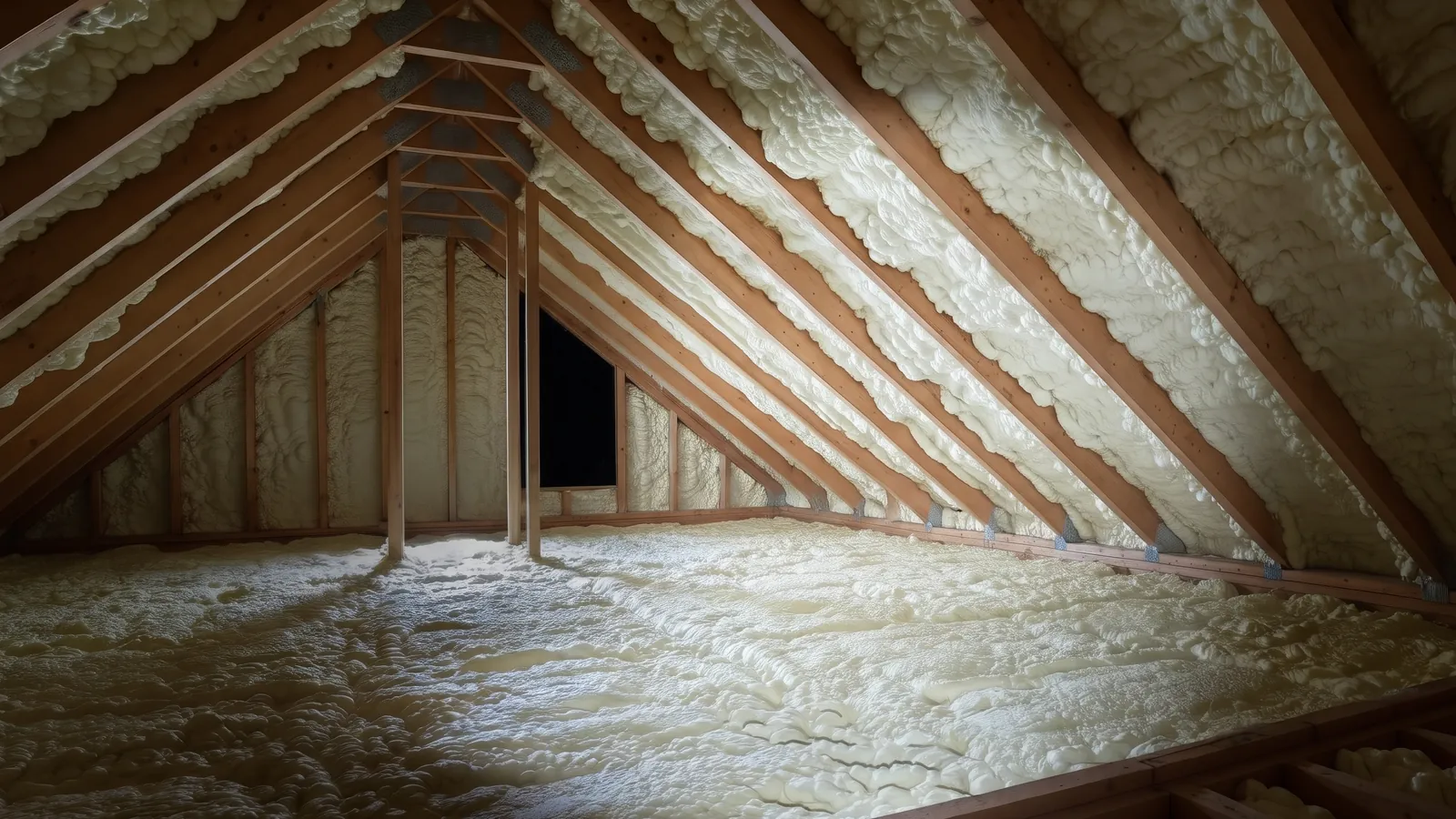
Worth it for what? Three different jobs
"Worth it" means a different thing for each job a foam layer can do, and most buildings need only one or two of them.
| Job | Who it matters to | How you measure the value |
|---|---|---|
| Keep heat in | A shop, garage or barn you heat in winter | Fuel not burned: therms or gallons a season |
| Keep damp air off cold steel | Any steel building that drips, heated or not | Whether the dripping stops; see the test below |
| Seal air leaks and add strength | Buildings with drafts, or framing that needs a stiff skin | Harder to price; the benefits list below says what is documented |
One honest caution before the numbers. Foam is a poor purchase when it answers a question nobody asked. A building with no heat bill and no dripping has no problem for it to solve.
Is spray foam worth it for a heated shop? Energy in therms and gallons
Heat loss through a surface is its area times the temperature difference divided by its total R. Over a season, a rough first estimate multiplies the surface's conductance (U times area, written UA) by the heating degree days and by 24 hours. A heating degree day is a day's shortfall below 65 F in mean temperature, which the U.S. Energy Information Administration states as subtracting the base temperature from the mean when the mean is below 65 F (EIA, degree days). The same agency gives the conversion factors used below: 1 therm is 100,000 Btu and 1 gallon of propane is 91,452 Btu (EIA, Btu conversion factors).
Seasonal heat = UA x heating degree days x 24, then divided by the heater's efficiency to get the fuel burned.
An illustration, not a forecast for your building
The inputs below are made up for the arithmetic. They are not a Kansas City figure and not a reading of any building. They use the same air-film values as the shop heat-loss calculator, where the method and its limits are written out, and the same 1,000 sq ft wall as a cold shop in winter.
| Case (1,000 sq ft of wall) | Total R | UA (Btu/h per F) | Heat lost over 4,500 degree days | In therms | In gallons of propane (heat delivered, 100% efficient heater) |
|---|---|---|---|---|---|
| Bare steel, air films only | 0.85 | 1,176.5 | 127.1 million Btu | 1,270.6 | 1,389.3 |
| Same wall with R-10 foam | 10.85 | 92.2 | 9.95 million Btu | 99.5 | 108.8 |
| Difference | 117.1 million Btu | 1,171.0 | 1,280.5 |
The 4,500 degree days is a test input. A heater that is 80 percent efficient burns a quarter more fuel than the heat it delivers, so the last column would read about 1,601 gallons for the difference, not 1,281. Efficiency is on the heater's label.
Reading the table without fooling yourself
- The foam row is about a twelfth of the bare row, because R-10 plus the films is about 12.8 times the resistance of the films alone. That ratio is the same at any degree-day count; only the totals scale. At 3,000 degree days the gap is 780.7 therms for this wall; at 6,000 it is 1,561.4.
- Degree days assume a 65 F building. A shop kept at 50 F while you are away loses less than the table says, and one held at 70 F loses more. North Dakota State University's farm-shop guide describes exactly that kind of split, with the shop at 50 F and an attached office at 72 F (NDSU Extension AE1620, rev. January 2025). It is a North Dakota source and a colder climate; we use the idea of heating zones, not its numbers.
- The table covers walls only. A roof adds its own row, a slab loses heat to the ground that wall foam never touches, and thermal bridging at the steel frame means real loss runs higher than the foam row shows.
- Air leaks are separate. After foam goes on, leakage is often the largest piece left, and foam only helps there where it actually closes the gaps. The leak ranking is on the cold-shop page.
- Steady-state arithmetic ignores sun, wind and the heat stored in the slab. Use it to rank options, not to predict a bill.
Finishing the sum with your own fuel price
Take the gallons saved from your own version of the table, multiply by the price on your last propane delivery or your gas bill, and compare the result with the written estimate you get after a visit. We do not print a fuel price or a payback in years here, because a fuel price printed today is wrong next season and a payback depends on a bill only you can see. Where the estimate comes from is on what drives spray foam cost. Any federal or utility incentive is separate and dated; the status page for 2026 is spray foam tax credits and rebates.
Unheated buildings: the condensation test
A building with no heat bill can still be worth foaming, but for a different reason: damp air meeting cold steel. The mechanism, the moisture sources and the fix ladder are on why a metal building sweats, and the check for whether a given foam thickness keeps the surface above the dew point is on how thick closed-cell foam should be. This page only turns that into a decision.
Ask three questions about the unheated building.
- Does it drip or run now, on cool mornings or after a clear night? If not, there is nothing to cure. Wait and watch a season, because a building that drips only after you start keeping animals or storing wet hay has a new moisture source, not a new roof problem.
- What is under the drip? Water falling on a concrete floor is a nuisance. Water falling on stored tools, grain, seed, a vehicle or a stack of lumber is a loss, and that loss is the value of stopping it. We cannot put a number on your stored goods; you can.
- Is the moisture source fixable for less? A wet slab, an unvented heater or open livestock water can be dealt with before any foam. The ladder on the sweating page puts those rungs first on purpose.
If the answers are "yes it drips, valuable items are under it, and the sources are already handled," foam on the steel is a direct fix, and the value is the damage that stops. If the answers are "no drip," it is not worth it for condensation.
What the benefits of spray foam insulation are, and what is only claimed
The U.S. Department of Energy's Building America guide, written in 2009, says foam's ability to stop air flow makes it superior to fiberglass or cellulose, which block air flow far less well (DOE Building America, Which Spray Foam Is Right For You?). The same guide reports closed-cell foam at about ten times the compressive strength of open-cell and says it is used as a structural adhesive in some factories. The guide is a federal document from a different region and decade, and the physics it describes is the same in Kansas; the figures on a current product come only from that product's data sheet.
The documented benefits, then, are three: air sealing, moisture control on the steel, and a stiffer skin. A fourth, "saves you money," is the one this page turns into a sum you do yourself. Anything else you read, such as resale value or a stated percentage saved, belongs next to a source before you rely on it. We have not opened one for those, so we do not repeat them.
When spray foam is not worth it
This is the honest list. It is not a sales funnel, and we would rather say it than spray a building that does not need it.
- Dry, unheated storage with no dripping. No heat to save and no moisture to stop.
- A shop you heat a few days a year. The seasonal gallons in the table shrink with the hours you actually heat. A portable heater and a warm coat may be the better answer.
- Drafts are the problem. If the loss is at the doors, eaves and base, sealing those comes first. Our order of fixes is on the cold-shop page.
- The roof already has a continuous liner system. A properly built liner system reaches a much higher whole-roof R than a draped blanket, as the table on metal building insulation options compared shows. Adding foam to a roof that is already performing may not move your heat bill.
- The building is wet at the source. Foam over a leaking roof or a wet slab hides a problem and does not fix it. The fix is the leak.
- The covering cost was never counted. Where a building is occupied or the code asks for a barrier, the foam may need a thermal barrier over it, which is a separate material and installer. The rules are on what must cover spray foam, and the meaning of fire-rating label words is covered on a separate fire-rating page.
- Old blanket is in the way. We do not remove insulation. If old material must come out first, that work is somebody else's, and it belongs in your comparison.
- The building will not be yours or standing long. We have no sourced figure for how foam affects resale and we will not guess one.
Not sure which side you are on
Two pages narrow it. The options for a steel building, including cheaper ones, are on metal building insulation options compared, and the sums for your own areas are on the shop heat-loss calculator. If you want a person to look at the building, that is the visit below.
FAQ
Is spray foam worth it for a metal building?
For a heated or humid steel building it often is, and for dry, unheated storage it often is not. The estimator above shows the heat side in therms and gallons, and the three questions show the condensation side. We print no payback in years, because that needs your own fuel price.
When is spray foam not worth it?
In unheated, dry storage with no condensation problem. The list above adds a shop heated only a few days a year, a building whose real problem is drafts or a leak, and a roof that already has a liner system.
Does spray foam really lower heating use?
On a wall it cuts the conduction through the surface sharply, as the table shows, but it does not stop leaks it does not reach, and it does not touch the slab. How much of your total it removes depends on the building.
Book a free on-site measurement
The visit is the cheapest way to find out which side of this page you are on. We measure the walls and roof, look at the heater, doors and slab, and ask what is stored and where it drips. You get a written estimate after the visit. If foam is the wrong answer for your building, we will say so. The visit is free; how it works is on the free estimate visit.
Book a free on-site measurement
Pick "Spray foam insulation" on the booking form. We work within about 35 miles of Spring Hill, KS.
Spray foam insulation is a new PolyJacks service line run by its own crew and rig.
Who wrote this: PolyJacks spray foam team. How it was made: drafted with AI assistance from the sources below, then checked against each source.
Sources
- U.S. Energy Information Administration, Degree days: eia.gov
- U.S. Energy Information Administration, Btu conversion factors: eia.gov
- NDSU Extension, Farm Shop Heating and Insulation Guide (AE1620, rev. January 2025): ndsu.edu
- U.S. Department of Energy, Building America, "Which Spray Foam Is Right For You?" (Steven Winter Associates, 2009): www1.eere.energy.gov
- NOAA, Normal Monthly Heating Degree Days (Base 65F), normals 1971-2000 (copy hosted by the Missouri PSC): efis.psc.mo.gov
Ready for a measurement?
Book a free on-site visit. We measure first, then quote in writing.
Book a free on-site measurement
We measure the building first, then you get a written quote. Prefer to talk? Call (913) 713-7794.