
DIY Closed Cell Spray Foam Kits and Rental Rigs vs Hiring a Crew: An Honest Comparison
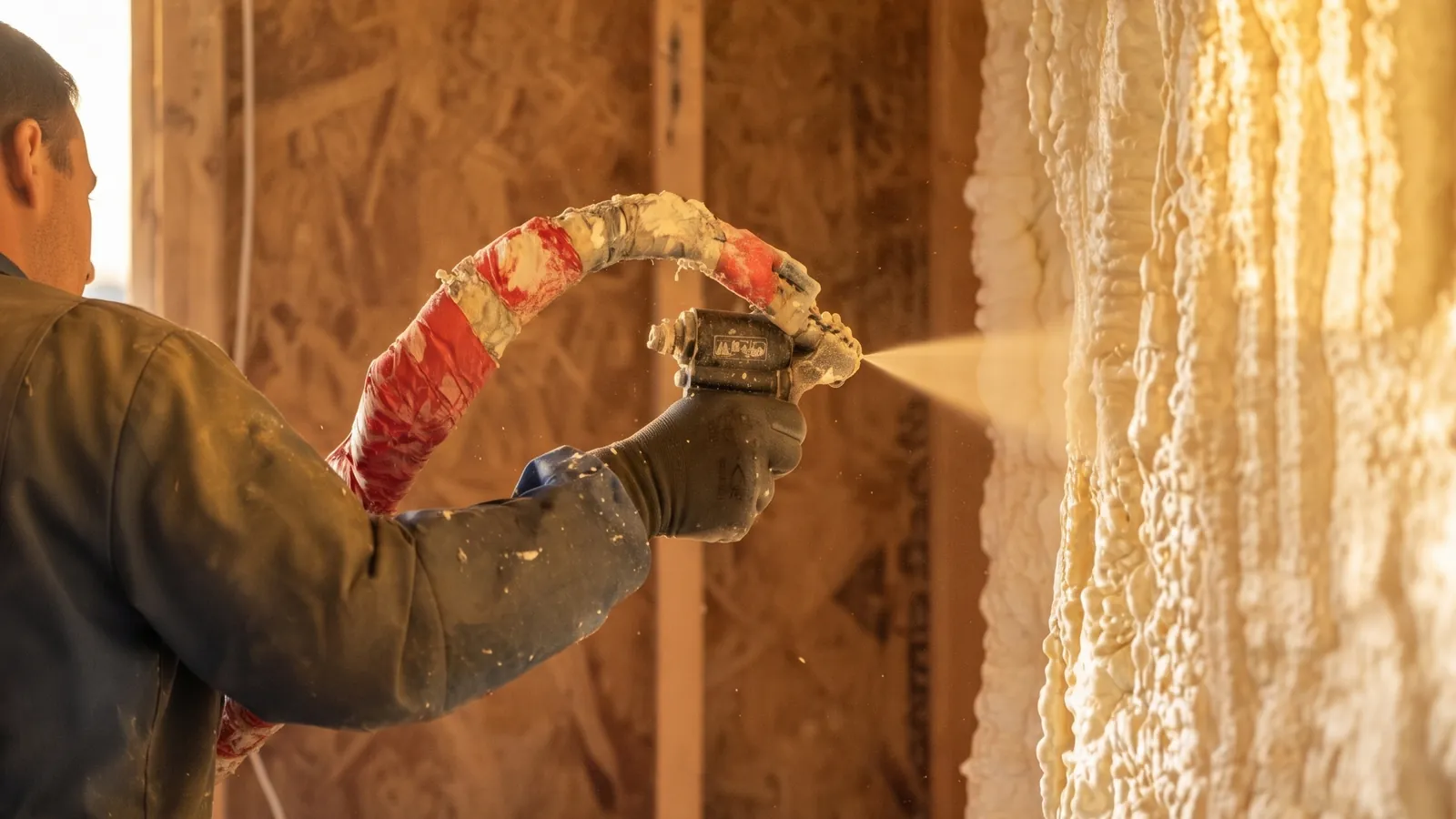
DIY closed cell spray foam: what the kit sheet itself says
A search for DIY closed cell spray foam turns up two very different products, and mixing them up is how people buy the wrong thing. One is a small disposable canister of foam for gaps. The other is a two-component kit, sold in sets measured in board feet, meant to be sprayed through a gun. This page is about the second kind, because that is the one people compare with hiring a crew for a shop, a barn or an attic.
We can say what a kit's own paperwork requires, and we can do the arithmetic. We cannot tell you your kit will work. So the page leans on one real maker's technical data sheet that we opened, and tells you where to read your own. That sheet is for ICP's Handi-Foam High Density, a low-pressure two-component closed-cell spray polyurethane foam kit (ICP Adhesives & Sealants technical data sheet, Rev 3/2018). It is an example of a kit's limits, not a recommendation, and a different kit will have different numbers.
Read that sheet the way you would read the sheet for any kit you were thinking of buying:
| Topic | What this one sheet says | Why it matters for a whole-building job |
|---|---|---|
| Intended use | Describes use to repair foam blisters on existing spray foam roofs and to fill voids, cavities and penetrations around equipment | A product described for repair and voids is not described for covering a building |
| Who may use it | "FOR PROFESSIONAL USE ONLY" | The maker restricts the product even in kit form |
| Protective gear | Use in a well-ventilated area "with certified respiratory protection or a powered air purifying respirator (PAPR)"; protective glasses with side shields or goggles, nitrile gloves, clothing that protects against skin exposure | Gear is a requirement of the product, not an extra |
| Stronger respirator | A positive pressure supplied-air respirator, approved by NIOSH, is recommended "if exposure guidelines may be exceeded" | The right respirator depends on a measured exposure, which a homeowner cannot easily check |
| Temperature | Outside application and surface (substrate) temperature 40 to 100 F; chemical to be conditioned to 75 to 85 F before use | The steel or wood you spray must be inside the range, not just the air |
| Storage | Chemical stored between 60 and 90 F; no open flame; "excessive heat can cause premature aging" | A kit left in an unheated shed or a hot truck can be spoiled before it is used |
| Shelf life | 12 months | Kits bought for a project that slips may expire |
| Yield | 60, 115 or 340 board feet per kit, based on free-rise density; foam sprayed into a cavity "may result in higher in-place densities," giving lower yields | The yield printed on the box is a best case |
| Fire | The sheet says cured foam "will support combustion" and may present a fire hazard if exposed to excessive heat | Cured foam still needs the covering the code asks for (see below) |
Other makers publish different limits. Before you spend anything, get the technical data sheet and the safety data sheet for the exact kit and read the sections on application conditions and personal protective equipment.
How many kits does your job take?
The count is simple: kits = board feet divided by one kit's yield, rounded up. A board foot is a square foot of foam one inch thick, so board feet are area times thickness. The calculator that does it for you is on the board-foot calculator; the area comes from measuring the surfaces you want covered.
Two illustrations, both arithmetic and not any real building's takeoff.
A round number to show the method. Say a job comes to 4,800 board feet and the kit's rated yield is 600. That is exactly 8 kits.
The same job against the real sheet above. Its three sizes yield 60, 115 and 340 board feet, so 4,800 board feet takes:
| Kit size on the sheet | Board feet per kit | 4,800 / yield | Kits, rounded up |
|---|---|---|---|
| Smallest | 60 | 80.0 | 80 |
| Middle | 115 | 41.7 | 42 |
| Largest | 340 | 14.1 | 15 |
Yields are free-rise figures, so the real count can be higher. The smaller point is the rounding: 15 kits of 340 is 5,100 board feet, 300 more than the job needs.
What 4,800 board feet represents
At 2 inches, 4,800 board feet is 2,400 square feet of surface. A 40 x 60 ceiling or roofline is about that size, as worked on the pole barn ceiling or roof page. So the first example is a whole barn roof. Measure first; do not trust the box. How area, thickness and access drive a job is on what drives spray foam cost, with no price list.
Safety gear and what a kit does not hand you
The EPA's pages on spray polyurethane foam say the chemicals can cause asthma and sensitization, that only trained and protected workers should be present, and that occupants and other trades should stay out until the maker's re-entry steps are met (see the archived EPA SPF page). That is a summary of an archived page, and it was written for professional installation. The gear in the table above is the minimum the kit sheet names; the EPA's point is that gear is only one piece of the program.
The pieces that do not come in the box:
- Fit testing. A respirator has to fit the face that wears it. The kit sheet asks for certified respiratory protection but does not fit one to you.
- Ventilation you control. The sheet says to use the product in a well-ventilated area. In a closed shop in winter that is a design problem, not a window left open.
- Keeping others out. Family, helpers and pets stay out. Pets and animals in a barn are on when you can go back in.
- Disposal and storage. The sheet sends you to the SDS for disposal of empty cylinders.
None of this means a homeowner cannot be careful. It means the careful version of DIY is a program, and the kit is one part.
Temperature limits
The range on the sheet is a range for the substrate, the surface the foam bonds to, as well as the air. Steel is the hard one: it follows outdoor temperature, warms and cools faster than the air, and can be below the air temperature on a still night. A surface below the kit's lower limit is a surface the kit is not rated for. That is a number you measure on the day with an infrared thermometer, not one anyone can promise from a calendar.
For the chemical, the sheet asks you to condition it to 75-85 F before use. Those cylinders need a warm space and time to reach that range, which a rig with heated hoses handles differently. Our own rig has a heated hose; we do not publish its temperature settings, because they belong to the named product's sheet, not to this page.
DIY attic spray foam and the barrier question
Searches for DIY attic spray foam insulation ask about a space that has its own rule. The code treats foam in an attic separately from foam on a wall: for attic-type spaces entered only to service utilities, it asks for an ignition barrier, not the full thermal barrier. The difference is explained on thermal and ignition barriers. Two cautions apply regardless of who sprays:
- The code does not exempt your own work. The scope of the foam plastic section applies to "foam plastic insulation in buildings and structures" (IBC 2603.1, UpCodes Kansas viewer). It does not say who did the spraying.
- Ask the office first. Whether your building needs a permit, and what must cover the foam, is the building official's call. Ask in writing before you buy a kit.
Open-cell kits are also sold, and we do not install open-cell foam or advise on it. This page is about closed-cell.
A note on rental rigs
Searches for spray foam equipment rental and for renting a rig are common. We did not read any rental company's terms for this page, so we are not describing them. If you are considering a rental, these are the questions the cost of the rental will not answer:
- Who trains you, and is training required before you take the equipment?
- Does the rental include the chemical, and is the chemical conditioned and in date?
- What happens if the proportioner goes off-ratio mid-job, and who pays for the bad foam?
- Is the hose heated, and what temperature range does the chemical's data sheet ask for?
- What are the return and cleaning terms?
When a crew is worth it
A crew earns its place where the weak points of a kit are the hard points of the job. This is our judgment, built from how the work is done; no source ranks these.
| Your job | Kit or crew | Why |
|---|---|---|
| Small voids, a rim gap, a few penetrations | A kit or a can can be reasonable | Small area, short exposure, the product's described use |
| One accessible wall of a small shop | A kit with full protective gear and a plan | Manageable, but still bound by the sheet's temperature and gear rules |
| A roof, or a building that drips today | A crew | Thickness has to be even and continuous or the drip comes back; uneven thickness is easier to avoid with a rig that holds temperature and ratio |
| A heated shop that needs code covering | A crew, or a very good plan | The covering is a separate decision; see what must cover the foam |
| Anywhere other people or animals stay nearby | A crew | Keeping people out and ventilating are part of the work |
If you do hire, ask the questions on how to choose a spray foam contractor. PolyJacks uses a POLY 10 rig with a heated hose and employee crews, sprays closed-cell foam only inside buildings within about 35 miles of Spring Hill, KS, and measures first. A kit might still be the right call for you, and we would rather say so than sell you a job you do not need.
For a shed or backyard office, the choice between a kit, board and a crew is on backyard office insulation.
FAQ
How many spray foam kits do I need for my shop?
Board feet divided by the kit's rated board feet, rounded up. A shop at 4,800 board feet takes 8 kits of 600, or 15 of the 340 board-foot size on the sheet we opened. The arithmetic is on the board-foot calculator.
Is DIY closed cell spray foam as good as a hired crew?
The chemistry can be similar, but even thickness, temperature control and ratio are harder with kits, and the kit sheet we read sets gear, temperature and professional-use limits. Read the maker's limits for your kit first.
Do DIY spray foam kits need a thermal barrier too?
Yes. The code treats all foam plastics the same and the scope does not depend on who sprays. What must cover the foam, and the exceptions, are on thermal and ignition barriers.
Book a free on-site measurement
If you are weighing a kit against a crew, a measured area is the first number either one needs. We measure the surfaces and the access, look at what is up there now, and give a written estimate after the visit. The visit is free, and nothing on it commits you.
Book a free on-site measurement
Pick "Spray foam insulation" on the booking form. We work within about 35 miles of Spring Hill, KS. How the visit works is on the free estimate visit.
Spray foam insulation is a new PolyJacks service line run by its own crew and rig. We have not yet finished an insulation job, so this page makes no claims about past jobs.
Who wrote this: PolyJacks spray foam team. Last updated: October 27, 2026. How it was made: drafted with AI assistance from the sources below, then checked against each source.
Sources
- ICP Adhesives & Sealants, Handi-Foam High Density Spray Foam technical data sheet A16418, Rev 3/2018 (hosted by Spray Foam Systems): sprayfoamsys.com
- EPA (archived), Spray Polyurethane Foam (SPF) Insulation and How to Use It More Safely: archive.epa.gov
- IBC 2018 Chapter 26 (2603.1), UpCodes Kansas viewer: up.codes
- Kit-count tables computed on this page from the yields above
Ready for a measurement?
Book a free on-site visit. We measure first, then quote in writing.
Book a free on-site measurement
We measure the building first, then you get a written quote. Prefer to talk? Call (913) 713-7794.