
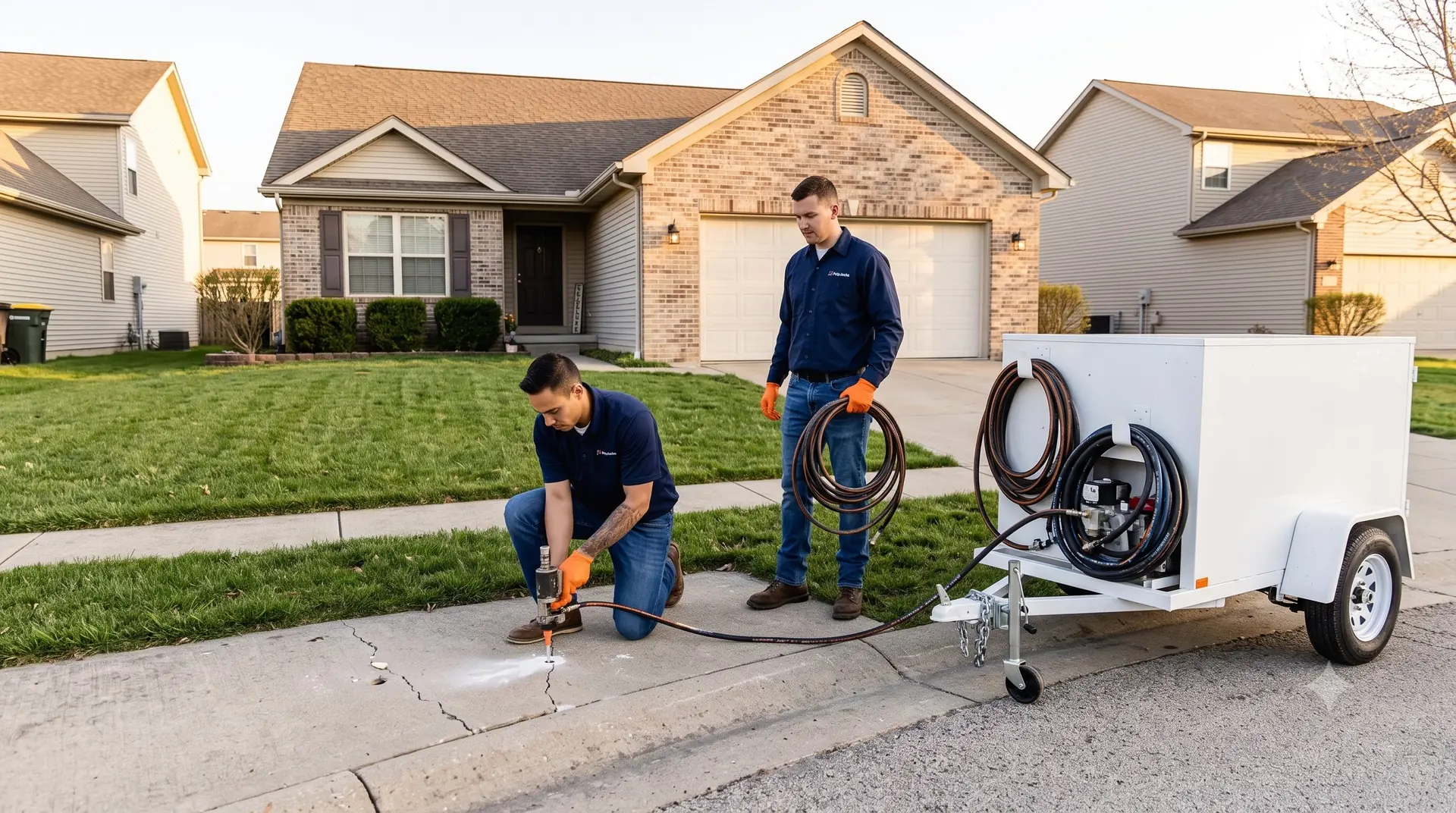
 Illustrative
Concrete Leveling in Raytown, MO
PolyJacks levels sunken driveways, walkways, and patios in Raytown, MO with polyurethane foam injection: free on-site estimate, usable within hours.
Raytown is named for William Ray, who opened a blacksmith shop on the Santa Fe Trail around 1848; the settlement was known as "Ray's Town" and then "Raytown" by 1854. The number that actually explains a sunken Raytown driveway, though, is this one: 33,632. That's how many people lived here in 1970, near double the 1960 count of 17,083, and Raytown has never hit that number again since. Fifty-five years on, the city sits at 30,012, still short of its own 1970 peak. A town that stopped growing doesn't get a steady trickle of new construction to dilute its concrete's age, so the driveways, walkways, and patios settle in clusters, not one house at a time.
Where the Name Raytown Comes From
Raytown takes its name from William Ray, who set up a blacksmith shop on the Santa Fe Trail around 1848 to serve wagon traffic heading west. The settlement that grew up around his shop was known first as "Ray's Town" and then simply "Raytown" by 1854, and the city's flag still features an anvil to commemorate the original blacksmith shop. The Rice-Tremonti House, built in 1844 and also sitting on the old Santa Fe Trail route, still stands in Raytown today, making it older than the town's own name. None of that trail history changes how concrete settles, but it places Raytown's roots more than a century before the housing boom that actually produced most of the driveways and patios PolyJacks gets called out to level.
A City That Peaked in 1970 and Never Grew Again
Census figures tell an unusual story for a Kansas City suburb: Raytown had 17,083 residents in 1960 and 33,632 by 1970 — population nearly doubled, up 96.9%, in a single decade. Then it reversed. The 1980 count was 31,831, already down from the 1970 peak, and it kept easing lower through 1990 (30,601), 2000 (30,388), and 2010 (29,526), before ticking back up slightly to 30,012 in 2020: still below where the city stood 50 years earlier. Neighboring suburbs kept annexing farmland and platting new subdivisions decade after decade; Raytown mostly stopped after 1970. So a homeowner calling PolyJacks from a Raytown address is very likely calling about concrete from that same narrow 1960s pour, now 55 to 65 years old, sitting next to a dozen other houses that settled around the same year.
A Small, Fully Built-Out City
Raytown covers just 9.97 square miles, sitting at 1,014 feet elevation in Jackson County between Kansas City and Independence. Because the city stopped growing after 1970 and its footprint is compact to begin with, there was never much undeveloped land left for later infill the way larger, still-growing suburbs had. That combination. A small city, built out fast in one decade, then left alone: is a big part of why so many Raytown driveways, garage floors, and patios are showing settlement signs around the same time as their neighbors' concrete, not scattered across a wide range of construction eras.
Mudjacking Raytown vs. polyjacking
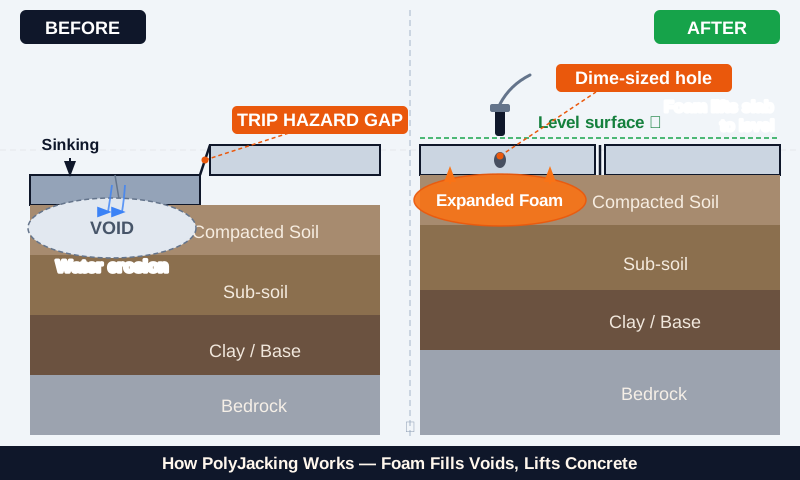
Traditional mudjacking pumps a heavy cement slurry through holes an inch or two wide, adding significant new weight onto soil that's already been settling for 55-plus years in most of Raytown. PolyJacks injects polyurethane foam instead, through holes about the size of a dime. The foam expands to fill the void and lift the slab, but it stays lightweight, so it doesn't add fresh stress to tired, clay-heavy ground, and it's waterproof, so it won't break down in wet soil the way mud slurry can. On concrete this uniformly old, that lighter, water-resistant approach holds up better over time than adding more weight to ground that's already worked loose.
What We Level in Raytown
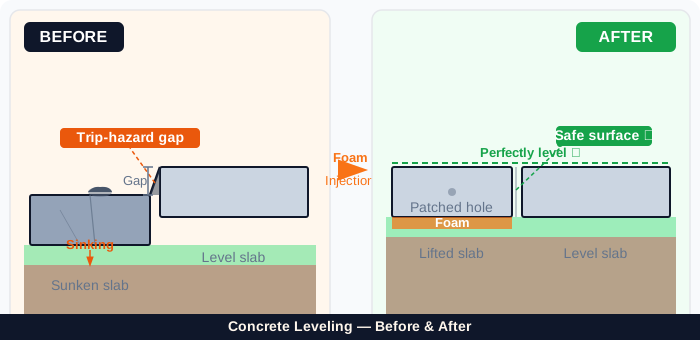
PolyJacks levels the full range of sunken concrete on Raytown properties: driveways that have dropped where they meet the street, cracked or uneven sidewalks and walkways, patios pulling away from the back door, a garage floor that pitches toward the house, pool decks, and porch or step settling. We also fill voids under slabs that are still level but hollow underneath, before they turn into a bigger sinking problem. On concrete this uniformly aged, most Raytown jobs are a straightforward foam lift. We start with a free on-site estimate, walk the slab with you, and only recommend foam when it's genuinely the right fix.
Raytown Service Area
Spring Hill-based PolyJacks drives into Raytown regularly, along with the Jackson County communities that border it — Independence to the north, Sugar Creek and Kansas City to the west, and Grandview and Lee's Summit to the south. A Raytown visit almost always means the same 1960s concrete described above, so our crews already know roughly what to expect before they pull up: how deep the void usually sits, how the slab tends to tilt, and how many holes it typically takes to bring it back level. Call or text (913) 713-7794, or book online, to get a free estimate on the books.
Why concrete settles in Raytown: the local risk data
In Raytown, about 43.0% of Jackson County's soil rates high-shrink-swell (USDA). Raytown is named for an 1848 blacksmith shop on the Santa Fe Trail. Its population peaked in 1970 and has never returned to that high.
KC winters bring about 75.2 freeze-thaw days (NOAA).
Sources: USDA SSURGO · NOAA / ACIS (KCI) · local record. See the full KC Concrete Settlement Risk Index.
Our concrete leveling services
Commercial Leveling
Lift a settled parking lotConcrete leveling near Raytown
PolyJacks is your local concrete leveling contractor in Raytown — we serve Raytown and the surrounding communities:
Real job documentation
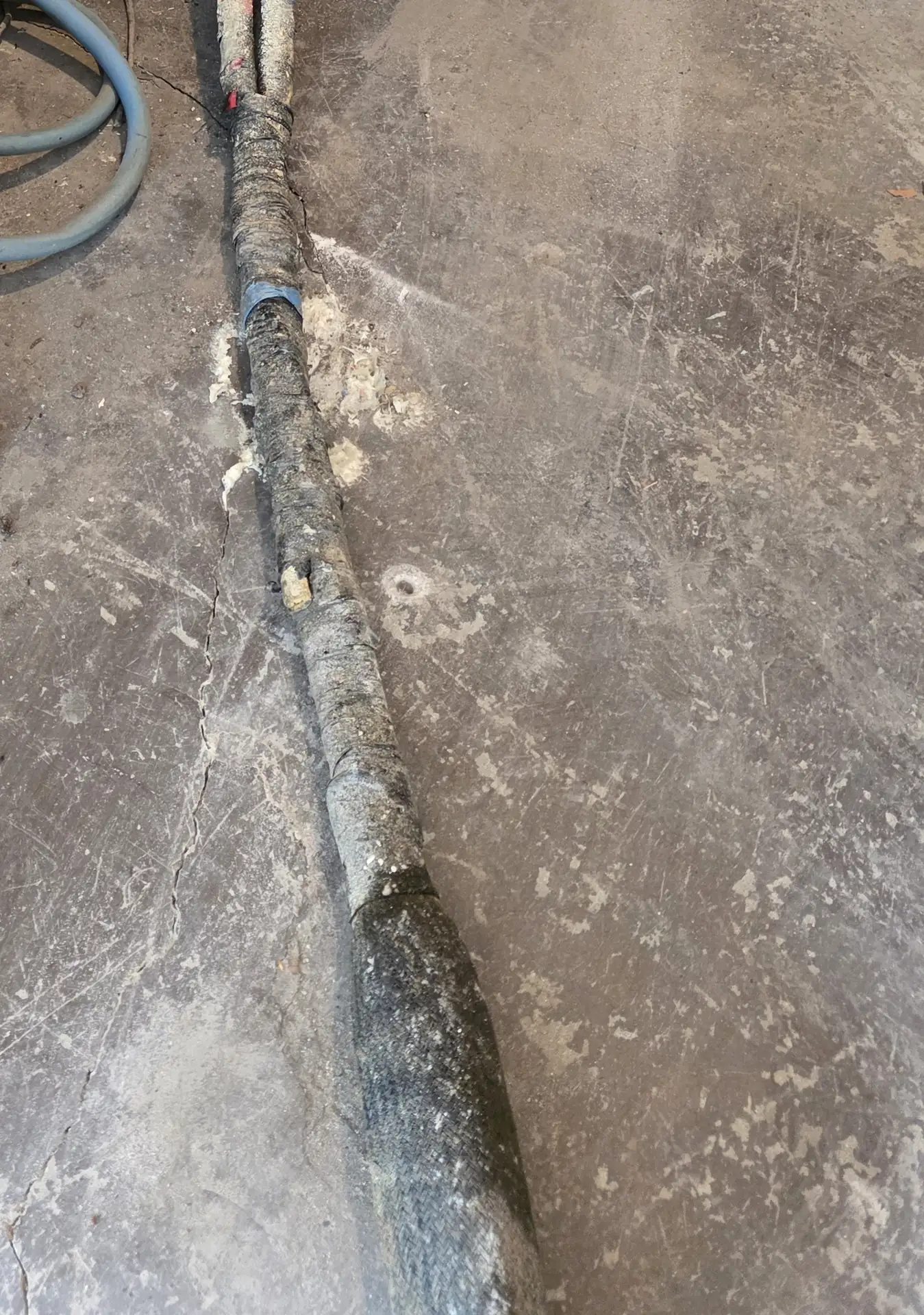
How polyjacking works in 90 seconds
Our team walks you through the three-step process: dime-sized holes, high-density polyurethane foam that fills every void and compresses the soil beneath your slab, and use within hours with no heavy trucks. Call (913) 713-7794 or book a free estimate below.
Frequently asked
Why does so much of Raytown's concrete seem to be the same age?
Raytown jumped from 17,083 residents in 1960 to 33,632 in 1970, then leveled off and has stayed at or below that number ever since (30,012 as of 2020). With no later building boom to add younger concrete into the mix, most Raytown driveways, walkways, and patios date to that same 1960s stretch and are now 55 to 65 years old.
Where does the name Raytown come from?
William Ray opened a blacksmith shop on the Santa Fe Trail around 1848, and the settlement that formed around it became known as "Ray's Town," then "Raytown" by 1854. The city's flag still features an anvil in honor of the original blacksmith shop.
How much does concrete leveling cost in Raytown?
We don't post a fixed price because every driveway or patio settles differently. The cost depends on how far the slab has dropped, how much foam it takes, and how many injection points are needed. Every Raytown estimate is free and done on-site before we recommend anything.
How long does concrete leveling take?
Most residential jobs (a driveway, walkway, or patio) are done in a single visit. The foam cures fast, so you can typically walk on the area in 15-30 minutes and drive on it in 1-2 hours.
Is polyurethane foam leveling permanent?
The lift itself is permanent as long as the underlying soil stays stable. Because the foam is waterproof, it won't break down or wash out the way loose fill can, which matters on Jackson County's clay soil under Raytown's older concrete.
Do you serve areas near Raytown?
Yes. We work all across the Kansas City metro, including Independence, Sugar Creek, Kansas City, Grandview, and Lee's Summit on the Missouri side, and the rest of the metro on both sides of the state line.
Who does concrete leveling near me in Raytown, MO?
Yes — PolyJacks levels concrete in Raytown, MO. Most jobs take 2–4 hours, you can walk on the slab in 15–30 minutes, and drive on it in 1–2 hours, back in use the same day. Book a free Raytown estimate.
Free concrete leveling estimate in Raytown
No obligation. Honest advice, usable within hours. If foam isn't the right fix, we'll tell you straight.
Book your free estimate
Pick a time that works for you. Free on-site inspection, no obligation. Prefer to talk? Call (913) 713-7794.