
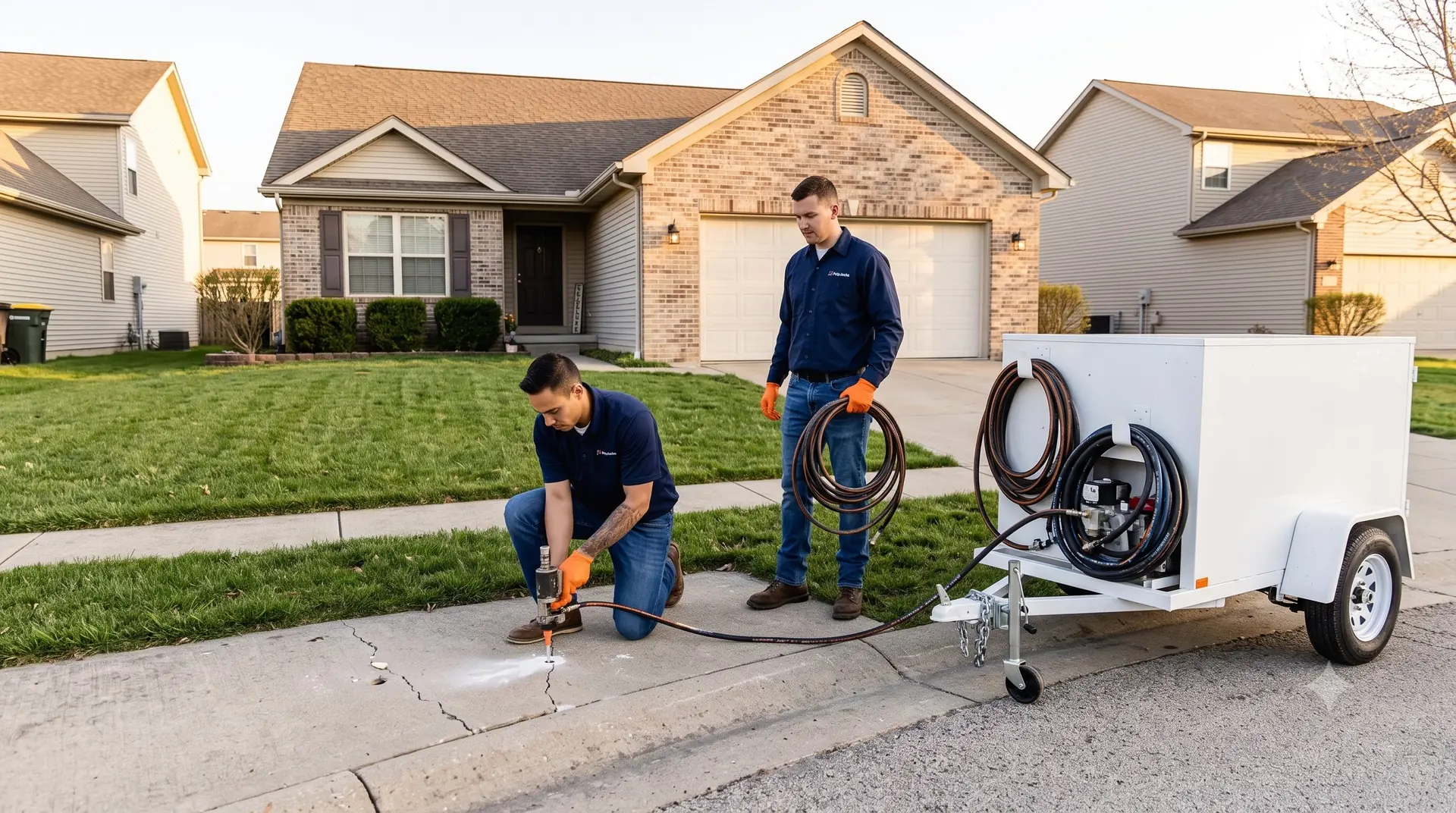
 Illustrative
Concrete Leveling in Independence, MO
Independence was founded in 1827, decades before most of its Kansas City-area neighbors existed, and it's one of only two county seats in Jackson County (the other is Kansas City itself).
But the story that matters most for a sunken driveway isn't the founding date. It's what happened between 1950 and 1970, when the city's population roughly tripled and then growth almost completely stopped for the next 50 years. That left Independence with an unusually large share of concrete all sitting in the same age range. PolyJacks levels that settled concrete with polyurethane foam, backed by a free, no-obligation estimate.
Independence Square: Concrete Nearly 200 Years in the Making
Independence was founded on March 29, 1827, which makes its historic core older than almost anywhere else in the Kansas City metro. It's one of only two county seats in Jackson County. An unusual setup, since most Missouri counties have just one, and the Jackson County Courthouse, modeled after Philadelphia's Independence Hall, still anchors the Square today. Independence also earned the nickname 'Queen City of the Trails' as the main departure point for the Santa Fe, Oregon, and California Trails, when wagon trains loaded up on the streets around what's now the historic district. None of that history changes how concrete settles, but it does explain why some of the sidewalks, steps, and foundations closest to the Square have had roughly two centuries to work with expanding and contracting clay soil: longer than almost any other spot in the metro PolyJacks serves.
A City That Tripled in 20 Years, Then Stopped
Census figures show a growth pattern unlike most of its neighbors: Independence had 36,963 residents in 1950, 62,328 in 1960, and 111,630 by 1970. The population nearly tripled in just two decades. Then it essentially stopped. The 1980 count was 111,806, barely different from 1970. Growth stayed slow for the next 40-plus years (123,011 at the 2020 peak, with a slight decline since to roughly 121,740). What that means for a homeowner today is that most of Independence's residential concrete (driveways, walkways, garage floors, patios) was poured in that same compressed 1950-to-1970 window. It is now uniformly 55 to 75 years old, with far less newer construction mixed in to dilute it than in suburbs that kept growing after 1970. Whole streets tend to show the same settlement signs around the same time.
From the Missouri River Bluffs to the Boom-Era Neighborhoods
Independence sits on the south bank of the Missouri River at about 863 feet elevation, and the city is large enough (78 square miles) that it actually crosses into a second county, with a small piece extending north into Clay County. Most of that footprint filled in during the 1950-1970 boom described above, on ground that ranges from river bluffs to rolling farmland turned subdivision almost overnight. Older storm drainage systems from that era, plus downspouts that were often routed close to the foundation by 1950s and 1960s building standards, add a second cause of settlement on top of ordinary Jackson County clay movement: washing soil out from under a slab edge a little at a time until a void opens up underneath.
Mudjacking Independence vs. polyjacking
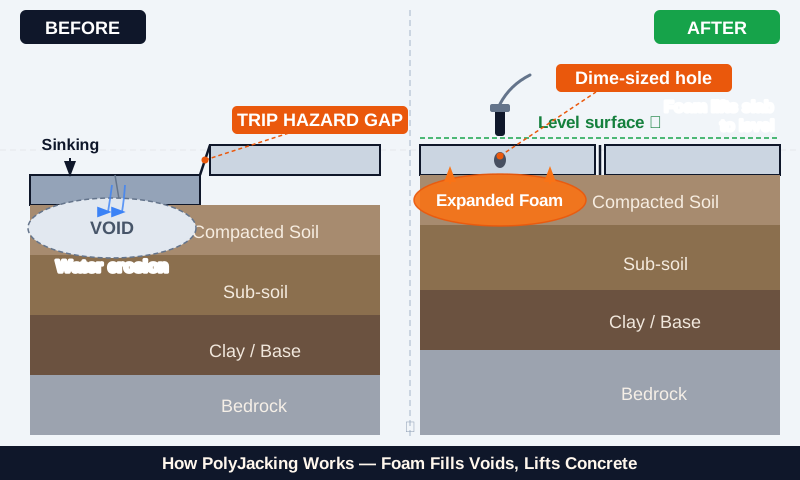
Traditional mudjacking, which some Independence contractors still offer, pumps a heavy cement slurry through holes an inch or two wide, adding significant new weight onto soil that's already been settling for half a century or more. PolyJacks injects polyurethane foam instead, through holes about the size of a dime. The foam expands to fill the void and lift the slab, but it stays lightweight, so it doesn't add fresh stress to tired, clay-heavy ground, and it's waterproof, so it won't break down in wet soil the way mud slurry can. For driveway leveling Independence homeowners want to actually last, that difference matters more on 55-to-75-year-old ground than it would on freshly graded soil.
Serving Independence and the surrounding area
PolyJacks is a locally owned business based in Spring Hill, and we work all across Independence and the neighboring communities — Sugar Creek, Raytown, North Kansas City, Kansas City, Blue Springs, and Pleasant Valley. Between the nearly 200-year-old streets around the Square and the boom-era neighborhoods that make up most of the city, we've seen how Jackson County clay treats concrete at every age. If a driveway, walkway, or patio has settled anywhere on your Independence property, call or text (913) 713-7794 or book online for a free estimate with no pressure to book.
Why concrete settles in Independence: the local risk data
In Independence, about 43.0% of Jackson County's soil rates high-shrink-swell, and about 65.5% across the Clay County line (USDA). The 'Queen City of the Trails' roughly tripled between 1950 and 1970, then stopped growing. It lines the south bank of the Missouri River and reaches into Clay County.
KC winters bring about 75.2 freeze-thaw days (NOAA).
Sources: USDA SSURGO · NOAA / ACIS (KCI) · local record. See the full KC Concrete Settlement Risk Index.
Our concrete leveling services
Commercial Leveling
Level a commercial slabConcrete leveling near Independence
PolyJacks is your local concrete leveling contractor in Independence — we serve Independence and the surrounding communities:
Neighborhoods across Independence:
Real job documentation
How polyjacking works in 90 seconds
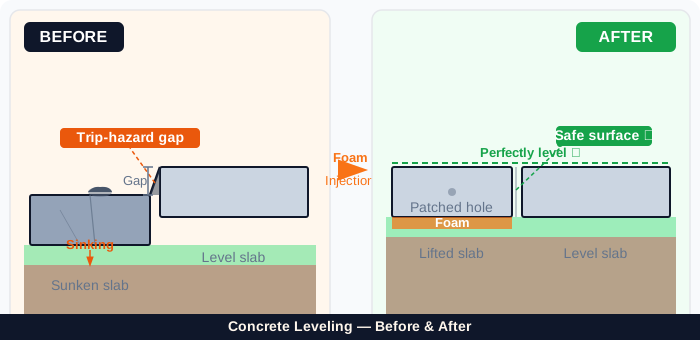
Our team walks you through the three-step process: dime-sized holes, high-density polyurethane foam that fills every void and compresses the soil beneath your slab, and use within hours with no heavy trucks. Call (913) 713-7794 or book a free estimate below.
Frequently asked
Why does so much of Independence's concrete seem to be the same age?
Independence's population nearly tripled between 1950 and 1970 (36,963 to 111,630) and then growth almost stopped for the next 40-plus years. That means most of the city's driveways, walkways, and patios were poured in that same 20-year window and are now hitting the same 55-to-75-year settlement range at roughly the same time.
Is concrete near Independence Square older than the rest of the city?
Often, yes. Independence was founded in 1827, well before the 1950-1970 building boom that produced most of the city's residential concrete, so sidewalks, steps, and foundations closest to the historic Square have had more time (sometimes close to two centuries) for clay soil to work on them.
How much does concrete leveling cost in Independence?
We don't post a fixed price because every driveway or patio settles differently. For scale, we've leveled a comparable sidewalk elsewhere in the metro for a fraction of its replacement bid, and a garage floor for a fraction of its bid as well. Every Independence estimate is free and done on-site before we recommend anything.
How long until I can use the concrete again?
You can generally walk on it in 15 to 30 minutes and drive on a driveway within 1 to 2 hours. The foam cures fast, so there's no multi-day downtime.
Is this a permanent repair or a temporary patch?
The polyurethane foam is waterproof and holds up well over time, including on the decades-old clay soil common across Independence. We'll walk you through your specific soil and drainage situation at the free estimate so you know what to expect.
Do you work outside Independence proper?
Yes. We regularly serve Sugar Creek, Raytown, North Kansas City, Blue Springs, Pleasant Valley, Kansas City, and the rest of the KC metro on both sides of the state line.
Looking for concrete leveling near me in Independence?
PolyJacks covers Independence, MO. Count on 2–4 hours on site for most jobs, then you're back to using your concrete within hours. Walk on it in 15–30 minutes, drive within 1–2 hours. The estimate is free. Book online.
Free concrete leveling estimate in Independence
No obligation. Honest advice, usable within hours. If foam isn't the right fix, we'll tell you straight.
Book your free estimate
Pick a time that works for you. Free on-site inspection, no obligation. Prefer to talk? Call (913) 713-7794.