
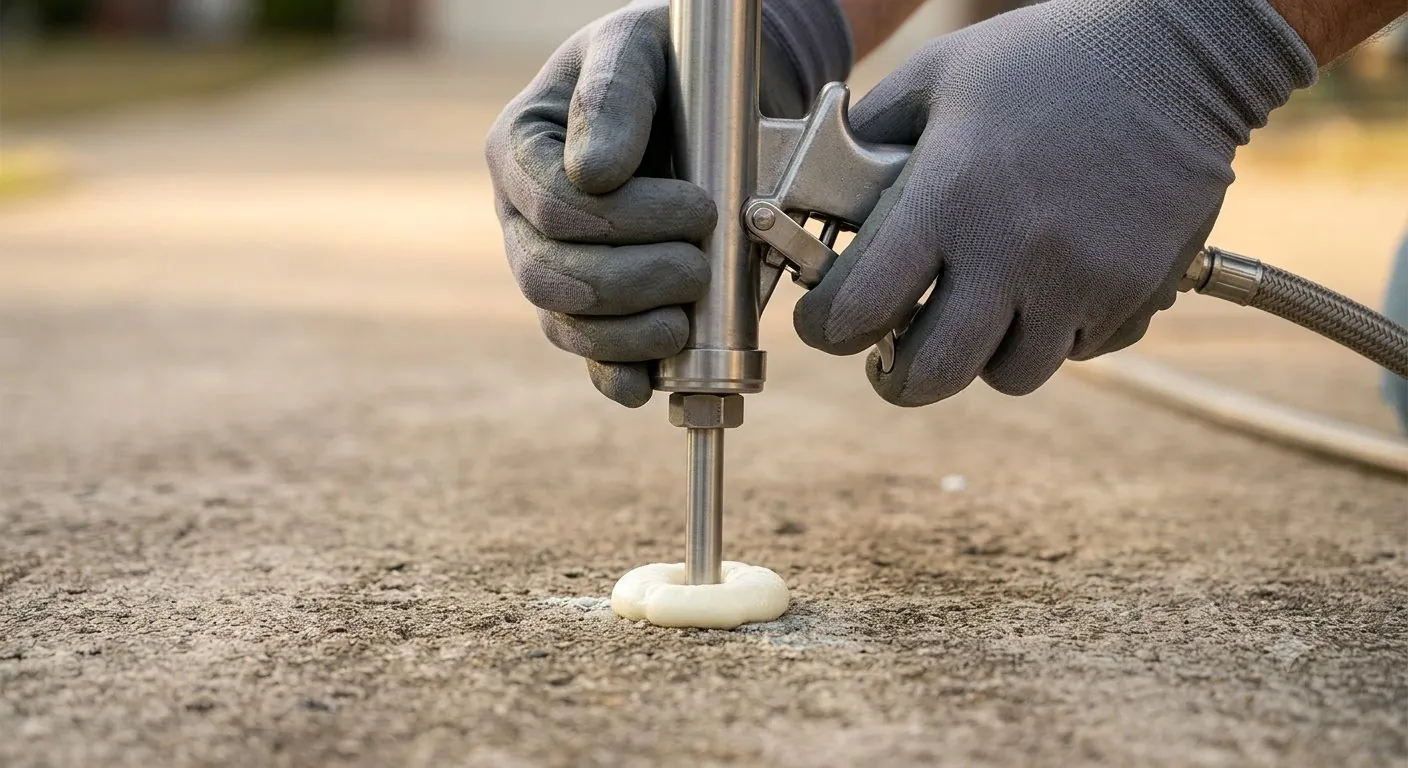
 Illustrative
Polyjacking vs. Mudjacking in Kansas City: The Real Differences
Both lift sunken concrete, but the material differs. Mudjacking pumps heavy cement slurry through large holes; polyjacking injects lightweight, waterproof polyurethane foam through dime-sized ones. Foam adds little weight to the soil, resists water, and cures within hours. In Kansas City's clay and freeze-thaw climate, that usually means it re-settles less.
Kansas City Says "Mudjacking." Most of the Time, People Mean Concrete Slab Jacking.
Around here, "mudjacking" became the catch-all word for slab jacking (lifting sunken concrete) the same way people say "Kleenex" for any tissue. But mudjacking is one specific method, and it's not what we do.
PolyJacks uses waterproof polyurethane foam, not cement slurry. If you've been calling around and hearing "mudjacking" from every company in the phone book, it's worth knowing there are real differences in the hole size, the cure time, and how the fix holds up through a Kansas City winter.
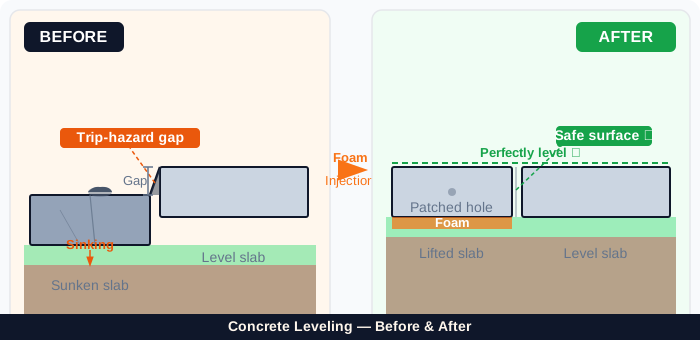
This page lays out those differences straight, so you know what you're actually choosing between.
Three Ways to Fix Sunken Concrete
Slab jacking is the umbrella term for raising a sunken slab back to grade; in Kansas City it comes down to three paths.
Mudjacking pumps a slurry of soil, cement, and water under the slab through holes much wider. It's been around a long time and it does lift concrete, but the mix is heavy, porous, and takes a day or more to cure.
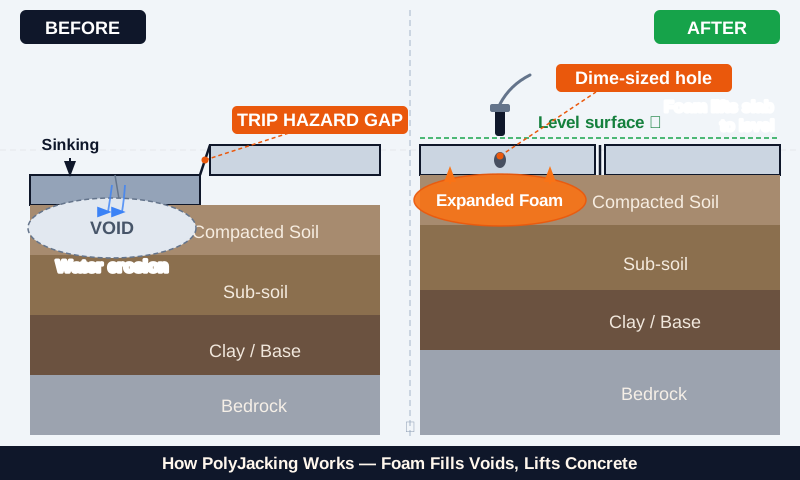
Polyjacking (foam injection) (what we do) injects a two-part polyurethane foam through dime-sized holes. The foam expands 30–40 times its liquid volume, fills the voids under the slab, and lifts it. It cures in minutes, not days.
Full replacement means breaking out the old slab and pouring new concrete. It's sometimes the right call. A slab that's cracked into pieces or structurally failed needs this, not a lift. We'll tell you if that's your situation instead of trying to sell you a fix that won't hold.
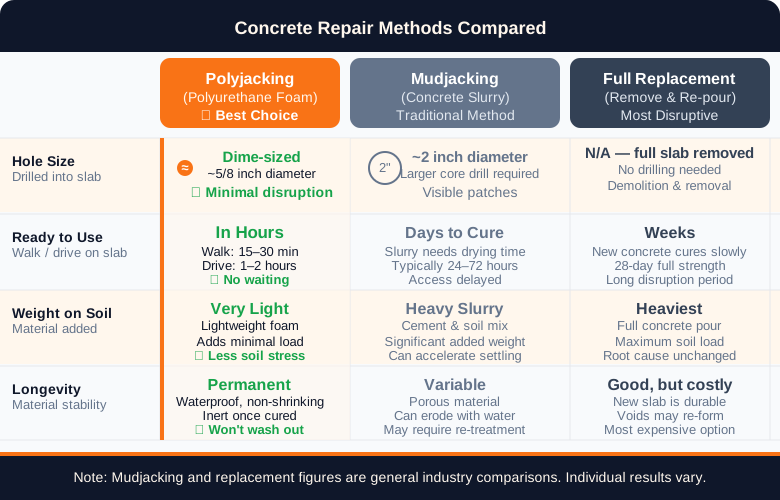
Polyjacking vs. Mudjacking, Side by Side
| Polyurethane Foam (PolyJacks) | Mudjacking | |
|---|---|---|
| Cure time | 15–30 minutes to walk on it | 24–72 hours |
| Drive on it | 1–2 hours | Several days |
| Material weight | Featherlight | Far heavier |
| Injection hole size | ~dime-sized (dime-sized) | much wider |
| Waterproof | Yes (inert once cured | No) can reabsorb water |
| Adds load to soil | Minimal, due to light weight | Significant, due to heavy fill |
| Typical job length | 2–4 hours | Often a full day or more |
The hole size matters more than people expect: smaller holes mean a faster patch and a lot less visible repair on your driveway or patio. And because foam weighs a fraction of what mud does, it isn't adding a heavy new load onto the same soil that let the slab sink in the first place.
Polyjacking vs. Full Replacement
Replacement means demo crews, a poured slab that needs about a week before you can use it lightly and a full 28 days to reach full strength, and a driveway or patio you can't use in the meantime. It's the right answer when concrete is broken, not just settled.
When a lift is the right fix, polyjacking gets you back to normal within hours: walk on it in 15 to 30 minutes, drive on it in 1 to 2 hours. And because we're filling voids instead of pouring new concrete, jobs typically run far less than full replacement.
We don't put a number on that until we've seen the slab. Pricing is based on the actual foam volume your job needs, measured during a free on-site inspection. Not a guess over the phone.
Why This Matters More in Kansas City Than Most Places
Metro soil is heavy on expansive clay. It swells when it's wet and shrinks when it dries out, and it does that over and over through the seasons. Add in repeated freeze-thaw cycles most KC winters, and you've got the two biggest reasons concrete sinks and cracks here.
Underneath that, the actual cause is usually one of: soil washout or erosion, poor fill compaction under a newer slab, a plumbing leak moving water where it shouldn't be, bad drainage or a downspout dumping water at the foundation, tree roots, or a straight-up void that formed under the slab.
A fix that can't handle water and freeze-thaw cycling is fighting the wrong battle in this climate. That's a big part of why we use foam. It's waterproof and non-shrinking once it cures, so it's not degrading the same way a wet, porous mud fill can.
When We'll Tell You Foam Isn't the Answer

We'd rather tell you the truth than sell you a lift that won't hold.
If a slab is cracked into separate pieces or structurally broken, it needs replacement. Foam can't glue broken concrete back together. If the sinking is being caused by an active plumbing leak, that leak needs to be fixed first, or the ground underneath will keep washing out no matter what we inject. If tree roots are heaving the slab, the root issue needs addressing before a lift will hold.
And we don't touch foundation repair. If that's what your home needs, we'll say so and point you toward someone who does that work.
On top of that, every polyjacking job we do comes with a 1-year limited warranty, transferable if you sell the house: if the slab settles more than 1/4 inch from our work within 12 months, we re-lift it free. That warranty doesn't cover drainage neglect, tree roots, heavy loads within 48 hours of the job, acts of God, or cosmetic hairline cracks, but it does mean we stand behind the lift itself.
See It for Yourself: Free Estimate, No Pressure
The best way to know which method your concrete actually needs is to have someone look at it. PolyJacks is a locally owned crew based in Spring Hill, working driveways, sidewalks, patios, garage floors, and pool decks across roughly 35 suburbs in Johnson, Wyandotte, Jackson, Clay, and Platte counties, plus commercial lots and warehouse floors.
We're licensed and insured. The estimate costs nothing and the visit tells you straight whether foam is the right call, or whether you need something else.
Related guides
How polyjacking works in 90 seconds
Our team walks you through the three-step process: dime-sized holes, high-density polyurethane foam that fills every void and compresses the soil beneath your slab, and use within hours with no heavy trucks. Call (913) 713-7794 or book a free estimate below.
Frequently asked
Is polyjacking the same thing as mudjacking?
No. Mudjacking pumps a cement-and-soil slurry under the slab through much larger holes. Polyjacking injects waterproof polyurethane foam through holes about the size of a dime. Different material, different holes, different results. A lot of Kansas City homeowners use "mudjacking" as the generic word for any concrete lift, but the two methods aren't interchangeable.
Which lasts longer, foam or mudjacking?
Foam holds up better here because it's waterproof and inert once it cures. It won't reabsorb water, freeze, or break down the way a cement slurry can after repeated freeze-thaw cycles. Mud mix is heavy and porous, so KC's swings between wet clay and hard freezes can work against it over time. Foam was built to handle that cycle.
Can polyjacking fix a slab that was mudjacked before?
Usually, yes. If the old mud fill has washed out or left new voids, we can inject foam to fill the gap and re-level the slab. We'll look at the slab's condition during your free estimate and tell you straight whether foam will hold or whether the slab has other issues to deal with first.
How much cheaper is polyjacking than pouring new concrete?
It runs far less than full replacement. We just don't quote a number until we've measured the actual foam volume your job needs, which we do on-site for free. Every slab, soil condition, and void size is different, so a phone-quote price isn't a real one.
Will polyjacking work on my driveway, patio, or garage floor?
For sunken or unevenly settled slabs, yes. That's the majority of what we see across the metro. It's not the fix for a slab that's cracked into pieces or structurally broken; that needs replacement. We'll tell you which situation you're in before we recommend anything.
How do I know if I need polyjacking or a plumber first?
If the sinking is tied to an active water or drain leak under the slab, that leak needs to be fixed first. Foam won't hold against water still washing soil out from underneath. During your free estimate we'll flag it if that looks like the cause, before you spend a dime on lifting.
Get your free concrete leveling estimate
No obligation, and if foam isn't the right fix, we'll tell you straight.
Book your free estimate
Pick a time that works for you. Free on-site inspection, no obligation. Prefer to talk? Call (913) 713-7794.