
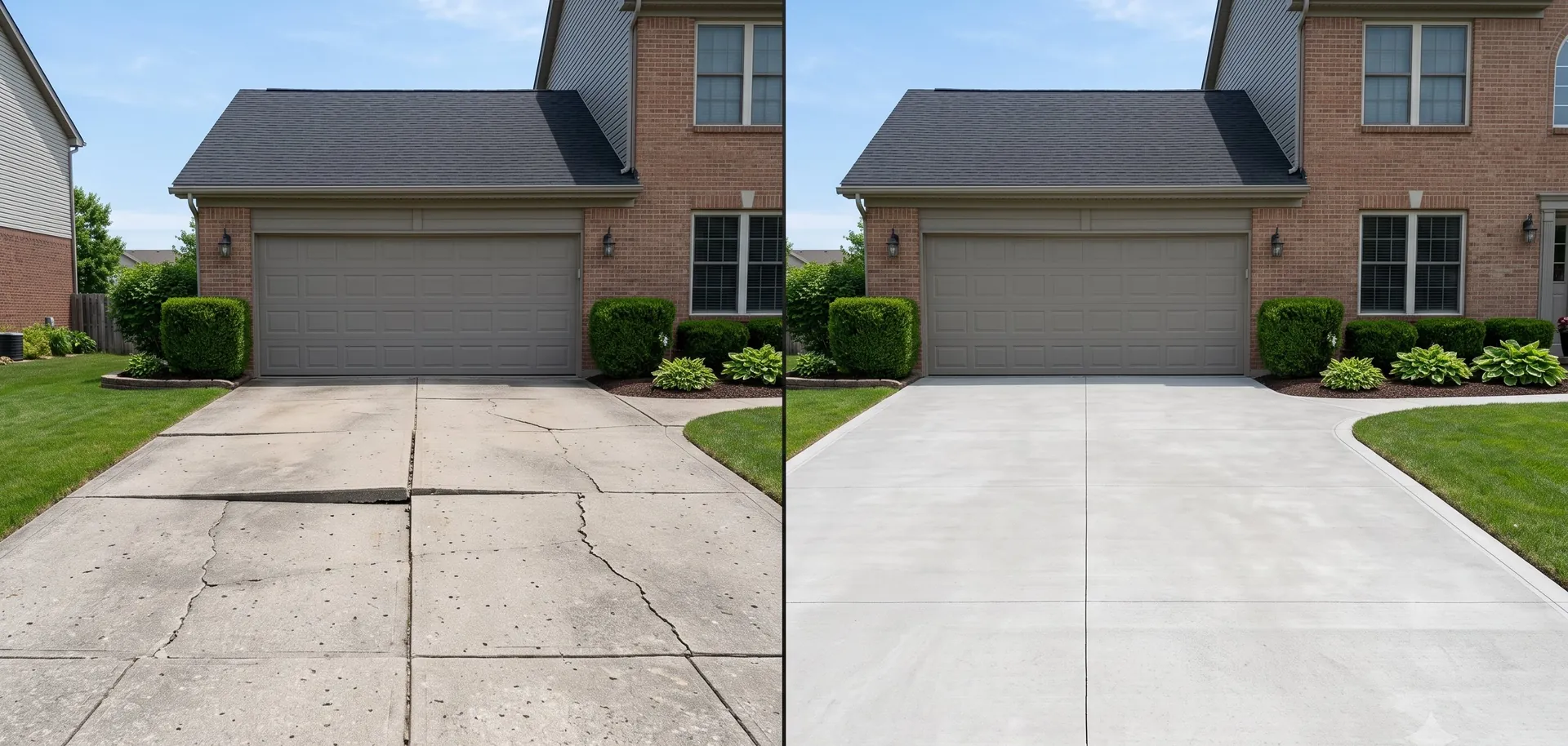
 Illustrative
5 Warning Signs Your Concrete Needs Leveling
The clearest signs concrete needs leveling: raised trip lips at joints, water pooling on the surface, a gap opening where the slab meets your house, a hollow sound underfoot, and stair-step cracks. Any of these means soil has settled beneath the slab. A free on-site estimate confirms whether foam leveling fits.
Your Concrete Is Trying to Tell You Something
Concrete doesn't sink overnight. It gives you warning signs first: small ones, then bigger ones. Catch it early and a slab that's starting to settle is usually a straightforward lift. Wait too long and water gets under there, the void grows, and it turns into a bigger repair.
Below are the signs your concrete needs leveling that we run into most on driveways, sidewalks, patios, and garage floors across the KC metro. If more than one sounds familiar, it's worth a free look.
Trip Lips at the Joints
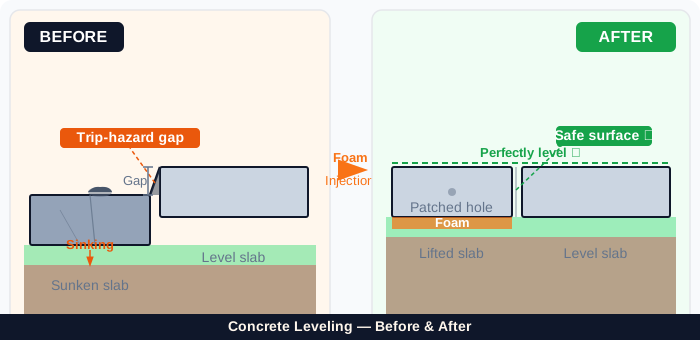
A trip lip is where one slab sits higher than the one next to it at a control joint. Even a half-inch step is enough to catch a toe, a wheelchair wheel, or a delivery cart, and it's a common reason walkways get flagged during a home inspection or insurance walk-through.
Trip lips show up most at sidewalk joints, driveway-to-garage transitions, and patio-to-house thresholds. Anywhere two separate pours meet. If you can feel the edge with your shoe, it's worth checking.
Water Pooling Where It Didn't Used To
Concrete is supposed to shed water away from your house, not collect it. If you're seeing puddles in the middle of the driveway, on the patio, or right against the foundation after a rain, part of that slab has settled lower than the rest of it.
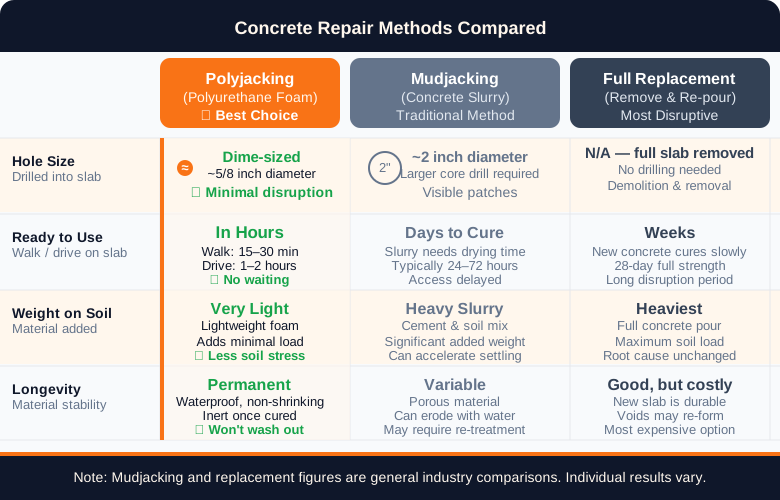
Standing water isn't just an inconvenience. It works its way into cracks and joints, softens the soil underneath even more, and speeds up whatever caused the sinking in the first place.
Gaps Opening Up at the House
Look where your porch, patio, or garage slab meets the foundation. A gap that's widening, or one you can slide a finger or a putty knife into. Usually means that slab is pulling away and dropping while the house stays put, since the foundation sits on deeper footings.
This is one of the most common calls we get, and in most cases it's the slab that moved, not the house. We'll tell you plainly if what we're looking at is actually a foundation issue instead. That's not something foam fixes, and we'll point you to someone who does that work.
A Hollow, Rocking, or Bouncy Slab
Walk your driveway or patio and pay attention to the sound. A dull, hollow thud, or a slab that visibly rocks or squirts water when you step near an edge, means there's a void underneath. The concrete on top can still look perfectly fine while the ground under it has washed out or never compacted right to begin with.

This one's easy to miss because nothing looks wrong yet. It's also exactly what our foam is built to fix. We fill that void and lift the slab back to level in the same visit.
Cracks With a Step in Them
Not every crack means trouble. Hairline cracks are normal (concrete does that as it cures) and they're cosmetic. What we're watching for is a stepped crack: one side sits higher than the other, so you can feel a ridge when you run your hand across it. That's a sign the slab has actually shifted, not just cracked on the surface.
If the concrete is cracked but structurally sound, foam can lift and stabilize it. If it's broken into pieces or badly deteriorated, we'll tell you replacement is the better call. We're not going to inject foam under something that needs to come out.
Why This Happens So Much in Kansas City
It's not bad luck and it's not always bad concrete. The KC metro sits on expansive clay soil that swells when it's wet and shrinks when it dries out, cycling like that all year. Add in repeated freeze-thaw cycles most winters, and the ground under your slab is moving constantly even when the slab itself looks still.
The usual culprits: soil that erodes or washes out from under the edges, fill dirt that never got compacted right on a newer slab, a slow plumbing leak softening the ground from below, downspouts and drainage dumping water next to the foundation, or tree roots disturbing the base. Most of the time it's more than one of these working together.
What to Do When You Spot One of These
Start with a free, on-site inspection. We look at the slab and figure out what's actually causing it: sometimes that means telling you it's a drainage fix or a plumber's job before it's a foam job: then quote based on exactly how much foam the lift needs. No guessing, no upsell.
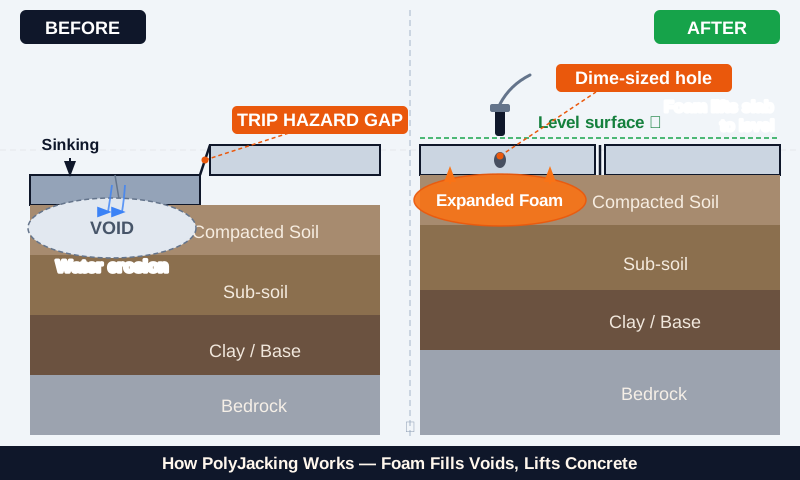
If polyjacking is the right fix, most jobs run 2 to 4 hours. We drill dime-sized holes, typically 4 to 12 of them, and inject a waterproof, high-density polyurethane foam that expands 30 to 40 times its liquid volume to fill voids and lift the slab. You can walk on it in 15 to 30 minutes and drive on it in 1 to 2 hours. Just no heavy vehicles for the first 48 hours while it fully cures. The work is backed by a 1-year limited warranty: if the slab settles more than 1/4 inch from our work within 12 months, we come back and re-lift it at no charge.
When Leveling Isn't the Right Fix
We'll say it straight: foam isn't the answer for everything. A slab that's cracked into pieces or badly deteriorated needs replacement, not a lift. An active plumbing leak needs a plumber first: lifting concrete over a leak just buries the problem. And if tree roots are heaving a slab, that root work needs to happen before we touch it.
We'd rather tell you that up front than sell you a fix that won't hold.
See These Signs at Your Place?
Trip lips, pooling water, gaps at the house, a hollow slab, or a stepped crack. Even just one of these is worth a free look. Book a Free Estimate or call (913) 713-7794.
We're a locally owned crew based in Spring Hill, licensed and insured, and we've been fixing sunken concrete across the Kansas City metro since 2024. We'll tell you straight what's going on and what it'll take to fix it. No pressure, no guessing.
How polyjacking works in 90 seconds
Our team walks you through the three-step process: dime-sized holes, high-density polyurethane foam that fills every void and compresses the soil beneath your slab, and use within hours with no heavy trucks. Call (913) 713-7794 or book a free estimate below.
Frequently asked
Is a hairline crack the same as a sign my concrete needs leveling?
No. Hairline cracks are normal. Concrete does that as it cures, and they're cosmetic. What we watch for is a stepped crack, where you can feel one side sitting higher than the other. That means the slab has actually moved, not just cracked on the surface.
What does a hollow or rocking sound under my driveway or patio mean?
It usually means there's a void underneath. The soil washed out or never got compacted right, and the slab is sitting over empty space instead of solid ground. It can still look fine on top while being unsupported underneath, which is why it's easy to miss.
The gap between my patio or porch and my house is getting wider. Is that a foundation problem?
Most of the time, no. It's the slab settling while the foundation, which sits on deeper footings, stays put. We'll confirm which one it is during your free inspection. If it does turn out to be a foundation issue, we'll tell you straight and point you to someone who handles that work.
Can polyjacking fix a crack that already has a step in it?
Often, yes: as long as the concrete itself is still structurally sound. If it's broken into pieces or badly deteriorated, we'll tell you honestly that replacement is the better move rather than inject foam under something that needs to come out.
How much does it cost to fix these signs?
We price every job by the exact amount of foam it needs, which we determine during a free on-site inspection. There's no flat rate because no two slabs need the same lift. It consistently runs far less than tearing out and replacing the concrete.
How fast can someone come look at my concrete?
Call (913) 713-7794 or book a free estimate online and we'll get out to your property for a no-cost inspection. Most of these warning signs are quick to diagnose in person.
Get your free concrete leveling estimate
No obligation, and if foam isn't the right fix, we'll tell you straight.
Book your free estimate
Pick a time that works for you. Free on-site inspection, no obligation. Prefer to talk? Call (913) 713-7794.