
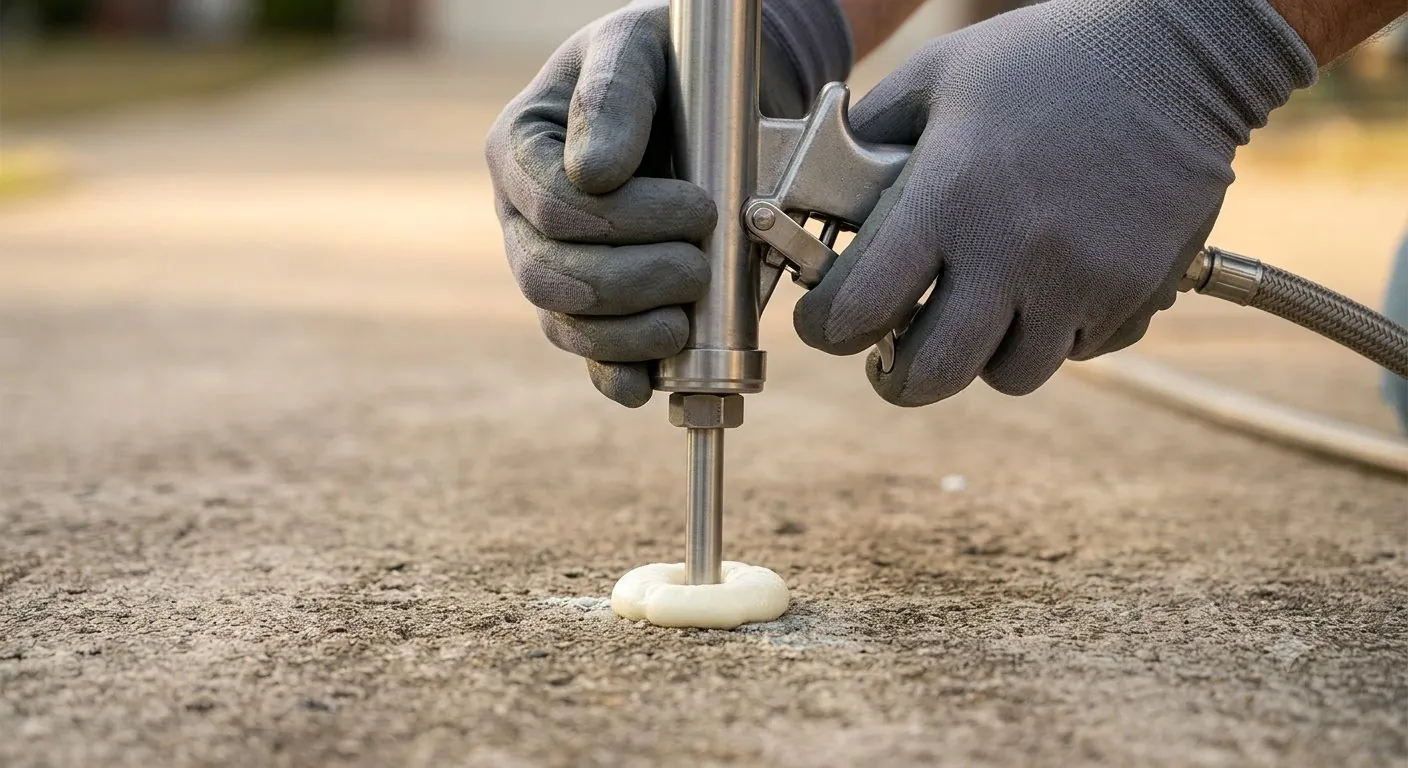
 Illustrative
Polyjacking FAQ: Kansas City Homeowners' Questions, Answered
Straight Answers From a Local Crew
Andrew started PolyJacks in 2024 after years working in the trades around Kansas City, watching the same story play out driveway after driveway. Clay soil that never sits still, freeze-thaw winters that pound at concrete, and homeowners quoted a full slab replacement when the real problem underneath could be fixed in an afternoon.
PolyJacks is licensed and insured. Every estimate is free, with no obligation to book.
Below are the questions we hear most, answered the same way we'd answer them standing in your driveway: plain and straight. If your question isn't here, call us at (913) 713-7794.
Still Have Questions?
Every slab is different, and the fastest way to know what's actually happening under yours is to have someone take a look in person. Our estimates are free and come with a straight answer. If polyjacking is the right fix, we'll tell you. If it isn't, we'll tell you that too and point you toward what will work.
Book Free Estimate or call (913) 713-7794 to get on the schedule.
How polyjacking works in 90 seconds
Our team walks you through the three-step process: dime-sized holes, high-density polyurethane foam that fills every void and compresses the soil beneath your slab, and use within hours with no heavy trucks. Call (913) 713-7794 or book a free estimate below.
Frequently asked
Will my concrete sink again after polyjacking?
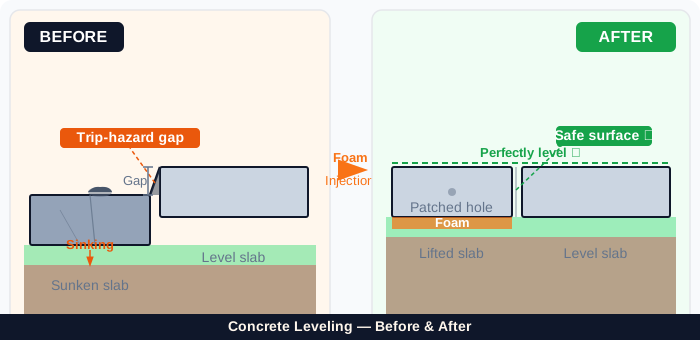
Not from the foam itself. It doesn't shrink, break down, or wash out once it cures. A lift only gives way if the original cause is still active underneath: a leaking pipe washing soil out, or drainage still funneling water beneath the slab. Handle that and the lift holds for good, which is why we flag any active drainage or grading issue on the estimate. And if a slab we lifted settles more than 1/4 inch within a year due to our work, we come back and re-lift it free under warranty.
How soon can I use my driveway or walkway after leveling?
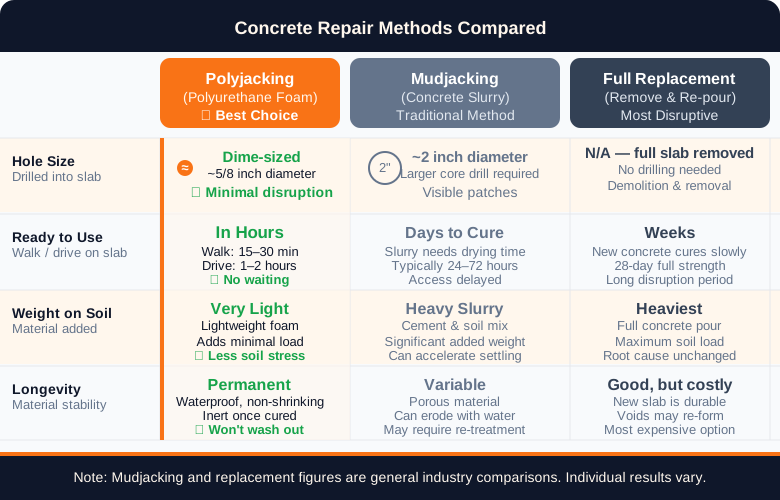
The foam sets up firm enough to walk on in 15 to 30 minutes and handle regular vehicle traffic in 1 to 2 hours. We just ask you hold off on anything heavy (trucks, RVs, trailers, dumpsters) for 48 hours while it reaches full cure.
How long does polyjacked concrete last?
Indefinitely, in most cases. The foam itself doesn't shrink, wash out, or break down over time. How long the lift holds depends on what's happening underneath: if erosion, poor drainage, or root growth caused the original sinking and that keeps going, the ground can still move. That's why we look at the whole picture during your free estimate, not just the slab on top.
Why does concrete sink and crack so much around Kansas City?
Two things working against you here. Our clay soil swells when it's wet and shrinks when it dries out, so it's constantly moving under your slab. Then add repeated freeze-thaw cycles most winters and that ground never really settles. On top of that you've got the usual culprits: drainage washout, downspouts dumping water next to the slab, poor fill compaction under newer concrete, tree roots, and voids that form underneath over the years. Most jobs are a mix of two or three of these.
How big are the injection holes, and will they show?
About the size of a dime. A typical job needs 4 to 12 holes depending on the size of the slab and how many low spots we're filling. We patch every hole with a color-matched concrete cap before we leave, so from a few feet back most people can't tell where we worked.
Is polyjacking messy? Will it tear up my yard?
No digging, no jackhammering, no dump truck hauling off broken concrete. We drill small holes, pump foam through them, and patch. Most jobs wrap up in 2 to 4 hours in a small work area around the slab. Compare that to a mudjacking crew running slurry or a replacement crew tearing out and repouring, and it's a different level of mess. We clean up before we go.
What's the difference between polyjacking and mudjacking?
Both raise sunken concrete, but the material's different. Our foam cures in 15 to 30 minutes; mudjacking slurry needs 24 to 72 hours before you can use the slab. Foam weighs a fraction of what mud does. That extra weight can add more stress to soil that's already struggling. Foam goes in through dime-sized holes; mudjacking needs much larger holes. And foam is waterproof and won't break down; mud can.
Why choose foam over just tearing out and replacing the slab?
Replacement means jackhammering out the old concrete, hauling it off, forming and pouring new slab, then waiting about a week before you can use it and a full 28 days before it's at full strength. Polyjacking uses the concrete you've already got. We just lift it back into place, and it's usable within hours. It also runs far less than tearing out and repouring. If the slab itself is cracked or broken up, replacement is sometimes the right call, and we'll tell you straight if that's your situation. We do exactly that across the metro. You can see real Kansas City examples, from an Olathe driveway to an Overland Park sidewalk, on our concrete leveling cost page.
What's covered under your warranty?
One year, limited, and it transfers if you sell the house. If a slab we lifted settles more than 1/4 inch within 12 months due to our work, we come back and re-lift it at no charge. It doesn't cover new settling from things outside the original repair: neglected gutters or drainage, tree roots, heavy loads on the slab within 48 hours of the job, acts of God, or hairline cosmetic cracks that don't affect the level.
Can you polyjack in the winter or when it's freezing?
Yes, we work through the Kansas City winter. Freeze-thaw cycles are actually a big reason concrete sinks here in the first place, so we don't shut down for cold weather. Extreme conditions can affect scheduling on a given day, but polyjacking isn't a fair-weather-only repair the way pouring new concrete is.
How long does a typical job take?
Most residential jobs (a driveway, sidewalk, patio, or garage floor) run 2 to 4 hours start to finish. Larger commercial jobs like parking lots or warehouse floors take longer depending on square footage. We'll give you a real time estimate during your free on-site inspection.
Is polyjacking a good fit for my concrete, or do I need something else?
For most sunken but structurally sound concrete (driveways, sidewalks, patios, garage floors, pool decks) yes. It's not the right tool for a badly cracked or broken-up slab, and we don't do foundation repair; if that's what's going on, we'll tell you and point you to someone who does. The only way to know for sure is to have us take a look. Book Free Estimate and we'll give you a straight answer.
My slab has cracks, not just a dip? Can foam still fix it?
Depends on the crack. Hairline cracks and minor separation are common even in slabs we lift and level just fine. If a slab is broken into pieces or badly deteriorated, foam can't hold it together. That's a replacement job, and we'll say so instead of selling you a fix that won't hold.
I think I have a drainage problem too. Do you handle that?
We'll flag it for you. Downspouts dumping water next to a slab and poor grading are two of the most common reasons concrete sinks again after it's been leveled, so we walk the property during your estimate and tell you what we see. We don't do drainage work ourselves, but a lift only lasts if the water problem causing it gets solved too.
What if a tree root is causing the concrete to lift or heave?
If a root is pushing concrete up rather than settling it, foam isn't the fix. That needs root work first. We'll tell you during the inspection if that's what's happening so you're not paying to level something that's going to move again.
How much does polyjacking cost?
We don't quote a number until we've seen the job. Every driveway, patio, or garage floor needs a different amount of foam depending on the size of the void and how much lift it needs, so we price by the exact volume your job takes. That quote comes after a free, no-obligation on-site inspection. What we can tell you up front: it consistently runs far less than tearing out and replacing the slab. Book Free Estimate to get your exact number.
What areas do you serve, and do you work on commercial properties?
We cover the KC metro, around 35 suburbs across Johnson, Wyandotte, Jackson, Clay, and Platte counties, roughly 50 miles out from our Spring Hill base. For commercial work, like parking lots and warehouse floors, we'll travel up to 100 miles. Not sure if you're in range? Call (913) 713-7794 and we'll tell you.
Get your free concrete leveling estimate
No obligation, and if foam isn't the right fix, we'll tell you straight.
Book your free estimate
Pick a time that works for you. Free on-site inspection, no obligation. Prefer to talk? Call (913) 713-7794.