
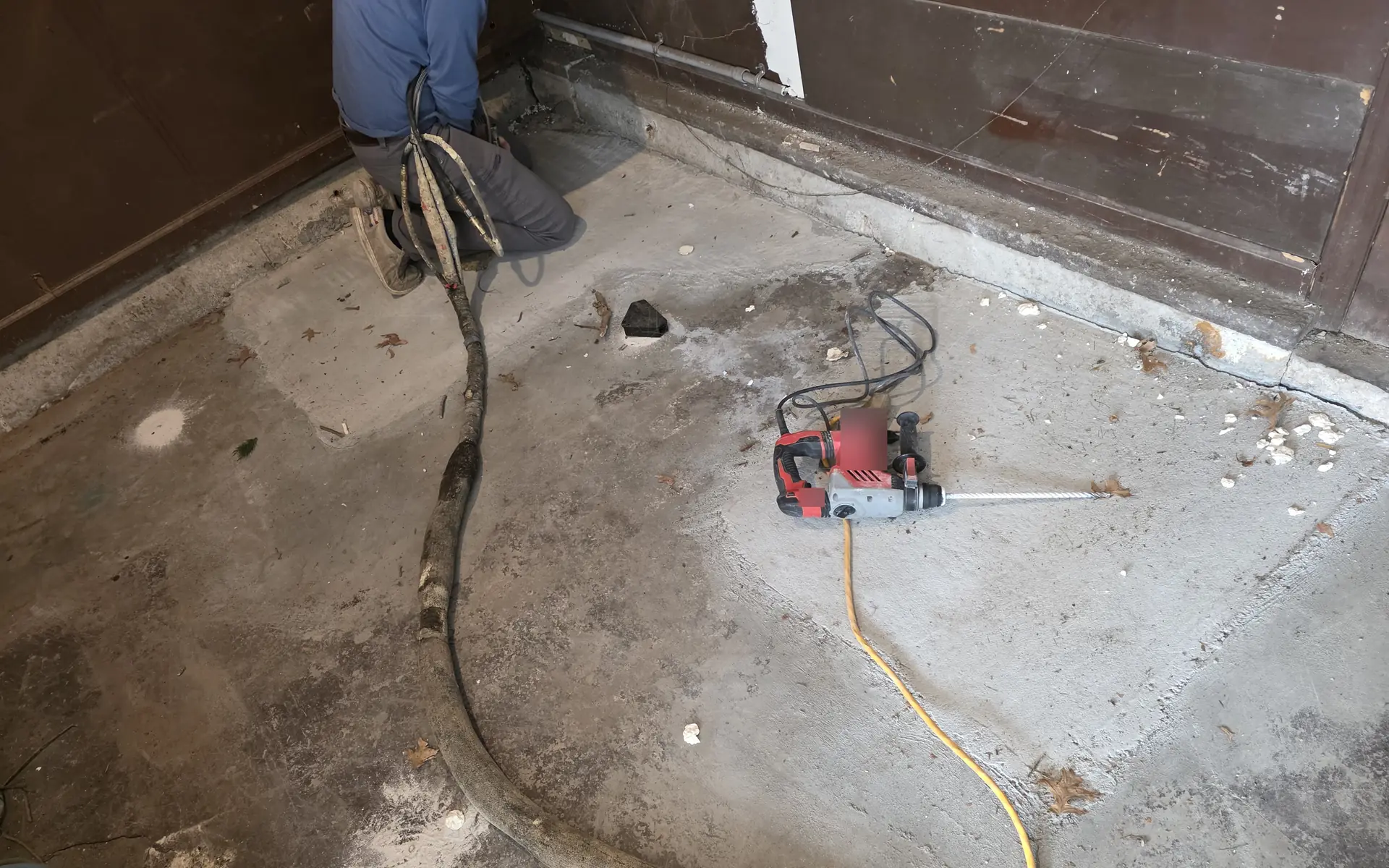
Concrete Leveling in Prairie Village, KS
Prairie Village is unusual among Kansas City suburbs because it was not assembled in waves over multiple decades — J.C. Nichols Company built essentially the entire city in a single run between 1946 and 1961, averaging one completed home per day at the peak.
The concrete that went in those driveways, front walks, and back patios during that window is now 65 to 80 years old across the board. There is no newer part of town, no post-2000 fill-compaction corridor where the slabs are still young. The whole city entered the deep settlement window at the same time, and you can see it block by block in Corinth Hills, Somerset Hills, and Indian Fields. PolyJacks levels sunken Prairie Village concrete with polyurethane foam. No digging, no replacement, usable within hours.
One Developer, One Decade: Why Prairie Village Concrete Ages Together
Most Kansas City suburbs were built in waves over several decades, producing a natural mix of concrete ages. A 1990s subdivision beside a 1960s neighborhood, newer fill-era slabs alongside original city-era pours. Prairie Village works differently. J.C. Nichols Company started construction in 1946 and delivered, at the peak, an average of one completed home per day. By 1961, eight residential sections — Prairie Village, Prairie Hills, Indian Fields, Prairie Ridge, Prairie Fields, Prairie Fields-South, Corinth Hills, and Kenilworth: were largely complete. Nearly the entire city’s residential concrete went in during a span of roughly 15 years. That concrete is now 65 to 80 years old across every block. There is no younger zone in the southeast corner where things have not started moving yet. When we get calls from Prairie Village, the slab is consistently old, consistently sitting on soil that has had generations to open voids underneath it, and consistently at or past the point where leveling is the right answer.
What Seven Decades of Johnson County Clay Does to Concrete
The Wymore-Ladoga clay under Prairie Village is the same expansive soil series that underlies the rest of Johnson County — 60 to 80 percent clay content, very high shrink-swell rating. What separates Prairie Village from a newer suburb is accumulated time. Each spring thaw saturates the clay and it swells slightly, opening a void at the slab edge. Each dry late summer contracts the clay, and the void grows a little wider. After 70 cycles, the micro-gaps under a Prairie Village driveway are real voids, not hairline spaces. Frost heave compounds the same process: water in the soil freezes and expands roughly 9 percent, lifts the slab, then thaws and leaves a gap underneath. Across 50 to 70 freeze-thaw transitions per winter in the Kansas City metro, 70 years of winters represents an enormous cumulative load of lifting and re-settling. By the time a Prairie Village homeowner notices a slab edge has dropped half an inch, the void underneath has typically been developing for years.
Tree Roots and Old Concrete: Prairie Village’s Dual Sidewalk Problem
J.C. Nichols planted trees alongside the first Prairie Village homes in the late 1940s. Those trees are now 70-year-old specimens with root systems that have grown well beyond the drip line and into the zone where front walkways, driveway edges, and patio slabs were poured. Prairie Village Public Works trims trees over streets and sidewalks on a four-to-five-year rotation, but root systems grow year-round and the trimming program does not address roots under concrete. The result is a dual mechanism that most suburban calls do not show in combination: clay settlement opens a void under the slab center while a root system pressures the edge upward from below, creating a tilted panel rather than a uniformly settled one. If the whole front walk has dropped two inches evenly, that reads as clay settlement. If one edge is up and the opposite edge is down, a root is likely involved. We assess both at the estimate before recommending what can be leveled and what needs replacement.
Why Foam Works Better Than Mudjacking on 70-Year-Old Concrete
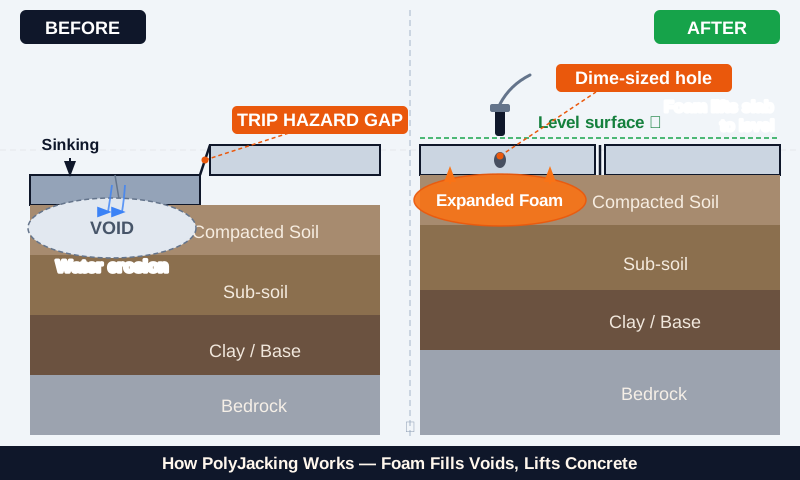
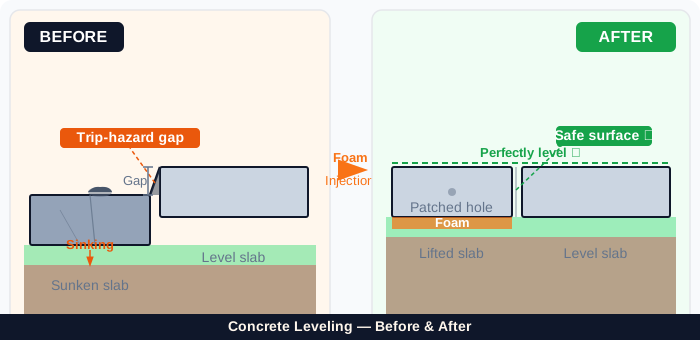
Mudjacking has been around since before Prairie Village was built, and some of the original J.C. Nichols slabs may have been releveled once or twice by a prior mudjacking contractor over the decades. Traditional mudjacking pumps a heavy cement-soil slurry under the slab through holes 1.5 to 2 inches in diameter. On a 70-year-old slab that is already cracked or showing edge stress from root displacement, large drill holes add structural stress the concrete may not handle cleanly. Polyurethane foam uses dime-sized holes, adds no meaningful weight to soil that has been working for 70 years, and cures waterproof: unlike slurry, it does not break down if moisture cycles resume under the slab after the repair. The foam fills voids completely and holds without shrinking. For Prairie Village’s oldest concrete, foam is the lower-risk method in every dimension that matters: hole size, weight added, and long-term moisture resistance. If a slab is too deteriorated for either method, we say so at the estimate.
Serving Prairie Village and the Surrounding Inner Suburbs
PolyJacks works Prairie Village driveways, front and side walkways, back patios, garage floors, and porch slabs as part of our regular Kansas City metro coverage out of Spring Hill. We also serve the immediately surrounding inner suburbs — Mission Hills, Leawood, Fairway, Mission, and Roeland Park: where postwar-era concrete faces similar timelines on the same Johnson County clay. If you are in Corinth Hills and your front walk has been slowly tilting toward the street for two years, or in Indian Fields with a garage apron that dips at the door threshold, call (913) 713-7794 for a free on-site estimate. We look at the slab, explain what is causing the movement, and give you a straight answer on whether foam is the right fix or whether something else is warranted.
Why concrete settles in Prairie Village: the local risk data
In Prairie Village, about 77.7% of Johnson County's soil rates high-shrink-swell (USDA). Developer J.C. Nichols built nearly the entire city starting in 1946. Public Works trims mature street trees on a four-to-five-year rotation to limit root damage.
KC winters bring about 75.2 freeze-thaw days (NOAA).
Sources: USDA SSURGO · NOAA / ACIS (KCI) · local record · local record. See the full KC Concrete Settlement Risk Index.
Our concrete leveling services
Commercial Leveling
Raise a warehouse or dock floorConcrete leveling near Prairie Village
PolyJacks is your local concrete leveling contractor in Prairie Village — we serve Prairie Village and the surrounding communities:
Neighborhoods across Prairie Village:
Real job documentation
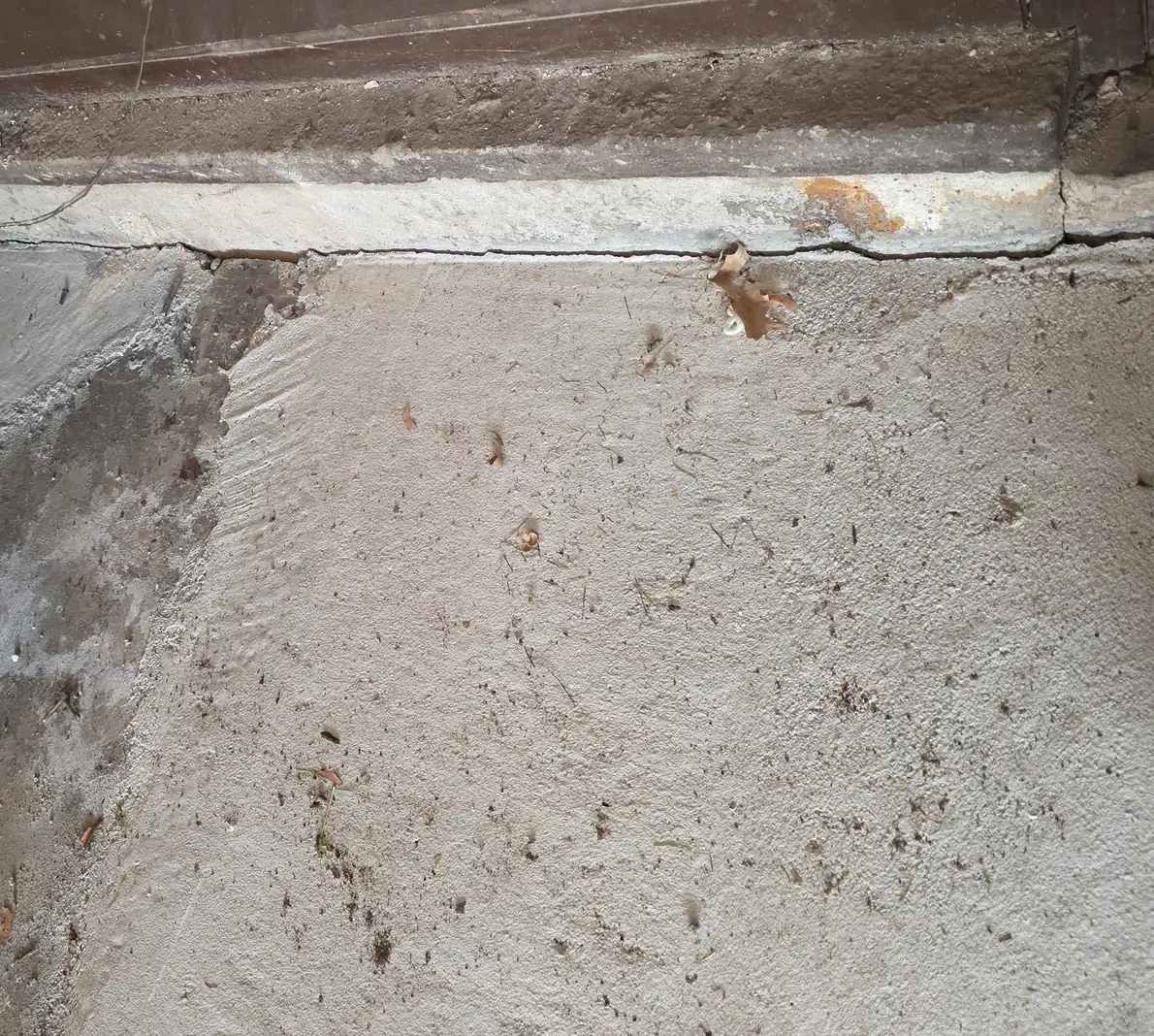
How polyjacking works in 90 seconds
Our team walks you through the three-step process: dime-sized holes, high-density polyurethane foam that fills every void and compresses the soil beneath your slab, and use within hours with no heavy trucks. Call (913) 713-7794 or book a free estimate below.
Frequently asked
My Prairie Village house was built in the 1950s. Why is the concrete just now sinking?
Wymore-Ladoga clay settlement is a slow accumulation, not a sudden event. Each freeze-thaw cycle opens the void slightly; each dry summer contracts the clay a bit further. After 65 to 70 years, those incremental movements add up to a visible gap and a slab that finally drops measurably. Prairie Village concrete is often at or past that tipping point. Not because it failed early, but because it has done its job for a very long time on difficult soil.
My entire block in Prairie Village seems to be having concrete problems at the same time. Is that coincidence?
It is not a coincidence. It makes sense given how Prairie Village was built. J.C. Nichols poured all the concrete in each neighborhood within a few years of each other, so it all enters the settlement window at roughly the same time. If one neighbor is getting a driveway leveled, it is common for several others nearby to start noticing similar issues. The concrete is the same age on the same clay.
Are tree roots causing my Prairie Village walkway problem, or is it clay soil settling?
Often both at once. Prairie Village’s 70-year-old trees have root systems that pressure slab edges upward while clay settlement opens voids under the center. The tilt pattern tells us a lot: if one edge is higher than the opposite edge, a root is likely involved in addition to any void underneath. We assess both at the free estimate before recommending a repair approach.
Can you level 70-year-old concrete, or is it too old to repair?
Age alone does not make a slab unlevable. If the concrete is structurally intact. Not crumbling, not broken into multiple loose pieces. Foam leveling works regardless of how old the pour was. Prairie Village concrete that has held together for 65 to 70 years often has decades of useful life remaining; it just needs the void underneath filled. We check the slab condition at the estimate and tell you directly if replacement is the better answer.
Do I need a city permit to level concrete in Prairie Village?
Foam leveling of an existing slab typically does not require a permit in Prairie Village. You are not adding new concrete, just stabilizing what is already there. If the panel sits in the public right-of-way between the street and your property line, we will let you know at the estimate if any additional step applies for your specific location.
How does concrete leveling cost in Prairie Village compare to full replacement?
Foam leveling typically costs 50 to 70 percent less than pouring new concrete. For comparison, a Leawood pool deck and a Shawnee garage floor were each leveled for a fraction of the replacement bids their owners already had in hand. Prairie Village jobs are quoted after a free on-site estimate: call (913) 713-7794 for your number.
Looking for concrete leveling near me in Prairie Village?
PolyJacks covers Prairie Village, KS. Count on 2–4 hours on site for most jobs, then you're back to using your concrete within hours. Walk on it in 15–30 minutes, drive within 1–2 hours. The estimate is free. Book online.
Free concrete leveling estimate in Prairie Village
No obligation. Honest advice, usable within hours. If foam isn't the right fix, we'll tell you straight.
Book your free estimate
Pick a time that works for you. Free on-site inspection, no obligation. Prefer to talk? Call (913) 713-7794.