
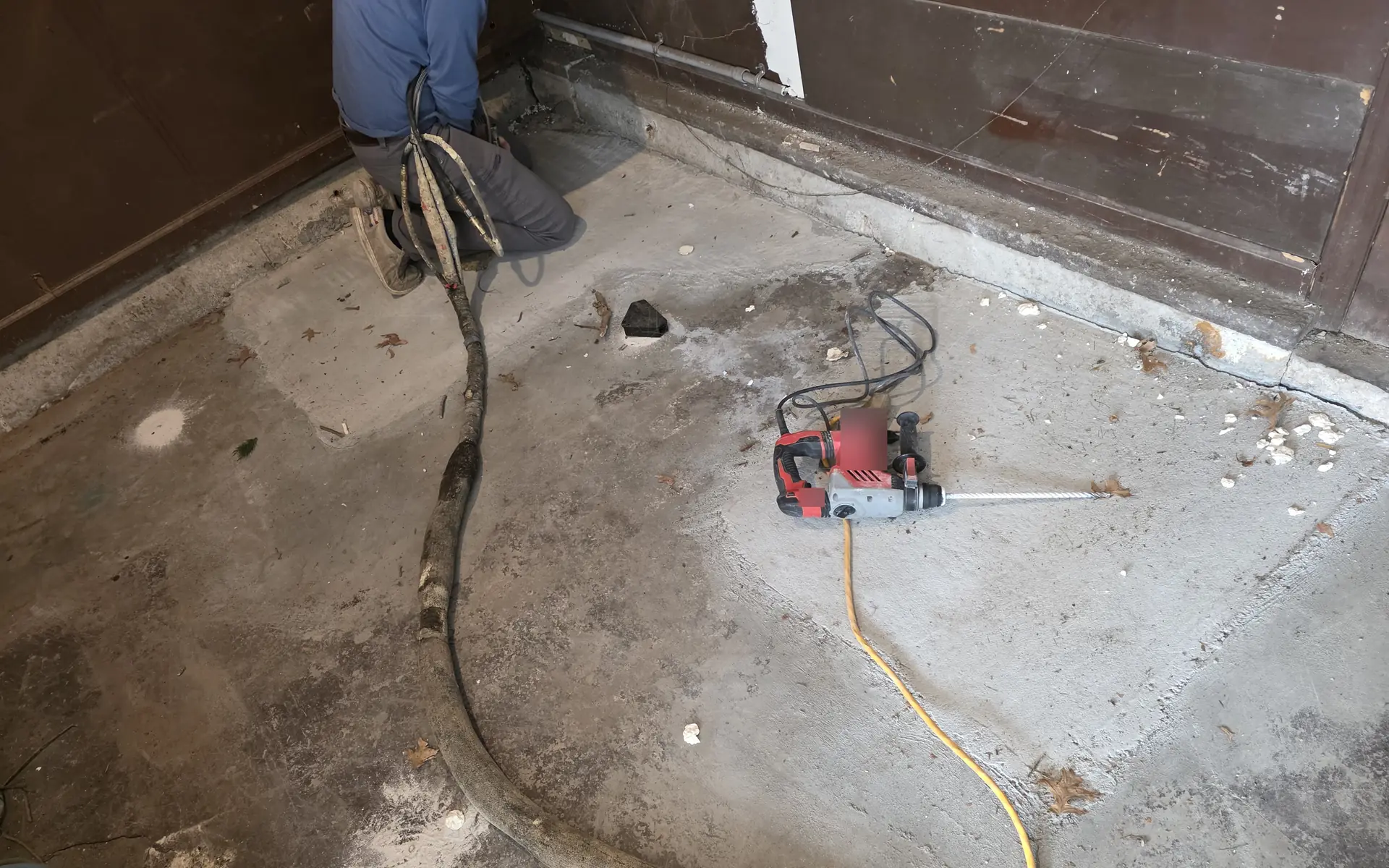
Concrete Leveling in Olathe, KS
Olathe is a three-era city for concrete: old-town slabs from the 1950s and 1960s that have been moving for 60-plus years, mid-city driveways from the 1980s and 1990s around the College Boulevard corridor that are now old enough to have real voids underneath, and newer homes west of K-7 poured on fill that is still compacting under its own weight.
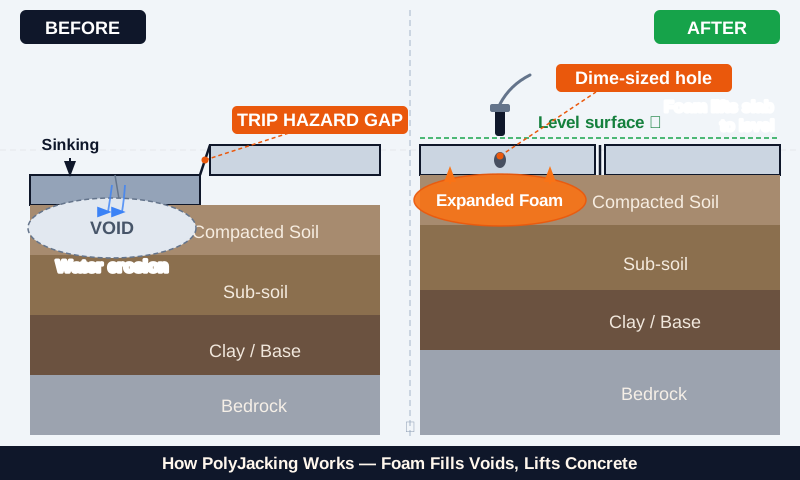
All three patterns end up at the same fix: polyurethane foam through dime-sized holes, in one visit. No tearing out concrete that still has decades left in it.
Three Eras, One Fix: How Olathe's Growth Pattern Shapes Concrete Problems
Olathe has added residents faster than almost any city in Kansas (149,000 people as of 2024) and that growth layered three distinct generations of concrete over the same landscape.
The oldest concrete is downtown and in old-town neighborhoods built in the 1950s and 1960s. These slabs are 60-plus years old. They've been through three full generations of Wymore-Ladoga clay shrink-swell cycles and 50-plus freeze-thaw transitions every winter. If the slab is still intact (not shattered, not crumbling) foam typically adds another decade or more of service life for a fraction of replacement cost.
The mid-city band. The College Boulevard corridor and the neighborhoods built out in the 1980s and 1990s: is where we do most of our Olathe work. These slabs are 35 to 45 years old. Old enough to have real voids underneath and panels that have shifted; young enough that the concrete itself is still structurally sound. Replacement is premature. Foam is the right call.
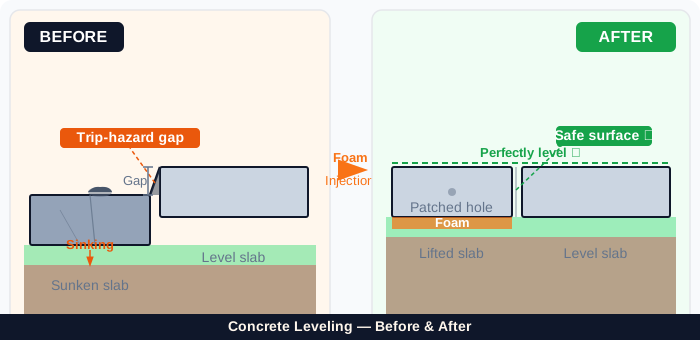
West of K-7, it's the opposite story: homes built in the 2000s and 2010s on the city's expanding western edge, often on fill dirt that wasn't fully compacted. Fill dirt typically takes 5 to 15 years to settle under its own weight. Exactly the window when garage-floor aprons, driveway panels, and patio slabs start dropping on newer Olathe lots.
Eastern Olathe's Loess Layer: Why Some Slabs Here Settle Differently
Most of the KC metro's concrete problems trace to one soil type: Wymore-Ladoga clay. But eastern Olathe has a second layer that most of the metro doesn't — Peorian loess, windblown silt deposited during the last glacial period, up to 17 feet thick under parts of the old downtown and east-side neighborhoods.
When dry, loess is stable. When saturated, and Olathe averages more than 40 inches of annual rainfall, with May alone pushing over 5 inches: loess compresses under the load of a slab sitting on top of it. That means slabs in eastern Olathe can be settling for two independent reasons at once: clay shrinking away from the slab when it dries out, and loess slowly compressing under the slab's weight when it gets wet.
If you're on the east side of Olathe and one panel of your driveway has dropped more than the others, uneven loess thickness under that panel is a plausible cause. Not just drainage or clay movement. Foam injection fills the void regardless of which layer created it: it re-establishes contact under the slab and lifts the concrete back level.
Real Olathe Job: Mid-City Driveway Leveled for a Fraction of Replacement
A mid-city Olathe homeowner called us after getting a full replacement quote for a driveway that had settled significantly at the street joint. The kind of drop that catches a tire and pools water toward the garage.
We leveled it for a fraction of that quote.

The concrete was structurally solid. No widespread cracking, no shattered panels, just a slab that had lost soil contact underneath and dropped. Polyurethane foam through dime-sized injection points filled the voids, lifted the slab back to grade, and the homeowner was driving on it that afternoon.
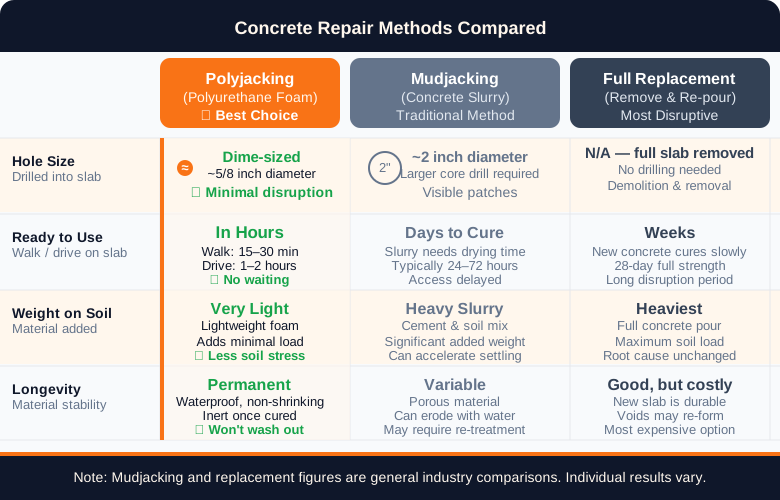
That difference isn't a corner cut. Foam addresses what actually failed: the void under the slab. Replacement tears out structurally sound concrete and re-pours new: solving the same void problem at six times the cost, with weeks of downtime. If the slab is intact, leveling is almost always the better answer.
Olathe Permits: What Driveway Replacement Requires That Leveling Skips
If you're weighing replacement, know what it requires from the city. The City of Olathe requires a Right-of-Way permit for any driveway installation or replacement in the public right-of-way. The strip between the sidewalk and the street. Residential drives are exempt from the ROW Performance and Maintenance Bond, but the permit application, pre-pour inspection scheduling (minimum 24 hours advance notice), and city sign-off are still required.
Polyurethane foam leveling lifts the existing slab without replacing anything. You're not pouring new concrete in the ROW. You're lifting what's there. No ROW permit, no inspection scheduling, no city coordination. We come out, we lift it, and you're back on it within hours.
For a settled driveway that's still structurally sound, foam leveling is faster, cheaper, and simpler to permit than going the replacement route.
PolyJacks in Olathe: Coverage and What We See Most
We're based 15 minutes from downtown Olathe in Spring Hill, and Olathe is one of our most-worked cities. We cover all of it: the old-town blocks near Cherry Street and Santa Fe, the mid-city residential neighborhoods off Mur-Len Road, Cedar Creek and Mill Valley out toward K-7, and the newer construction west of US-169.
Olathe jobs we do regularly: garage-floor aprons that have dropped below the door threshold (a pattern in 1990s-built homes as the garage slab settles away from the apron), driveway street joints settled toward the gutter, patio slabs pulled away from the back door, and sidewalk panels with trip-hazard offsets. All of these are foam jobs: lift the panel, close the gap, use it within hours.
Call (913) 713-7794 or book a free estimate online. We'll come look and tell you honestly whether foam is the right call, and if it isn't, we'll say so.
Why concrete settles in Olathe: the local risk data
In Olathe, about 77.7% of Johnson County's soil rates high-shrink-swell (USDA). Eastern Olathe adds up to seventeen feet of compressible Peorian loess above the clay. Its neighborhoods span a 1950s downtown, an 1980s corridor, and post-2000 subdivisions west of K-7.
KC winters bring about 75.2 freeze-thaw days (NOAA).
Sources: USDA SSURGO · NOAA / ACIS (KCI) · local record. See the full KC Concrete Settlement Risk Index.
Our concrete leveling services
Commercial Leveling
Raise a warehouse or dock floorConcrete leveling near Olathe
PolyJacks is your local concrete leveling contractor in Olathe — we serve Olathe and the surrounding communities:
Neighborhoods across Olathe:
Real job documentation
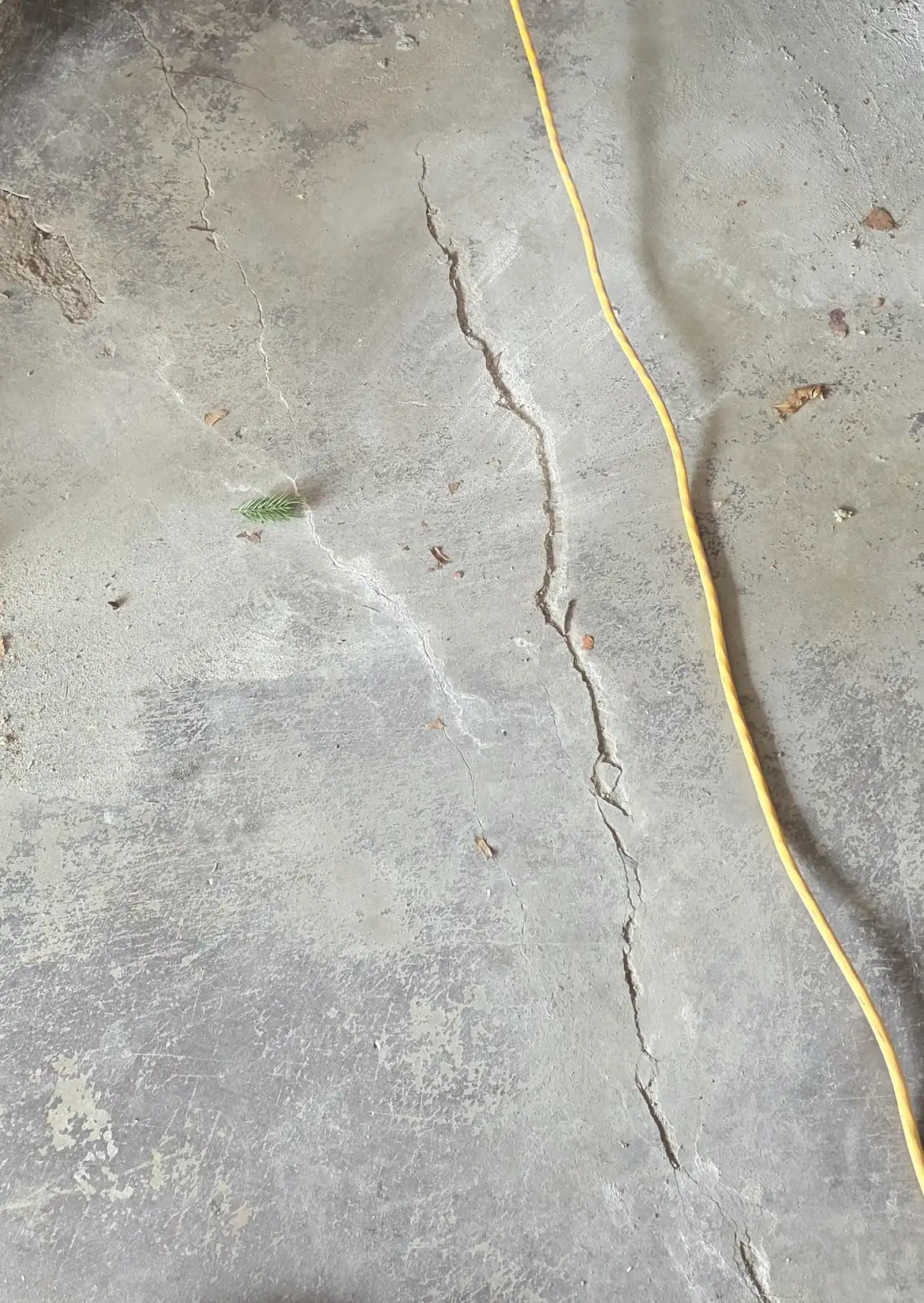
How polyjacking works in 90 seconds
Our team walks you through the three-step process: dime-sized holes, high-density polyurethane foam that fills every void and compresses the soil beneath your slab, and use within hours with no heavy trucks. Call (913) 713-7794 or book a free estimate below.
Frequently asked
My Olathe driveway was poured in the 1980s or 1990s? Is it too old to level?
No. That age range is the sweet spot for foam leveling in Olathe. Those slabs are old enough that voids have formed underneath them, but the concrete itself is typically still structurally sound. As long as the slab isn't shattered or crumbling, we can almost always lift it. A free on-site estimate confirms whether foam is viable.
Does leveling a sunken driveway in Olathe require a city permit?
No. Foam leveling lifts the existing slab without replacing anything in the right-of-way, so it doesn't trigger Olathe's ROW permit requirement. Driveway replacement in the public ROW does require a permit and pre-pour inspection: leveling skips all of that. We come out, lift it, done in a single visit.
Why is a newer home in west Olathe already showing settled concrete?
New construction west of K-7 is frequently built on fill dirt that continues compacting for 5 to 15 years after the slab is poured. This is especially common on lots that were graded for new development. The fill below the slab hasn't reached equilibrium yet. Foam fills those early-forming voids and re-establishes contact under the concrete.
One corner of my driveway sinks faster than the other three? Why would that happen?
In eastern Olathe, an uneven Peorian loess layer under the slab is a likely factor. Loess compresses when saturated, and if it's thicker under one corner than another, that panel drops faster. Foam fills the void wherever it exists and brings everything back to level. The root cause doesn't change the fix.
Can you level a garage-floor apron that has dropped below the door threshold?
Yes. That's one of the most common jobs we do in Olathe. A dropped apron leaves a gap under the door, breaks the weather seal, and in some cases stops the door from closing flush. We inject foam through dime-sized holes at or near the threshold, lift the apron back to its original height, and the door seals again. Most of these are a half-day job, and you're driving on it the same afternoon.
How long does foam leveling last in Olathe's soil conditions?
The foam is waterproof, non-shrinking, and chemically inert. It won't break down in the Wymore-Ladoga clay or the Peorian loess. As long as drainage is correct (gutters flowing, downspouts extended at least 5 feet from the slab, grading positive), a foam lift holds for many years. If the drainage issue that originally created the void isn't fixed, new voids can form alongside the foam over time. We flag every drainage concern we see on every estimate.
Is there a concrete leveling company near me in Olathe, KS?
That's what PolyJacks does in Olathe — most leveling jobs finish in 2–4 hours and the slab is back in service within hours (walk on it in 15–30 minutes, drive in 1–2 hours). Book a free estimate.
Free concrete leveling estimate in Olathe
No obligation. Honest advice, usable within hours. If foam isn't the right fix, we'll tell you straight.
Book your free estimate
Pick a time that works for you. Free on-site inspection, no obligation. Prefer to talk? Call (913) 713-7794.