
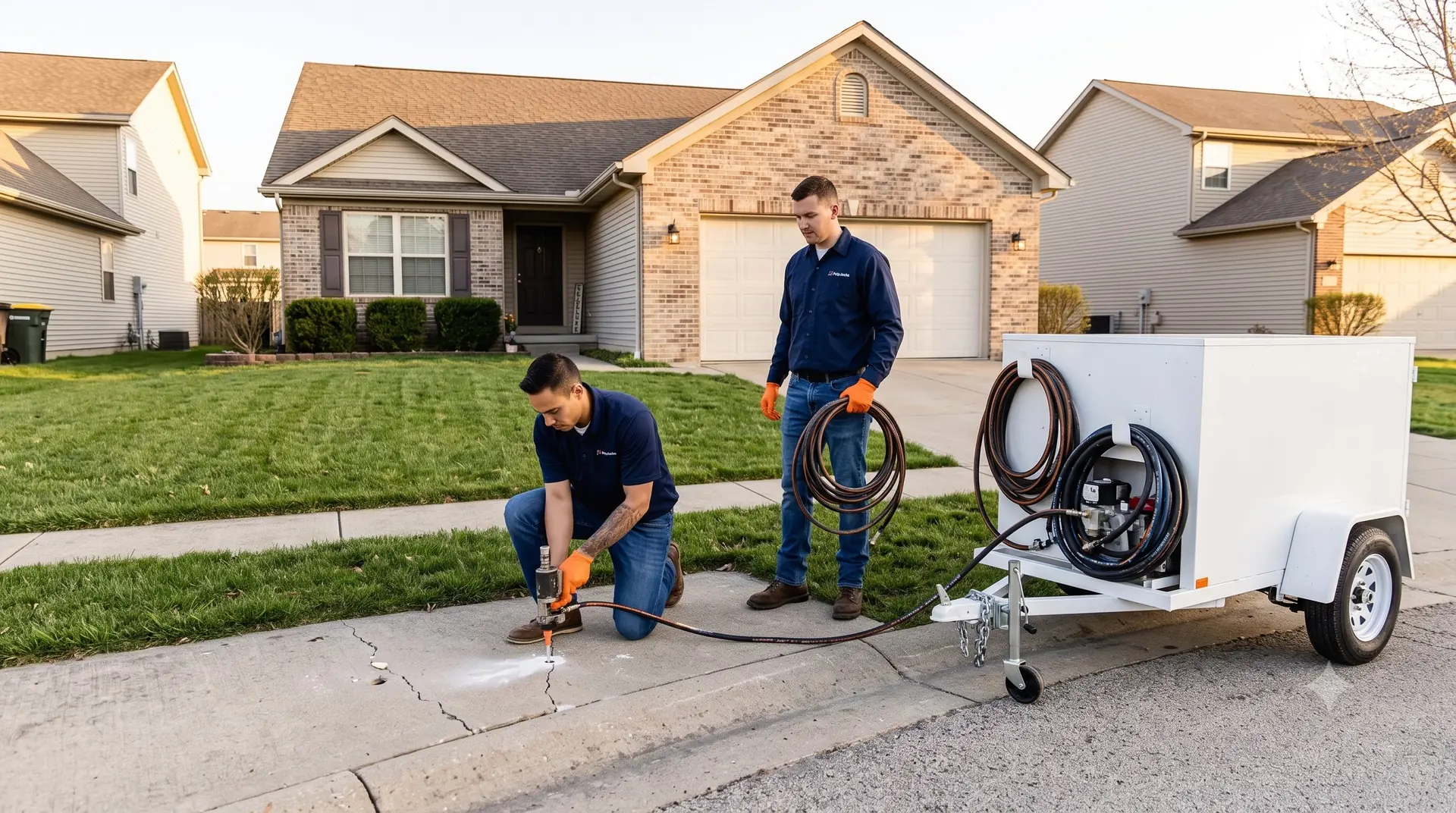
 Illustrative
Concrete Leveling in Belton, MO
Belton was platted in 1871 and likely named for surveyor Capt. Marcus Lindsey Belt, but for the next seven decades it barely grew at all — 552 residents in 1880, still only 1,233 by 1950, with several census counts in between actually going down.
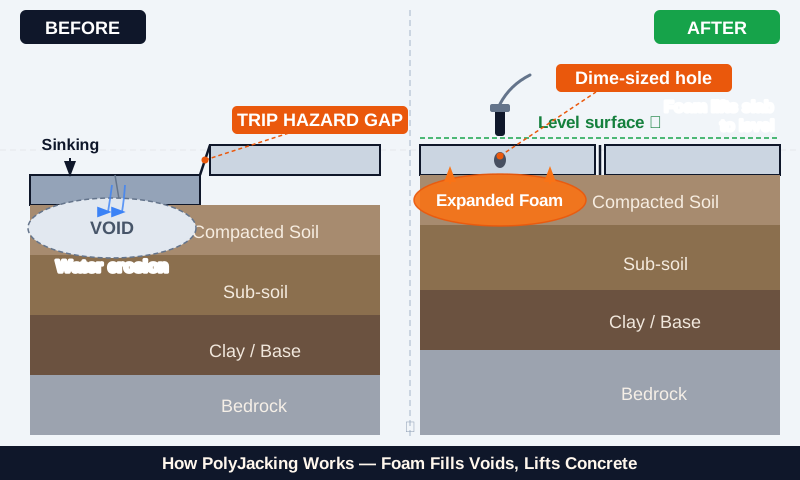
Then, in the span of two decades, the town nearly quintupled and then more than doubled again: 4,897 by 1960, 12,270 by 1970. A roughly ninefold jump in twenty years. That "nothing, then everything" pattern is different from every other Kansas City suburb PolyJacks has covered so far, and it means Belton's concrete splits cleanly into a tiny, very old pre-1950 core and a much larger mid-century boom-era majority, with lighter, steadier growth layered on since. PolyJacks levels that boom-era concrete with polyjacking (foam injection through dime-sized holes) instead of a full tear-out, and every job starts with a free on-site estimate.
Platted in 1871, Named for a Surveyor
Belton was platted in 1871 and is likely named for Capt. Marcus Lindsey Belt, a surveyor who worked the area; a post office opened under the town's name in 1872. The town has a well-documented tie to national history, too: temperance movement leader Carry A. Nation is buried in Belton Cemetery next to her mother's grave, and the Belton Museum's "Carry Nation Carriage House" holds her funeral hearse and original wooden grave marker. The town still holds an annual Carry Nation Days festival in her honor. None of that changes how a slab settles, but it's a reminder that Belton's downtown core predates almost every other structure in the city by decades.
Nothing, Then Everything: Belton's Population Boom
Census figures tell an unusually flat-then-explosive story. Belton had 552 residents in 1880, 988 in 1890, then bounced between roughly 900 and 1,000 for the next 50 years — 1,005 in 1900, 922 in 1910, 899 in 1920, 992 in 1930, 971 in 1940: before finally reaching 1,233 in 1950. Then the town changed almost overnight: 4,897 by 1960 (+297.2%) and 12,270 by 1970 (+150.6%), a roughly ninefold increase across those two decades alone. Growth continued afterward but at a far steadier pace — 12,708 in 1980, 18,150 in 1990, 21,730 in 2000, 23,116 in 2010, and 23,953 in 2020. Unlike Raytown (boomed in the 1960s, then declined and never regrew), Blue Springs (one single boom decade), Independence (tripled, then flat), or Liberty (steady growth every decade with no boom at all), Belton spent seven decades essentially unchanged and then compressed most of its growth into just two of them.
Why the Boom Matters for Your Slab
Because so much of Belton was built out in that 1950-1970 window, the majority of the city's residential concrete is sitting in the same 50-to-70-year age band right now: past the point where clay-soil cycling and old drainage design have had decades to open voids underneath it. The small pre-1950 core near downtown carries even more age, while the subdivisions built since 1980 toward Raymore and Peculiar are on a newer, still-settling timeline. PolyJacks crews treat those as three distinct situations rather than assuming one cause explains every sunken slab in town.
A Small Footprint on High Ground, Still Served by Rail
At 14.31 square miles, Belton has one of the smallest land areas of any city in this stretch of the metro, but sits at 1,099 feet elevation: among the higher ground nearby. The Belton, Grandview and Kansas City Railroad, a heritage line and museum, still runs a five-mile excursion out of Belton on former St. Louis-San Francisco ("Frisco") trackage. The same rail corridor the original town grew up around. That combination of a compact footprint and a long-running rail line means Belton's older, denser concrete near downtown and the tracks has had longer exposure to the area's soil movement than almost anywhere else PolyJacks serves nearby.
Serving Belton, Raymore, Grandview, and Peculiar
PolyJacks covers Belton regularly along with the nearby Cass and Jackson County communities of Raymore, Grandview, Peculiar, Greenwood, and Lee's Summit. Whether your settling concrete dates to Belton's 1950s-70s boom era, the small pre-1950 downtown core, or a newer subdivision built since 1980, the estimate is free and the diagnosis is honest. Call or text (913) 713-7794, or book online, to get on the schedule.
Why concrete settles in Belton: the local risk data
In Belton, about 75.0% of Cass County's soil rates high-shrink-swell (USDA). Belton's population held near-flat for seven decades, then jumped roughly nine-fold across the 1950s and 60s. The town was platted in 1871, likely named for surveyor Captain Marcus Belt.
KC winters bring about 75.2 freeze-thaw days (NOAA).
Sources: USDA SSURGO · NOAA / ACIS (KCI) · local record. See the full KC Concrete Settlement Risk Index.
Our concrete leveling services
Commercial Leveling
Lift a settled parking lotConcrete leveling near Belton
PolyJacks is your local concrete leveling contractor in Belton — we serve Belton and the surrounding communities:
Real job documentation
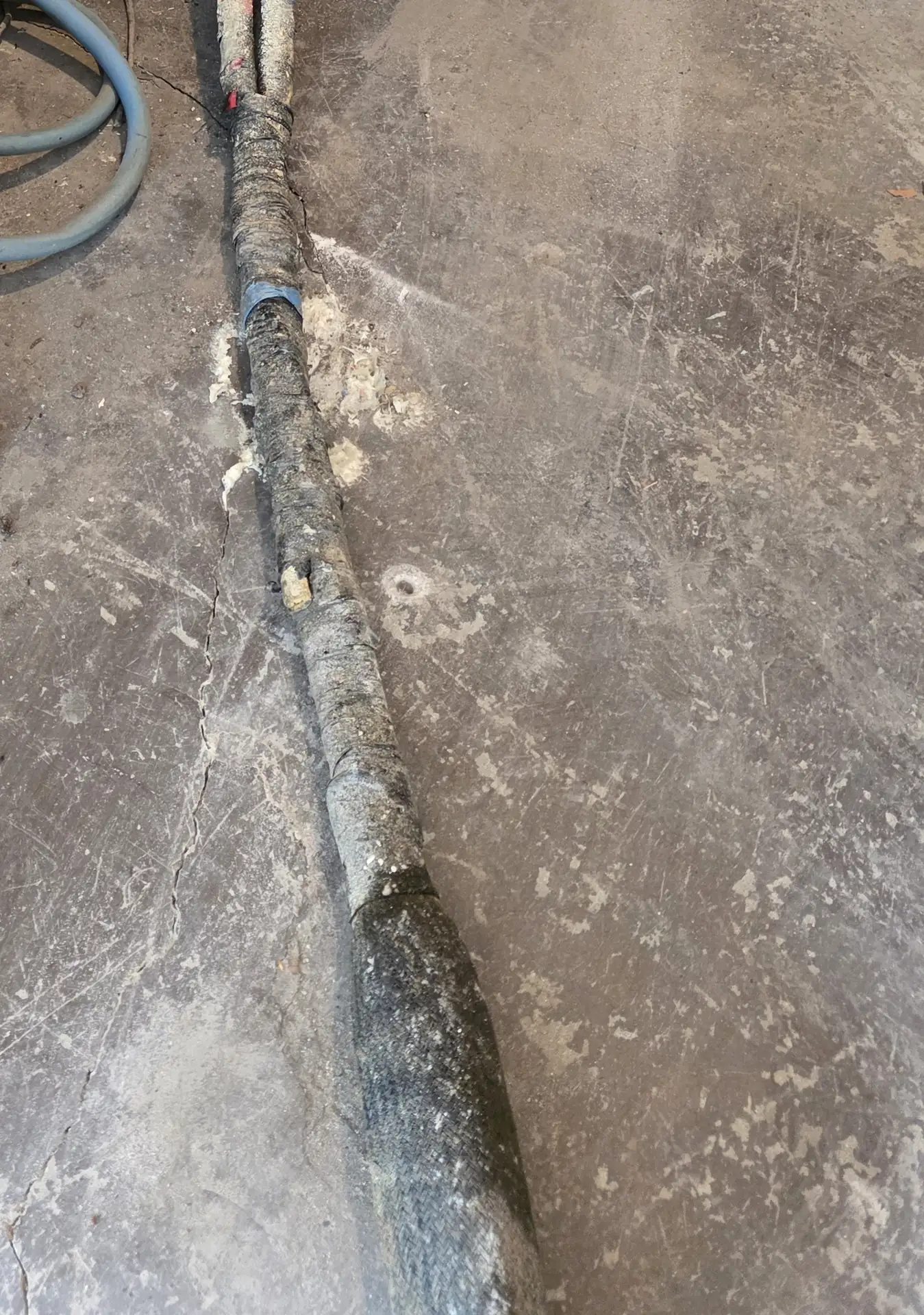
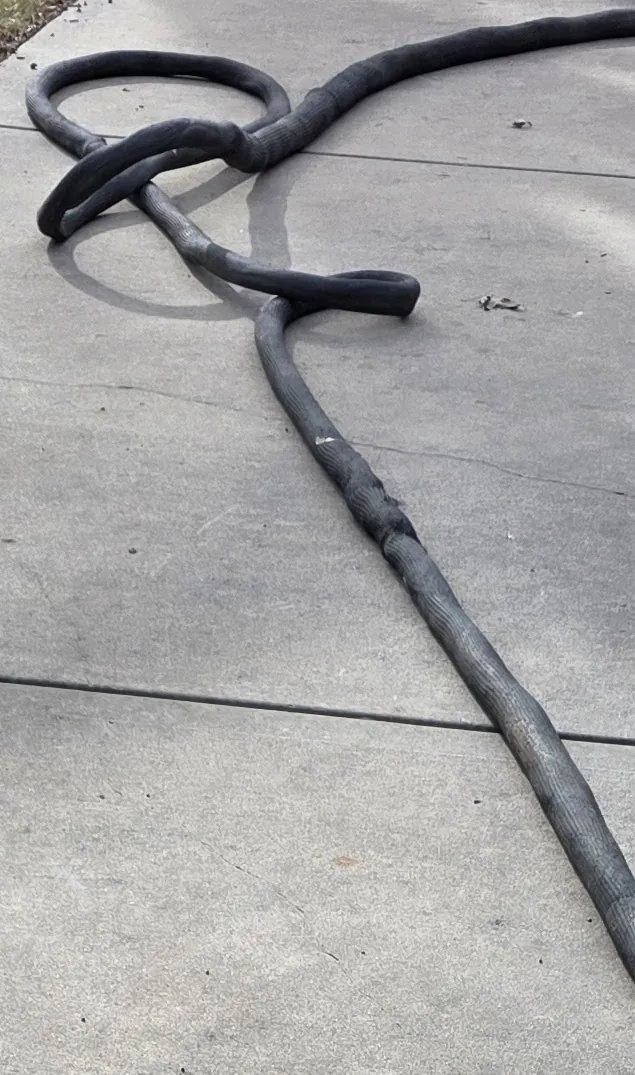
What sidewalk leveling looks like
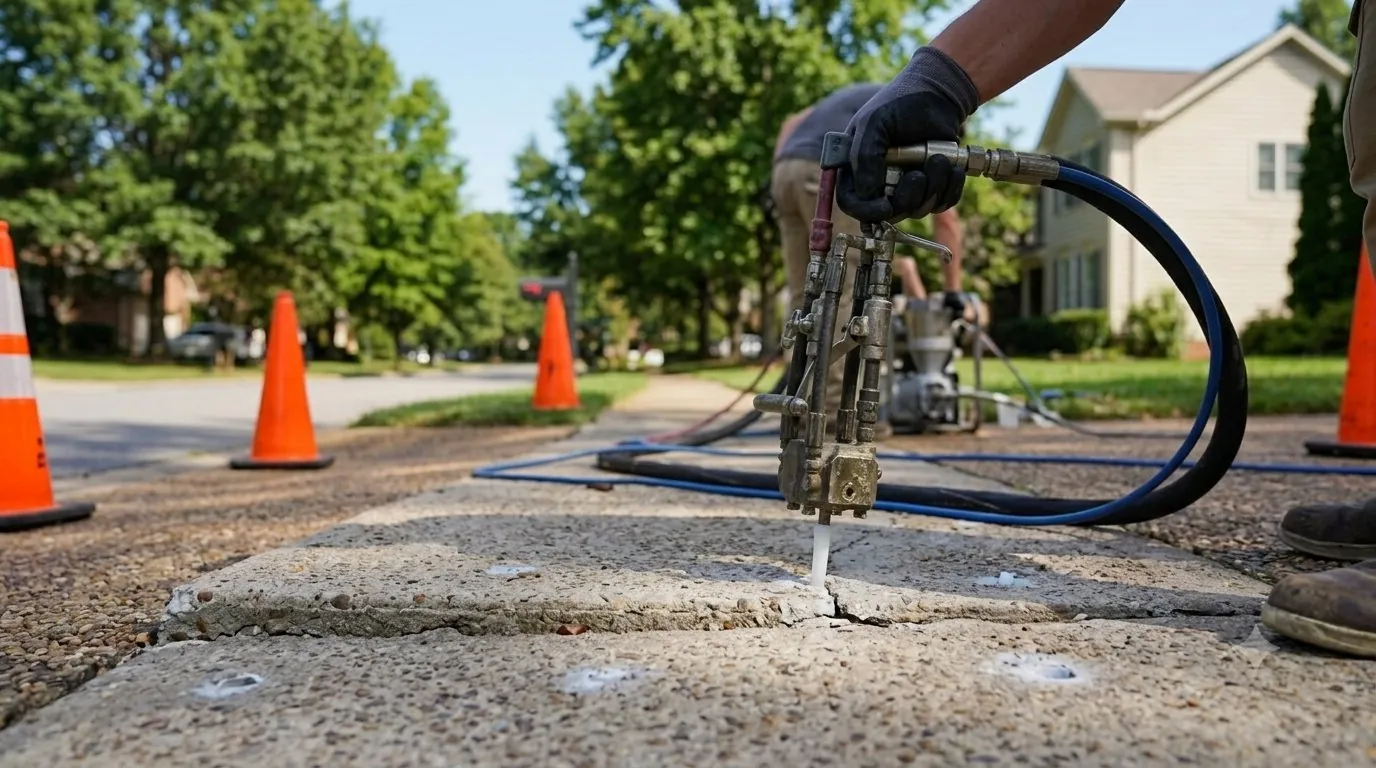
How polyjacking works in 90 seconds
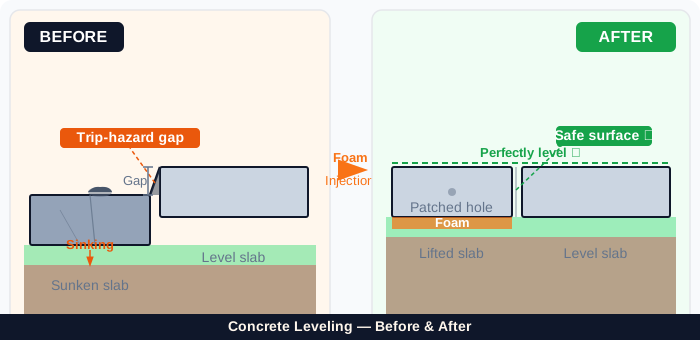
Our team walks you through the three-step process: dime-sized holes, high-density polyurethane foam that fills every void and compresses the soil beneath your slab, and use within hours with no heavy trucks. Call (913) 713-7794 or book a free estimate below.
Frequently asked
Why did Belton grow so fast in the 1950s and 1960s?
Belton stayed small for its first 70 years (only 1,233 residents by 1950) then grew almost ninefold in two decades, reaching 4,897 by 1960 and 12,270 by 1970. That compressed boom is why so much of Belton's residential concrete falls into the same 50-to-70-year age band today, rather than being spread evenly across a century like some neighboring cities.
What's the Carry Nation connection to Belton?
Temperance movement leader Carry A. Nation is buried in Belton Cemetery next to her mother, and the Belton Museum's Carry Nation Carriage House displays her funeral hearse and original grave marker. The town holds an annual Carry Nation Days festival in her honor.
How much does concrete leveling cost in Belton?
Every driveway, sidewalk, or patio settles differently, so we don't post a fixed price. For scale, we've leveled a comparable sidewalk elsewhere in the metro for a fraction of the homeowner's replacement quote. Every Belton estimate is free and done on-site before we recommend anything.
How long does concrete leveling take?
Most residential jobs (a driveway, walkway, or patio) are done in a single visit. The foam cures fast, so you can typically walk on the area in 15-30 minutes and drive on it in 1-2 hours.
Is polyurethane foam leveling permanent?
The lift is permanent as long as the soil underneath stays stable. The foam itself is waterproof and doesn't break down, which matters on Cass County's clay soil whether the slab above it dates to Belton's 1950s-70s boom or a newer subdivision.
Do you serve areas near Belton?
Yes. We regularly cover Raymore, Grandview, Peculiar, Greenwood, and Lee's Summit, plus the rest of the Kansas City metro on both sides of the state line.
Who does concrete leveling near me in Belton, MO?
Yes — PolyJacks levels concrete in Belton, MO. Most jobs take 2–4 hours, you can walk on the slab in 15–30 minutes, and drive on it in 1–2 hours, back in use the same day. Book a free Belton estimate.
Free concrete leveling estimate in Belton
No obligation. Honest advice, usable within hours. If foam isn't the right fix, we'll tell you straight.
Book your free estimate
Pick a time that works for you. Free on-site inspection, no obligation. Prefer to talk? Call (913) 713-7794.